


 by Tom Gurney
Tom Gurney BSc (Hons) is an art history expert with over 20 years experience
Published on June 19, 2020 / Updated on November 6, 2025
Email: tomgurney1@gmail.com / Phone: +44 7429 011000
Michelangelo's Lost Bronze David for Pierre de Rohan
While Michelangelo was carving the colossal marble David for Florence, the Florentine Republic commissioned another David from him in bronze. This second figure was smaller—two and a quarter Florentine braccia—and intended not for the city but for France. It was a diplomatic gift prompted by Pierre de Rohan, Maréchal de Gié, a powerful figure at the court of Louis XII.
The commission was signed on 12 August 1502. Casting and finishing dragged on for years as politics changed and Michelangelo's commitments multiplied. By the time the statue left Florence in 1508, Pierre had fallen from favour. French treasurer Florimond Robertet secured the gift, and it eventually stood at his Château de Bury. The bronze was last recorded in the late eighteenth century and is lost.
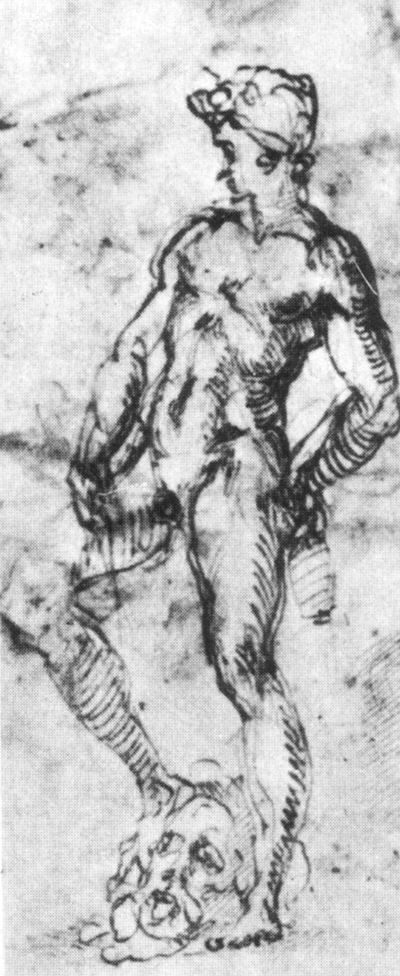
A Louvre sheet of studies for David belongs to the project, but neither it nor later images gives the sculpture back exactly.[1] What survives most clearly is the commission's purpose: Florence used a biblical hero, transformed by bronze and Michelangelo's invention, to conduct foreign policy.
At a Glance
- ArtistMichelangelo Buonarroti
- TitleBronze David; often called the Rohan or De Rohan David
- Commission date12 August 1502
- Completion and dispatchFinished with assistance and shipped to France in late 1508
- MediumBronze
- HeightContracted at two and a quarter Florentine braccia, approximately life-size or slightly under depending on the conversion used
- PatronThe Florentine Republic
- Intended recipientPierre de Rohan, Maréchal de Gié
- Eventual French recipientFlorimond Robertet
- Known French locationChâteau de Bury
- StatusLost; last recorded in 1795
- Related workMichelangelo's studies for David, Louvre INV 714, about 1502–1503
Contents
- A Diplomatic Request
- The Economics of a Gift
- The Contract of 12 August 1502
- Two Davids at Once
- The Louvre Studies for David
- Casting and Delay
- Pierre de Rohan's Fall
- Shipment to France in 1508
- At the Château de Bury
- What Did the Bronze Look Like?
- Disappearance
- Why the Bronze David Matters
A Diplomatic Request
Florentine envoys in France reported in 1501 that Pierre de Rohan admired a bronze David at Palazzo Vecchio and wanted a work of the same subject.[2] Whether he expected to pay or receive a gift was diplomatically ambiguous. Florence had strong reasons to satisfy a man close to the French crown.
The republic depended on French power during conflict and political instability. Cultural gifts could create obligation, advertise refinement and keep personal channels open. A bronze sculpture was durable, prestigious and capable of representing Florence abroad.
David was an especially charged choice. The young biblical hero defeated a stronger enemy through courage and divine favour. Florentine civic art had repeatedly used him as an image of the smaller polity resisting powerful opponents.
Sending David to a French marshal allowed the symbol to travel. It honoured martial service while reminding the recipient of the republic that produced both the hero's image and the artist capable of remaking it.
The request seems to have arisen from admiration for an existing bronze David, often connected in the tradition with Donatello or Verrocchio. Michelangelo was not simply required to make a mechanical copy. The contract entrusted him with a new figure, allowing Florence to answer an admired civic sculpture through contemporary invention.
The Economics of a Gift
A diplomatic gift is free to its recipient but never without cost. Florence paid Michelangelo, supplied or financed metal, involved specialist labour and absorbed years of official correspondence. The expense entered a political calculation: a work of art could purchase goodwill without looking like a cash payment.
Bronze made that value visible. Copper and tin were costly before modelling began, and a failed cast could consume both labour and material. A successful figure embodied the republic's technical resources as well as its taste.
The gift also created asymmetry. Pierre could enjoy Michelangelo's work as personal honour while Florence expected influence useful to the whole state. When Pierre lost power, that expected return weakened, explaining why officials hesitated and why Robertet's renewed demand mattered.
Art did not merely illustrate diplomacy after agreements were made. Production delays, recipient changes and delivery became diplomatic events themselves. Each unanswered letter risked suggesting disrespect. Each new payment prolonged Florence's commitment.
This economic history protects the sculpture from being treated as a smaller appendix to the marble David. The bronze existed because foreign policy required a portable concentration of material, skill and civic symbolism.
The Contract of 12 August 1502
The Signoria commissioned Michelangelo to model a David two and a quarter braccia high and expected rapid completion.[2] The recorded agreement gives the lost work a firmer identity than many sculptures surviving without documents.
Bronze required stages different from marble. Michelangelo first needed a model, probably in clay or wax, from which moulds could be prepared. Casting transformed the model through heat and metal; chasing, filing, patching and finishing resolved the surface afterward.
The contract's scale was far below the five-metre marble David under way at the same time but still substantial. A figure around human height required major metal, foundry knowledge and coordination.
Michelangelo's responsibility centred on design and modelling, but bronze was collaborative by necessity. Founders and finishing specialists contributed technical expertise. This matters because later work by Benedetto da Rovezzano did not make the composition cease to be Michelangelo's.
Deadlines proved unrealistic. The artist was carrying the marble David, Piccolomini figures, Madonna commissions and other projects. The republic repeatedly had to negotiate between his concentration and diplomatic urgency.
Two Davids at Once
The bronze and marble Davids were developed in overlapping years, but they were not reduced and enlarged versions of one figure. Their materials, destinations and civic functions differed.
The marble colossus was carved from an old cathedral block and eventually placed outside Palazzo Vecchio as a public emblem. It presents David before combat, alert and holding his sling with Goliath absent.
Evidence for the bronze suggests a more compact victory image, potentially including Goliath's head and an active contrapposto. Such a solution would relate more directly to Florentine bronze predecessors and suit a diplomatic object displayed in a court or château.
Bronze permits different extensions and weight distribution from marble. A raised arm, sword or separated limb can be supported through an internal metal structure. Surface catches light in sharper, darker flashes.
The simultaneous projects show Michelangelo reconsidering one hero rather than repeating a successful answer. Public marble made David monumental before Florence; portable bronze made him exchangeable across courts.
The Louvre Studies for David
Louvre drawing INV 714 contains studies connected with the lost bronze and is dated about 1502–1503.[1] Its relation confirms that Michelangelo developed the project graphically during his return to Florence after the first Roman period.
The sheet is precious because the sculpture is gone, but it must be interpreted as working thought. Drawings test weight, limb position and contour. A pose on paper may be rejected, reversed or altered during modelling.
Scholars have debated exactly which sketch represents the final David and how it relates to later engravings of the sculpture in France. Differences in supporting leg, sword, Goliath's head and turn prevent one uncontested reconstruction.
The drawing therefore establishes invention more securely than appearance. Michelangelo was solving a smaller bronze David through figures distinct from the marble colossus. The sheet does not authorise a definitive three-dimensional replica.
This distinction makes the surviving drawing more, not less, useful. It lets viewers enter a process rather than merely treating paper as a faded photograph.
Casting and Delay
Evidence suggests that the figure had been cast by late 1503, but substantial finishing remained. Bronze emerges from moulds with casting channels, seams, surface irregularities and possible flaws. Chasing turns a successful pour into a resolved sculpture.
Michelangelo's other commitments repeatedly interrupted that work. In 1505 he was drawn to Rome for Julius II's tomb; later conflict sent him back to Florence and then Bologna, where he undertook the colossal bronze portrait of Julius. By 1508 he was beginning the Sistine Ceiling.
The David's delays reveal an artist's workload colliding with state diplomacy. Florence could not treat the object as a purely private studio matter because officials had promised it abroad.
Benedetto da Rovezzano, a capable Florentine sculptor, was engaged to complete finishing when Michelangelo could not return.[2] His contribution should be stated rather than hidden. Authorship of a Renaissance bronze can include a master's model, foundry casting and another sculptor's chasing.
The result remained identified as Michelangelo's David because the invention and principal modelling were his. Collaborative completion explains how it finally left the city.
Pierre de Rohan's Fall
Pierre de Rohan fell from royal favour before delivery. A gift designed to strengthen influence now lacked its intended political target. The statue's value did not disappear; its destination changed.
Florimond Robertet, a leading royal secretary and treasurer, pursued the work and became its eventual recipient. The transfer illustrates the flexibility—and opportunism—of diplomatic gifts. A promised masterpiece could follow power rather than the name written at the commission's beginning.
This is why “Rohan David” is historically useful but incomplete. Rohan's request generated the project, yet he may never have possessed it. Robertet's château supplied the principal French display.
The title preserves intention; provenance preserves outcome. Both are necessary.
Shipment to France in 1508
After finishing by Benedetto da Rovezzano, the bronze was shipped through Livorno late in 1508.[2] Transporting a heavy, valuable figure required packing, sea and river routes, customs arrangements and correspondence across governments.
The journey occurred six years after the contract. Michelangelo was then in Rome painting the Sistine Ceiling, unable or unwilling to leave papal service to complete the bronze personally.
Dispatch finally fulfilled Florence's diplomatic obligation, but to a changed French political network. The work entered a court culture increasingly eager for Italian art.
Its bronze material assisted travel compared with a giant marble but did not make it simple. Metal could dent, projecting parts could break and sea transport carried risk. Arrival itself was an achievement of administration.
At the Château de Bury
Robertet displayed the David at the Château de Bury in the Loire region, where it became a prized Italian object. An inventory celebrated the “beautiful great David” by Michelangelo in the middle of the château.[3]
Central placement made the figure more than private ornament. It embodied the owner's access to Florence, royal administration and the most celebrated Italian artist of his generation.
In France, David's political meaning could change. The Florentine underdog became an image inside elite service to a monarchy. Later writing even associated the biblical king with French royal identity.
The sculpture also participated in the larger movement of Italian art into France before and during the formation of Fontainebleau's court style. It was an early ambassador for sculptural ideas that French patrons would increasingly seek.
What Did the Bronze Look Like?
The contract establishes subject, medium and approximate scale. The Louvre drawing supplies related poses. Later engravings and descriptions may preserve elements of its French appearance. None provides a complete, uncontested record.
Reconstructions often show David with one foot near or on Goliath's head and holding a sword. The body shifts through contrapposto rather than standing in the concentrated stillness of the marble colossus.
Which leg supported the weight, how the sword was held and where Goliath's head appeared remain debated. Later images can reverse compositions through printmaking or record restorations.
It is safest to describe a youthful bronze victory figure, approximately human scale, distinct from the marble David and developed through the Louvre studies. A modern reconstruction can test one hypothesis but must be labelled as such.
Disappearance
The David remained known through French records into the eighteenth century and was last recorded in 1795.[4] The upheaval of the French Revolution, estate dispersal, metal reuse and simple loss all offer possible contexts, but its final fate is unknown.
Bronze is especially vulnerable because it can be melted and recast. Artistic identity offers protection only while records and ownership preserve it. A figure associated with royal and elite collections could become politically endangered.
No surviving bronze has gained acceptance as the original. A rediscovery would require extraordinary provenance and technical evidence, not merely resemblance to a drawing.
The absence is substantial. Together with the destroyed Julius II monument, the lost David removes Michelangelo's documented monumental bronze practice from direct study.
Why the Bronze David Matters
The lost David matters because it joins artistic invention to diplomacy. Florence did not send neutral luxury. It sent a hero embedded in civic identity, remade by the sculptor then transforming the city's public image.
The commission also broadens Michelangelo's material history. He modelled for casting, worked with founders and accepted that completion could pass to another sculptor. Renaissance authorship appears as managed collaboration.
Its long delay charts the pressure of his rapidly expanding career. Marble David, papal tomb, Bologna bronze and Sistine Ceiling crowded one state promise. Officials, ambassadors and specialists carried the work across the finish line.
Finally, the Louvre studies and French records demonstrate how a lost sculpture can be known responsibly. They preserve project, movement and partial form. They do not restore every gesture. The bronze survives as diplomatic action—and as the outline of another Michelangelo David the world can no longer see.
Frequently Asked Questions
Discussion
What details, sources or comparisons stand out to you in De Rohan David?
Reader Insights
Which formal detail changes how the work reads?
Which documented source or collection history feels most useful?
Which related Michelangelo work should readers compare next?
Join the Conversation
Add a source-led observation, comparison or question for other readers.
References
- Musée du Louvre, Études pour la figure de David,” INV 714, recto:, View source.
- John Addington Symonds, The Life of Michelangelo Buonarroti, documentary narrative of the Rohan commission:, View source.
- *Les collectionneurs de l'ancienne France: notes d'un amateur*, Robertet inventory discussion:, View source.
- Mitteilungen des Kunsthistorischen Institutes in Florenz 63 (2021), discussion of the lost bronze David's documentary history:, View source.