 by Tom Gurney
Tom Gurney BSc (Hons) is an art history expert with over 20 years experience
Published on June 19, 2020 / Updated on August 8, 2026
Email: tomgurney1@gmail.com / Phone: +44 7429 011000
Lorenzo de’ Medici by Michelangelo
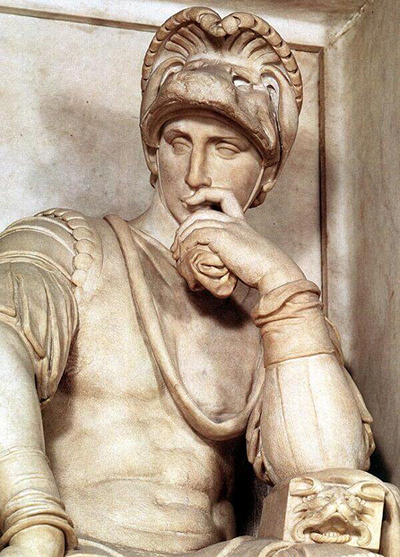
The armoured man does not look outward like a commander receiving acclaim. He withdraws beneath a shadowed helmet, raises one hand toward his mouth and turns thought into a bodily enclosure. Michelangelo’s seated Lorenzo de’ Medici presides over a tomb in the New Sacristy of San Lorenzo, yet it is famously unlike a documentary portrait. It represents a duke by transforming him into an enduring type of contemplation.
The identity needs immediate precision. This is Lorenzo de’ Medici, Duke of Urbino, who died in 1519—not Lorenzo the Magnificent, the fifteenth-century statesman associated with Michelangelo’s youth.[1][2] The earlier Lorenzo is commemorated with his brother Giuliano beneath the Medici Madonna on another wall. The seated duke belongs above Dawn and Dusk. Repeated names make confusion easy; Michelangelo’s idealisation makes it easier still.
At a Glance
- ArtistMichelangelo Buonarroti
- SubjectLorenzo de’ Medici, Duke of Urbino
- DateDesigned and carved during the New Sacristy campaign, principally in the 1520s and early 1530s
- MediumMarble
- FormIdealised seated ducal figure in armour and helmet
- MemorialTomb wall of Lorenzo, Duke of Urbino
- Paired personificationsDawn and Dusk[4][5]
- Original and present settingNew Sacristy, San Lorenzo, Florence, within the Medici Chapels museum complex[1][3]
- Popular descriptionOften called Il Pensieroso, “the thoughtful” or “pensive one”
- Portrait cautionA memorial image representing rank and character, not a verified record of Lorenzo’s facial appearance
- Identity cautionNot Lorenzo the Magnificent, who is commemorated under the Medici Madonna
- CounterpartGiuliano de’ Medici, Duke of Nemours, seated above Night and Day
Contents
- The Duke and the Magnificent
- A Portrait That Refuses Likeness
- Il Pensieroso
- Helmet, Shadow and the Hidden Face
- A Body Folded Around Thought
- Lorenzo Above Dawn and Dusk
- The Tomb Wall as a Single Design
- Design Before the Final Wall
- Lorenzo and Giuliano Across the Chapel
- Lorenzo and the Medici Madonna
- Armour Without Battle
- The Hands and the Closed Circuit
- Surface, Finish and Distance
- How to Look at Lorenzo
- Why Lorenzo de’ Medici Matters
- Artist Up Close
The Duke and the Magnificent
Lorenzo, Duke of Urbino, was a grandson of Lorenzo the Magnificent. The recurrence of the family name reflects Medici dynastic memory, but it does not make the two men interchangeable. The younger Lorenzo’s title connected him with Medici territorial ambition and papal politics in the early sixteenth century.
He died young, and his memorial formed part of the Medici campaign to transform San Lorenzo into a dynastic sacred space. Michelangelo’s commission had to distinguish individual dead while also representing family continuity. An exact likeness was only one possible tool—and not the one he chose to privilege.
The Magnificent and his brother Giuliano occupy the shared sarcophagus on the Madonna wall. The dukes Lorenzo and Giuliano receive separate architectural tombs with ideal figures and personifications. Correct genealogy is therefore also correct visual reading: it reveals why the chapel contains three differently organised memorial zones.
A Portrait That Refuses Likeness
Michelangelo’s Lorenzo does not invite comparison with a reliable painted face to test whether the nose, mouth or jaw are accurate. The national catalogue’s New Sacristy account treats the ducal images as ideal portraits within the tomb programme.[2] They embody the dead through role, disposition and monumental type.
Idealisation did not make identity meaningless. Armour signals secular rank and martial capacity. Placement above the sarcophagus identifies the duke. The pensive pose gives him a distinct character in relation to the active Giuliano opposite. What the statue withholds is the modern expectation that portraiture should reproduce a unique face.
This choice is sometimes explained through Michelangelo’s reported indifference to literal resemblance, on the grounds that future viewers would not know the difference. Whether or not a famous saying is repeated, the sculpture’s logic is visible. Memory is being built for the long duration, and Michelangelo chooses an idea of Lorenzo more durable than physiognomic detail.
Il Pensieroso
The unofficial name Il Pensieroso captures the figure’s inwardness. Lorenzo rests his head or mouth area near a raised hand, while the helmet casts deep shadow across the upper face. The body is present, armoured and powerful, but attention appears turned within.
“Thought” here is a visual interpretation, not access to the duke’s private mind. The hand-to-face gesture, hidden gaze and compressed posture create the signs by which viewers recognise contemplation. They do not tell us what Lorenzo thinks about—death, rule, faith, fame or nothing so narratively specific.
The nickname is useful because it names an experience shared by generations. It is limiting if it turns the sculpture into an illustration of melancholy alone. Michelangelo’s figure is not collapsed by grief. His withdrawal has weight and authority.
Helmet, Shadow and the Hidden Face
The helmet plays a double role. It identifies Lorenzo as a military or ruling figure, and it creates a pocket of darkness around the eyes. The face therefore becomes both public and withheld. Rank is displayed; interiority is protected.
In changing chapel light, that shadow can deepen dramatically. Features that might appear legible in a bright photograph become recessive within architecture. Michelangelo uses illumination as a material partner. Carving establishes the overhang, but the room continually remakes the expression.
The helmet’s unusual form also pushes the statue away from contemporary dress and toward an invented antiquity. Lorenzo becomes less a man caught in 1520s fashion than a timeless captain-thinker. Armour belongs to memorial character rather than battlefield reportage.
A Body Folded Around Thought
The figure’s inwardness is not confined to the head. Limbs and torso build an enclosure. One arm rises, another descends toward the lap, and the seated body narrows its energy instead of projecting it. Michelangelo makes thinking a spatial organisation.
Armour intensifies the paradox. A hard shell ordinarily prepares a body for public action, but Lorenzo’s equipment surrounds withdrawal. The image joins martial status to contemplation, refusing to make the duke simply active or passive.
The lower body remains essential. Bent legs, supporting feet and drapery stabilise the complex upper gesture. Even when spectators focus on the shadowed face, the tomb architecture asks them to register the entire seated mass as the vertical culmination of the wall.
Lorenzo Above Dawn and Dusk
Below the duke, Dawn and Dusk recline across the curved lid of the sarcophagus. Official catalogue records secure their identity and their attachment to Lorenzo’s tomb.[4][5] They are not decorative attendants added to fill space. They embody transitions of time beneath the commemorated ruler.
Dawn twists as if emerging from sleep into difficult awareness. Dusk settles toward decline, a muscular body yielding to evening. Their opposing temporal motions frame a tomb that moves between beginning and ending. Lorenzo remains above that cycle, still and inward.
The hierarchy does not mean the duke has literally conquered time. In a funerary setting, his death is the reason time has been personified. The composition holds memorial aspiration against bodily mortality: an ideal image endures while morning and evening perpetually turn.
The Tomb Wall as a Single Design
Separating Lorenzo from architecture produces only a partial understanding. He sits in a niche whose depth, mouldings and flanking forms regulate the statue’s scale. The sarcophagus below supports two bodies whose diagonals expand across the wall. Vertical ruler and horizontal times depend on the same architectural field.
Michelangelo’s design makes the wall behave almost like a body. Supports bear loads; projections create pressure; recesses produce shadow. The duke does not merely occupy a shelf above his own tomb. He completes a system of forces running upward from sarcophagus to niche.
This is why a close photograph of the head, however compelling, can distort the work’s function. Lorenzo’s interiority becomes meaningful through contrast with the exposed, unstable bodies below and with Giuliano’s different tomb across the chapel.
Design Before the Final Wall
British Museum sheets preserve studies for free-standing and double-tomb arrangements in the Medici project.[6][7] They demonstrate that the existing wall tomb was not Michelangelo’s only idea. Memorial form changed as patronal needs, space and artistic thinking developed.
These drawings must not be treated as exact blueprints for the final Lorenzo monument. A study can test an alternative never built, combine several possibilities or preserve a discarded phase. Its value is evidence of design as process.
The Metropolitan Museum’s career study of Michelangelo as draftsman and designer gives that process a wider frame.[8] Disegno connected thought on paper with models, sculpture and architecture. Lorenzo’s final niche therefore represents not a first impulse made permanent, but one outcome of sustained revision.
Lorenzo and Giuliano Across the Chapel
The two dukes establish a fundamental opposition. Lorenzo withdraws, shadowed and pensive. Giuliano sits more openly, holding the signs of command and directing bodily energy outward. Their contrast has often been described as contemplative and active life.
That philosophical pairing is persuasive at the level of form, but it should not become a claim that the historical men possessed exactly those characters. Michelangelo idealised both. The opposition belongs to the chapel’s memorial language.
Their Times of Day extend the difference. Lorenzo’s Dawn and Dusk are transitional thresholds. Giuliano’s Night and Day are broader temporal states. Together the four bodies surround two rulers with the total movement of earthly time.
Lorenzo and the Medici Madonna
The duke’s side wall does not constitute an isolated world. Across the chapel, the Medici Madonna centres the memorial to his grandfather Lorenzo the Magnificent and great-uncle Giuliano. Saints Cosmas and Damian complete that sacred group.[1][2]
The repeated Lorenzo name creates genealogical continuity, while the different monuments distinguish generations. The duke receives idealised public identity above personified time. The Magnifici receive a shared sarcophagus beneath Mary and Christ.
Spatially, the sacred group provides a devotional focus toward which the ducal tombs can be understood as oriented. Secular memory and temporal allegory are placed under Christian salvation. Lorenzo’s pensive withdrawal belongs within that larger movement.
Armour Without Battle
Nothing in the tomb shows Lorenzo fighting. Armour carries status, preparedness and the classical language of rulership rather than illustrating a particular campaign. It transforms a young Medici duke into a timeless captain.
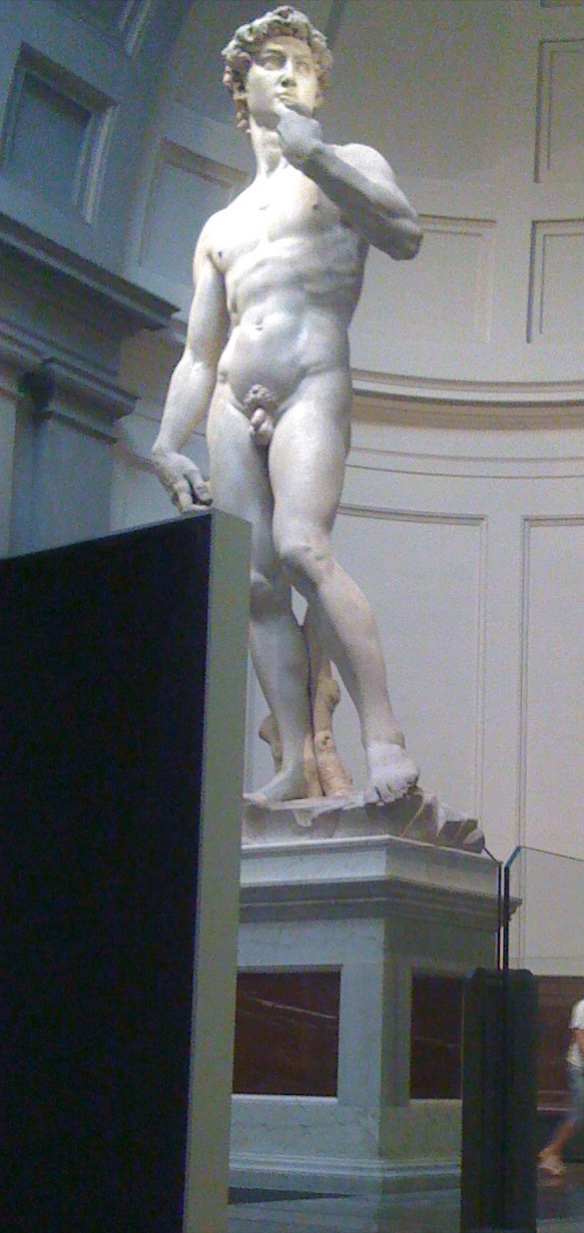
The absence of battle is important. Michelangelo’s earlier David gathers energy before conflict, while Victory shows one body above another. Lorenzo’s armour contains no immediate action. Its hardness contrasts with thought.
This conjunction may be the statue’s deepest invention. Political authority is made credible through equipment, but memorable through introspection. The duke appears capable of action and deliberately removed from it.
The Hands and the Closed Circuit
Lorenzo’s hands perform different kinds of containment. The raised hand brings thought toward the face; the lower hand settles nearer the lap and the objects or folds gathered there. Together they keep energy inside the seated silhouette. Nothing reaches decisively toward the spectator.
This closed circuit is more important than assigning a single symbolic name to every held form. Objects around the lap have prompted interpretations connected with money, authority or melancholy, but attributes become unreliable when made to carry a programme unsupported by firm documentation. Their secure role is compositional: they give the lowered arm a destination and balance the raised gesture.
Hands are often where Michelangelo converts general bodily type into action. David holds a sling almost invisibly; Moses grips the tablets; Giuliano’s hands distribute command outward. Lorenzo touches the zone of his own thought. The contrast makes contemplation an activity rather than an absence of movement.
Surface, Finish and Distance
The figure belongs to a chapel whose completion history is layered and whose sculptures retain different degrees of finish.[2][3] It is prudent not to assign every visible transition to one final intention or every installed relationship solely to Michelangelo’s last decision.
From the floor, fine details yield to silhouette and shadow. The statue’s elevated position privileges the helmet, bent arm and compact seated mass. Close study reveals carving, but architectural distance is not a defect to overcome; it is part of the design.
Current museum stewardship makes the New Sacristy publicly accessible within the Medici Chapels complex, and official cultural sources frame its continuing care.[1][3] Present viewing conditions may change, while the distinction between sculpture, tomb and room remains constant.
How to Look at Lorenzo
Begin with the entire wall. Find Lorenzo in the niche and trace a vertical line down to the sarcophagus. Then follow Dawn and Dusk outward. Their recline widens the base from which his inward body rises.
Move closer to the gesture. Ask how much of “thinking” comes from hand, head, shadow and the refusal of eye contact. Notice that removing any one element weakens the nickname Il Pensieroso.
Finally turn toward Giuliano and the Madonna wall. The meaning of Lorenzo is relational. He becomes most contemplative opposite activity, most secular beside sacred motherhood, and most enduring above bodies that personify passing hours.
Why Lorenzo de’ Medici Matters
The statue matters because it redefines portraiture. Michelangelo does not preserve a face; he creates a durable character from posture, armour and controlled obscurity. The duke becomes an idea of governance turning inward.
It matters because no part works alone. Dawn and Dusk, sarcophagus, niche and chapel light produce Lorenzo’s meaning. The sculpture demonstrates Michelangelo’s ability to make architecture and bodies conduct one memorial argument.
And it matters because its identity tests historical care. Confusing the Duke of Urbino with Lorenzo the Magnificent collapses two generations and two walls. Once the names are restored, the pensive figure becomes more than a famous pose: he is the ideal memorial of a specific young ruler within a dynasty’s carefully differentiated chamber of death.
Artist Up Close
Michelangelo’s work for the Medici joined gratitude, patronage, artistic ambition and political danger. Lorenzo the Magnificent’s circle had fostered him as a youth; later Medici popes and dukes commissioned the New Sacristy; still later he served the republic that opposed their return. The seated Lorenzo should not be treated as a coded verdict on that history. It shows Michelangelo creating an ideal ruler whose ambiguity could survive the immediate politics: armoured yet inactive, present yet shadowed, commemorated yet subject to time.
Frequently Asked Questions
Discussion
How does Michelangelo make a memorial portrait depend on the architecture around it?
Reader Insights
How does Lorenzo's inward posture change the mood of the tomb wall?
Does the contrast between Lorenzo above and Dawn/Dusk below make the monument feel stable or unsettled?
How does the New Sacristy setting change the meaning of a portrait sculpture?
Join the Conversation
Set Lorenzo above Dawn and Dusk. Does the tomb wall feel more like a portrait, an allegory of time or an architectural idea?
References
- Musei del Bargello, Cappelle Medicee”:, View source.
- Catalogo generale dei Beni Culturali, Michelangelo e la Sagrestia Nuova in Firenze — Un progetto innovativo”:, View source.
- Ministero della Cultura, Firenze — Cappelle Medicee: Un ascensore per Michelangelo”:, View source.
- Catalogo generale dei Beni Culturali, Aurora”:, View source.
- Catalogo generale dei Beni Culturali, Crepuscolo”:, View source.
- British Museum, The Medici Tombs in the New Sacristy: Studies for a Free-standing Sepulchral Monument”:, View source.
- British Museum, The Medici Tombs in the New Sacristy: A Study for a Double Tomb with Figures”:, View source.
- The Metropolitan Museum of Art, Michelangelo: Divine Draftsman and Designer”:, View source.