


 by Tom Gurney
Tom Gurney BSc (Hons) is an art history expert with over 20 years experience
Published on June 19, 2020 / Updated on November 6, 2025
Email: tomgurney1@gmail.com / Phone: +44 7429 011000
Leah
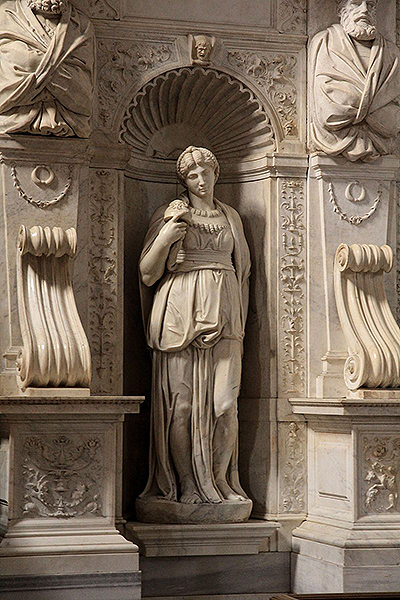
Michelangelo's Leah stands at the viewer's right of Moses on the monument to Pope Julius II in San Pietro in Vincoli, Rome. Her fingers gather a long braid while the other hand holds a polished object traditionally read as a mirror. The pose is calm but not idle: weight, turn, grooming and attention make her the monument's image of a life conducted through action.
The identification comes from the Old Testament sisters Leah and Rachel, both wives of Jacob. Christian interpretation had long used them as figures of the active and contemplative lives. Leah, who was fruitful and engaged in worldly labour, represents the vita activa; Rachel, Jacob's beloved, represents contemplation. Michelangelo carved both women for the final, drastically reduced version of the tomb in the early 1540s.[1]
Leah is therefore neither an independent biblical portrait nor a surviving figure from Julius's first, colossal project of 1505. She belongs to the monument's last solution, where two forms of spiritual life flank the lawgiver. Her quiet gesture is the endpoint of forty years of frustrated architectural change.
At a Glance
- ArtistMichelangelo Buonarroti
- TitleLeah; also interpreted as the Active Life
- DateAbout 1542–1545
- MaterialMarble
- HeightApproximately 209 centimetres
- Current locationMonument to Pope Julius II, San Pietro in Vincoli, Rome
- PositionLower tier, viewer's right of Moses
- Biblical identityLeah, daughter of Laban and wife of Jacob
- Allegorical identityThe active life (vita activa); sometimes Active Charity or Love
- AttributesLong braid and a mirror or diadem-like object
- Authorship boundaryOne of the three principal lower figures carved by Michelangelo; much of the upper monument was executed by assistants
Contents
- Leah in Genesis
- The Active Life
- How the Figure Stands
- A Late Work Beside an Earlier Moses
- Forty Years of the Julius Tomb
- Authorship Across the Monument
- Mirror, Diadem and Braid
- Leah, Women and Michelangelo's Late Sculpture
- Action, Office and a Papal Memorial
- How to Look at Leah
- Why Leah Matters
Leah in Genesis
In Genesis, Leah and Rachel are daughters of Laban. Jacob loves Rachel and agrees to work seven years to marry her, but Laban substitutes Leah at the wedding. Jacob then works another seven years for Rachel. The sisters become wives within a difficult household marked by rivalry, fertility and dependence.[2]
Leah bears several sons, including Levi and Judah. Through Judah she enters the ancestry of David and, in Christian genealogy, of Christ. Her biblical importance comes not from a single heroic act but from endurance and generative labour.
Michelangelo does not illustrate the wedding deception or surround the figure with children. He uses a long interpretive tradition that converted the sisters into complementary modes of life. The historical Leah remains underneath the allegory, but narrative detail has been stripped away.
That transformation suits a tomb. The viewer is not asked to reconstruct Jacob's family drama. Leah becomes a durable way of thinking about human conduct before death and salvation.
The Active Life
The pairing of Leah and Rachel as action and contemplation reaches Christian readers especially through Gregory the Great and Dante. In the final canto of Purgatorio before Dante enters the earthly paradise, he dreams of Leah gathering flowers to make herself a garland while Rachel sits before a mirror, content to look.[3]
Michelangelo's Leah appears to handle her hair and an object often called a mirror. The attributes are not distributed as mechanically as an illustrated key might suggest. This has produced alternative readings of the object as a diadem and of the figure as Active Charity.
The active life is not mere busyness. In Christian thought it encompasses ethical work directed toward others: labour, mercy, responsibility and virtuous government of the self. It can prepare the soul for contemplation rather than oppose it.
Leah's grooming should therefore not be reduced to vanity. Arranging hair can signify the ordered preparation of a life. If the object is a mirror, it may evoke Prudence and self-knowledge as well as beauty. Michelangelo makes embodied care an image of moral activity.
How the Figure Stands
Leah bears weight on one leg while the other relaxes, creating a classical contrapposto. The hips shift, the torso answers and the head turns slightly. Her movement is contained rather than dramatic.
The long braid establishes a diagonal sequence between hand, chest and hip. It gives the fingers a task and turns hair into a line the eye can follow. Folds descend more heavily, stabilising the body beneath the smaller movement above.
Her niche limits projection. Unlike the earlier Prisoners imagined around the tomb's freestanding architecture, Leah belongs to a shallow wall monument. Michelangelo designs her to read from the front while keeping enough rotation to animate the niche.
The relation to Moses is decisive. Moses sits massively at the centre, his head turned and body charged with restrained power. Leah's smaller standing form provides vertical balance at his side. Her concentrated gesture changes the register from prophetic command to daily discipline.
The monument is not symmetrical in feeling even when architecture pairs its figures. Rachel kneels or bends inward at the other side; Leah stands and handles an object. Action and contemplation become visibly different postures.
A Late Work Beside an Earlier Moses
Michelangelo carved Moses largely during earlier phases of the tomb project, beginning around 1513. Leah and Rachel were made roughly three decades later for the final contract of 1542.[1] Their juxtaposition compresses much of his career into one tier.
The difference is visible. Moses has an expansive anatomical and emotional force associated with the artist's High Renaissance monumentality. The later women are narrower, clothed and closely adapted to their niches. Their energy is inward and devotional.
This should not be explained simply as decline. Michelangelo was over sixty-five, but the project had also changed fundamentally. A freestanding papal mausoleum with dozens of sculptures had become a two-storey wall monument in a different church. Scale, budget, theology and available labour demanded another kind of figure.
Leah's restraint belongs to that condition. She does not need to compete with the abandoned captives. Her work is to mediate between the central lawgiver and the upper register of Marian and prophetic figures.
The resulting ensemble contains temporal seams. Its artistic power does not come from pretending every part was conceived at once.
Forty Years of the Julius Tomb
Julius II summoned Michelangelo to Rome in 1505 for a monumental tomb intended for the new St Peter's Basilica. The first project was enormous and freestanding. Papal priorities soon shifted, work stopped, and Michelangelo left Rome in anger.
Successive contracts in 1513, 1516, 1526 and 1532 reduced the scheme. Sculptures begun for earlier versions were dispersed or abandoned: the Louvre Slaves, the four Florence Prisoners and Victory all testify to futures that did not survive.[4]
After completing the Last Judgement, Michelangelo reached a final agreement with the Della Rovere heirs in 1542. The monument installed in San Pietro in Vincoli was completed in 1545. Julius's body was not transferred there; he was buried at St Peter's. Strictly, the structure functions as a memorial or cenotaph rather than the pope's containing tomb.
For this last design, the earlier Moses became the lower centre. Michelangelo carved Leah and Rachel to flank it, while assistants executed much of the upper sculpture under his direction.[1]
Leah thus answers the project's collapse without representing failure. She is a new figure made to reconcile inherited sculpture, a reduced architectural frame and a changed religious climate.
Authorship Across the Monument
The lower tier can encourage a false shorthand: “Michelangelo's tomb” becomes “everything visible was carved by Michelangelo.” Scholarship distinguishes design, reused work, direct carving and assistant execution.[1]
Michelangelo's authorship of Leah is accepted. Rachel and Moses are also his. On the upper level, the reclining pope, Madonna and Child, prophet and sibyl involve other sculptors, including Raffaello da Montelupo, Tommaso Boscoli and other assistants associated with the final campaign.
This division was not an embarrassment hidden from Renaissance viewers. Large monuments depended on collaboration. Michelangelo's late responsibility included supplying models, revising architecture and supervising work he could not execute alone.
Leah matters partly because she identifies where his chisel returned directly to the monument. Her surface can be compared with surrounding figures without forcing all differences into one artist's stylistic evolution.
Attribution also clarifies interpretation. The active and contemplative lives were not incidental workshop additions; Michelangelo personally embodied the pair anchoring his final scheme.
Mirror, Diadem and Braid
The object in Leah's hand has been called a mirror. A mirror can signify truth, self-knowledge or Prudence, but it can also carry moral warnings about vanity. Its meaning depends on gesture and setting.
Some descriptions call it a diadem or the support for a garland. Dante's Leah gathers flowers to adorn herself, which strengthens the idea of active virtue preparing its own beauty.[3] The braid passing through or beside the hands complicates a fixed identification.
Michelangelo often allows attributes to remain integrated with bodily action. The viewer does not read a label attached to a passive saint. Hands, hair and object form one sculptural knot.
That knot slows recognition. Leah's activity is intimate, even domestic, while her monumental scale makes it exemplary. The ordinary labour of arranging becomes an allegory because attention is disciplined.
It is best to preserve the range: the figure is securely Leah/Active Life within the paired programme; the precise handheld object's meaning is less secure.
Leah, Women and Michelangelo's Late Sculpture
Michelangelo's female figures are often discussed primarily through muscular anatomy developed from male models. Leah asks for a broader view. Her body is largely clothed, and expression is produced through stance, fabric, hair and task.
She is neither maternal like the Pietà Virgins nor cosmic like Night and Dawn. Her identity comes through ethical conduct. The figure's dignity depends on action that might otherwise be overlooked as minor.
The classical dress gives Leah historical distance without reconstructing biblical costume. Renaissance allegory could use an ancient-looking matron to make Scripture, virtue and monumental sculpture share one visual language.
Her scale also refuses subordination. Although Moses dominates, Leah is over life-size. Active life is not a decorative accessory to contemplation; it stands as one of the monument's primary supports.
Action, Office and a Papal Memorial
The active life has particular force beside the memorial of a pope. Julius II had defined his reign through campaigns, building, administration and patronage. The original tomb projected that public energy on an imperial scale. Its final form could no longer celebrate action without qualification.
Leah offers a different model of doing. She neither conquers nor commands. Her work is ordered, attentive and turned toward virtue. The contrast does not condemn every public act, but it subjects worldly achievement to moral measure.
This makes the pair with Rachel more than a private devotional theme. Church office requires action: teaching, governing, serving and caring for a community. It also requires contemplation so that action does not become appetite for power. A papal memorial flanked by the sisters can therefore be read as an examination of office as well as an image of personal salvation.
Michelangelo had experienced the burdens of papal action directly. Julius's ambitions diverted him among tomb, ceiling, façade and political service; later popes inherited and changed those demands. Leah's disciplined gesture does not narrate that biography, but it gives the final monument a quieter definition of productive work than the first commission's colossal rhetoric.
How to Look at Leah
View her first in relation to the whole lower tier. Note the spacing between her niche and Moses and the different widths of standing and seated bodies.
Then follow the braid through the hands. Decide how this small action directs the torso and head.
Compare the weighted and relaxed legs. The classical stance provides stability, but the folds prevent the body from becoming an anatomy display.
Look across to Rachel. Action and contemplation are expressed through posture before their names are known.
Finally look upward. Leah participates in a monument completed by several sculptors. Differences in finish and conception are evidence of the tomb's forty-year history.
Why Leah Matters
Leah gives the Julius monument an ethic of completion. The youthful project promised colossal fame; the late sculpture speaks about work, self-ordering and the active life within mortal limits.
She also corrects the habit of treating the tomb only as the setting for Moses. Without Leah and Rachel, the lower tier would lack the spiritual pair that makes the final design intelligible.
Michelangelo turns a woman arranging her hair into a monument to purposeful action. The gesture is modest, but that modesty is the point. After four decades of obstruction, the tomb was completed not through its original grandeur but through disciplined labour—the very life Leah represents.
Her survival in place matters as well. Earlier tomb figures were given away, left unfinished or moved to other collections when their architectural roles disappeared. Leah has remained inside the final arrangement for which she was carved. The relation among body, niche and neighbouring statues is therefore primary evidence, not a modern reconstruction. To see her only as a freestanding photograph is to miss the rare case in which Michelangelo's late sculptural intention can still be read through its completed setting.
Frequently Asked Questions
Discussion
What details, sources or comparisons stand out to you in Leah?
Reader Insights
Which formal detail changes how the work reads?
Which documented source or collection history feels most useful?
Which related Michelangelo work should readers compare next?
Join the Conversation
Add a source-led observation, comparison or question for other readers.
References
- Paul Joannides, The Prisoner and the Veil: The Symbolism of Michelangelo's Tomb of Julius II,” Italian Studies 49 (1994):, View source.
- Bible Gateway, Genesis 29–30, New Revised Standard Version Updated Edition:, View source.
- Princeton Dante Project, Purgatorio 27, Leah and Rachel:, View source.
- British Museum, drawing of the lower storey of the Julius monument, 1859,0514.824:, View source.
- Rijksmuseum Research Library, Michelangelo's Tomb for Julius II: Genesis and Genius:, View source.
- National Gallery of Denmark, Michelangelo Imperfect, digital guide, tomb section:, View source.