


 by Tom Gurney
Tom Gurney BSc (Hons) is an art history expert with over 20 years experience
Published on June 19, 2020 / Updated on November 6, 2025
Email: tomgurney1@gmail.com / Phone: +44 7429 011000
The Virgin and Child Drawing
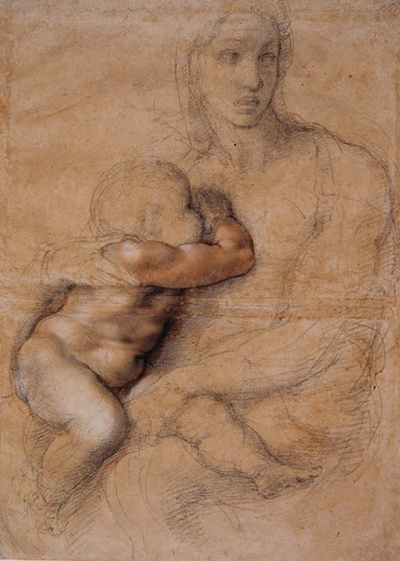
Michelangelo's late Virgin and Child seems at first like a black-chalk study of maternal embrace. Look longer and the sheet becomes more complicated. The figures have been enclosed by the remains of a gold silhouette, as though a later owner wanted to convert the drawing into a precious icon. Turn the paper over and sacred bodies give way to words: a draft of one of Michelangelo's poems survives on the verso.
The Royal Collection preserves the sheet as RCIN 912772 and dates the drawing to about 1545.[1] Michelangelo used black chalk over traces of red chalk. The largely removed gold is not part of his original act; it records a later intervention in the object's history.[2]
The drawing may have supplied a design for Marcello Venusti, Michelangelo's frequent collaborator in late religious imagery, but no corresponding painting is known.[2] Its function therefore remains open. It could be an abandoned model for translation into paint, a devotional work in its own right, or a sheet whose intended destination has disappeared.
At a Glance
- TitleThe Virgin and Child
- ArtistMichelangelo Buonarroti
- DateAbout 1545
- MediumBlack chalk over traces of red chalk
- Later alterationFigures formerly silhouetted with gold paint, now mostly removed
- CollectionRoyal Collection
- InventoryRCIN 912772
- VersoA draft of a poem in Michelangelo's hand
- Possible purposeA design for Marcello Venusti; no related painting is known
- SubjectThe seated Virgin holding and supporting the infant Christ
Contents
- Two Bodies, One Compact Form
- Chalk That Behaves Like Modelling
- A Possible Design for Venusti
- The Gold That Came Later
- Drawing on the Back of Poetry
- Recto and Verso
- Motherhood in Michelangelo's Late Work
- Incarnation Without Narrative Setting
- Is It a Presentation Drawing?
- The Royal Collection Context
- The Drawing as an Icon—and Against an Icon
- How to Look at the Sheet
- Why This Drawing Matters
Two Bodies, One Compact Form
The Virgin and Child form a single steep mass. Mary bends over the infant while supporting him across her lap. His small body turns within the shelter of hers.
Michelangelo does not create intimacy through facial sweetness. The relation is carried by structure: the angle of Mary's torso, the cradle of her arms and the pressure of the child against her.
The composition is easy to imagine in relief or paint because its main forms are so compact. Yet it does not resolve into a simple triangular emblem. Limbs fold across one another, and the child's turning body sets movement inside the stable maternal frame.
This is a late version of a problem Michelangelo had pursued since the Madonna of the Stairs: how can a mother and child appear almost inseparable while sacred history guarantees their eventual separation?
The answer here is neither theatrical prophecy nor domestic play. The group withdraws into itself, creating a concentration suited to private devotion.
Chalk That Behaves Like Modelling
Black chalk allows Michelangelo to build rather than merely outline. Repeated strokes accumulate around the bodies, deepening shadow and locating weight.
Traces of red chalk beneath the black reveal that the visible solution developed over another stage.[2] The final image is not the product of one unbroken line; it emerged through adjustment.
The method resembles modelling in a soft substance. Contours thicken, merge and are restated. A shoulder or knee acquires force through neighbouring darkness.
Late Michelangelo is sometimes described as if failing finish were only a sign of age. This drawing resists that reduction. Selective completion focuses the relation of the bodies and leaves surrounding space almost empty.
The blank paper is active. It isolates the group, permitting a small devotional subject to feel monumental without an architectural setting, landscape or throne.
A Possible Design for Venusti
Marcello Venusti translated several of Michelangelo's late sacred designs into painted panels. Their collaboration separated invention from execution without making either role insignificant.
The British Museum's 2024 exhibition guide suggests that RCIN 912772 may have been designed for Venusti.[2] The possibility fits Michelangelo's late practice: he could resolve the governing arrangement in chalk while another artist developed colour, surface and setting.
No related painting has been identified. That absence changes how the proposal must be stated. “Possibly for Venusti” is responsible; “study for a Venusti painting” would imply evidence that does not survive.
The sheet may instead have been retained precisely because it worked as a finished devotional conception. Renaissance drawings could move among practical, collectible and contemplative uses without belonging permanently to only one category.
Its later gilding supports the history of independent veneration, but it cannot prove Michelangelo's original intention.
The Gold That Came Later
At some point after Michelangelo's work, an owner painted gold around the figures, turning their outline into a silhouette. Most of this addition has since been removed.[2]
Gold altered the drawing's visual category. Chalk figures on ordinary paper began to resemble an icon or a small luxury object. Their irregular, exploratory edges were enclosed by a precious field.
The intervention shows an act of interpretation. A later viewer did not see only a master's working sheet. That viewer recognised a sacred image worthy of material elevation.
Removal produced another historical layer. Modern conservation sought to recover Michelangelo's chalk, but the surviving traces still testify to the object's devotional or collectible afterlife.
It is tempting to call the gold damage. Physically, it obscured the original. Historically, however, it is evidence: proof that drawings were touched, reframed and adapted as their meanings changed.
Drawing on the Back of Poetry
The verso carries a draft of a poem by Michelangelo, conventionally dated around 1540–45.[3] Image and language therefore occupy the same support.
Michelangelo's poetry was not a secondary hobby detached from his visual work. He revised sonnets and madrigals with the same persistence that appears in his drawn contours. Both activities use correction to find form.
The coexistence of poem and Madonna should not encourage a forced one-to-one interpretation. Without a secure textual dedication or explicit reference to Mary, the verse cannot simply be labelled an explanation of the drawing.
What the sheet establishes is material proximity. In Michelangelo's studio and household economy, a paper bearing literary thought could be turned and reused for visual invention.
That economy collapses later categories. We now place drawings and poems in separate catalogues; Michelangelo placed them on opposite faces of one object.
Recto and Verso
Museums designate the primary face of a sheet as the recto and its reverse as the verso. Those terms sound neutral, but this object asks which face was primary at which moment.
If the poem came first, the surface later called “verso” may initially have been the working front. The drawing then reoriented the paper and its value.
A collector could display the Madonna and conceal the text. A literary scholar might reverse that hierarchy. Conservation and digital photography now allow both faces to be studied without treating the hidden one as incidental.
The object's meaning changes every time it is turned. One side presents the Incarnation through bodies; the other presents thought through handwriting. Both preserve Michelangelo's pressure, hesitation and revision.
The sheet is consequently not just a carrier of two works. It is a record of how a scarce material moved between forms of attention.
Motherhood in Michelangelo's Late Work
Michelangelo returned repeatedly to the Virgin and Child from adolescence into old age. The repetition did not yield a standard formula.
The early Madonna of the Stairs uses extremely shallow relief and a nursing child. The marble Bruges Madonna allows Christ to stand between Mary's knees as if preparing to move away. The Taddei Tondo makes the child recoil from a symbol of the Passion. The Medici Madonna combines physical closeness with a mother's distant look.
RCIN 912772 belongs to this long investigation but should not be reduced to a summary of earlier sculptures. Chalk makes the relation less permanent. Bodies emerge through layers and could still have changed.
Its late date also places it near Michelangelo's intensified religious thought and his collaborations with painters. The sacred theme remained both personal and shareable: fit for meditation, poetry and translation into another medium.
Incarnation Without Narrative Setting
There is no stable, crib or attendant saint. The drawing does not illustrate an episode from the infancy of Christ.
Instead, it concentrates on the theological fact of a divine child held by a human mother. Weight, support and touch become the narrative.
This reduction makes the subject universal without making it generic. Any caregiver recognises the bodily negotiation of holding a moving child; Christian viewers also read that dependence as the chosen vulnerability of the Incarnation.
Mary's scale and inward bend protect Christ, yet the composition cannot prevent knowledge of the Passion from entering. Michelangelo's earlier Madonnas had already linked childhood to future sacrifice through birds, gestures and distant gazes.
Here no explicit omen is required. The viewer supplies the future because the two bodies are so intensely present.
Is It a Presentation Drawing?
Michelangelo produced highly finished gift drawings for friends, especially Tommaso de' Cavalieri. Those sheets often display refined surfaces, complex mythological or sacred inventions and an awareness of a particular recipient.
RCIN 912772 has a concentrated devotional character, but the surviving evidence does not identify a recipient. Nor does the later gold establish that Michelangelo presented it in that form.
Calling it a presentation drawing would therefore exceed what is known. It is better understood within the broader culture that elevated drawings from workshop instruments to independent objects of exchange and contemplation.
Its survival in the Royal Collection and the gilding imposed by a former owner show that later audiences certainly treated it as more than scrap paper. Original function and later valuation, however, must remain separate questions.
The Royal Collection Context
RCIN 912772 belongs to an exceptional group of Michelangelo drawings in the Royal Collection. Nearby inventory numbers include the Punishment of Tityus, The Virgin and Child with the Young Saint John and late Crucifixion sheets.[1]
Inventory sequence does not imply that Michelangelo made the works as a set. It records collecting and cataloguing, not studio order.
The distinction is especially useful here because RCIN 912773 presents a different Madonna composition, dated about 1532, with the young Baptist included.[4] The adjacent numbers can invite accidental merger.
RCIN 912772 contains only the Virgin and Christ Child on its principal face; the poem is on the reverse. RCIN 912773 is a separate black-chalk sheet whose complex attribution history and third figure create another object entirely.
Precise inventory numbers keep similar titles from erasing material differences.
The Drawing as an Icon—and Against an Icon
Traditional icons use stable types and precious materials to present sacred persons outside ordinary time. The later gold pushed Michelangelo's group in that direction.
The chalk resists complete transformation. Its revisions and variable pressure expose making. The bodies do not arrive as a fixed formula; they have been searched for.
This tension may explain the intervention's fascination. A later owner attempted to stabilise a mutable drawing as a sacred emblem, while modern removal reopened the exploratory perimeter.
Neither state is historically innocent. Michelangelo's original is the primary artistic act, but the object's long life includes people who wanted it to look more explicitly holy.
What remains is a hybrid: devotional concentration surrounded by traces of changing taste.
How to Look at the Sheet
Start with the largest dark masses rather than the faces. Follow how Mary's torso and arms create a shelter around Christ.
Look for red chalk beneath the black. Those traces preserve an earlier stage of construction.
Then inspect the perimeter for remnants of gold and imagine how a continuous metallic field would have hardened the silhouette.
Finally, remember the reverse. The image's paper is also a page of writing. Even when the poem cannot be seen, it is physically present behind every chalk mark.
Why This Drawing Matters
The Virgin and Child matters because it preserves several lives at once. It is a late sacred invention, a possible collaborative design, a reused surface carrying poetry and an image later remade as a golden icon.
No identified painting completes its story. That lack prevents easy classification but allows the sheet's own complexity to come forward.
Michelangelo compresses mother and child into a structure of protection. Later hands compressed the drawing into an emblem. Conservation recovered much of its openness, leaving enough gold to remind us that masterpieces are not only made once; they are repeatedly understood, altered and recovered.
Frequently Asked Questions
Discussion
What details, sources or comparisons stand out to you in Madonna and Child?
Reader Insights
Which formal detail changes how the work reads?
Which documented source or collection history feels most useful?
Which related Michelangelo work should readers compare next?
Join the Conversation
Add a source-led observation, comparison or question for other readers.
References
- Royal Collection Trust, The Virgin and Child,” RCIN 912772, View source.
- British Museum, Michelangelo: The Last Decades, large-print guide, entry for RCIN 912772, View source.
- Royal Collection image record, Verso: A draft of a poem,” RCIN 912772, reproduced through Wikimedia Commons, View source.
- Royal Collection Trust, The Virgin and Child with the Young St John,” RCIN 912773, View source.