


 by Tom Gurney
Tom Gurney BSc (Hons) is an art history expert with over 20 years experience
Published on June 19, 2020 / Updated on November 6, 2025
Email: tomgurney1@gmail.com / Phone: +44 7429 011000
Michelangelo’s Madonna of the Stairs
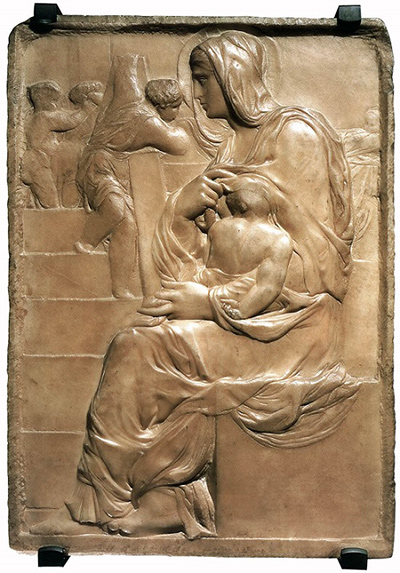
Michelangelo’s Madonna of the Stairs compresses a monumental mother and child into a marble field scarcely deeper than a drawn line. Mary sits in profile on a block-like seat, filling the height of the relief. The Christ Child is held against her body, largely turned away. Behind them, a stair rises beside four small figures whose actions remain difficult to explain. Quiet at first glance, the sculpture grows stranger the longer it is seen.
Casa Buonarroti dates the marble to about 1490, when Michelangelo was still in his mid-teens, and records dimensions of 56.7 × 40.1 centimetres.[1] The shallow technique recalls Donatello, the Florentine master who had made minute differences of depth carry light, space and emotion. Michelangelo’s response is already independent: the relief may be small, but Mary has the mass and remoteness of architecture.
Why is Madonna of the Stairs more than a small early Madonna relief? The page keeps the relief's shallow carving, monumental calm, Casa Buonarroti context and open iconographic details in view at the same time.
At a Glance
- ArtistMichelangelo Buonarroti
- TitleMadonna of the Stairs; Italian Madonna della scala
- DateAbout 1490
- MediumMarble relief
- Dimensions56.7 × 40.1 centimetres
- Current locationCasa Buonarroti, Florence
- Inventory190
- SubjectVirgin Mary holding the Christ Child, with a stair and four background children
- TechniqueVery shallow relief associated with the Florentine tradition of stiacciato
- Documentary limitNo known lifetime mention; first recorded by Vasari in the 1568 edition of the Lives
- InfluenceClosely related to Donatello’s relief tradition without being a simple imitation
- Iconographic cautionThe full meaning of the stair and the background children is unresolved
- Recent careConserved and redisplayed through the 2020–2022 Room of Marbles project
Contents
- Monumentality Without Depth
- Mary in Profile
- The Child Turned Away
- The Stair and the Four Children
- Michelangelo and Donatello’s Shallow Relief
- A Young Work Without a Known Commission
- Beside the Battle of the Centaurs
- Surface, Conservation and the Room of Marbles
- Later Madonnas and Tondi
- How the Relief Changes as You Look
- Why This Small Marble Matters
- Artist Up Close
Monumentality Without Depth
Relief usually creates space by allowing figures to project at different levels from a background. Michelangelo works here with extraordinary restraint. The carving is so shallow in parts that light rather than measurable volume seems to form an edge.
Mary nevertheless feels massive. Her head, shoulder, back and legs organise a large geometric presence. The seated body does not dissolve into the thin field; it appears to press against it from within. Scale is psychological and compositional rather than literal.
The rectangular slab strengthens this effect. Mary occupies one side as a vertical body, while the stair establishes a competing architecture behind her. The relief balances a human mass against repeated horizontal steps.
The Christ Child is held within Mary’s outline rather than presented openly to the viewer. This containment makes the group feel private, yet Mary’s remote profile resists ordinary domestic intimacy. She does not turn outward to invite devotion. Her attention remains enclosed.
The small background children register a greater distance through shallower carving and reduced scale. Michelangelo creates recession without constructing a broad perspectival room. A few planes are enough to separate monumental foreground from enigmatic activity behind.
Mary in Profile
Mary’s profile is unusual in its severity. Face and torso turn away from frontal address, making her seem absorbed in thought. The shape of her head and the straight fall of her body create an almost antique gravity.
Her hands and arms bind Christ to her. The child’s body is not displayed like a sacred attribute; it is physically absorbed into maternal support. This closeness can suggest sleep, nursing or shelter, but the shallow surface and unusual orientation resist a simple narrative label.
The composition joins tenderness to distance. Mary’s touch is intimate, while her scale and stillness are impersonal. Michelangelo’s Madonna is both a young mother and a form capable of carrying theological weight.
Clothing reinforces monumentality. Large folds do not describe every softness of fabric. They organise the body into planes that catch or release light. Drapery becomes a structural system through which the seated pose can be felt.
The profile also makes the viewer conscious of looking from outside. We are not placed face to face with Mary. Devotion proceeds through observing an inward relation that does not acknowledge us.
The Child Turned Away
Christ’s orientation is one of the relief’s most affecting choices. The child does not offer his face clearly. His body is held close, and the back or side becomes more immediately legible than expression.
This withholding prevents the subject from becoming a charming portrait of infancy. The child’s anonymity allows repose to acquire a more solemn association. Viewers familiar with the Passion may see a distant anticipation of the dead Christ held by Mary, though no surviving explanation by Michelangelo confirms a deliberate Pietà prophecy.
Physical relation remains the strongest evidence. Mary encloses a smaller body; curved limbs answer her larger planes; the child’s vulnerability changes the meaning of her strength. Her monumentality exists to support.
The relief’s shallow depth makes their separation ambiguous. Where one body overlaps the other, minimal projection must communicate contact. Light joins and divides them according to angle.
This sensitivity makes direct viewing particularly valuable. Under frontal light, contours can nearly disappear; raking illumination can reveal small ridges and depressions. The sculpture’s emotional intensity depends on the same tiny differences that construct anatomy.
The Stair and the Four Children
The stair gives the work its modern title, yet its meaning is not settled. It rises behind Mary as both architecture and symbol, establishing repeated levels that contrast with her uninterrupted body.[1]
Four children occupy this background. Casa Buonarroti describes two as if dancing and two as stretching a drapery.[1] Their small, busy gestures differ sharply from Mary’s stillness. They create life around an absorbed sacred centre.
The cloth has attracted interpretations connected with funerary or Passion imagery, while the stair can suggest ascent, a household setting or a symbolic ladder. These associations remain possibilities. The relief contains no inscription or unambiguous attribute that closes the meaning.
The ambiguity may be artistically useful. The children animate distance without forcing one story. Their activity makes Mary’s calm feel chosen rather than empty, while the stairs transform a bare background into ordered space.
The title itself demonstrates how one visible feature can govern reception. Without it, viewers might first remember Mary’s profile or the turned child. “Madonna of the Stairs” makes architecture part of identity while leaving its purpose unresolved.
Michelangelo and Donatello’s Shallow Relief
Vasari connected the work with Donatello’s manner, and Casa Buonarroti treats the relationship as intense but independent.[1] The comparison centres on stiacciato, the extremely shallow relief associated above all with Donatello.
In such carving, a fraction of depth can distinguish foreground from distance. Incised or barely raised lines behave almost like drawing, while light converts them into space. It is a technique that demands certainty because there is little material available for correction.
Michelangelo learns from this tradition without copying one known composition. His foreground Madonna is heavier and more architectonic than the word “shallow” might suggest. Donatello’s spatial subtlety becomes a way to test the pressure of mass.
The relation also places Michelangelo within Florentine memory. Innovation did not require rejecting earlier masters. It could arise through choosing an inherited technical problem and forcing it toward a new bodily language.
The work therefore complicates the myth of innate genius. Its achievement is inseparable from close attention to existing sculpture. Michelangelo’s independence appears in how he transformed knowledge, not in having no teachers.
A Young Work Without a Known Commission
Casa Buonarroti knows no mention of the relief during Michelangelo’s lifetime. Vasari’s 1568 Lives provides its first recorded appearance.[1] This gap limits claims about who requested it, where it first stood and how it functioned.
The date around 1490 places it within Michelangelo’s formative Florentine years and the world of Medici collecting and artistic study. That context is important, but it should not be turned into an exact commission unless documentation emerges.
An intimate scale and sacred subject are compatible with domestic devotion. Yet possibility is not provenance. The relief may also have functioned as an experiment, gift or self-directed work. Its first purpose remains open.
The documentary silence changes interpretation. Because no patronal contract names an iconographic programme, the stair and children cannot be decoded against a written request. The marble must carry more of the argument.
Vasari’s later notice also reminds us that “early Michelangelo” was reconstructed after the artist had become famous. The small relief entered history through a biography already aware of the Sistine ceiling, David and the Medici tombs. Later greatness inevitably shaped how youthful skill was seen.
Beside the Battle of the Centaurs
Casa Buonarroti presents Madonna of the Stairs with Battle of the Centaurs as the two great marble reliefs of Michelangelo’s youth.[2] The pairing is historically and visually productive.
The Madonna compresses a few bodies into extreme shallowness and emotional stillness. The Battle crowds nude figures into physical collision and leaves more of the marble visibly unfinished. One treats intimacy; the other violence.
Their contrast proves range more than linear progress. It would be misleading to say that Michelangelo simply moved from calm to action or from finish to non-finito. Both works experiment with how a rectangular marble field can contain bodies.
The pairing also belongs to museum history. The two reliefs occupied changing parts of the Buonarroti house before being united in modern display.[2] Their present adjacency makes comparison immediate but is not their only historical context.
Seen together, the works establish that Michelangelo’s youth was already conceptually ambitious. He did not merely practise hands and faces. He tested opposing definitions of relief: almost weightless depth around a monumental mother and dense stone around struggling bodies.
Surface, Conservation and the Room of Marbles
Casa Buonarroti and Friends of Florence document conservation and refurbishment of the two early reliefs through the Room of Marbles project, completed across 2020–2022.[2][3] The work involved named restorers and renewed attention to display.
Conservation matters acutely for shallow relief. Dirt, deposits and changing light can suppress distinctions that are only millimetres deep. Cleaning and careful installation may restore legibility without making the marble newly carved.
The modern room also frames the relief as a family and national treasure. A small object intended for an uncertain first setting now carries the institutional weight of Michelangelo’s beginnings.
Display cannot be neutral. Height determines whether Mary’s profile is met directly or from below; lighting controls whether the children separate from the background; proximity governs whether technique or overall mass dominates.
The conservation record belongs to the object’s continuing life rather than its 1490 meaning. It shows how modern care makes historical looking possible while adding another layer of interpretation.
Later Madonnas and Tondi
Michelangelo returned repeatedly to Mary and Christ in different formats. The Madonna of Bruges is a nearly life-size freestanding group in which the child steps away. The Pitti and Taddei Tondi place sacred figures in circular marble fields. The Medici Madonna joins mother and child to the architecture of the New Sacristy.
These comparisons reveal recurring problems—support, separation, foreknowledge and bodily intimacy—without turning the works into stages of one design. Madonna of the Stairs owns the profile, extreme shallowness, stair and background children.
Its relationship to the later Pietàs is likewise thematic rather than preparatory. Mary holds a vulnerable Christ in both traditions, but the child here remains within infancy. Any anticipation of death arises through devotional reading, not a documented blueprint for the Vatican group.
The relief’s small scale does not make it minor. It demonstrates that monumentality can be produced by proportion, stillness and pressure rather than dimensions alone.
How the Relief Changes as You Look
At first glance the composition can seem almost austere: a seated woman in profile, a child against her, a stair rising behind them. A slower encounter unsettles that simplicity. Mary is physically still, yet nearly every neighbouring form introduces a different direction. The stair climbs; one child leans across its edge; another seems to pull or spread a length of cloth; the infant turns away from the spectator; Mary's projecting knee establishes a low, firm diagonal. These small departures keep the relief from becoming an emblem frozen in marble.
The order in which the eye discovers those elements matters. Mary and Christ command attention because they occupy the largest continuous mass. The background children arrive later, partly because their shallow cutting makes them dependent on light. The stair is later still: it can read as architecture, as an organising grid, or simply as a series of horizontal intervals behind the figures. Michelangelo therefore gives the relief more than one tempo. Its main silhouette is immediate, while its quieter incidents disclose themselves gradually.
That delayed visibility is one of the virtues of very low relief. In a deeply modelled carving, cast shadows announce the hierarchy of forms. Here, small changes in illumination can make a face, arm or fold appear more clearly and then recede. The object asks the viewer to notice not just bodies but the minute distance between one marble plane and another. Monumentality is achieved through discrimination rather than bulk.
The relief also rewards attention to what Michelangelo does not clarify. The activity of the four children has never received one universally binding explanation, and the stair does not come supplied with a caption. Attempts to turn every gesture into a fixed symbol can diminish the composition's strange life. It is more faithful to acknowledge that the background generates devotional atmosphere without becoming a fully legible anecdote. Ambiguity here is not an excuse to stop looking; it is the condition that makes close looking necessary.
Why This Small Marble Matters
The Madonna of the Stairs is important because it overturns several easy assumptions about young artists and small devotional objects. A youthful work need not be a timid exercise. A relief only a few centimetres deep can create a commanding human presence. A Madonna and Child can carry emotional gravity without theatrical expression. Michelangelo obtains all three results while leaving enough uncertainty to keep the work open.
It also establishes an enduring feature of his art: the body communicates through disposition before it communicates through facial drama. Mary's broad back, sheltered lap and profile convey stability; the Child's turned head and extended arm disturb it. The emotional relation is contained in the way the two bodies meet and diverge. Later sculptures will use much greater depth and scale, but this early marble already shows how decisively Michelangelo could think through posture.
Seen beside the Battle of the Centaurs, the work further demonstrates that early Michelangelo cannot be reduced to one emerging style. He could make marble whisper through minute planes and make it erupt through crowded bodies. The two reliefs are valuable together precisely because neither explains the other away. The Madonna of the Stairs remains the quieter object, but quiet is not the same as slight.
Artist Up Close
Michelangelo makes the slightest depth bear enormous responsibility. A ridge becomes the turn of a shoulder; a plane becomes distance; the edge of Mary’s body establishes an entire spatial order. Nothing can be lavish because the stone is too shallow.
The work also shows a young artist willing to withhold. Christ’s face is not offered, the background action is not explained, and Mary does not meet the viewer. The relief achieves authority by refusing easy access.
Frequently Asked Questions
Discussion
What feels most radical in Madonna of the Stairs: the shallow relief technique, the monumental Virgin, or the unresolved details around the stair and children?
Reader Insights
How much space can Michelangelo create with so little carving depth?
Where does Donatello's precedent end and Michelangelo's pressure begin?
Should the stair and children be explained, or allowed to remain partly open?
Join the Conversation
Compare relief format, Casa Buonarroti source evidence and cautious iconography while keeping this early Madonna distinct from other Michelangelo routes.
References
- Fondazione Casa Buonarroti, Madonna della scala”:, View source.
- Fondazione Casa Buonarroti, Michelangelo’s Marbles”:, View source.
- Friends of Florence, The Madonna of the Stairs and the Battle of the Centaurs, and the Refurbishment of the Room of Marbles”:, View source.