 by Tom Gurney
Tom Gurney BSc (Hons) is an art history expert with over 20 years experience
Published on June 19, 2020 / Updated on August 8, 2026
Email: tomgurney1@gmail.com / Phone: +44 7429 011000
Medici Madonna by Michelangelo
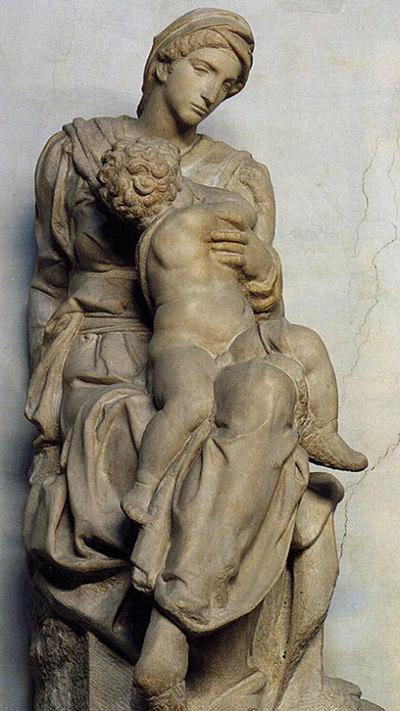
Mary sits upright, yet nothing between her and the Christ Child is still. The infant straddles and turns across her body; her legs and torso establish opposing directions; contact becomes a knot of nourishment, protection and impending separation. Michelangelo’s Medici Madonna occupies the altar wall of the New Sacristy at San Lorenzo, where mother and child face a chapel built around Medici death. Intimacy is placed inside dynastic commemoration.
The sculpture belongs to the memorial of Lorenzo the Magnificent and his brother Giuliano, not to the facing tombs of the two later Medici dukes.[1][2] It stands above their comparatively plain sarcophagus and between Saints Cosmas and Damian, which were executed by Giovanni Angelo Montorsoli and Raffaello da Montelupo from Michelangelo’s models or designs.[3] Those distinctions are essential. The Madonna is one work within a designed wall, the wall is one part of the New Sacristy, and the hands visible across the ensemble are not all Michelangelo’s.
At a Glance
- ArtistMichelangelo Buonarroti
- TitleMedici Madonna, or Madonna and Child
- DateDeveloped during the New Sacristy campaign, broadly about the 1520s to 1534
- MediumMarble
- SubjectThe Virgin Mary seated with the Christ Child turning across her lap
- Original and present settingNew Sacristy, Basilica of San Lorenzo, Florence; now administered within the Museo delle Cappelle Medicee[1][4]
- Memorial functionCentral devotional image above the sarcophagus of Lorenzo the Magnificent and his brother Giuliano
- Flanking saintsCosmas and Damian, Medici patron saints
- Execution boundaryMadonna by Michelangelo; Saint Cosmas executed by Montorsoli and Saint Damian by Raffaello da Montelupo from Michelangelo’s models or designs[3]
- StateUnfinished
- Identity cautionThe commemorated Lorenzo and Giuliano are not the younger dukes portrayed on the facing tomb walls
- Central formal featureStrong, interlocking torsion between mother and child within an upright, compact group
Contents
- The Devotional Centre of a Funerary Chapel
- Which Lorenzo and Giuliano?
- The Memorial That Was Reduced
- Mary’s Upright Gravity
- The Child in Motion
- Torsion as Emotional Language
- An Unfinished Sacred Image
- Saints Cosmas and Damian
- The Madonna and the Ducal Tombs
- A Related Madonna and Child Drawing
- Designing a Wall, Not Placing a Statue
- The Chapel After Michelangelo
- How to Look at the Medici Madonna
- Among Michelangelo’s Madonnas
- Why the Medici Madonna Matters
- Artist Up Close
The Devotional Centre of a Funerary Chapel
The New Sacristy joins architecture, sculpture and tomb design into one of Michelangelo’s most ambitious environments. The ducal monuments on opposing walls use seated rulers above the reclining Times of Day. The altar wall establishes a different focus: a Madonna and Child flanked by saints over the Magnifici sarcophagus.[1][2]
That position gives the group a liturgical and spatial authority beyond a freestanding devotional statue. Mary and Christ do not simply invite private affection. They preside over memory, salvation and the family’s sacred identity. The dead are placed under the image of incarnation, while Medici patron saints join the intercession.
The Madonna also helps orient the chapel. Figures on the ducal tombs have often been understood as turning or directing attention toward the altar-wall group. Whether every gaze aligns precisely from every position is less important than the hierarchy Michelangelo constructed: worldly rank and personified time are subordinate to the sacred centre.
Which Lorenzo and Giuliano?
Medici names repeat, and confusion changes the meaning of the sculpture. The sarcophagus beneath the Madonna commemorates the statesman called Lorenzo il Magnifico alongside Giuliano, his sibling and the victim of the 1478 Pazzi conspiracy.[1][2] These men belonged to an earlier generation central to Florence and to Michelangelo’s youthful Medici connections.
The seated armoured figures on the side walls represent different family members: Lorenzo, Duke of Urbino, and Giuliano, Duke of Nemours. The duke Lorenzo is paired with Dawn and Dusk; the duke Giuliano with Night and Day. Their idealised portraits and allegories form autonomous tomb ensembles.
The Medici Madonna therefore does not sit on “Lorenzo’s tomb” in the sense usually invoked by images of the pensive duke. It marks the shared memorial of the Magnifici. Keeping those identities straight reveals the chapel as a family programme across generations rather than two isolated masterpieces and an unrelated Madonna.
The Memorial That Was Reduced
Michelangelo’s plans for the Magnifici developed through alternatives more elaborate than the wall now visible. National catalogue material explains the New Sacristy as an innovative but altered programme in which the memorial for the elder Lorenzo and Giuliano did not reach its envisaged monumental form.[2]
The surviving arrangement centres a relatively plain sarcophagus beneath the three-figure sacred group. Simplicity here is not evidence that the dead mattered less. It records the project’s contraction, Michelangelo’s departure and the practical process by which successors arranged designs and sculptures.
British Museum drawings for free-standing and double-tomb schemes demonstrate how fluid Medici memorial planning could be.[7][8] They should not be treated as literal blueprints of the final Madonna wall. Their value lies in showing that Michelangelo tested relationships among tomb mass, wall, figure and viewer before the chapel reached its present state.
Mary’s Upright Gravity
The Virgin forms a strong vertical presence, but she is not rigid. Her legs establish one direction, her torso another, and her head participates in the group’s controlled inward turn. Drapery magnifies her seated mass without dissolving the body beneath.
Michelangelo avoids the open presentation of a frontal Madonna displaying the Child to worshippers. Mary contains Christ close to herself. Her posture can feel guarded, solemn and monumental. Those qualities arise from bodily arrangement before facial expression.
Because she sits above a tomb, gravity carries more than physical meaning. Her weight anchors a family memorial, while the child crossing her body introduces life into a space of death. The sculpture does not erase mourning with sweetness. It makes incarnation substantial enough to answer the chapel’s marble dead.
The Child in Motion
Christ’s small body creates the group’s sharpest directional change. He turns across Mary rather than settling into a passive lap pose. Limbs and torso establish contact at several points, making the relationship tactile and structurally intertwined.
The movement has been read in relation to nursing and to the intimacy of mother and infant. Even without insisting on one exact action, the body’s closeness evokes nourishment and dependency. The child who Christian belief understands as divine is shown through ordinary physical need.
At the same time, his twist produces separation within contact. He is held but moving. This tension prevents maternal intimacy from becoming closed or static. Christ’s future mission lies beyond Mary’s body, and the composition makes that future perceptible as a directional force.
Torsion as Emotional Language
The national catalogue’s emphasis on the strong torsion of both figures offers a precise way to understand the work.[2] Torsion is not virtuosity added to a simple subject. It is the language through which relation becomes visible. Mother and child meet because their differently directed bodies must negotiate one another.
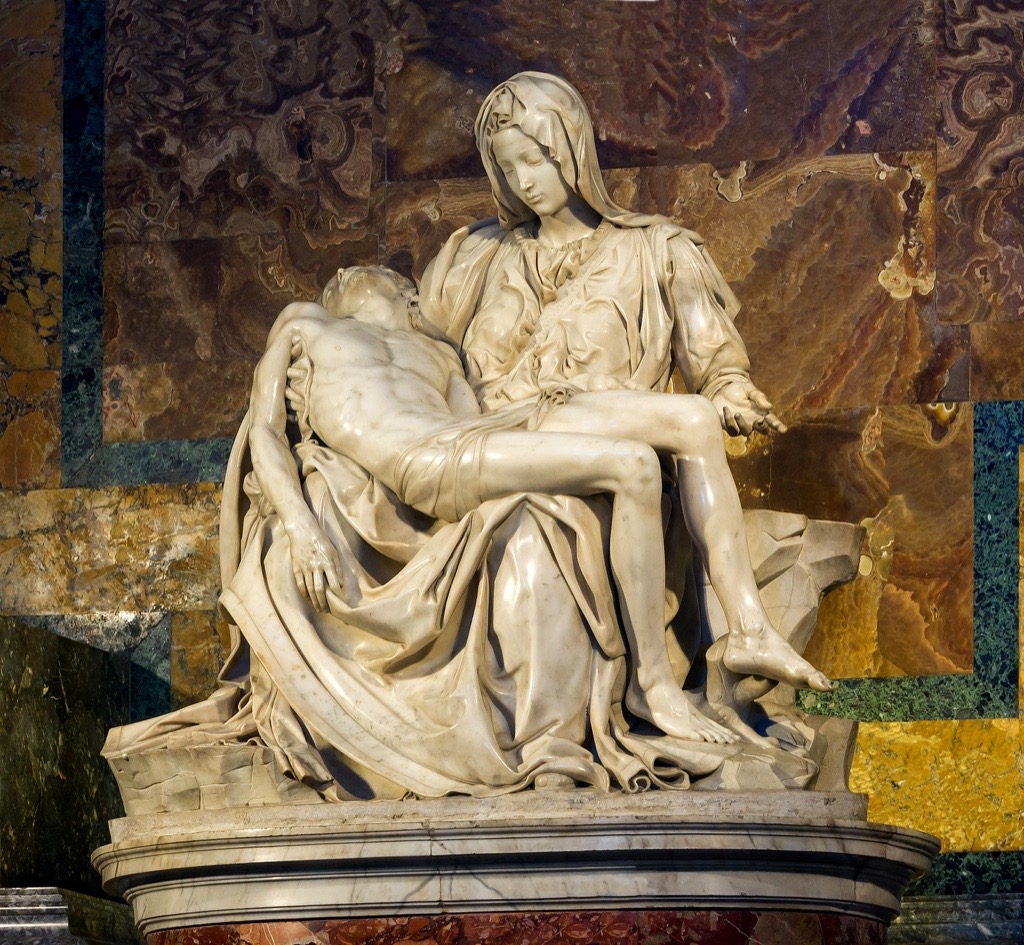
Michelangelo’s sculptural groups often make emotion through load and counterload. In the Roman Pietà, Christ’s dead weight spreads across Mary’s lap. In the Madonna of Bruges, the Child moves toward independence between her knees. In the Medici group, the infant turns across an upright maternal figure, generating a more compact resistance.
No smile or dramatic gesture is needed. Tenderness, reserve and future loss are carried by how much each body yields and how much it maintains its own direction.
An Unfinished Sacred Image
The Medici Madonna remained unfinished within the New Sacristy’s disrupted history.[2][3] Its surfaces vary in resolution, and some transitions retain visible evidence of carving. Yet “unfinished” should not be made to explain the sculpture as a whole.
Michelangelo left Florence permanently in 1534 amid political tension and was absorbed by Roman obligations. Assistants and later organisers helped bring the chapel toward a displayable state.[2][4] The Madonna’s condition belongs to that concrete chronology. It is not automatically a deliberate declaration that sacred love is incomplete or that figures spiritually struggle to escape matter.
Its present effect can still be interpreted. Different finishes make light behave unevenly; some passages hold bodily certainty while others remain open. The tension between maternal monumentality and emerging detail suits the chapel’s mixture of fulfilled art and unrealised design. Consequence, however, should remain distinct from cause.
Saints Cosmas and Damian
Cosmas and Damian were early Christian physician saints and important patrons of the Medici family. Their names resonated with “medici,” physicians in Italian, making them especially apt intercessors for the dynasty. Kneeling or turning toward the central group, they transform the Madonna from an isolated pair into a three-part sacred ensemble.
Their authorship must remain explicit. The official catalogue identifies Saint Cosmas as executed by Giovanni Angelo Montorsoli from Michelangelo’s model or design, and Saint Damian as executed by Raffaello da Montelupo from his design.[3] Michelangelo controlled the larger conception, but other sculptors translated that conception into marble.
This division complicates the idea of a unified visual programme without destroying it. Renaissance authorship could operate through models, supervision and arrangement as well as direct carving. The wall’s coherence belongs partly to Michelangelo’s design; its material execution belongs to several hands.
The Madonna and the Ducal Tombs
The ducal monuments stage rank and mortality. Idealised rulers sit above personifications of morning, evening, day and night, while architecture confines and activates their bodies. The Madonna wall answers with Christian time: birth, incarnation, death, intercession and hoped-for salvation.
The Times of Day make temporal passing bodily. The Child makes sacred history bodily. Together, the chapel holds cyclical time and redemptive time in one room. That relationship explains why the Madonna must not be treated as a pleasant devotional pause between more famous statues.
Scale and position also create dialogue. The Madonna’s seated form can answer the dukes’ vertical authority, but her meaning differs. They represent Medici memory; she provides the sacred axis before which that memory is ordered.
A Related Madonna and Child Drawing
Casa Buonarroti preserves a Madonna and Child drawing of about 1525 connected in scholarship with the Medici sculpture.[5] The sheet offers evidence of Michelangelo exploring how a maternal body and turning child could interlock on paper.
Drawing is not a miniature contract with marble. A line can test an alternative quickly, reverse direction or preserve several thoughts at once. The Casa Buonarroti record itself notes scholarly caution around the sheet.[5] It is better treated as related design thinking than as a one-to-one cartoon mechanically transferred to stone.
The Metropolitan Museum’s major study of Michelangelo as draftsman and designer supplies the broader concept of disegno: drawing as both mark and intellectual conception across media.[6] In the New Sacristy, that process expanded from sheets and models to bodies, walls and architectural light.
Designing a Wall, Not Placing a Statue
The Madonna’s effect depends on height, niche, neighbouring saints and the sarcophagus below. A museum plinth would give the group another meaning. Michelangelo designed a wall in which the sacred figures participate in vertical and lateral relationships.
This architectural dependence helps explain the group’s concentrated silhouette. Details must survive distance, and the Child’s turn must remain legible within a larger field of pale stone. The figure group needs enough density to centre the wall without closing it off from Cosmas and Damian.
Michelangelo’s achievement as architect and sculptor cannot be neatly separated here. Architecture frames devotion; sculpture gives architecture a human and sacred focus. Even an unfinished marble can fulfil much of its spatial task.
The Chapel After Michelangelo
Michelangelo did not leave the New Sacristy as a fully completed and fixed installation. Political upheaval, his move to Rome, assistant execution and later arrangements shaped what visitors now see.[2][4] Current museum presentation preserves the complex as a major Michelangelo environment while institutional history remains part of its interpretation.[1][4]
That afterlife requires care when attributing placement. A figure designed by Michelangelo, carved partly by another artist and installed after his departure can belong to his programme without every visible relation being his final decision. The Madonna wall contains different levels of authorship just as the individual sculptures contain different levels of finish.
Rather than weakening the chapel, these layers make it representative of monumental art: large projects survive through continuation, compromise and stewardship.
How to Look at the Medici Madonna
First identify the memorial wall as a whole. Locate the sarcophagus, central mother and child, and two flanking saints. Notice how the saints direct attention inward and how the Madonna provides the stable vertical axis.
Then follow the bodies. Begin at Mary’s feet and knees, rise through her torso and observe how the Child cuts across that direction. Identify points of contact and intervals where shadow separates them. The emotional structure emerges through this map of pressure.
Finally compare finish and distance. From farther away, the group reads through mass and turn. Close inspection reveals toolwork and unresolved passages. Neither viewpoint is complete alone; the sculpture was made for architecture and survives as an object of intimate study.
Among Michelangelo’s Madonnas
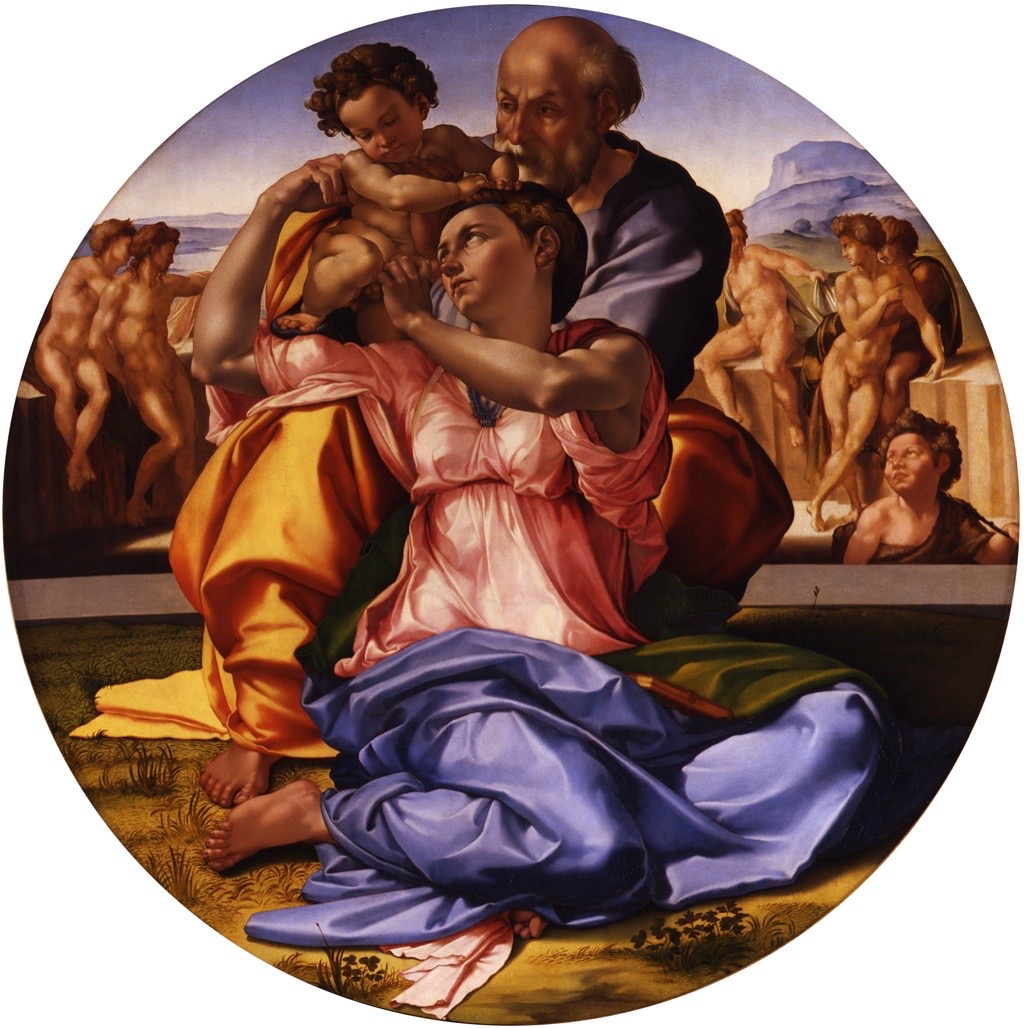
Michelangelo returned to Mary and Christ across relief, freestanding sculpture, painting and drawing. Comparison reveals no fixed Madonna type. In the early Madonna of the Stairs, Mary’s profile and extremely shallow carving create solemn compression. The Pitti and Taddei tondi organise sacred relationships inside circles. The Madonna of Bruges gives the Child a more independent downward movement.
The Medici group is distinguished by its architectural office and tightly opposing torsions. Mary is not contained by a roundel or presented as an autonomous church statue. She centres a funerary wall. The Child’s crossing body must therefore work at two scales: intimate contact when viewed closely and a strong diagonal within the chapel from farther away.
These differences prevent a sentimental chronology in which every Madonna simply anticipates a later, sadder version. Michelangelo revisited the subject because new medium, destination and patronal meaning required new bodily solutions. The New Sacristy sculpture belongs to that sustained inquiry while remaining irreducibly attached to Medici memory.
Why the Medici Madonna Matters
The Medici Madonna matters because it is the sacred centre of a chapel too often remembered only for reclining nudes and idealised dukes. Its mother and child give dynastic commemoration a theological horizon. Time destroys bodies; incarnation offers salvation.
It also presents one of Michelangelo’s most concentrated maternal relationships. Mary’s monumentality does not overwhelm the infant, and Christ’s movement does not escape her. Their opposing torsions make attachment active. Love appears not as repose but as the difficult maintenance of contact between separate bodies.
Finally, the work embodies the New Sacristy’s layered authorship and incompletion. Michelangelo’s unfinished Madonna, assistant-executed saints, reduced Magnifici memorial and later installation coexist. Understanding those layers makes the sculpture more precise and more moving: a powerful sacred image holding together a monument that history never allowed its designer to finish completely.
Artist Up Close
Michelangelo’s New Sacristy years joined Medici patronage with repeated political crisis. He designed tombs for the ruling family, then helped defend Florence against forces that restored Medici power. The Medici Madonna should not be reduced to a cipher of those loyalties, but its tense inwardness belongs to a world in which artistic service and personal danger overlapped. His design moved across drawing, models, direct carving, assistant execution and architecture. The group’s strength lies in that total conception even where his own chisel stopped.
Frequently Asked Questions
Discussion
How does Michelangelo make a Madonna and Child belong to a memorial architecture?
Reader Insights
How does the Madonna-and-Child group change the mood of the New Sacristy?
Why does the authorship boundary for Saints Cosmas and Damian matter?
How does the Magnifici wall differ from the ducal tomb walls?
Join the Conversation
Set the Madonna and Child between the Magnifici memorial and the ducal tomb walls. Does the group feel devotional, dynastic or architectural?
References
- Musei del Bargello, Cappelle Medicee”:, View source.
- Catalogo generale dei Beni Culturali, Michelangelo e la Sagrestia Nuova in Firenze — Un progetto innovativo”:, View source.
- Catalogo generale dei Beni Culturali, San Cosma”:, View source.
- Ministero della Cultura, Firenze — Cappelle Medicee: Un ascensore per Michelangelo”:, View source.
- Casa Buonarroti, Madonna and Child”:, View source.
- The Metropolitan Museum of Art, Michelangelo: Divine Draftsman and Designer”:, View source.
- British Museum, The Medici Tombs in the New Sacristy: Studies for a Free-standing Sepulchral Monument”:, View source.
- British Museum, The Medici Tombs in the New Sacristy: A Study for a Double Tomb with Figures”:, View source.