


 by Tom Gurney
Tom Gurney BSc (Hons) is an art history expert with over 20 years experience
Published on June 19, 2020 / Updated on November 6, 2025
Email: tomgurney1@gmail.com / Phone: +44 7429 011000
Rachel
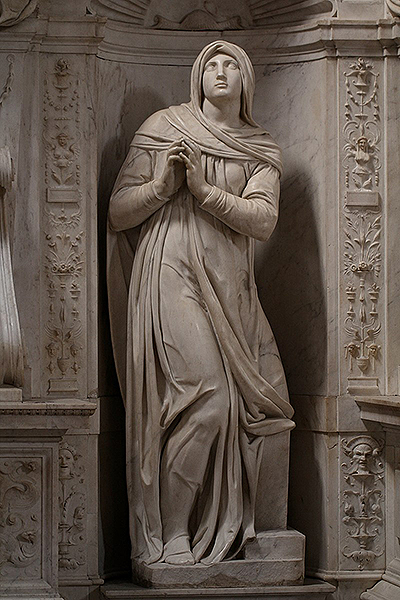
Michelangelo's Rachel gathers herself inward. She stands with one foot raised and her hands joined near the chest, lifting her face as if attention has passed beyond the material monument. At the viewer's left of Moses in San Pietro in Vincoli, she answers her sister Leah across the lower tier.
The sisters represent complementary lives. Leah handles her hair and an object associated with work, Prudence or adornment; Rachel withdraws into prayerful sight. Christian tradition read Rachel as the contemplative life, the soul directed toward divine truth. Michelangelo carved her about 1542–1545 for the sixth and final design of Pope Julius II's monument.[1]
Rachel is late in every sense: late in Michelangelo's career, late in a commission begun in 1505, and late in the monument's sequence of reductions. Her stillness is not empty. It turns the exhaustion of a public project toward an image of inward freedom.
At a Glance
- ArtistMichelangelo Buonarroti
- TitleRachel; also interpreted as the Contemplative Life
- DateAbout 1542–1545
- MaterialMarble
- HeightApproximately 197 centimetres
- Current locationMonument to Pope Julius II, San Pietro in Vincoli, Rome
- PositionLower tier, viewer's left of Moses
- Biblical identityRachel, daughter of Laban and wife of Jacob
- Allegorical identityThe contemplative life (vita contemplativa); sometimes Faith
- GestureHands joined, head raised, one foot supported
- Authorship boundaryCarved by Michelangelo; upper figures of the monument involve assistants
Contents
- Rachel in Genesis
- The Contemplative Life
- A Posture of Inward Ascent
- Rachel and Moses
- Rachel and Leah as a Pair
- The Final Tomb Contract
- Late Style and the Question of Finish
- Faith, Reform and Vittoria Colonna
- Seeing Rachel in the Church
- Copies, Photographs and the Isolated Rachel
- How to Look at Rachel
- Why Rachel Matters
Rachel in Genesis
Genesis introduces Rachel as Laban's younger daughter, encountered by Jacob at a well. Jacob loves her and serves seven years for the right to marry her, only to receive Leah through Laban's deception. He serves a further term and marries Rachel as well.[2]
Rachel's story is marked by desire for children, rivalry with Leah and eventual motherhood of Joseph and Benjamin. She dies giving birth to Benjamin and is buried on the road to Ephrath. Biblical Rachel is not simply passive or serenely contemplative; she acts, schemes, suffers and travels.
Allegory selects from that complex life. Her status as the deeply desired wife allowed Christian interpreters to associate her with the beauty of contemplation—an end loved for itself. Leah's fertility and labour supported the active counterpart.
Michelangelo relies on this interpretive structure rather than illustrating a narrative episode. No well, child or household attribute identifies Rachel. Her body becomes the attribute.
The Contemplative Life
The active and contemplative lives were not simple opposites in Christian theology. Action through charity could purify and prepare the soul; contemplation offered a foretaste of divine vision. Monastic practice, clerical office and lay devotion combined them in different proportions.
Gregory the Great used Leah and Rachel to articulate the pair, and Dante gave the sisters memorable form in Purgatorio. In Dante's dream, Leah moves through a meadow gathering flowers while Rachel remains before a mirror, absorbed in seeing.[3]
Michelangelo's Rachel does not visibly hold a mirror. Her joined hands and lifted face convert sight into prayer. This alteration moves the allegory away from a domestic object and toward direct devotional concentration.
She has also been interpreted as Faith, while Leah becomes Active Charity or Love.[1] These terms overlap rather than cancel one another. Faith directs the soul toward what cannot yet be seen fully; contemplation sustains that direction.
The label “Contemplative Life” remains the most widely useful, provided it is understood as spiritual attention rather than inactivity.
A Posture of Inward Ascent
Rachel's body is vertical but not rigid. One knee bends and the foot rests higher, allowing the drapery to climb across the lower body. The hands meet near the chest, and the head turns upward. A sequence rises from supported foot to face.
The pose contains effort. Contemplation is not shown as sleep or collapse. Balance must be maintained while the body withdraws from outward task.
Her drapery both reveals and restrains anatomy. Folds gather around the lifted leg and then descend, making a visual ascent possible without displaying the nude body. Michelangelo's knowledge of weight remains present through fabric.
The niche encloses her more tightly than open space would. She appears to turn inward partly because architecture prevents expansive gesture. Constraint becomes spiritually productive.
From a distance, joined hands and raised head are legible as a devotional silhouette. Up close, the small displacements of hip, knee and shoulder keep the figure alive.
Rachel and Moses
Moses dominates the monument's centre. Seated, horned according to the Vulgate tradition and holding the tablets, he embodies law, authority and restrained prophetic force. Rachel stands at his right hand from his perspective, the viewer's left.
Their scales are related but their energies differ. Moses turns sharply outward as if responding to a disturbance. Rachel's turn closes around an unseen object of attention. One body contains potential public action; the other seeks interior vision.
The connection is not merely formal. In Christian interpretation, the Mosaic law, the active life and contemplation can form stages within sacred history and spiritual practice. The monument places these abstractions into human bodies rather than presenting a written theological diagram.
Rachel's upward gaze also mediates between tiers. She draws attention from the lower marble figures toward the Madonna and Child and prophetic figures above. Her contemplation has an architectural direction.
Calling the monument only “Michelangelo's Moses” obscures this work. Rachel helps convert a dominant statue inherited from an earlier scheme into the centre of a new devotional programme.
Rachel and Leah as a Pair
The sisters are distinguished by action. Leah attends to hair and handheld object; Rachel joins her hands and looks upward. One stands more openly; the other bends and gathers herself.
They are also linked. Both are over-life-size women in classicalising drapery, adapted to corresponding lower niches. Each turns enough to respond to Moses, and each offers a form of disciplined attention.
Their asymmetry protects the allegory from becoming static personification. Active and contemplative lives are not two identical bodies carrying different props. They produce different balances.
The pairing also avoids ranking too easily. Christian writers often regarded contemplation as the higher end, but action remained necessary. On the monument both women flank Moses at the same architectural level.
Michelangelo carved both, a fact that gives the pair special unity within the collaborative structure. They are late answers conceived for one final arrangement, not unrelated earlier marbles reused beside Moses.
The Final Tomb Contract
The Julius tomb had begun as a grand freestanding mausoleum for St Peter's. Forty years of papal service, revised contracts, competing projects and family pressure transformed it into the much smaller wall monument completed in San Pietro in Vincoli in 1545.[4]
By 1542 Michelangelo had just finished the Last Judgement. Pope Paul III helped negotiate release from some obligations, and assistants took substantial responsibility for the tomb's upper sculpture. Michelangelo reused the earlier Moses and designed the final architecture.
Rachel and Leah were newly carved for this conclusion.[1] Their presence signals the project's changed theology. The first tomb had emphasised papal magnificence through an enormous population of captives, victories and personifications. The last is more explicitly devotional and biblical.
The monument contains no body of Julius. The pope remained buried at St Peter's. A recumbent effigy on the upper tier represents him, but the structure at San Pietro in Vincoli is commemorative.
Rachel's contemplation fits this displacement. The true destination of the dead pope and the viewer's prayer lies beyond the visible marble.
Late Style and the Question of Finish
Rachel's surfaces do not display the same expansive modelling as the earlier Moses. Some passages are broad, and the niche setting reduces opportunities for complex rotation. Older criticism sometimes treated such differences as evidence of declining physical power.
Age mattered: Michelangelo was approaching seventy. But task and chronology matter more. Rachel was made quickly within a final collaborative campaign, for a position and scale unlike the original project. The artist's late priorities had also shifted toward architecture, poetry and devotional drawing.
Restraint may be intentional. An allegory of contemplation should not erupt into the physical turbulence of a Sistine nude. The figure's concentration depends on closed hands, modest turn and contained drapery.
At the same time, praise should not erase workshop reality or uneven execution. The monument needs close technical study to distinguish Michelangelo's direct surface, assistant intervention, later cleaning and restoration.
The accepted authorship of Rachel rests on documents and the final project's history, not on an assumption that every centimetre must look equally “Michelangelesque.”
Faith, Reform and Vittoria Colonna
Michelangelo's religious life intensified during the years around the Last Judgement and the final tomb. His friendship with the poet and reform-minded noblewoman Vittoria Colonna brought him into conversations about grace, faith and interior devotion.
Scholars have connected Rachel and Leah with this climate, reading contemplation/Faith and action/Charity as a late Catholic reform programme.[1] Such context is persuasive without turning either statue into a portrait of Colonna or a coded declaration of a single theological faction.
Rachel's joined hands and raised face belong to a wider late practice. Michelangelo's drawings for friends repeatedly concentrate on Crucifixion, Pietà and Resurrection subjects. Salvation becomes an object of personal attention rather than monumental triumph alone.
The marble translates that inward turn into public sculpture. Rachel is private prayer made over-life-size, placed beside one of the most commanding embodiments of law in European art.
Seeing Rachel in the Church
San Pietro in Vincoli is dedicated to the chains of Saint Peter. The Julius monument occupies the right transept, where changing church light and distance affect its lower figures. Rachel is not encountered as a museum object isolated at eye level.
Her upward gaze interacts with altar, architecture and the monument above. The visual movement continues beyond her own niche.
Visitors often approach for Moses and may stand centrally. To see Rachel, move to the left and note how her posture changes at an oblique angle. Her bent leg and the depth of her hands become clearer.
Then step back until both sisters enter one field. The meaning is relational. Rachel's stillness becomes legible because Leah acts; Leah's action acquires an end because Rachel contemplates.
Copies, Photographs and the Isolated Rachel
Later drawings and casts often detached Rachel from the wall tomb. Felice Giani, for example, studied figures from the Julius monument as works after Michelangelo, turning Moses, Madonna, Leah and Rachel into a portable repertory.[7] Cast collections performed a similar separation in three dimensions.
Isolation helped artists examine drapery and pose, but it weakened the figure's programme. A photograph cropped around Rachel may make her seem like an independent praying woman. The architectural niche, Moses and Leah restore why this particular prayer takes this particular form.
Reproduction also changes viewpoint. Michelangelo designed the marble for an elevated church setting; a level photograph can disclose the face while altering proportions intended for viewing from below. Raking light makes tool marks dramatic that ordinary church light subdues.
These afterlives are not merely distortions. They show Rachel becoming an exemplar of contemplative posture. The responsible viewer moves between them: isolated images permit close study, while the monument recovers meaning. Neither should silently replace the other.
How to Look at Rachel
Begin with the raised foot and follow the diagonal folds upward. This reveals that the apparent stillness is constructed through an active balance.
Look at the hands. Their meeting closes the body and makes the chest the centre of attention.
Follow the face's direction, then continue visually toward the upper tier. Rachel links the monument vertically.
Compare her with Leah without treating one as superior. Ask how two modes of life can be different and mutually necessary.
Finally compare their surfaces with Moses and the upper sculptures. The changes record chronology and several hands, not a single frozen moment.
Why Rachel Matters
Rachel gives inwardness a monumental body. She shows contemplation not as escape from weight but as a way of organising it. Foot, knee, hands and gaze cooperate in an upward sequence.
She also reveals Michelangelo's capacity to redesign meaning around inherited work. The earlier Moses could have remained a relic of the abandoned colossal tomb. Flanked by Rachel and Leah, he becomes part of a late spiritual triad.
The quiet figure is therefore essential to the final monument. After decades in which papal ambition repeatedly controlled Michelangelo's labour, Rachel imagines another freedom: attention directed where stone, contract and worldly reputation cannot reach.
Unlike the Prisoners removed from successive schemes, Rachel was made for the architecture she still inhabits. Her bent knee, upward gaze and narrow projection can be tested against the niche rather than restored through hypothetical models. That intact relation is unusually valuable within the history of the Julius commission. The statue is not simply one more displaced masterpiece from an impossible tomb; it is evidence of how Michelangelo finally made reduction meaningful.
Its quietness is thus an achieved condition, not a lack of invention: spatial pressure, theological pairing and late style have been resolved into still attention.
Frequently Asked Questions
Discussion
What details, sources or comparisons stand out to you in Rachel?
Reader Insights
Which formal detail changes how the work reads?
Which documented source or collection history feels most useful?
Which related Michelangelo work should readers compare next?
Join the Conversation
Add a source-led observation, comparison or question for other readers.
References
- Paul Joannides, The Prisoner and the Veil: The Symbolism of Michelangelo's Tomb of Julius II,” Italian Studies 49 (1994):, View source.
- Bible Gateway, Genesis 29–35, New Revised Standard Version Updated Edition:, View source.
- Princeton Dante Project, Purgatorio 27, Leah and Rachel:, View source.
- British Museum, drawing of the lower storey of the Julius monument, 1859,0514.824:, View source.
- Rijksmuseum Research Library, Michelangelo's Tomb for Julius II: Genesis and Genius:, View source.
- National Gallery of Denmark, Michelangelo Imperfect, digital guide:, View source.
- Cooper Hewitt, Smithsonian Design Museum, Felice Giani, studies after the Julius tomb figures:, View source.