


 by Tom Gurney
Tom Gurney BSc (Hons) is an art history expert with over 20 years experience
Published on June 19, 2020 / Updated on November 6, 2025
Email: tomgurney1@gmail.com / Phone: +44 7429 011000
Saint Peter
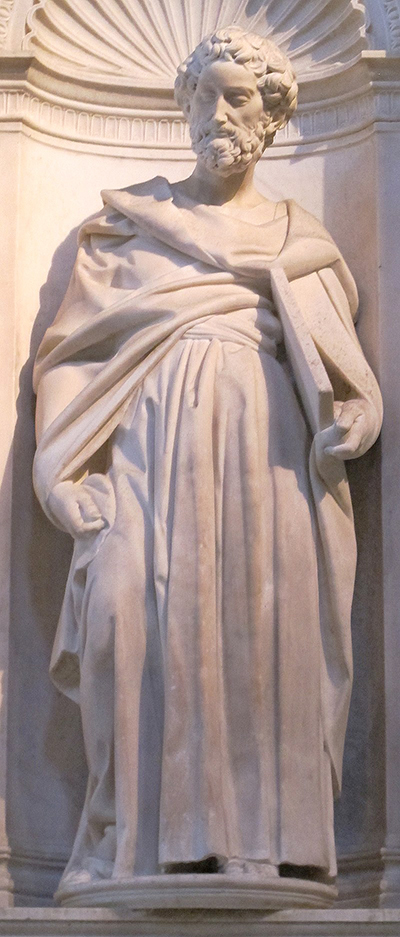
Michelangelo's Saint Peter leans into the narrow space of the Piccolomini Altar. A heavy mantle wraps the apostle, but the body does not disappear: one leg bears weight, the other relaxes, and the head turns down toward viewers in Siena Cathedral.
The marble is approximately 124 centimetres high and dates from about 1501–1504, the same years in which Michelangelo carved the colossal David in Florence.[1] Its smaller scale is not evidence of a lesser artistic category. Peter was made for an existing niche designed by Andrea Bregno, one member of a saintly series rather than a civic figure meant to command an open square.
The key to the sculpture is adjusted attention. Peter's downward glance, compact contrapposto and deep drapery make an elevated apostle reach a congregation below.
At a Glance
- ArtistMichelangelo Buonarroti, with workshop participation within the Piccolomini commission
- TitleSaint Peter
- DateAbout 1501–1504
- MaterialMarble
- HeightApproximately 124 centimetres
- Current locationPiccolomini Altar, Siena Cathedral
- PositionLower niche on the altar's left side
- SubjectPeter, apostle and first bishop of Rome in Catholic tradition
- Typical attributeKeys; their visibility and present condition should be checked in the object
- Visual characterHeavy mantle, contrapposto stance, head inclined down and left
- Architectural boundaryFigure by Michelangelo; altar framework by Andrea Bregno
Contents
- Peter the Apostle
- A Body Beneath a Heavy Mantle
- The Downward Gaze
- Peter and Paul Across the Altar
- The Piccolomini Commission
- Workshop and Direct Carving
- At the Same Time as David
- Keys, Hands and Object Condition
- Peter Within Siena Cathedral
- How to Look at Saint Peter
- Why Saint Peter Matters
Peter the Apostle
The New Testament presents Simon Peter as a fisherman called by Christ, a leading disciple who confesses Jesus as Messiah, denies him during the Passion and becomes a witness to the Resurrection. Catholic tradition regards him as the first pope.[2]
Keys are his most familiar attribute, derived from Christ's promise of the keys of the kingdom of heaven in Matthew 16. They signify authority to bind and loose. Artists also distinguish Peter by short curling hair, beard, book or scroll.
In the Piccolomini programme, Peter does several kinds of work. As an apostle, he pairs naturally with Paul across the altar. As the foundation of Roman papal authority, he supports the Piccolomini family's celebration of Pius II and Pius III.
The statue should not be treated as a portrait of one pope. Peter's authority is typological and institutional. His body gives the dynasty a sacred predecessor without collapsing saint into patron.
A Body Beneath a Heavy Mantle
Peter's mantle is broad and weighty. It falls in passages often compared with the “wet drapery” tradition associated with Verrocchio, where cloth clings enough to disclose form while retaining its own mass.[1]
The garment does not produce an even column. A shift at the hip and bent free leg establish contrapposto. Folds change direction as they cross chest, waist and knee, allowing the underlying body to be inferred.
Michelangelo's skill lies less in multiplying cloth than in making it answer weight. On the supporting side, folds bear downward; around the relaxed leg they loosen or break. The mantle becomes evidence of stance.
The compact niche required controlled projection. A broad flying hem would be vulnerable and visually disruptive. Michelangelo holds motion near the body, turning depth into shadow within the architectural frame.
From below, the largest fold rhythms remain legible. Close photographs reveal finer transitions, but their purpose belongs to the total pattern.
The Downward Gaze
Peter's head inclines left and down, apparently seeking the viewer beneath him.[1] This is not accidental melancholy. It is an optical and relational solution.
A straight-ahead face placed above eye level can seem to look over the congregation. Lowering the gaze draws the apostle into contact with worshippers. Slight enlargement or emphasis of features can compensate for distance.
Donatello's sculpture offered Michelangelo important precedents for figures adjusted to elevated settings. The lesson is not a copied pose but an understanding that site changes anatomy and expression.
The downward look also suits Peter's spiritual identity. His biography combines authority with failure and repentance. A contained, grave face can hold both without illustrating the denial scene.
We should resist turning the gaze into a precise narrative moment. The statue is a standing saint in an altar programme, not a Passion episode.
Peter and Paul Across the Altar
Peter occupies the lower left niche and Paul the lower right. Their placement anchors the architectural sides with Christianity's two great Roman apostles.
The figures are close in height—Peter about 124 centimetres, Paul about 127—but they are not mirror copies.[3] Peter's downward engagement differs from Paul's sharper lateral turn and concentrated energy.
Their pairing carries institutional meaning. Peter represents apostolic authority and the Church's foundation; Paul represents conversion, teaching and mission to the Gentiles. Together they make the Piccolomini memorial part of universal Rome.
Formal difference prevents emblematic stiffness. Viewers cross from one apostle to the other, comparing folds, heads and balances. Architecture supplies symmetry; bodies supply variation.
The pair also foreshadows Michelangelo's much later Conversion of Saul and Crucifixion of Peter in the Pauline Chapel. Those frescoes are separate works from another century of his life, but they show the two apostles remaining a linked problem.
The Piccolomini Commission
Cardinal Francesco Todeschini Piccolomini commissioned Andrea Bregno's marble altar in the 1480s to honour his uncle, Pope Pius II, and his family. The architecture preceded Michelangelo by about fifteen years.[4]
In 1501 Michelangelo accepted a contract for a large population of small statues after Pietro Torrigiani's earlier involvement. He completed four surviving figures: Peter, Paul, Gregory and the figure now variously called Pius or Augustine.[4]
The planned series was never fulfilled. Michelangelo was carving David, and his expanding ambitions made the Sienese obligation increasingly difficult. An agreement in 1504 regularised delivery of the four figures; the contract's final release came much later.
Peter belongs to what was completed, but absence remains visible around him. Empty or differently filled niches disclose a monument assembled across changing plans.
This context prevents the figure from being ranked as if Michelangelo had conceived a freestanding masterwork and then chosen a small format. He was answering a contracted unit within older architecture.
Workshop and Direct Carving
The four statues were produced with workshop help, and photographic catalogues sometimes identify Michelangelo and assistants in the altar's execution.[5] That wording matters especially for a multi-figure commission running alongside David.
Michelangelo could design, block out decisive passages, refine face and hands, and delegate routine work. The exact division is not documented chisel by chisel. Declaring every surface autograph is as misleading as assigning the whole figure to anonymous assistants.
Peter's accepted object identity remains a Michelangelo work. Workshop participation describes production, not rejection of authorship.
Technical study of tool marks, marble and unfinished surfaces may refine the distribution. Comparisons among the four statues can locate repeated workshop habits, although circular quality judgments should be avoided.
Public credit is best phrased with layers: Michelangelo was responsible for the statue within a commission executed with help; Bregno made the architectural altar.
At the Same Time as David
The coincidence with David tempts comparison. Both figures use contrapposto and direct bodily balance, but their jobs are radically different.
The Florentine hero is nude, more than four metres high and ultimately installed before the Palazzo della Signoria. Peter is clothed, less than one-third life size and raised within a cathedral niche.
In David, anatomy and alertness expand into civic visibility. In Peter, drapery and downward gaze compress apostolic authority into architectural rhythm.
The contrast shows Michelangelo's adaptability. Monumental thought is not identical to physical height. A small figure can still organise weight, direction and beholder with precision.
It also explains production pressure. The work that made Michelangelo famous did not erase prior contracts. The Siena saints embody the practical coexistence of fame and obligation.
Keys, Hands and Object Condition
Peter's keys are central to his identity, but small attributes are often the most vulnerable parts of an elevated marble. Thin shafts can break, metal additions can be replaced, and a dark church photograph may hide what survives. Description should therefore distinguish the apostle's conventional attribute from the current physical state of this statue.
The hands remain meaningful even if the keys are difficult to see. Their grip or placement organises the mantle and creates a local focus against the broad clothing. An attachment hole or repaired finger can preserve evidence of a lost or altered object.
Comparison with older photographs is especially useful. It can show whether an attribute was present before restoration or whether a modern guide has simply repeated an iconographic expectation. The saint's identity is secure through placement, type and documentation, but the history of the keys belongs to conservation.
This caution improves rather than weakens interpretation. Peter's authority is signified by more than a detachable emblem: gaze, position opposite Paul and place within a papal family altar all sustain it.
Peter Within Siena Cathedral
The cathedral's striped marble, dense sculpture and uneven light create a visually competitive setting. Peter was never meant to dominate it alone. His strong mantle and lowered head let him emerge when the visitor finds the Piccolomini structure along the nave.
Liturgical use and visitor movement change access. Candles, barriers and crowds may prevent a stable central view. The sculpture's design succeeds across partial encounters: first a dark niche, then a face, then the apostolic pair.
How to Look at Saint Peter
Start with his location, not a close crop. Register how the niche frames the body and how far above you the face sits.
Follow the direction of the gaze. Move laterally and see when apparent eye contact is strongest.
Trace the supporting leg through the mantle. Look for folds changing under pressure rather than treating drapery as decoration.
Compare Peter across the altar with Paul. Note difference before searching for symmetry.
Finally distinguish hands: Michelangelo and workshop made the statue; Bregno's older architecture determines its field.
Why Saint Peter Matters
Peter shows Michelangelo designing for a beholder within strict limits. The saint's authority reaches downward through head, mantle and stance rather than through colossal scale.
The statue also restores complexity to the years of David. Michelangelo was not working on one inevitable masterpiece in isolation. He managed contracts, assistants, shipping and the demands of a distant Sienese altar.
Within the Piccolomini ensemble, Peter anchors apostolic succession. His small marble body connects a family of Renaissance popes to the fisherman entrusted with keys.
Frequently Asked Questions
Discussion
What details, sources or comparisons stand out to you in St Peter?
Reader Insights
Which formal detail changes how the work reads?
Which documented source or collection history feels most useful?
Which related Michelangelo work should readers compare next?
Join the Conversation
Add a source-led observation, comparison or question for other readers.
References
- Italian-language object history, San Pietro (Michelangelo)”:, View source.
- Bible Gateway, selected passages on Peter:, View source.
- Penn State University Libraries, Piccolomini Altar: St. Paul and St. Peter”:, View source.
- Opera della Metropolitana di Siena, The Cathedral”:, View source.
- Fondazione Federico Zeri, Buonarroti Michelangelo, San Pietro”:, View source.