 by Tom Gurney
Tom Gurney BSc (Hons) is an art history expert with over 20 years experience
Published on June 19, 2020 / Updated on August 8, 2026
Email: tomgurney1@gmail.com / Phone: +44 7429 011000
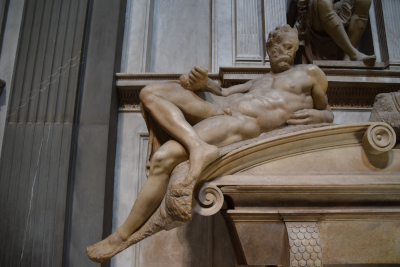
Dusk by Michelangelo
Evening arrives as a body whose strength is still visible but no longer fully available. Michelangelo’s Dusk lies across the Tomb of Lorenzo de’ Medici, turning a muscular male figure into the sensation of light and energy withdrawing. The head inclines, the torso settles and the pose seems to accept a decline it cannot reverse.
Known in Italian as Crepuscolo, twilight, the statue shares Lorenzo’s sarcophagus with Dawn.[1][2] They are the two transitional Times of Day, set opposite the more complete polarities of Night and Day on Giuliano’s tomb.[3] Dusk is not just Dawn’s male counterpart or an evening label applied to a reclining nude. Its particular achievement is to make ending feel gradual.
At a Glance
- ArtistMichelangelo Buonarroti
- TitleDusk, or Crepuscolo
- DateNew Sacristy campaign, principally the 1520s to early 1530s
- MediumMarble
- SubjectMale personification of twilight and the waning of day
- MonumentTomb of Lorenzo de’ Medici, Duke of Urbino
- PartnerDawn, the female figure on the other side of the sarcophagus[1]
- Wider cycleNight and Day occupy the opposing ducal tomb
- SettingThe Lorenzo monument in San Lorenzo’s New Sacristy, Florence[2][3]
- Body typeMature, muscular male nude in a reclining, downward-settling pose
- Central tensionPhysical power represented at the moment it yields to fatigue and darkness
- Programme cautionNo surviving statement turns every anatomical detail into a fixed iconographic code
Contents
- Twilight Rather Than Night
- On Lorenzo’s Sarcophagus
- A Mature Male Body
- The Head and the Lowering of Attention
- Strength That Cannot Stop Time
- Dusk and Dawn
- Dusk Among the Four Times
- Architecture and the Sense of Sliding
- Design, Model and Revision
- Finish and the Meaning of Twilight
- Copies and the Afterlife of Crepuscolo
- Dusk and the Viewer’s Own Time
- Twilight and Uncertain Seeing
- How to Look at Dusk
- Why Dusk Matters
- Artist Up Close
Twilight Rather Than Night
The Italian crepuscolo identifies an interval. Day has not vanished, but its defining light has weakened. Michelangelo’s figure inhabits that unstable middle rather than the completeness of sleep.
The body appears conscious enough to register decline. Unlike Night, it does not close itself fully into slumber. Unlike Day, it does not possess the energetic pressure of waking hours. Its power is residual.
This temporal specificity matters because evening is experienced through gradual loss. Edges become less certain, effort becomes harder to sustain and activity contracts. Marble, a material associated with permanence, becomes the vehicle for diminution.
On Lorenzo’s Sarcophagus
The object record securely assigns Crepuscolo to the tomb of Lorenzo, Duke of Urbino.[1] The pensive ruler sits above, while Dawn and Dusk span the chest below. Their transitional nature complements his inward withdrawal.
The sarcophagus is both burial sign and difficult platform. Its curvature prevents an easy horizontal rest. Dusk must settle across a surface that seems to encourage sliding, so repose retains muscular effort.
This tension joins architecture with allegory. Evening yields, but cannot simply collapse. The body remains held within a memorial system whose stone must endure.
A Mature Male Body
Michelangelo distinguishes Dusk from the youthful ideals that dominate many of his sculptures. The mature body remains formidable, but heaviness and age modify its power. Muscle does not guarantee endless action.
That choice makes twilight analogous to human aging without turning the figure into a portrait of an old man. The day’s life passes from energy toward fatigue just as bodies pass through time. Allegory arises from that shared curve.
Gender also participates in the paired design. Female Dawn gathers into awakening; male Dusk releases toward night. The contrast is visible, but no secure evidence reduces it to a simple theory about femininity as birth and masculinity as decline. Michelangelo varies bodies to make time plural.
The Head and the Lowering of Attention
Dusk’s head inclines rather than rising into the room. Its direction draws awareness back toward the body and the sarcophagus. The pose makes attention fade spatially.
Expression is less important than orientation. A viewer may perceive resignation, melancholy or exhaustion, but the sculpture does not narrate a particular feeling. The downward turn is enough to communicate diminishing engagement.
Shadows reinforce that effect. As light falls beneath brow, chin and curls, the face can become less available. Twilight is represented by a figure who withdraws from visibility.
Strength That Cannot Stop Time
The torso demonstrates command of anatomy, but anatomy is placed in a losing contest. No amount of muscle can prevent evening. This contradiction gives the statue its gravity.
Michelangelo avoids portraying decline through weakness alone. A frail figure would make dusk a simple failure of strength. By giving it a powerful body, he shows that temporal passage exceeds individual capacity.
The tomb intensifies that truth. Lorenzo’s idealised memory occupies an elevated niche, yet the exhausted Time below announces what happened to every ruler: the day ends.
Dusk and Dawn
The two figures share a monument and a transitional category. Dawn turns from sleep toward consciousness; Dusk turns from activity toward rest. Their directions cross rather than mirror exactly.
Dawn’s effort feels inaugural. The body assembles itself for a day. Dusk’s effort is residual, what remains as the body gives up its work. One figure makes awakening difficult; the other makes decline reluctant.
Their pairing prevents the tomb from favouring progress alone. Every beginning tends toward an ending, and every twilight yields to a night from which another dawn may come. Lorenzo’s death sits within that impartial cycle.
Dusk Among the Four Times
Across the chapel, Day displays immense, partly unresolved power, while Night closes into sleep and carries specific nocturnal attributes. The four statues do not illustrate equal quarters like figures on a clock. They translate different conditions of body and awareness.
Dusk is perhaps the least theatrical of the group. It has neither Night’s emblems nor Day’s famously unfinished face nor Dawn’s visible awakening. Its subtlety lies in deceleration.
That quietness should not be mistaken for lesser importance. A cycle needs thresholds. Evening connects the activity of day with the surrender of night, and Michelangelo gives the connection its own anatomy.
Architecture and the Sense of Sliding
The curved sarcophagus makes the reclining body appear insufficiently secured. Limbs and torso distribute weight across slopes rather than resting on a stable bed. Michelangelo exploits the difference between physical support and visual unease.
The wall’s horizontal mouldings promise order, but Dusk’s diagonals cut across them. Sculpture presses against architecture, creating a sense that time cannot be neatly contained within the tomb’s geometry.
From below, this effect is heightened. The figure’s mass seems to project over the viewer, while the duke remains recessed above. Dusk occupies the dangerous threshold between memorial wall and lived space.
Design, Model and Revision
British Museum drawings record changing free-standing and double-tomb concepts for the Medici project.[4][5] A separate British Museum figure model provides evidence of the way three-dimensional studies could mediate between drawn thought and monumental sculpture.[6] None should be assigned mechanically as the sole surviving preparatory object for every part of Dusk.
Models allow balance and torsion to be tested in real volume before the risks of marble. A reclining body on a sloped support demands such spatial reasoning. Limbs that work in profile must also survive oblique viewpoints.
The Metropolitan Museum’s broader account of Michelangelo as designer situates these transitions among paper, model, architecture and stone.[7] The finished idea was not born in one medium.
Finish and the Meaning of Twilight
The New Sacristy’s interrupted history produced sculptures with different degrees of completion.[2][3] Dusk’s surface should be described through what is visible without turning roughness into an automatic symbol of fading light.
Nevertheless, uneven resolution affects perception. Highly articulated anatomy gathers illumination, while broader passages diffuse it. The figure can seem to move between presence and obscurity, an effect well suited to twilight.
That suitability belongs to reception unless documents prove intention. Michelangelo established a body of decline; the surviving surface adds another layer to how decline is felt.
Copies and the Afterlife of Crepuscolo
Michelangelo’s Times circulated through casts, copies and models, allowing bodies designed for a Florentine tomb to enter other collections. Sir John Soane’s Museum records a model after Il Crepuscolo, evidence of Dusk’s afterlife as a form that could be studied apart from the chapel.[8]
Such copies change scale, material and context. They can reveal the pose in isolation and document admiration, but they cannot reproduce the sarcophagus, Lorenzo above or the dialogue with Dawn. Their value is reception history, not substitution.
The British Museum’s related model evidence similarly reminds us that a three-dimensional version can have several possible relationships to an original: preparatory, workshop, reproductive or later study.[6] Exact object records must govern those distinctions.
Dusk and the Viewer’s Own Time
Morning can be imagined as future promise; night as complete otherness. Dusk is harder to distance because it arrives as the viewer looks. The chapel’s light may itself decline, producing real shadows on an image of decline.
The body makes that temporality intimate. Fatigue at the end of work, the lowering of attention and the desire to rest belong to ordinary experience. Michelangelo elevates them without sanitising them.
On a tomb, ordinary fatigue becomes mortal. The end of one day stands for the finite shape of a life, yet the paired Dawn ensures that the cycle exceeds any individual ending.
Twilight and Uncertain Seeing
Dusk is also the hour when vision becomes less reliable. Forms remain present, but their edges soften and colours lose distinction. Michelangelo translates that optical condition into sculpture through a figure whose pose is legible while its inner attention seems to recede.
The chapel reinforces the analogy. Recesses and projections distribute shadow unevenly, so the body may appear more or less resolved from different positions. Twilight is not painted around Dusk; it occurs in the viewer’s effort to see him.
This does not require a claim that every rough or shadowed passage was intentionally calibrated to imitate evening. It identifies a productive encounter between title, form and actual illumination. The marble remains constant while perception declines and recovers.
That optical uncertainty differentiates Dusk from the explicit attributes gathered around Night: twilight belongs less to objects than to the weakening conditions under which every object is perceived.
The hour alters beholder and body together.
How to Look at Dusk
First identify the points where the figure finds support. Follow weight from torso into arms, hips and legs. Notice that apparent surrender still requires active balance.
Then study direction. The head lowers while parts of the body retain strength. Ask where the pose seems to lose energy and where it resists.
Finally widen the view: Dawn, Lorenzo, the opposing tomb and the Madonna wall. Dusk becomes fully legible when one evening body participates in the chapel’s complete temporal and sacred structure.
Why Dusk Matters
Dusk matters because it makes decline dignified without making it painless. Michelangelo gives twilight a body strong enough to understand the magnitude of yielding.
The sculpture also demonstrates that allegory need not depend on attributes. Time is communicated through posture, age, support and direction before the title confirms it. Anatomy becomes a temporal vocabulary.
Within the Tomb of Lorenzo, Dusk ensures that contemplation is not detached from mortality. The duke may endure as an ideal portrait, but the exhausted body beneath him reminds every ruler and spectator that light spends itself.
Artist Up Close
Michelangelo’s Dusk emerged from the total design of the New Sacristy, where sculpture had to perform inside architecture and across a family of related bodies. His understanding of mature male anatomy allowed him to represent fading energy without resorting to frailty. At the same time, the project’s interrupted execution requires caution about finish and intention. What survives is both a specific phase of an unfinished monument and one of the most complete bodily metaphors for evening in Western sculpture.
Frequently Asked Questions
Discussion
How does Michelangelo make twilight feel like a body losing force?
Reader Insights
How does Dusk's relaxed body change the mood of Lorenzo's tomb?
What changes when Dusk is read as a passage toward night rather than as a simple symbol?
How do Dawn and Dusk differ as a pair from Night and Day across the chapel?
Join the Conversation
Set Dusk beside Dawn, Night and Day. Which figure makes time feel most physical?
References
- Catalogo generale dei Beni Culturali, Crepuscolo”:, View source.
- Catalogo generale dei Beni Culturali, Michelangelo e la Sagrestia Nuova in Firenze — Un progetto innovativo”:, View source.
- Musei del Bargello, Cappelle Medicee”:, View source.
- British Museum, The Medici Tombs in the New Sacristy: Studies for a Free-standing Sepulchral Monument”:, View source.
- British Museum, The Medici Tombs in the New Sacristy: A Study for a Double Tomb with Figures”:, View source.
- British Museum, Model; Figure”:, View source.
- The Metropolitan Museum of Art, Michelangelo: Divine Draftsman and Designer”:, View source.
- Sir John Soane’s Museum, Il Crepuscolo (‘Twilight’), Model after Michelangelo”:, View source.