


 by Tom Gurney
Tom Gurney BSc (Hons) is an art history expert with over 20 years experience
Published on June 19, 2020 / Updated on November 6, 2025
Email: tomgurney1@gmail.com / Phone: +44 7429 011000
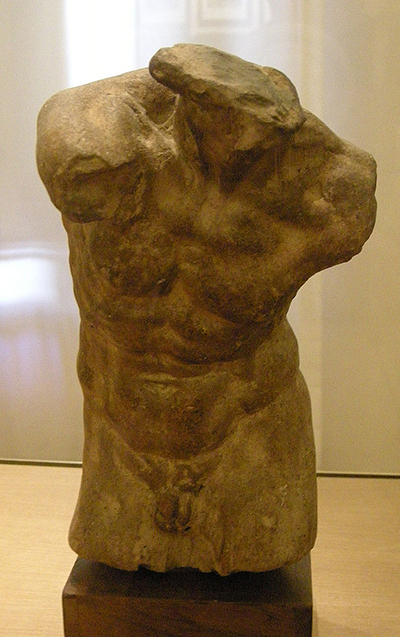
Male Torso I
Male Torso I is only twenty-three centimetres high and lacks head, arms and legs. Nothing distracts from the clay body turning forward upon itself. One shoulder advances, the neck begins a rotation, and the abdominal wall contracts as though a larger action continues beyond every broken—or deliberately omitted—edge.
Casa Buonarroti preserves the light terracotta among a collection of models whose authorship is not uniform. The work is generally dated about 1513 and has often been connected with a Prisoner planned for the tomb of Pope Julius II. Most modern critics have supported attribution to Michelangelo, but support is not unanimity: Carlo Falciani has proposed Pontormo instead.[1] The responsible title is therefore an attributed model, not an unquestioned autograph.
Its value does not depend on making that uncertainty disappear. The torso concentrates a sculptural problem central to Michelangelo's work: how a body's turn can be designed as one continuous pressure before marble fixes its scale.
At a Glance
- Controlled titleMale Torso I (Torso virile I)
- ArtistAttributed to Michelangelo Buonarroti; dissenting attribution to Pontormo recorded
- DateAbout 1513
- MaterialLight terracotta
- Height23 centimetres
- Current collectionCasa Buonarroti, Florence
- TypeSmall sculptural model or bozzetto
- ConditionTorso without head, arms or lower limbs; conceived as a fragmentary study
- Proposed purposePreparatory model for a Prisoner in the second project for the tomb of Julius II
- Key cautionThe model-to-Prisoner relationship is a scholarly identification, not a documented commission record
Contents
- A Torso Conceived as a Torso
- The Body in Rotation
- Why Terracotta?
- The Julius II Tomb Context
- Model and Marble
- The Attribution to Michelangelo
- The Problem of “Michelangelesque” Anatomy
- From Family Object to Museum Exhibit
- How to Look at Male Torso I
- Why Male Torso I Matters
A Torso Conceived as a Torso
The missing parts do not simply make Male Torso I a damaged miniature. Accounts of the object describe it as conceived without head and limbs.[1] The boundaries focus work upon trunk, shoulder girdle and the beginning of the neck.
Such concentration makes practical sense. A modeller can isolate the engine of a pose before resolving extremities. The torso determines the direction of the head, the reach of the arms and the distribution of weight into legs that may not yet exist.
It also connects Renaissance making with the authority of ancient fragments. Rome's surviving torsos demonstrated that an incomplete body could carry enormous formal force. Michelangelo did not need to imitate one antique object directly for the fragment to become a productive way of thinking.
The model's edges should nevertheless be examined closely. Some losses may result from age, while others belong to original procedure. A catalogue conclusion about intended incompleteness is more reliable than an imaginative reconstruction of every absent limb.
The Body in Rotation
The torso bends forward while turning around its vertical axis. The shoulders are not level, and the neck does not rise neutrally from the chest. Contraction gathers the muscles into a sequence that implies resistance.
This is more than an anatomy demonstration. Individual forms are coordinated. A change at the shoulder answers a change across the ribcage; the abdomen responds to the turn above; the surviving beginnings of the hips indicate that weight would have been unequal.
The spiral encourages a viewer to move. A single frontal image can flatten the torso into a diagram, but the clay was made in the round. Profile and rear views reveal how far one side projects and how the back drives the visible twist.
Charles de Tolnay praised the model's unusually high finish in relation to other small works in the Casa Buonarroti collection.[2] Finish here does not mean polished completion. It means sustained definition: planes have been clarified beyond a first handful of clay.
Why Terracotta?
Terracotta begins as workable clay. It accepts addition, pressure, scraping and cutting. A pose can change rapidly before firing hardens it. This makes it suited to the exploratory stage of sculpture, when relations among parts matter more than final surface.
Clay also registers touch differently from wax. It can hold tool marks and compressed planes while sustaining a firmer architecture. At small scale, a modeller can grasp the whole torso and change opposite surfaces in one sequence.
Firing transforms provisional modelling into a durable object, but survival can distort our sense of intention. A workshop study made to solve a temporary problem may later be displayed as an independent sculpture. Its fragmentary state then appears aesthetically complete because modern viewers have learned to admire the unfinished.
For Michelangelo, the important transition would have been from additive clay to subtractive marble. The model allowed mass to be built and revised; the block required irreversible removal. Translation involved rethinking, not mechanical enlargement.
The Julius II Tomb Context
Pope Julius II commissioned his tomb in 1505. Over the next four decades, changing contracts reduced and reorganised the project repeatedly. The scheme of 1513 followed the pope's death and included a substantial population of bound male figures commonly called Prisoners or Slaves.[3]
The Louvre's Dying Slave and Rebellious Slave belong to this period of planning, while four unfinished Prisoners now in Florence arose from a later phase. Their precise symbolic function remains debated. They may have represented conquered provinces, liberal arts, virtues, souls or forces subjected to papal authority.
The Male Torso I has been proposed as a model for one such figure.[1] The date, compressed pose and collection history make the connection plausible. Yet no inscription says which Prisoner it prepared, and similarity can arise because Michelangelo repeatedly explored torsion and constraint.
The safest conclusion is functional rather than overly specific. The torso belongs to the bodily world of the tomb project and may preserve a design stage for its Prisoners. It should not be labelled as a miniature of one finished marble unless the comparison can account for differences as well as likenesses.
Model and Marble
A sculptural model can serve several purposes. It may test a first pose, communicate with an assistant, organise figures within architecture, guide measurements or preserve a design for presentation. Its degree of finish does not automatically reveal which function dominated.
For the Julius tomb, architecture and bodies were inseparable. A Prisoner had to respond to a pier, niche or adjacent figure. A small model could be placed against a larger architectural scheme and judged by silhouette before monumental carving began.
Scale changes anatomy. A form convincing in a hand-sized terracotta may need broadening to read at architectural distance. Marble also demands supports and bridges that soft clay can ignore. Arms projected freely in a model might fracture at full scale.
Comparison must therefore avoid treating difference as failure. If Male Torso I led toward a Prisoner, its importance lies precisely in being one stage through which the design moved.
The Attribution to Michelangelo
The model has long been in Casa Buonarroti, the house-museum formed around the Buonarroti family's collection. Late nineteenth-century inventories assigned it to Michelangelo, and much modern criticism has accepted that attribution.[2]
Provenance is supportive but not decisive. Family collections can preserve genuine studio material, later copies, works by followers and objects gathered because they seemed Michelangelesque. Casa Buonarroti itself presents its models as a mixed field of originals and derivations.[4]
Quality provides another argument. The integrated twist, economy and refinement have seemed to many scholars worthy of Michelangelo. Yet quality judgments can become circular: a compelling object is attributed to a great artist, then its compelling qualities are cited as proof.
The dissenting proposal of Pontormo is important because it tests the assumption that exceptional modelling must be Michelangelo's.[1] Pontormo was a profoundly inventive Florentine artist whose engagement with Michelangelo's bodies could extend beyond painting.
No brief page can settle the attribution. The correct public position is to state the majority attribution and named dissent together, then allow material, provenance and comparison to remain open to further study.
The Problem of “Michelangelesque” Anatomy
The torso looks Michelangelesque because its muscles are powerful and its motion spirals. Those traits are real, but they were also widely learned. Drawings, models, prints and direct observation spread Michelangelo's bodily vocabulary among contemporaries and later artists.
Attribution needs more exact questions. How does the clay pass from one plane to another? Does the twist arise structurally from pelvis and ribcage, or are prominent muscles applied separately? How are small transitions handled where the neck joins the shoulder? Can tool marks be compared with securely accepted models?
Technical analysis might identify clay composition, firing and restoration. It can locate the object geographically or expose later additions, although compatible Florentine material would not identify one hand by itself.
The attribution remains strongest when several independent kinds of evidence converge. Until then, the qualifying phrase “attributed to” protects both scholarship and the object's capacity to be seen freshly.
From Family Object to Museum Exhibit
Casa Buonarroti's model collection acquired its present meaning gradually. An inventory of 1664 provides the earliest broad record of models in the house, and a more detailed inventory followed in 1684.[4] Those documents do not make every object listed an autograph Michelangelo. They reveal a family collection already being ordered a century after the artist's death.
The models later receded from attention and were brought back into view during the nineteenth century, when interest in Michelangelo's working process intensified. A historical photograph held by the Istituto Nazionale di Studi sul Rinascimento records small models arranged in a display case at Casa Buonarroti around the end of that century.[5] The case itself shaped comparison: torsos, waxes and copies appeared together as material evidence of invention.
For Male Torso I, the late nineteenth-century inventory attribution belongs to this museum history. It may preserve sound earlier knowledge, or it may express a period newly eager to gather powerful small works around Michelangelo's name. Modern scholarship must test rather than merely inherit it.
Display also changes scale. A model once picked up and turned becomes an object viewed through glass. Photography restores multiple viewpoints but can exaggerate finish through lighting and enlargement. The most faithful encounter recognises both conditions: the torso is a hand-sized working form and a carefully conserved museum object.
How to Look at Male Torso I
Begin with the silhouette. Follow the body from the base upward and identify where its axis departs from vertical.
Next compare the shoulders. Decide which advances and how that movement changes the chest. Then move to the back and test whether the rotation remains convincing from every side.
Look at transitions rather than counting muscles. The passage from abdomen to flank reveals more about sculptural intelligence than the prominence of any single anatomical form.
Finally imagine alternative continuations. Several positions of arms and legs might satisfy the torso. That openness is evidence of a design problem, not permission to declare one reconstruction certain.
Why Male Torso I Matters
The small terracotta makes Michelangelo's great tomb project tangible at the scale of thought. It preserves a body before identity, attribute and final material were fully fixed.
It also offers a lesson in attribution. Casa Buonarroti's provenance and the model's quality support the Michelangelo proposal, while the Pontormo alternative and the collection's mixed history prevent certainty from hardening too soon.
Seen responsibly, the model gains rather than loses. It becomes a record of how Renaissance bodies were invented, circulated and debated. Its absent limbs hold open the moment when a turn in clay could still become several monumental futures.
Frequently Asked Questions
Discussion
What details, sources or comparisons stand out to you in Male Torso I?
Reader Insights
Which formal detail changes how the work reads?
Which documented source or collection history feels most useful?
Which related Michelangelo work should readers compare next?
Join the Conversation
Add a source-led observation, comparison or question for other readers.
References
- Google Arts & Culture with Casa Buonarroti, Torso virile,” about 1513:, View source.
- Italian-language object history, Torso virile I”:, View source.
- San Pietro in Vincoli, official church guide to Michelangelo's Moses and the tomb of Julius II:, View source.
- Casa Buonarroti, Michelangelesque Models”:, View source.
- Istituto Nazionale di Studi sul Rinascimento, photographic record of models at Casa Buonarroti:, View source.