


 by Tom Gurney
Tom Gurney BSc (Hons) is an art history expert with over 20 years experience
Published on June 19, 2020 / Updated on November 6, 2025
Email: tomgurney1@gmail.com / Phone: +44 7429 011000
Male Torso II
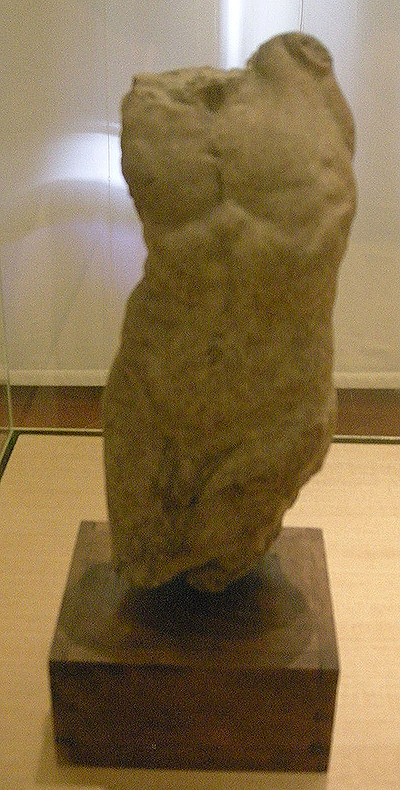
Male Torso II rises rather than curls. The small terracotta body seems to stretch upward through the chest while the missing head and limbs leave the destination of that effort unresolved. Its surface is less fully defined than Male Torso I, but the upward pull has encouraged comparison with Michelangelo's unfinished Awakening Slave in Florence.
The work is preserved at Casa Buonarroti and usually dated about 1513. Its attribution history is more fragile than a famous name on a checklist suggests. Older inventories apparently offered no attribution; Charles de Tolnay argued for Michelangelo in 1954, partly through a sixteenth-century drawing in the Uffizi that copies the model.[1] It remains an attributed work.
That caution is not a prelude to dismissal. The model offers a rare opportunity to ask how a body begins in clay, how copies can preserve evidence, and how the long, unstable design of Pope Julius II's tomb connects objects now divided among collections.
At a Glance
- Controlled titleMale Torso II (Torso virile II)
- ArtistAttributed to Michelangelo Buonarroti
- DateAbout 1513
- MaterialTerracotta
- Height22.5 centimetres
- Current collectionCasa Buonarroti, Florence
- TypeSmall sculptural model or bozzetto
- ConditionMale torso without head, arms or legs
- Proposed purposeStudy for a Prisoner associated with the tomb of Julius II
- Frequent comparisonThe unfinished Awakening Slave in the Galleria dell'Accademia
- Attribution historyDirect Michelangelo attribution proposed by Charles de Tolnay in 1954
- Supporting comparisonSixteenth-century drawn copy, Uffizi, Gabinetto dei Disegni e delle Stampe, 18358 F
Contents
- A Body Stretching Upward
- Male Torso II and Male Torso I
- The Uffizi Drawing as Evidence
- The Tomb of Pope Julius II
- Model, Memory and Reuse
- Clay as a Thinking Material
- Attribution and the Casa Buonarroti Collection
- The Awakening Slave Comparison
- How to Look at Male Torso II
- Why Male Torso II Matters
A Body Stretching Upward
The surviving trunk is organised around extension. The chest lifts, the abdomen lengthens and the whole fragment suggests that an absent limb once pulled or braced above. Because neither arms nor head survives, the viewer reads direction through the torso alone.
This makes the object an unusually concentrated study of force. It does not describe every muscle with equal finish. Instead, it establishes an upward tendency that could govern later decisions.
The lower degree of refinement in comparison with Male Torso I has been noted in accounts of the pair.[1] Roughness may indicate an earlier exploratory moment, rapid execution, damage or a different maker. It is not automatically a sign of Michelangelo's celebrated non-finito; that concept belongs chiefly to incomplete monumental works and should not become a universal explanation for every irregular surface.
The incomplete state produces visual ambiguity. The torso can seem to awaken, struggle, reach or hang. Those readings are valuable as observations of posture but do not identify a subject by themselves.
Male Torso II and Male Torso I
The numbering invites the two objects to be treated as a pair. Both are small terracottas at Casa Buonarroti, both are dated around 1513, and both have been associated with Prisoners for Julius II's tomb.
Their differences are just as important. Male Torso I is approximately 23 centimetres high, bends and twists forward, and received a Michelangelo attribution in late nineteenth-century inventories. Male Torso II is 22.5 centimetres, stretches upward, has less detailed finish and gained its influential direct attribution through de Tolnay in 1954.[1]
One therefore cannot prove the other. Similar collection history and format may indicate related study, later grouping or common taste. It does not guarantee the same hand or function.
Separate pages protect separate evidence. If the first model's quality is used to elevate the second, and the second's copy is used to authenticate the first, the argument becomes circular. Each object must sustain its own attribution.
The Uffizi Drawing as Evidence
De Tolnay linked Male Torso II with a sixteenth-century drawing in the Uffizi, inventory 18358 F, that reproduces the model.[1] A copy made relatively close to Michelangelo's lifetime proves that the form existed early enough to attract attention. It may also record details changed or lost from the clay.
What the copy cannot do automatically is identify the modeller. Renaissance draughtsmen copied works by masters, assistants, antiquity and anonymous workshop figures. A drawing can attest circulation without resolving authorship.
The relation must also be established carefully. If the draughtsman viewed the terracotta directly, corresponding irregularities may reveal its sixteenth-century condition. If both drawing and model descend from another invention, their likeness has a different meaning.
Copies are most useful when treated as independent historical objects. Medium, viewpoint and purpose alter what they preserve. A draughtsman may regularise a rough surface, complete an ambiguous contour or emphasise anatomy useful for study.
The Uffizi sheet strengthens the model's early history. De Tolnay's further step—to Michelangelo's own hand—remains an attributional argument.
The Tomb of Pope Julius II
The Julius tomb was the longest and most painful commission of Michelangelo's career. Begun in 1505 as a vast free-standing mausoleum, it was repeatedly contracted and redesigned before the wall tomb was installed in San Pietro in Vincoli in 1545.[2]
The revision of 1513 followed Julius's death. It retained a rich lower storey populated by nude captives. Michelangelo began the Dying Slave and Rebellious Slave, now in the Louvre, around this phase.[3]
Later plans generated the four unfinished Prisoners in the Galleria dell'Accademia: Young, Bearded, Atlas and Awakening. Because the project evolved, a model dated about 1513 should not be attached casually to a marble commonly associated with a later campaign.
The resemblance between Male Torso II and the Awakening Slave lies in their sense of upward emergence. The Accademia figure lifts through a block that still encloses much of the body. The terracotta concentrates a comparable extension in the trunk.
This may reflect continuity of an idea rather than a one-to-one preparatory sequence. Michelangelo could preserve, reverse and rework bodily solutions over years. The model is safest described as related to the Prisoner problem and often connected specifically with the Awakening Slave.
Model, Memory and Reuse
Michelangelo's designs did not proceed along a simple conveyor belt from drawing to model to identical marble. He could begin directly in stone, use wax or clay to solve a passage, consult drawings after carving had started and transfer an old pose into a new project.
A small torso was portable. It could remain in the studio after its immediate architectural scheme changed, becoming a reservoir of form. Assistants might draw it; visitors might copy it; later family members might preserve it without a precise record of purpose.
That mobility helps explain why model identification is difficult. The object may have begun for one Prisoner, influenced another and survived after both positions disappeared from the tomb.
The absence of limbs increases reuse. A torso is less tied to one gesture than a complete figure. Its extension could be completed by arms bound above, one arm lifting, or a turn in another direction.
This is not a defect in design. It is a sign that Michelangelo's bodily thinking often began with connected masses before narrative specificity.
Clay as a Thinking Material
Clay makes addition easy. A modeller can press material onto the chest, scrape a flank, bend an emerging shoulder and then judge the whole figure from another angle. The small scale places those changes within the span of a hand.
Terracotta is clay transformed by firing. Once fired, the temporary solution becomes a durable fragment, but breaks remain possible at projecting limbs. We should not assume every missing part was omitted from the beginning; nor should we reconstruct absent extensions without physical evidence.
The surface can preserve fingerprints and tool traces, though later cleaning and restoration complicate them. Technical study may reveal construction sequence: whether the torso was modelled solid or around a core, where pieces were joined and which areas were reworked after initial drying.
Such evidence can distinguish fast modelling from deliberate roughness. It may also help compare clay and technique with other Casa Buonarroti models. It rarely yields an artist's name alone.
What matters most visually is coordination. Even with limited finish, the upward pull must pass through the entire torso. If one region merely carries separate anatomical bumps, the action collapses.
Attribution and the Casa Buonarroti Collection
Casa Buonarroti contains the largest group of models attributed to Michelangelo and his circle, but its own museum history warns against treating the collection as a sealed studio deposit.[4] Inventories from the seventeenth century onward record objects with changing labels; models were forgotten, rediscovered and reassessed.
For Male Torso II, the absence of an old Michelangelo attribution matters. It does not prove the work is later or inauthentic, but it means continuous family testimony cannot carry the claim.
De Tolnay's 1954 proposal gave the object a new position in the corpus.[1] Later catalogues have repeated it with varying degrees of confidence. Responsible prose preserves the verb “attributed” so that repetition does not turn a proposal into a document.
Visual comparison can support the claim. The torso's compressed energy and Prisoner-like extension belong to Michelangelo's world. But followers could study precisely those qualities. A Michelangelesque body is evidence of influence before it is evidence of hand.
The object's identity should therefore have layers: a sixteenth-century terracotta at Casa Buonarroti; a form copied in an Uffizi drawing; a work connected with the Prisoners; and a model attributed, not secured, to Michelangelo.
The Awakening Slave Comparison
The Awakening Slave remains embedded in marble. Its head and one arm push upward while much of the lower body is only broadly established. The effect of emergence has made it an emblem of Michelangelo's unfinished carving.[5]
Male Torso II offers a tempting prehistory. Both bodies seem to pull vertically against constraint. Yet their scale, phase and surviving parts differ. The clay does not reproduce the marble's exact silhouette.
Comparison is strongest at the level of problem: how can a bound or obstructed figure make effort visible through extension of the trunk? It is weakest when used to claim that every contour in clay predicts the later stone.
The model may represent one route toward a family of Prisoner solutions. That broader relationship respects Michelangelo's revision and the tomb's shifting architecture.
Placed mentally beside the marble, the terracotta also reverses the famous story of emergence. In clay, Michelangelo—or another modeller—built the body by adding material. In marble, he exposed it by removal. Similar movement arose through opposite procedures.
How to Look at Male Torso II
First follow the body's central axis. It is not simply upright; different regions pull at slightly different angles.
Examine the upper edges where shoulders and neck end. Ask what directions they imply without choosing one completed pose too quickly.
Compare the front and back. The success of an upward stretch depends on the back carrying the movement, not only on a lifted chest.
Then compare photographs of Male Torso I and the Awakening Slave. Record differences before similarities. This prevents a famous marble from determining everything seen in the clay.
Finally remember the Uffizi copy. The model was not merely preserved; it was looked at and translated. That historical attention is evidence even where authorship remains open.
Why Male Torso II Matters
The terracotta matters because it preserves bodily invention in a state of possibility. It has enough direction to suggest struggle and too little completion to fix a single figure.
Its attribution history is equally instructive. An old object, a sixteenth-century copy and a respected scholar's judgment combine into a serious Michelangelo proposal, but none alone converts the model into an autograph certainty.
This disciplined uncertainty improves the viewing experience. Instead of searching for a signature hidden in every muscle, we can see a Renaissance study moving among hand, clay, drawing, collection and monumental project. The torso's upward reach continues because its conclusion was never made final.
Frequently Asked Questions
Discussion
What details, sources or comparisons stand out to you in Male Torso II?
Reader Insights
Which formal detail changes how the work reads?
Which documented source or collection history feels most useful?
Which related Michelangelo work should readers compare next?
Join the Conversation
Add a source-led observation, comparison or question for other readers.
References
- Italian-language object history, Torso virile II”:, View source.
- San Pietro in Vincoli, official church guide to Michelangelo's Moses and the tomb of Julius II:, View source.
- Musée du Louvre, Dying Slave and Rebellious Slave, collections: https://collections.louvre.fr/en/ark:/53355/cl010091874 and, View source.
- Casa Buonarroti, Michelangelesque Models”:, View source.
- Galleria dell'Accademia, Michelangelo's Prisoners or Slaves”:, View source.
- Istituto Nazionale di Studi sul Rinascimento, photographic record of models at Casa Buonarroti:, View source.