


 by Tom Gurney
Tom Gurney BSc (Hons) is an art history expert with over 20 years experience
Published on June 19, 2020 / Updated on August 8, 2026
Email: tomgurney1@gmail.com / Phone: +44 7429 011000
Risen Christ by Michelangelo
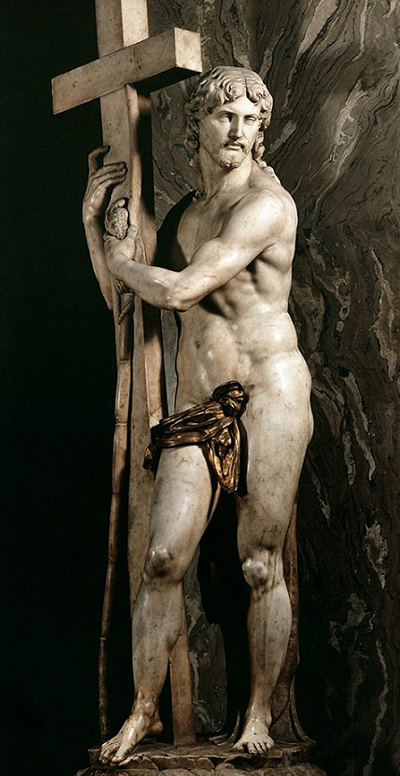
Christ stands upright beside the cross, nude except for a later covering, his body neither broken by crucifixion nor lifted into spectacle. Michelangelo’s Risen Christ in Santa Maria sopra Minerva is an image of victory made materially complicated. It followed an abandoned first attempt, was roughed out by Michelangelo and completed in Rome with workshop participation, and was later altered by the addition of gilded bronze drapery. The statue visible today contains several histories at once.
Often called the Cristo della Minerva from its Roman location, the work asks for more than admiration of an ideal body. Its subject is the resurrected Christ who carries the instruments of the Passion as signs of triumph. Its making exposes the vulnerability of marble and the practical reach of assistants. Its altered nudity records later religious expectations. Every one of those layers changes what “by Michelangelo” means without depriving the sculpture of his invention.
At a Glance
- Artist and designerMichelangelo Buonarroti
- TitleRisen Christ, Christ the Redeemer or Cristo della Minerva
- DateSecond version begun in the 1510s and completed in 1521
- MediumMarble, with later gilded bronze drapery
- SubjectThe resurrected Christ standing with the cross and instruments of the Passion
- LocationBasilica of Santa Maria sopra Minerva, Rome
- Commission contextA Roman devotional sculpture, associated with patron Metello Vari
- First-version problemMichelangelo abandoned an earlier block after discovering a flaw in the marble[1][6]
- Execution cautionThe Minerva version was roughed out by Michelangelo in Florence and completed in Rome by assistants or pupils[1]
- Later interventionGilded bronze covering was added to the nude body after Michelangelo’s work[1]
- Central distinctionThe sculpture is not simply an image of Christ carrying the cross toward death; it presents the risen Christ displaying the cross as an emblem of conquered death
Contents
- Why Cristo della Minerva?
- The Risen Christ and the Cross
- The First Block and the Marble Flaw
- Beginning Again
- Metello Vari and the Promise of Completion
- Michelangelo and His Assistants
- A Body Turning Around the Cross
- The Meaning of Nudity
- The Gilded Bronze Drapery
- Church, Piazza and Roman Memory
- Two Versions, One Commission History
- From Devotional Object to Layered Artwork
- Touch, Proximity and the Statue’s Public Life
- The Cross as Support and Counterbody
- Why the Risen Christ Matters
- Artist Up Close
Why Cristo della Minerva?
The familiar Italian name identifies the sculpture through place. Santa Maria sopra Minerva is a Dominican basilica near Rome’s Piazza della Minerva, and the church’s own historical account recognises Michelangelo’s Christ among its artistic treasures.[2] Civic and heritage sources likewise anchor the statue to this site.[3][4]
That location is more than a convenient label. Unlike a museum sculpture encountered in an abstract sequence of artists and periods, the Christ remains within a religious interior. Visitors approach it amid chapels, tombs, liturgical movement and the accumulated history of a Dominican church. Its cross speaks to actual devotion before it becomes a formal support or compositional axis.
“Minerva” can mislead those unfamiliar with Roman topography, since it seems to attach a pagan goddess to a Christian figure. The name derives from the basilica and piazza, themselves tied to the area’s ancient memory. It does not rename Christ or imply a mythological subject. Cristo della Minerva simply means the Christ associated with this particular Roman church.
The Risen Christ and the Cross
Michelangelo joins two moments that devotional art often separates. Christ’s upright, living body signifies the Resurrection, while the large cross recalls execution. The cross is no longer an instrument actively bearing his dead weight. It has become something he touches, holds or presents—evidence of suffering transformed into victory.
Other Passion instruments reinforce that compression of sacred time. Rather than narrating Calvary and the empty tomb in successive scenes, the sculpture embodies their relationship. The body is alive because death has occurred; the cross remains because death has been overcome. Triumph does not erase the means of suffering.
This theological structure explains why the nude body is central. The resurrected Christ is not a ghost. His body has passed through death and returned in glory. Michelangelo gives that doctrine the physical authority of marble. Yet later discomfort with the nudity would become part of the object’s history, overlaying its original conception with another interpretation of sacred propriety.
The First Block and the Marble Flaw
The commission produced two versions because stone intervened. Rome’s official Michelangelo itinerary records that Michelangelo began a first statue but discovered a flaw in the marble and abandoned the block.[1] Secondary art-historical summaries preserve the same essential chronology.[6]
A flaw in marble is not a small inconvenience. Carving is subtractive and irreversible. An inclusion, vein or defect can cross an area crucial to a face or body after months of labour, compromising appearance or strength. The sculptor cannot paint it out or replace a removed passage. Material selected for purity can reveal its resistance only as work advances.
The first version should not be confused with the Minerva statue. It belongs to the same commission history and helps explain the delay, but the Roman church received a second carving. Maintaining that distinction is necessary because photographs or accounts labelled “Risen Christ” may refer to different objects.
The flawed block also counters the idea that Michelangelo simply imposed intention upon passive stone. Marble had agency in the practical sense that its internal character could redirect a project. The celebrated master was answerable to geology.
Beginning Again
Starting a second version did not mean mechanically copying the first. Even if the commission and fundamental subject remained, a new block required new judgments about scale, stance, support and how the cross joined the body. Repetition in marble is never exact because the material and the developing figure differ.
Michelangelo roughed out the Minerva version in Florence, according to Turismo Roma, before it was brought into the orbit of completion in Rome.[1] Roughing out establishes the principal masses by removing large amounts of stone. It can fix the body’s general turn and relation to the block without resolving every surface or detail. The design was therefore substantially embodied, but execution remained open.
This geographical division—Florentine carving, Roman completion—also reflects Michelangelo’s working life across courts and commissions. A sculpture could travel before its authorship was materially complete, carrying the master’s decisions into another city and other hands.
Metello Vari and the Promise of Completion
The Roman nobleman Metello Vari is associated with the commission, which required a standing Christ for a specific devotional destination rather than an open-ended exercise in ideal anatomy. Secondary object histories preserve his role and the contractual complications surrounding the replacement of the flawed first block.[5][6] Patronage gives the two-version story an ethical as well as technical dimension: Michelangelo had promised an acceptable sculpture, and defective marble did not make that obligation vanish.
Beginning again can therefore be understood as a form of responsibility. The first carving retained artistic value, but it could not fulfil the commission as intended. A second block allowed Michelangelo to honour the subject and destination despite the material setback. The delay and divided execution show how that promise became difficult to keep in person.
Vari’s place should not be exaggerated into creative co-authorship. Nothing warrants assigning him the figure’s precise turn or theological treatment of nudity. His importance lies in commissioning, receiving and maintaining the practical framework within which Michelangelo’s invention had to become a deliverable object.
Michelangelo and His Assistants
The same official source states that pupils completed the statue in Rome in 1521.[1] Secondary guides offer more detailed narratives and names, but the safest description retains the distinction between Michelangelo’s conception and roughing-out and later workshop finishing.[5][6]
This does not turn the object into a simple copy. Assistants worked on a block whose bodily organisation Michelangelo had established. Nor does the great name make their labour disappear. Surfaces, details and transitions visible today may reflect completion beyond his own chisel. The statue is best understood as a Michelangelo project with collaborative execution.
Renaissance workshops made such divided labour normal, even when later collecting culture preferred the fiction of one hand. Patrons valued Michelangelo’s invention, while practical completion could be entrusted under pressure of distance and competing obligation. The Risen Christ makes that structure especially consequential because later criticism and alteration focus attention on the exact surface the workshop finished.
A Body Turning Around the Cross
The statue is frontal enough to establish direct presence, yet it does not lock into rigid symmetry. Weight shifts through the legs, the torso turns and the arms establish different relationships with the cross and associated objects. The upright axis of the cross intensifies the body’s subtler changes of direction.
Christ’s idealised nudity draws upon classical sculpture without converting the subject into a pagan athlete. Anatomical completeness expresses restored life. The body is not shown at the limits of endurance, as in a crucifixion, nor collapsed into Mary’s lap, as in the Pietà. It bears itself.
That self-possession gives the figure an unusual emotional temperature. Michelangelo avoids theatrical ecstasy. Christ’s triumph is made durable, almost severe. The viewer must reconcile an exposed, beautiful body with the brutal instrument beside it. Sacred meaning occurs in that collision.
The Meaning of Nudity
Nudity can signify vulnerability, shame, ideal perfection or primordial innocence depending on context. Here it belongs to resurrection. Christ has conquered the corruption of death, and the entire body participates in the revelation. Clothing is not needed to mark earthly status or historical costume.
Michelangelo’s art repeatedly used the nude as a carrier of spiritual and intellectual force. In the Sistine ceiling, naked bodies inhabit sacred history and its framing structure. In the Minerva Christ, the nude is not an attendant or ancestor but the central divine figure. That concentration made the theological claim powerful and exposed it to changing standards.
It would be simplistic to assume every later viewer rejected the sculpture or that censorship happened in one uncontested instant. What is certain from the civic source is that a bronze covering was added later and associated with the climate of post-Tridentine modesty.[1] The intervention materially changed the body through which Michelangelo had expressed resurrection.
The Gilded Bronze Drapery
The bronze loincloth is not marble and was not part of Michelangelo’s original solution. Its colour, surface and method of attachment distinguish it from the carved body. It should therefore be seen as an intervention rather than mistaken for an accessory conceived with the statue.
At one level, the addition conceals. At another, it reveals a history of reception. Sacred images do not cease changing when an artist finishes work. Clergy, patrons and viewers bring new standards of decorum, and institutions may alter objects to meet them. The Minerva Christ became a site where the ideal resurrected nude met a later desire for covering.
Removal would not simply restore an untouched original, because interventions themselves become historical evidence and may leave physical consequences. The present statue bears the tension between Michelangelo’s conception and subsequent guardianship. Looking responsibly means noticing both.
Church, Piazza and Roman Memory
Santa Maria sopra Minerva contains layers of medieval and Renaissance Roman history, and official heritage descriptions situate it as a major artistic site.[2][3] Piazza della Minerva, with its own civic identity, provides visitors with the geographical approach to the basilica and its Michelangelo.[4]
The setting matters to scale. A photograph can isolate the statue into a white field and make it resemble a museum specimen. In the church, architecture, ambient light and devotional furniture mediate it. The cross participates in a space already saturated with Christian symbols. The body’s whiteness responds to a coloured and shadowed interior.
Continued presence also keeps the work connected to worship. It has an art-historical life and a sacred one. Those modes overlap but are not identical. The statue can be studied for authorship, carving and intervention while still functioning as an image of the Redeemer.
Two Versions, One Commission History
The existence of two versions raises a question about priority. Is the abandoned first block merely a failed attempt, and is the Minerva statue the “real” work? The answer depends on purpose. The church’s finished devotional image is the second version. The first remains vital evidence of Michelangelo’s design and of the material accident that forced revision.
Neither should be used to erase the other. The early block is not the statue in Santa Maria sopra Minerva, while the finished Roman work cannot be understood fully without the flaw that preceded it. Their connection is historical, not interchangeable.
This paired history is particularly valuable for studying artistic decision. A new version allows differences to emerge, while collaborative completion means the second block does not offer a pure record of Michelangelo alone. Certainty decreases, but understanding deepens.
From Devotional Object to Layered Artwork
The statue’s identity has accumulated through stages: commission, abandoned marble, renewed carving, transport, workshop completion, installation and later covering. No single moment contains the whole object now encountered. Calling it a masterpiece without those layers reduces its history; treating collaboration and alteration as disqualifying reduces its art.
The more revealing category is a layered artwork. Michelangelo supplied the decisive invention and substantial carving. Assistants helped turn that project into the installed statue. Later custodians altered the body’s presentation. The church preserved it in the place that gives it a familiar name.
Such complexity is normal for long-lived sacred sculpture. The Cristo della Minerva simply makes it unusually visible.
Touch, Proximity and the Statue’s Public Life
The church setting permits an intimacy different from that of sculpture elevated on a façade or isolated behind the visual conventions of a museum. Christ’s body and the cross occupy the worshipper’s world. Their scale is human enough for direct address, while marble idealisation distinguishes sacred presence from an ordinary person.
That proximity helps explain both devotion and anxiety. A nude divine body seen at close range makes incarnation emphatic: salvation is carried by flesh. The same visibility can make changing standards of modesty especially urgent. The bronze drapery is therefore not an arbitrary assault arriving from nowhere; it is evidence that later custodians experienced the sculpture’s bodily directness as a problem requiring material action.
The figure’s public life also means that condition, setting and interpretation cannot be frozen at the date 1521. Centuries of attention have accumulated around it. Some responses honoured Michelangelo’s authorship, others prioritised doctrinal decorum, and modern scholarship seeks to distinguish those phases. The statue endured by being cared for and changed—two processes that are sometimes in tension.
The Cross as Support and Counterbody
The cross is simultaneously attribute, theological sign and sculptural partner. Its long straight members contrast with the body’s shifts of hip, shoulder and limb. Where Christ turns, the cross establishes an unyielding geometry. This makes his living flexibility more apparent.
It may also assist the practical stability and cohesion of the composition, but formal usefulness does not reduce sacred meaning. Renaissance sculptors routinely made an attribute perform several jobs. Here the instrument that identifies the Passion helps organise the resurrected body that has overcome it.
The closest comparison is therefore not another nude alone but another Michelangelo figure whose adjacent object carries meaning—the David with his sling, Moses with the tablets, or the Angel with its candlestick. In each, body and attribute produce a relationship. The Minerva Christ is distinctive because the object beside him once bore his death.
Why the Risen Christ Matters
The sculpture matters first because its imagery is profound. A living, ideal body stands with the device of death, making resurrection a physical relation between flesh and cross. Michelangelo’s controlled turn avoids easy triumphalism. Victory is calm enough to be contemplated.
It matters next because material failure became artistic history. The flawed first block forced Michelangelo to begin again, demonstrating that mastery does not eliminate contingency. Marble could refuse an intention, and a commission could survive through repetition.
Finally, the work matters because it complicates authorship without destroying it. Michelangelo’s design, assistant completion and later bronze intervention coexist. The visible object cannot be purified into a single moment or hand. Its very difficulty teaches a more truthful way to admire Renaissance sculpture: invention, labour, site and reception all leave marks.
Artist Up Close
Michelangelo conceived the Risen Christ during years dominated by the troubled Tomb of Julius II and other enormous obligations. His decision to make divine victory depend upon a nude body connects classical form with Christian doctrine, while the two-version and workshop history exposes the practical system behind the famous name. He was not simply a solitary carver completing every surface. He was a designer whose decisions could travel in marble, be continued by assistants and be reinterpreted by institutions long after him.
Frequently Asked Questions
Discussion
How does the Risen Christ change when you read it as a sculpture shaped by Michelangelo, assistants and later religious intervention?
What does the Santa Maria sopra Minerva setting add to the way the sculpture is experienced?
Where does the Minerva Christ sit beside the Pietà, St Matthew and other religious sculptures?
Join the Conversation
Compare the two-version history, assistant completion and later bronze drapery with Michelangelo's other religious sculptures.
References
- Turismo Roma / Roma Capitale, Michelangelo”:, View source.
- Santa Maria sopra Minerva, History and Architecture”:, View source.
- Soprintendenza Speciale Roma, Santa Maria sopra Minerva”:, View source.
- Turismo Roma / Roma Capitale, Piazza della Minerva”:, View source.
- Arte.it, Cristo Risorto”:, View source.
- Web Gallery of Art, Risen Christ”:, View source.