


 by Tom Gurney
Tom Gurney BSc (Hons) is an art history expert with over 20 years experience
Published on June 19, 2020 / Updated on November 6, 2025
Email: tomgurney1@gmail.com / Phone: +44 7429 011000
Saint Pius
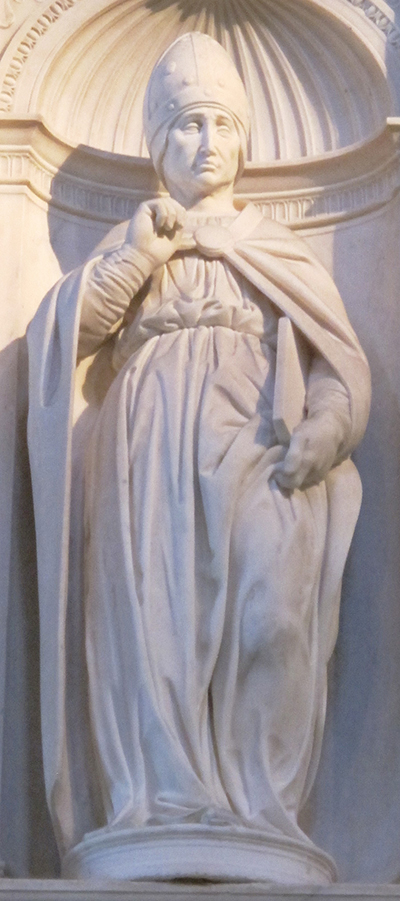
Michelangelo's Saint Pius stands in a narrow niche of the Piccolomini Altar in Siena Cathedral, a book secured beneath one arm. The marble is about 134 centimetres high: smaller than life, contained by architecture and easily overlooked beside the artist's colossal Florentine work of the same years.
Its name is less simple than the label suggests. The statue has often been called Saint Augustine, and the Opera del Duomo itself lists both Saint Pius and Saint Augustine among the four Michelangelo figures.[1] Some histories propose that a figure begun or intended as Augustine was later adapted to honour a Piccolomini pope named Pius.
The controlled page title follows the current Saint Pius tradition while preserving that identity history. The marble is unquestionably part of Michelangelo's Siena commission; which church father or papal saint its earliest carving represented requires more caution.
At a Glance
- ArtistMichelangelo Buonarroti
- Controlled titleSaint Pius
- Alternative or earlier identitySaint Augustine
- DateAbout 1501–1504
- MaterialMarble
- HeightApproximately 134 centimetres
- Current locationPiccolomini Altar, Siena Cathedral
- AttributeBook held beneath the arm
- CommissionOne of four surviving statues Michelangelo made for the Piccolomini ensemble
- PatronCardinal Francesco Todeschini Piccolomini, briefly Pope Pius III in 1503
- Architectural frameworkAndrea Bregno's earlier marble altar, begun in the 1480s
- Identity cautionPius/Augustine naming should be reported as a history, not silently resolved
Contents
- The Piccolomini Altar
- A Commission Overtaken by David
- Pius or Augustine?
- The Saint with a Book
- Sculpture Made for a Niche
- Michelangelo and Siena
- The Piccolomini Name and the Title Pius
- The Four Michelangelo Saints
- Authorship Within the Altar
- How to Look at Saint Pius
- Why Saint Pius Matters
The Piccolomini Altar
Cardinal Francesco Todeschini Piccolomini commissioned a monumental marble altar in Siena Cathedral to honour his family and his uncle, Enea Silvio Piccolomini, Pope Pius II. Andrea Bregno created the architectural structure between about 1481 and 1485.[2]
The altar rose as a wall of niches, columns, relief and sculpture. Its intended saints would place the Piccolomini dynasty inside a sacred genealogy while providing the cardinal with a commemorative focus in his native cathedral.
Sculptural completion extended beyond Bregno. Pietro Torrigiani was engaged and produced one figure before leaving. In 1501 the commission passed to Michelangelo, who was contracted for fifteen statues.[3]
Only four Michelangelo figures occupy the altar: Saints Peter, Paul, Pius and Gregory in current naming. The larger programme remained incomplete. A Madonna and Child already associated with the structure belongs to another sculptor and an earlier history.
The altar is therefore a composite. Calling it “by Michelangelo” would erase Bregno's architecture, other sculpture and the patron's long campaign.
A Commission Overtaken by David
Michelangelo accepted the Siena work in 1501, the year Florence commissioned him to carve the enormous David from a damaged block. The difference in scale and public opportunity was dramatic.
The David demanded sustained work and promised a central place in Florentine civic life. The Piccolomini saints were numerous, comparatively small and bound to an existing Sienese framework. Michelangelo's attention shifted.
He delivered four figures between about 1501 and 1504 rather than the contracted fifteen.[1][3] The unfinished programme should not make the surviving statues mere leftovers. It explains their economy and their relation to an architectural series.
Working across the two commissions also reveals range. The same sculptor developed a colossal nude visible from a civic square and clothed saints for elevated cathedral niches. Monumentality could reside in concentration as well as size.
The incomplete contract foreshadows a repeated career pattern: papal and civic demands overlapped, earlier obligations remained unresolved, and ambitious new work transformed what completion meant.
Pius or Augustine?
The book is a natural attribute for Augustine, one of the four Latin Doctors of the Church and author of the Confessions and City of God. He is commonly shown as a bishop with book, mitre and sometimes a flaming heart.
A Saint Pius could honour the Piccolomini popes Pius II and Pius III more directly. The name would reinforce family commemoration within the ensemble. The figure's papal or episcopal dignity and book could support either learned churchman.
Some accounts state that a statue originally conceived as Augustine was later recarved or renamed as Pius.[2] “Recarved” needs physical specificity: which attributes changed, at what date and by whose hand? Without that map, it is safer to say that title and iconographic identification changed.
The Opera del Duomo's English cathedral page lists Michelangelo as sculptor of Saints Peter, Paul, Pius and Augustine, language that may reflect variant nomenclature across the ensemble rather than five surviving statues.[1] Secondary catalogues differ between Gregory and Augustine for the fourth figure.
This confusion is precisely why object-by-object titles matter. Saint Pius is the controlled route here; its history includes Augustine rather than pretending the alternative never existed.
The Saint with a Book
The figure stands upright, wrapped in ecclesiastical clothing and holding a large book under the left arm. The head turns enough to avoid rigid frontality, while the niche keeps gesture close to the body.
The book adds both mass and meaning. Physically, it anchors one side and gives the forearm a task. Iconographically, it signifies doctrine, learning, office or a saint's writings.
Michelangelo makes the face dignified and serious rather than intensely individual. This is not a portrait proven to represent one Piccolomini pope from life. It is a type made specific through expression and context.
Drapery is organised in broad passages suited to elevation. Small folds would dissolve in the cathedral's complex interior; larger rhythms keep the body legible.
The scale is subordinate to the altar but not miniature. At 134 centimetres, the saint occupies real architectural presence while remaining clearly below the colossal ambition of David.
Sculpture Made for a Niche
A niche determines what a body can do. Deep backward projection is invisible, broad lateral gesture risks collision with the frame, and low light can flatten shallow carving.
Michelangelo responds with a compact silhouette and frontal clarity. The book projects enough to mark one side; head and shoulders create readable transitions; drapery produces shadows within the architectural opening.
Close photographs can make the figure seem freestanding. In the cathedral, it is one unit in a vertical and lateral pattern. Repetition among saints stabilises the altar while individual attributes differentiate them.
The setting also limits comparison with David. A stance made for a square and a stance made for a niche answer different viewers. Similar dates do not mean identical artistic problems.
The Piccolomini commission gave Michelangelo practice integrating sculpture into another artist's architecture—a skill that would become decisive in the Julius tomb, Medici Chapel and his own later buildings.
Michelangelo and Siena
Siena was not simply a remote client losing out to Florence. Its cathedral contained major sculpture by Nicola Pisano, Giovanni Pisano, Donatello, Jacopo della Quercia and others. Michelangelo's figures entered one of Italy's richest sculptural interiors.[1]
The Piccolomini patron brought papal and humanist prestige. Pius II had been a scholar, diplomat and author; Francesco became Pope Pius III for only twenty-six days in 1503. The altar's slow completion outlived both men's plans.
Michelangelo's four saints participate in this dynastic memory without functioning as straightforward portraits. Apostles and church authorities universalise the family's claims.
The commission also placed a Florentine artist inside Sienese artistic identity. Rivalry between cities did not prevent movement of artists, marble and patronage.
The Piccolomini Name and the Title Pius
The name Pius carried unusual dynastic force in Siena. Enea Silvio Piccolomini chose it when elected pope in 1458, becoming Pius II. His nephew Francesco Todeschini Piccolomini adopted the same name as Pius III in September 1503.[1]
That second pontificate lasted less than a month. The altar therefore commemorated a family whose papal authority was both spectacular and fragile. Naming a saint Pius could bind the sculptural programme to both men without functioning as a literal portrait of either.
The difficulty is that several canonised popes bore the name Pius, and a book alone does not establish which one. An Augustinian identity may fit conventional attributes more readily. Later family commemoration may have encouraged a title that made Piccolomini resonance clearer.
This is why “Saint Pius” should not be expanded into an unsupported biography of a specific pope-saint. The safest interpretation distinguishes three layers: the marble figure, its place in the saintly altar programme, and the title's dynastic usefulness.
The Four Michelangelo Saints
Peter and Paul are identifiable through apostolic type and attributes; the two learned church figures have generated more naming difficulty. Together the four form pairs across the altar rather than four isolated statuettes.[1]
Their narrow niches enforce common scale and frontality, but Michelangelo varies weight, drapery and the handling of books or keys. Repetition becomes a test of invention: how much difference can be created without breaking architectural rhythm?
The surviving quartet also preserves absence. Eleven contracted figures were never supplied by Michelangelo. Empty expectations shaped the altar's later history, encouraging incorporation, renaming and reassessment of what remained.
Viewing all four corrects the disproportion created by fame. The ambiguous Pius/Augustine is not a weakly identified appendix; it is one quarter of Michelangelo's completed Sienese contribution and a key witness to the commission's changing programme.
Authorship Within the Altar
The Opera del Duomo credits Michelangelo with four figures.[1] Andrea Bregno designed and carved the architectural altar; Pietro Torrigiani supplied an earlier saint; other historic sculpture was incorporated or associated with the ensemble.[2]
This division should appear in every description. Michelangelo did not design the whole structure from the beginning, nor did he complete the fifteen-figure programme.
Authorship can also vary within an individual object if blocks were roughed by assistants or altered later. The surviving documentation supports Michelangelo's responsibility for the four statues, but absolute claims about every surface need technical evidence.
The Pius/Augustine problem is an object-identity issue rather than a reason to deny authorship. A work can securely belong to Michelangelo's commission while its represented saint remains debated.
How to Look at Saint Pius
Locate the figure within the whole Piccolomini Altar before studying a crop. The niche explains compression and scale.
Find the book and ask what it contributes physically before using it to name the saint.
Compare head, shoulders and garment with Peter, Paul and Gregory/Augustine. Repetition reveals the series; differences reveal individual solutions.
Step back until the architecture dominates. Michelangelo's sculpture succeeds by serving an ensemble he did not originate.
Finally keep both names in mind. Pius explains Piccolomini patronage; Augustine explains the learned book and traditional church programme. The object has carried both histories.
Why Saint Pius Matters
The statue matters because it sits at the crossing of ambition and obligation. Michelangelo accepted fifteen small saints, completed four while carving David, and left Siena an incomplete but distinguished contribution.
It also demonstrates why a title is evidence, not decoration. Repeating “Saint Pius” without the Augustine history would make the work seem more certain than the surviving iconography permits.
Within its niche, the figure offers a different young Michelangelo from the heroic nude. Book, clothing and architectural restraint show him learning how intellectual and spiritual authority can inhabit a compact marble body.
Frequently Asked Questions
Discussion
What details, sources or comparisons stand out to you in St Pius?
Reader Insights
Which formal detail changes how the work reads?
Which documented source or collection history feels most useful?
Which related Michelangelo work should readers compare next?
Join the Conversation
Add a source-led observation, comparison or question for other readers.
References
- Opera della Metropolitana di Siena, The Cathedral,” sculpture section:, View source.
- Italian-language history, Altare Piccolomini”:, View source.
- Opera della Metropolitana di Siena, education page, Michelangelo's 1501 commission:, View source.
- Italian-language object history, San Pio (Michelangelo)”:, View source.
- Italian Ministry of Culture, Cattedrale di Siena e Libreria Piccolomini”:, View source.