 by Tom Gurney
Tom Gurney BSc (Hons) is an art history expert with over 20 years experience
Published on June 19, 2020 / Updated on August 8, 2026
Email: tomgurney1@gmail.com / Phone: +44 7429 011000
Michelangelo’s Boboli Slaves
The four unfinished Prisoners in Florence were not made for a garden. Michelangelo began them for successive versions of the Tomb of Pope Julius II, and they remained in his studio after reductions made their original purpose obsolete. Only later did Grand Duke Cosimo I have them installed in the Grotta del Buontalenti in the Boboli Gardens. Their garden setting was so memorable that the group became known as the Boboli Slaves.[1]
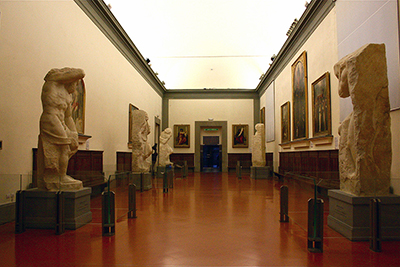
That name records an afterlife rather than an origin. The Atlas Slave, Awakening Slave, Bearded Slave and Young Slave are now in the Galleria dell’Accademia, where they have been displayed since their transfer in 1909.[1][2][3][4] Together they show four bodies meeting marble in markedly different ways: burdened, stirring, acquiring mature identity, or twisting upward. Their unfinished surfaces unite the group, but do not make the works identical.
The journey from papal tomb to Florentine studio, Medici grotto and modern museum transformed how the sculptures could mean. A funerary programme became a garden spectacle; abandoned work became an image of bodies born from rock; museum display turned interruption into evidence of Michelangelo’s creative process.
At a Glance
- ArtistMichelangelo Buonarroti
- Group nameBoboli Slaves, Florence Prisoners or four Prisoners
- MembersAtlas, Awakening, Bearded and Young Slave
- DateBroadly 1519–1534
- MaterialMarble
- Original commissionTomb of Pope Julius II
- StateUnfinished following reductions to the project
- First later locationMichelangelo’s studio
- Boboli patronGrand Duke Cosimo I de’ Medici
- Garden settingGrotta del Buontalenti, Boboli Gardens
- Current locationGalleria dell’Accademia, Florence
- Museum transfer1909
- Important distinctionThey are not the Louvre’s earlier Dying and Rebellious Slave, and none was installed in the final Roman tomb
Contents
- Four Marbles, Not One Sculpture
- Why the Group Needed a New Name
- Born from the Julius II Tomb Project
- In Michelangelo’s Studio
- Cosimo I and the Boboli Grotto
- Art, Nature and the Grotto Imagination
- Transfer to the Accademia
- A Museum Sequence and Its Hidden Argument
- The Meaning of Their Incompletion
- Captivity and the Politics of Display
- The Group as Evidence of Labour
- The Louvre Slaves Are a Different Pair
- Artist Up Close
Four Marbles, Not One Sculpture
The collective name is useful only if the individual works remain visible. Atlas appears compressed beneath a great upper block.[1] Awakening seems to turn or rise while much of its body remains difficult to separate from stone.[2] Bearded gains particular presence from a mature head.[3] Young Slave is a 256-centimetre figure whose raised left arm, flexed legs, turning torso and roughed head produce a different balance of action and incompletion.[4]
These contrasts show that unfinished is a condition, not a style formula. Unremoved marble acts as weight in one work, latency in another, an incomplete boundary around identity in a third, and resistance to a large twisting gesture in the fourth.
The titles were not supplied as a documented four-part programme by Michelangelo. They arose as practical and evocative ways to distinguish the surviving objects. Atlas and Awakening describe perceived actions; Bearded and Young describe physical types. None fixes an allegorical identity.
Nor does the broad 1519–1534 date establish a simple order based on finish.[1] Michelangelo may have worked intermittently under different agreements. One torso could be advanced while a head remained rough; one block could retain more surrounding mass because its proposed placement or material required it. The current surfaces are evidence of unequal work, not four numbered frames in a single process.
Why the Group Needed a New Name
Once the four works were removed from the tomb’s active history, their intended individual identities were difficult to preserve. A collective name based on later location offered a practical solution. “Boboli Slaves” said where the group could be encountered and kept it distinct from the more highly finished pair that entered France.
The name also made provenance memorable. It transformed a complex sequence of contracts into a geographical identity associated with Florence and the Medici garden. Even after 1909, “Boboli” continued to evoke a historical chapter that “Florence Prisoners” alone would not specify.
Yet the term can create two errors. It may imply that Michelangelo carved the sculptures for the garden, and it may make four very different objects seem like a formally planned grotto suite. The Accademia record corrects both: their first purpose was Julius’s mausoleum, while their Boboli role came later under Cosimo I.[1]
Collective naming is thus an act of interpretation. “Prisoners” stresses bodily condition, “Slaves” follows a familiar title tradition, “Boboli” stresses afterlife and “Florence” stresses current collection geography. No single label contains the whole history.
Born from the Julius II Tomb Project
Julius commissioned his tomb in 1505, imagining a monument associated with the new St Peter’s. Across about forty years, the site, contract, scale and sculptural population changed. The reduced structure eventually unveiled in 1545 bears little direct resemblance to the most ambitious early conception.[5]
The four Florence Prisoners belong to this shifting history. The Accademia says they were intended for the mausoleum and remained unfinished when the project was reduced.[1] They were not designed as independent gallery pieces and were not abandoned because a single artistic idea had necessarily reached perfection.
Their exact intended positions remain less secure than their commission. Drawings proposed bound figures around lower zones of several tomb schemes, while copies and modern reconstructions attempt to clarify changing architecture. The National Gallery of Denmark’s guide carefully distinguishes those forms of evidence.[7] A model can make a proposal visible without becoming proof.
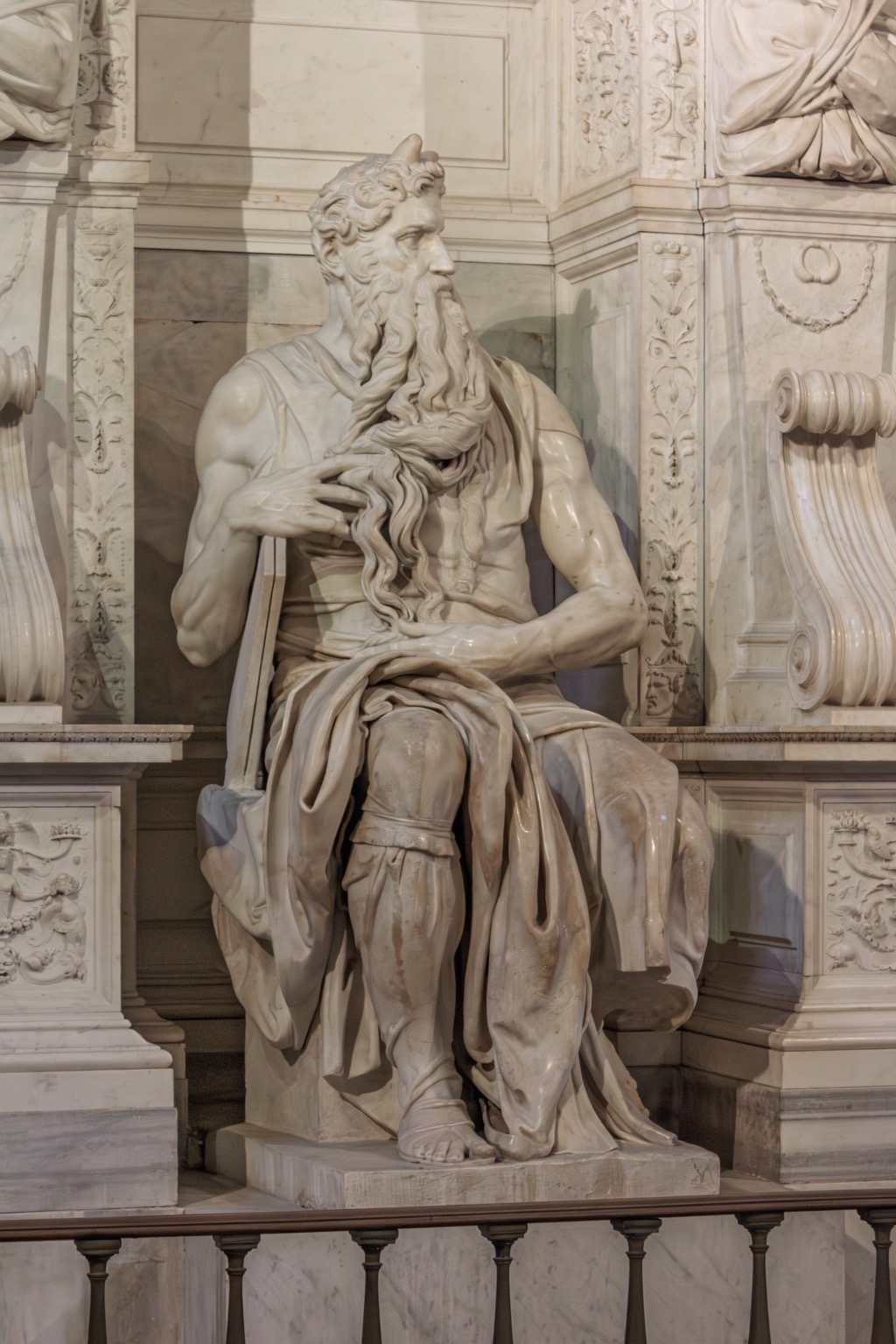
The completed monument is at San Pietro in Vincoli, where Moses occupies the centre of the lower level.[6] The four Prisoners never stood there. Their absence is structural: the final wall tomb uses a different programme, not four temporarily vacant places.
This unrealised purpose remains perceptible in their scale and vertical organisation. Bodies push against tall blocks as though intended to animate an architectural base. The powerful alternation of limbs would have introduced human motion among supports, but the surviving stones cannot on their own reconstruct the whole design.
In Michelangelo’s Studio
Once the changing agreement no longer required the figures, they stayed in Michelangelo’s studio.[1] This phase is easy to pass over because it lacks the spectacle of tomb or grotto, yet it was crucial to survival.
An unfinished marble in a Renaissance workshop could retain several possible statuses. It might be abandoned contract work, material available for reuse, a demonstration of practice or simply an object too substantial and valuable to discard. The Prisoners’ long presence did not guarantee future completion.
The studio context also differs from modern reverence for tool marks. Rough passages were part of ordinary making before museums taught viewers to see them as privileged access to genius. Michelangelo and his assistants would have understood point marks, tooth-chisel tracks and broad unworked masses as states within labour, whether or not work later resumed.
When the figures left this environment, incompletion became available for new interpretation. They no longer waited among the practical materials of production. They could be arranged as finished features within another person’s design.
Cosimo I and the Boboli Grotto
Grand Duke Cosimo I brought the four marbles into Medici possession and placed them in the Grotta del Buontalenti in the Boboli Gardens.[1] A grotto was an especially suggestive destination for bodies still joined to stone. Artificial cave architecture, water, natural-looking formations and sculpture could blur distinctions between art and nature.
Within such a setting, the Prisoners’ roughness no longer looked solely like stopped work. It could resemble figures generated by rock, caught between geological mass and human form. What had been a consequence of a failed architectural role became perfectly suited to an environment designed around transformation.
This was an act of reinterpretation. The statues’ scale and bodily force remained Michelangelo’s, but their relation to place changed from papal commemoration to Medici magnificence. Cosimo’s possession of major works by the celebrated Florentine reinforced dynastic cultural authority.
The garden setting also altered viewing. Instead of reading figures as repeated components around a tomb base, visitors encountered them within an immersive environment. Uneven light, damp surfaces, enclosing architecture and nearby decoration could make emergence from stone a spatial experience.
The name “Boboli Slaves” preserves this chapter even after the originals left. It is therefore historically useful, provided it does not imply they were carved for Boboli. The title tells us how powerfully a later display could overwrite an abandoned first purpose.
Art, Nature and the Grotto Imagination
Renaissance and Mannerist grottoes cultivated uncertainty between things made and things found. Rough rock, shell, water, painted surfaces and sculpture could appear to transform into one another. Art demonstrated its ingenuity by imitating nature, while nature appeared capable of generating art.
Michelangelo’s unfinished bodies were unusually suited to this environment. Their blocks preserve the transition that finished statues normally erase. In a grotto, an incomplete contour could look not like abandoned labour but like a natural formation becoming human under the viewer’s gaze.
This compatibility was created by the new setting rather than necessarily foreseen by the sculptor. The Prisoners’ surfaces did not change into grotto decoration by material alteration alone; placement provided the interpretive frame. Architecture told visitors how to understand roughness.
Water and variable light would have made that frame mobile. Moist or shadowed stone can conceal shallow anatomy, while a bright edge suddenly discloses a shoulder or face. The figures’ apparent emergence could recur as conditions changed.
The grotto also absorbed coercive bodies into courtly pleasure. Captivity became spectacle within a ducal garden. This tension should not be ignored: the works’ physical struggle could enhance the magnificence of a ruler who possessed them, just as captive figures had long served triumphal art.
Cosimo’s use of Michelangelo strengthened Medici cultural succession. A pope’s abandoned project was folded into a Florentine dynastic landscape, making possession and reinterpretation forms of political authorship. The sculptures carried the fame of Michelangelo even when their original patronal meaning had dissolved.
Transfer to the Accademia
The four sculptures moved to the Galleria dell’Accademia in 1909.[1] Their removal protected and concentrated them within a museum setting, but it also ended the direct encounter between Michelangelo’s rough blocks and the grotto architecture that had shaped their group name.
At the Accademia, the Prisoners form a celebrated approach toward David. Bright, controlled interior display permits close comparison of tool marks, emerging bodies and unworked masses. The sequence encourages a narrative in which artistic thought gradually frees form before culminating in the finished colossus.
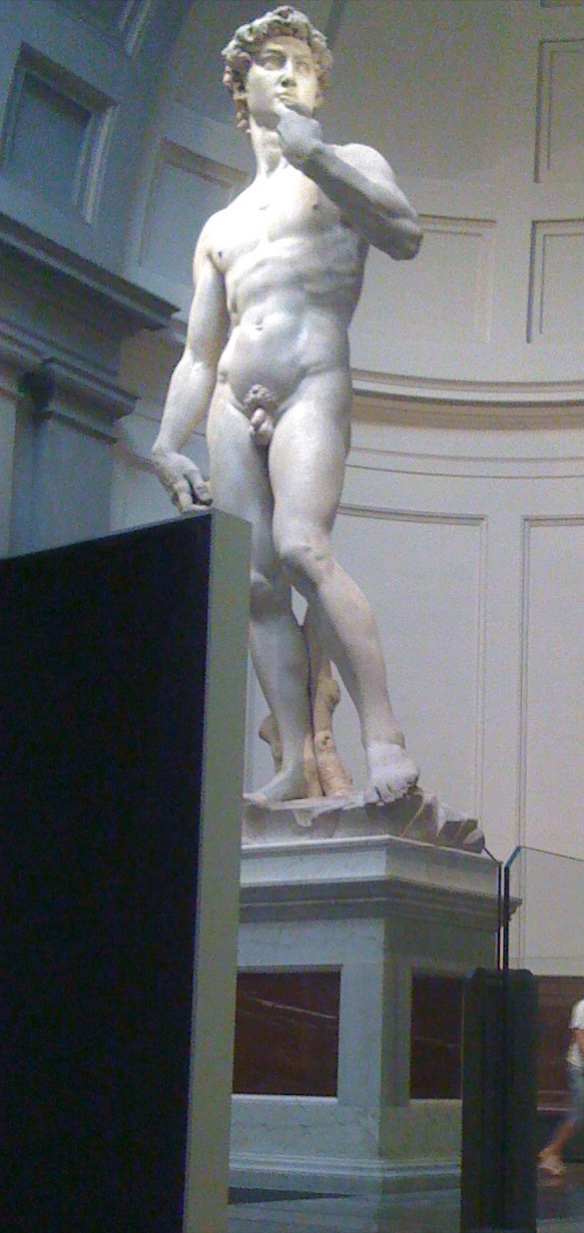
That story is compelling but modern. David was carved for Florence Cathedral and completed decades before much of the Prisoner work. The corridor is not a chronological reconstruction or an arrangement by Michelangelo. It is a curatorial argument made through space.
Museum display also individualised the group. Separate object names and records allow Awakening, Bearded and Young Slave to be studied rather than absorbed under Atlas, whose institutional account supplies much of the shared provenance.[1][2][3][4]
The move therefore produced both gain and loss. Visitors gained sustained visibility, comparison and conservation care; the works lost the grotto context that made their roughness part of an environmental fiction. Understanding both settings prevents the present gallery from seeming timeless.
A Museum Sequence and Its Hidden Argument
The Accademia’s arrangement does more than provide space. It makes the visitor advance alongside repeated unfinished bodies toward a single finished David. The approach turns walking into comparison and comparison into a story about artistic creation.
That story has extraordinary emotional effectiveness. Each Prisoner seems to demonstrate thought struggling with matter; David then appears as release achieved. But the works were made for different patrons, sites and dates. The museum produces a formal climax that history did not.
This does not make the display false. Curating necessarily creates relationships. The important step is to recognise the relationship as modern and ask what it reveals or hides. It reveals toolwork, scale and variation; it hides the missing tomb architecture and weakens the Boboli environment.
Individual object records partly correct this effect. The Young Slave’s 1530 date and 256-centimetre height, the specific identities of Awakening and Bearded, and Atlas’s burdened form restore differences within the corridor.[1][2][3][4]
The museum therefore gives the group a third designed context after tomb and grotto. None is merely a container. Each context makes an argument through adjacency, approach and light.
The Meaning of Their Incompletion
The four Prisoners are central to the modern idea of Michelangelo’s non-finito. Bodies appear to exist within blocks and struggle toward release. The metaphor seems particularly apt because the works were literally denied release into the architecture planned for them.
History and aesthetics should remain distinct without being separated. Reductions to the tomb explain why carving ceased.[1] They do not prevent the resulting surfaces from having expressive force. Conversely, the beauty of incompletion does not prove that Michelangelo regarded each marble as complete.
Different tool states reveal carving as removal. Projecting forms emerge only because surrounding stone has been cut away; uncarved mass preserves alternatives. The viewer encounters several times of making simultaneously rather than the unified surface of a finished statue.
Casts and reconstructions can extend that understanding, but they change evidence.[7] A cast records accessible form at a particular moment. A digital or physical model can test one tomb arrangement. Neither contains the lost decisions that would have brought the Prisoners to completion.
The group’s later history magnified the metaphor. A grotto made bodies seem naturally born from rock; a museum made them demonstrations of artistic process. What is now called non-finito belongs partly to Michelangelo’s carving, partly to contractual interruption and partly to centuries of viewing.
Captivity and the Politics of Display
The word “Slave” cannot be entirely neutral. In the original funerary context, captive bodies may have participated in ancient and Renaissance visual languages of triumph, subjection or allegory. In the Medici garden, their constrained magnificence could express possession by a new ruler. In the museum, the same bodies are often universalised as symbols of human creation and struggle.
Each translation gains something and risks losing something. A universal spiritual reading can detach the figures from political power. A purely political reading can overlook the material and anatomical complexity that made them adaptable. The absence of a securely documented allegory requires care, not silence.
The terms Prigioni and Prisoners may reduce some modern confusion, but they do not dissolve the image of bodily constraint. The figures remain powerful because freedom is made visible as something incomplete. Their arms, torsos and heads acquire agency against limits they cannot overcome.
Recognising the history of display helps keep that agency from becoming an abstract slogan. These bodies have repeatedly served institutions—papal, ducal and museum—even while appearing to resist confinement. The paradox is part of their continuing relevance.
The Group as Evidence of Labour
Seen together, the four marbles preserve different densities of work. Pointed-tool cavities, tooth-chisel tracks, broad planes and smoother anatomical zones show that “unfinished” contains many operations. The blocks are archives of decisions made by hand.
They also record the economics of abandoned labour. Quarrying, transport and years of carving had already invested enormous value in them. Reduction did not erase that labour; it stranded it. Their survival allowed later patrons to convert sunk effort into new cultural capital.
The group should therefore not be romanticised as effortless inspiration interrupted at a beautiful instant. Monumental marble required repeated physical impact, planning and risk. The apparent bodies were produced through exhausting removal before later viewers transformed tool traces into intimacy with genius.
This labour dimension returns the Prisoners to the tomb’s material history. Specialist study joins contracts and drawings to objects because design change was paid for in stone and time.[9] The Boboli Slaves are among the clearest surviving measures of that cost.
The Louvre Slaves Are a Different Pair
The Louvre’s Dying and Rebellious Slave were carved around 1513–1515 and are much more fully developed.[8] They belong to an earlier reduced version of Julius’s monument and acquired a collection history in France.
The six works share the language of captive or bound bodies, but they do not form one uniform set. Paris offers a paired contrast between yielding and resistance; Florence offers four blocks in which incompletion itself dominates. Different proposed architecture and later ownership changed the meaning of each group.
The Louvre’s possible allegories—conquered peoples, mourning arts, spirit constrained by matter—are useful context but do not automatically identify the Boboli group.[8] Their roughness may strengthen the soul-and-matter metaphor for modern viewers, yet no attribute confirms it.
The specialist Getty publication approaches the tomb through sculptures, drawings, contracts and modern study precisely because no one group can stand for the whole forty-year project.[9] The Boboli Slaves deserve collective treatment as a provenance and display history, not as a substitute for the monument or the individual objects.
Artist Up Close
Across the four marbles, Michelangelo made bodily direction legible before complete separation from stone. A head turns, a shoulder takes weight, an arm rises or a torso twists; each decisive movement causes surrounding mass to appear resistant.
Their collective afterlife reveals something equally important: meaning can be designed by placement. The same unfinished surface signified abandoned work in a studio, metamorphosis in a grotto and creative process in a museum. Michelangelo carved the bodies, but history repeatedly recarved their context.
Frequently Asked Questions
Discussion
How does the Boboli Gardens chapter change the way we understand unfinished tomb sculptures?
Reader Insights
How does the Boboli Gardens chapter change the way we understand unfinished tomb sculptures?
What is gained by separating object pages from a group/display-history support page?
How should public writing distinguish original commission, later display and modern museum setting?
Join the Conversation
Set the Boboli display history beside the individual Florence Prisoner object pages. What changes when a support route explains movement, display and reception?
References
- Galleria dell’Accademia di Firenze, Atlas”:, View source.
- Galleria dell’Accademia di Firenze, Prigione che si ridesta / Awakening Slave”:, View source.
- Galleria dell’Accademia di Firenze, Prigione Barbuto / Bearded Slave”:, View source.
- Galleria dell’Accademia di Firenze, Young Slave”:, View source.
- Metropolitan Museum of Art, Michelangelo: Divine Draftsman and Designer — Exhibition Galleries”:, View source.
- Roma Capitale / Turismo Roma, Michelangelo’s Locations”:, View source.
- National Gallery of Denmark, Michelangelo Imperfect — English Guide:, View source.
- Musée du Louvre, Imprisoned in Stone — The Louvre’s Slaves”:, View source.
- J. Paul Getty Museum / Getty Publications, Michelangelo’s Tomb for Julius II: Genesis and Genius:, View source.