 by Tom Gurney
Tom Gurney BSc (Hons) is an art history expert with over 20 years experience
Published on June 19, 2020 / Updated on August 8, 2026
Email: tomgurney1@gmail.com / Phone: +44 7429 011000
Day by Michelangelo
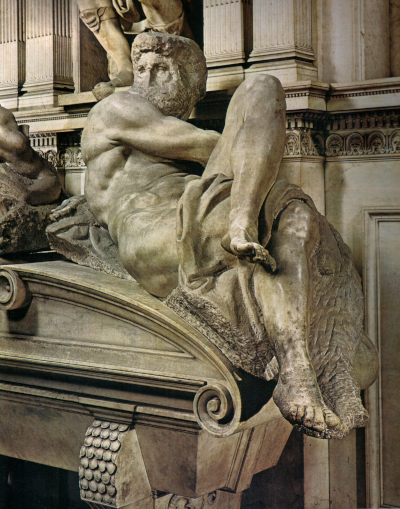
Michelangelo’s Day has the physique of a figure fully awake and the face of one still emerging from stone. A massive male body turns across the Tomb of Giuliano de’ Medici, muscles gathering force while the head remains broad and unresolved. The contradiction is central: daylight should reveal, but this personification withholds its identity at the point where a portrait would normally become most legible.
Known as Giorno in the official catalogue, the marble lies beside Night beneath the idealised Duke of Nemours.[1][2] Across the New Sacristy, Dawn and Dusk mark transitions on Lorenzo’s tomb.[3] Day is therefore one quarter of a temporal system, yet its unequal finish gives it a distinct problem. Is the rough head an interruption, an expressive success, or both? The evidence allows the last answer as a modern experience, not as certain proof of Michelangelo’s motive.
At a Glance
- ArtistMichelangelo Buonarroti
- TitleDay, or Giorno
- DateDeveloped during the New Sacristy campaign, chiefly in the 1520s and early 1530s
- MediumMarble
- SubjectMale personification of daytime
- MonumentThe Duke of Nemours’s funerary wall
- Companion figureNight[1][2]
- Opposite pairDawn and Dusk on Lorenzo’s tomb
- LocationThe Giuliano monument inside the Museo delle Cappelle Medicee[3][4]
- Defining featureA powerfully articulated torso joined to a markedly unfinished head and other less resolved passages
- Central cautionThe non-finito is visible and expressive, but should not be assigned one deliberate symbolic programme
Contents
- Day Without Sunlight Attributes
- On Giuliano’s Sarcophagus
- The Torso as the Figure’s Face
- The Unfinished Head
- Power Under Constraint
- Day and Night
- Across to Dawn and Dusk
- Ideal Male Nude and Funerary Time
- Masculinity, Effort and Exposure
- Wakefulness Without Vision
- Day as Duration, Not a Moment
- Disegno and the Changing Monument
- Non-Finito Without a Master Key
- Modern Access and Historical Distance
- How to Look at Day
- Why Day Matters
- Artist Up Close
Day Without Sunlight Attributes
Unlike Night, with owl, poppies, mask and celestial signs, Day does not depend on a dense set of objects for recognition. The title and pairing perform much of the iconographic work. A wakeful male body opposite a sleeping female figure becomes daytime through relation.
This relative absence of attributes makes anatomy more important. Day is not shown driving a solar chariot or holding the sun. It is bodily energy at its widest, a condition of full activity rather than a narrated deity.
The choice also creates ambiguity. Detached from the tomb, the figure might be read as a powerful unfinished nude rather than a temporal personification. Architecture and companion supply the category that the body makes experiential.
On Giuliano’s Sarcophagus
The official record places Giorno on the tomb of Giuliano, Duke of Nemours.[1] Above, the armoured ruler represents active command. Below, Day turns that active principle into a universal force rather than a personal trait.
The relationship is flattering and mortal at once. Giuliano appears aligned with wakefulness, authority and public action. Yet day passes, just as his life did. The allegory cannot secure permanent rule.
The sarcophagus’s curve destabilises the enormous nude. Even full daylight must balance on the sign of death. Michelangelo makes temporal power physically precarious.
The Torso as the Figure’s Face
Because the head remains unresolved, the torso carries an unusual share of identity. Shoulders, chest, abdomen and turning back communicate attention through pressure rather than expression. The body becomes the figure’s psychological instrument.
Michelangelo establishes a rotation that makes no single frontal view sufficient. One side offers the breadth of chest and arm; another exposes the compression of back and neck. The spectator must move to assemble Day, just as daylight moves across surfaces.
The analogy should not become a claim of documented symbolism. Its importance lies in perception: an unfinished face redirects the ordinary search for character into anatomy.
The Unfinished Head
The head is not blank, but it is less resolved than the torso. Broad carving establishes mass and turn without refining features into a stable expression. Light breaks across the surface, changing what seems visible.
This condition has generated poetic interpretations. A head too brilliant to look at could suit Day; an identity not yet fully born might complement the emerging morning on the opposite tomb. Such readings are imaginative responses, not archival explanations.
The New Sacristy’s interrupted history supplies a practical framework.[2][4] Michelangelo left Florence in 1534, with parts of the programme incomplete. The head’s expressive power today can coexist with a historical account of work that stopped.
Power Under Constraint
Day’s body appears capable of standing, yet it remains folded across architecture. Limbs and torso adjust to the narrow sarcophagus, turning strength into compression. The figure is not free to enact the force it possesses.
This creates an affinity with Michelangelo’s Prisoners without merging their programmes. Both make bodies appear more powerful because stone or support limits them. Here the constraint is architectural and allegorical, not the literal block surrounding an unfinished captive.
The tomb’s curve turns the male nude into a structural participant. His weight anchors one side of the monument while his torsion prevents stillness.
Day and Night
Night sleeps with a leg raised and a complex folded body, accompanied by signs of darkness. Day remains awake but faceless. Their opposition is clear without becoming a mirror.
Gender, finish and consciousness differentiate them. Night’s female face is identifiable but withdrawn; Day’s male torso is active while the face refuses full legibility. Each makes visibility unstable in another way.
Together they cover Giuliano’s sarcophagus with the largest natural alternation. The duke’s ideal public identity rises above both sleep and activity, while his death confirms that neither state lasts.
Across to Dawn and Dusk
Lorenzo’s Dawn and Dusk represent transitions. Day appears more complete as a state, but less complete as a carved face. Michelangelo lets material and iconographic completion cross.
Dawn awakens visibly; Day’s waking force has no settled expression. Dusk yields; Night sleeps. Viewed in sequence, the sculptures turn bodily consciousness into a cycle.
The arrangement requires movement around the chapel. The spectator supplies temporal continuity by comparing bodies separated in space.
Ideal Male Nude and Funerary Time
The ideal nude derives authority from classical art, where gods, heroes and personifications could appear outside ordinary clothing. Michelangelo uses that tradition for something less triumphant: the inescapability of passing hours.
Day’s body is not the historical Duke Giuliano. It represents a force that acts upon him. Its youth and strength make mortality more, not less, emphatic. Even the most powerful body belongs to time.
Placed beneath armour, nudity also marks a hierarchy of categories. Giuliano has social status and historical name; Day has universal bodily existence without individual biography.
Masculinity, Effort and Exposure
Michelangelo makes Day male, but the figure’s masculinity is not communicated by strength alone. Exposure matters. The body has no armour, occupation or social costume, so its power belongs to the abstract cycle rather than a historical person. This male nude is less protected than Giuliano above despite appearing physically larger.
The comparison with Dusk reveals two forms of masculine time. Dusk’s mature body releases energy; Day concentrates it. One suggests expenditure, the other availability. Neither is simply heroic, because both are forced to recline on tomb architecture rather than act in open space.
The male type thus carries a contradiction. Renaissance visual culture could associate ideal musculature with agency, yet Michelangelo denies the figure a clear deed and even a finished face. Day has all the equipment of action except freedom and personal identity.
Wakefulness Without Vision
Day’s unresolved eyes make wakefulness strange. Night sleeps and therefore has no need to look. Day should be the time of sight, but the marble does not offer a settled gaze. Activity exists without an object of attention.
This gap redirects spectators toward their own seeing. We look at a figure who cannot clearly look back, and daylight’s apparent transparency becomes one-sided. The viewer enjoys visibility that the personification does not possess.
Again, this is an effect of the surviving object rather than a securely documented programme. Its value lies in how perfectly material interruption complicates allegory. The rough head does not erase daytime; it makes the condition of seeing unexpectedly difficult.
Day as Duration, Not a Moment
Dawn and dusk have inherent directions: one arrives, the other leaves. Day is duration, the extended interval between them. Michelangelo avoids narrating a single hour or solar event and instead gives the figure sustained bodily capacity.
That duration helps explain the pose’s held energy. Day is not born or dying. It persists, but persistence on a tomb is never secure. Night will replace it.
The sculpture consequently embodies temporal breadth through physical mass. Its huge torso makes daytime feel expansive even while the sarcophagus limits movement.
Duration becomes muscular.
The marble holds noon indefinitely as concentrated, unusable strength.
Disegno and the Changing Monument
British Museum drawings for free-standing and double Medici tombs preserve phases before the surviving wall arrangement.[5][6] They show Michelangelo varying the relation among sarcophagus, sculpture and architecture.
These sheets cannot be used as final installation maps. Design develops. A figure may change pose, partner or architectural setting between study and marble.
The Met’s career-wide account explains disegno as invention moving between media.[7] Day’s body belongs to that process, where paper, models, carving and wall design informed one another.
Non-Finito Without a Master Key
Michelangelo’s unfinished surfaces attract grand explanations: figures escaping matter, spirit opposing flesh, perfection withheld because the ideal could never be realised. Such ideas may enrich response but cannot be applied mechanically to every object.
For Day, the safest method separates three levels. The work is visibly uneven in finish. The chapel’s history was interrupted. The present contrast between resolved torso and rough head has expressive consequences. None requires pretending that one cause explains everything.
This disciplined uncertainty makes the sculpture more interesting. It remains both an arrested labour and a remarkably complete embodiment of force.
Modern Access and Historical Distance
The Medici Chapels preserve Day within the architectural environment for which it was conceived.[3][4] That continuity is exceptional, but present viewing is not identical with sixteenth-century experience. Museum movement, conservation needs and lighting influence access.
The official cultural record of current stewardship is valuable for institutional context, not for freezing one visitor condition forever.[4] What remains stable is the need to see Day as part of Giuliano’s monument.
Close images reveal tool marks; the chapel establishes height, support and dialogue. Each view corrects the other.
How to Look at Day
Begin with the unresolved head, but do not stop there. Follow its turn into neck, shoulders and torso. Ask how the body communicates what the face withholds.
Locate every point of support on the sarcophagus and notice how strength is compressed into repose. Then compare Night’s sleeping withdrawal.
Finish by crossing toward Dawn and Dusk. Day’s identity is strongest when it completes a cycle rather than standing as a solitary anatomical fragment.
Why Day Matters
Day matters because Michelangelo made visibility paradoxical. The personification of light has no fully finished face, yet the body announces wakeful power with extraordinary clarity.
It also shows how unfinished sculpture can achieve formal completeness without a fictional claim that roughness was always intended. The torso, turn and architectural pressure already make Day present. Missing resolution changes that presence rather than cancelling it.
Within the New Sacristy, the figure gives Giuliano’s tomb an active temporal pole. Its strength cannot prevent death or stop evening. Marble turns that limitation into permanent tension.
Artist Up Close
Michelangelo’s command of the male nude allowed him to transfer expression from face to torso, an ability visible from the Sistine ceiling to the Prisoners. In Day, that skill met the unfinished history of a large architectural commission. The result should not be treated as a lucky accident or a fully intentional rough aesthetic. It is the surviving point at which design, bodily knowledge and interruption became inseparable.
Frequently Asked Questions
Discussion
How does Michelangelo make daylight feel tense, unfinished and physical?
Reader Insights
How does Day's twisting body change the tone of Giuliano's tomb?
Does the unfinished face make Day feel more powerful or less complete?
How does the Day/Night pair differ from Dawn/Dusk across the chapel?
Join the Conversation
Set Day beside Night, Dawn and Dusk. Which figure makes time feel most physical?
References
- Catalogo generale dei Beni Culturali, Giorno”:, View source.
- Catalogo generale dei Beni Culturali, Michelangelo e la Sagrestia Nuova in Firenze — Un progetto innovativo”:, View source.
- Musei del Bargello, Cappelle Medicee”:, View source.
- Ministero della Cultura, Firenze — Cappelle Medicee: Un ascensore per Michelangelo”:, View source.
- British Museum, The Medici Tombs in the New Sacristy: Studies for a Free-standing Sepulchral Monument”:, View source.
- British Museum, The Medici Tombs in the New Sacristy: A Study for a Double Tomb with Figures”:, View source.
- The Metropolitan Museum of Art, Michelangelo: Divine Draftsman and Designer”:, View source.