


 by Tom Gurney
Tom Gurney BSc (Hons) is an art history expert with over 20 years experience
Published on June 19, 2020 / Updated on November 6, 2025
Email: tomgurney1@gmail.com / Phone: +44 7429 011000
Pitti Tondo by Michelangelo
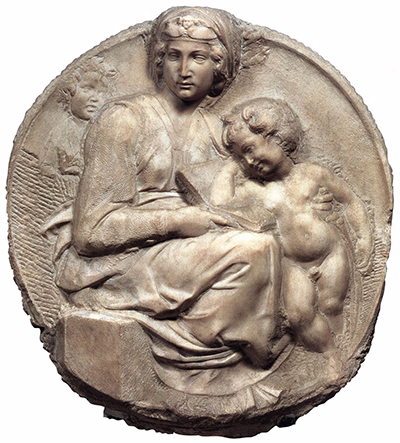
The circle appears to promise harmony. Michelangelo’s Pitti Tondo refuses to make that promise easy. Within its round marble boundary, the Virgin rises with a breadth that seems too large for the available field, the Christ Child presses into her, and the young Saint John emerges more tentatively at one side. Smooth and rough passages coexist. Some forms project with commanding clarity; others hover at the threshold of visibility. The relief is at once intimate and monumental, resolved and visibly in process.
The Museo Nazionale del Bargello in Florence now holds the work, which is generally placed in the opening years of the sixteenth century. Its familiar name connects it with the Pitti family, while its fuller object title identifies the subject as the Madonna and Child with the young Saint John.[1] Those basic facts matter because they keep three different things in view: this is a devotional image, a circular Florentine object, and an experiment in carving whose varying states of finish are inseparable from its modern power.
Why is Pitti Tondo more than a round Madonna relief? The page focuses on a specific marble tondo where devotional subject, circular design, relief depth and source-led finish language all matter together.
At a Glance
- ArtistMichelangelo Buonarroti
- TitlePitti Tondo, also known as Tondo Pitti or Madonna and Child with the Young Saint John
- DateEarly sixteenth century, commonly placed around 1503–1504
- MediumMarble relief
- FormatTondo, or circular relief
- SubjectMary with the infant Christ and the youthful John the Baptist
- Present locationMuseo Nazionale del Bargello, Florence
- Associated namePitti, reflecting the work’s historical connection with the Florentine family
- ConditionUnfinished, with markedly different degrees of carving and polish
- Central problemHow can monumental bodies, devotional intimacy and emerging form coexist inside a shallow circular field?
Contents
- What Is a Tondo?
- A Madonna Built Like a Monument
- Christ and the Young Saint John
- The Name and the Object’s History
- A Surface in Several States
- How Relief Depth Organises Meaning
- The Circle as Pressure, Not Decoration
- Pitti Tondo and Taddei Tondo
- Pitti Tondo and Doni Tondo
- Between Completion and Imagination
- Why the Pitti Tondo Matters
- Artist Up Close
What Is a Tondo?
The Italian word tondo refers to a round work of art. Circular paintings and reliefs were especially familiar in Renaissance Florence, where the shape could suit domestic settings and devotional subjects. Yet a tondo was never merely a rectangle trimmed into a pleasant curve. The boundary changes the artist’s task. There are no neutral corners in which secondary details can rest; every contour must answer the circumference.
Michelangelo makes that constraint conspicuous. The Virgin fills the field so amply that the circle seems barely able to contain her. Her head nears the upper edge, while her body establishes a broad central mass. The children do not occupy a separate foreground or background in the manner of figures arranged on a stage. They attach themselves to Mary’s form and to the roundel’s limited depth. The circular edge compresses the group and gives its inward relationships unusual force.
The format also guides the eye. Mary’s curved back and enclosing arms echo the outer limit without simply repeating it. Christ’s movement introduces a smaller, less stable rhythm, and John’s partial emergence prevents the composition from sealing itself into perfect symmetry. The circle creates unity, but Michelangelo populates that unity with unequal pressures.
A Madonna Built Like a Monument
The Virgin dominates the relief not through display but through scale and structure. Her torso, drapery and head form the composition’s architectural core. She does not appear as a fragile figure surrounded by ornamental space. Instead, she possesses the field. The effect is particularly striking because a devotional Madonna and Child would often have been associated with intimate contemplation. Michelangelo retains that intimacy while giving Mary the mass of public sculpture.
Her expression contributes to the work’s gravity. She does not dissolve into an easy exchange of smiles with the Child. Her face is controlled and inward, and the breadth of her body gives her reserve physical weight. The Christ Child is close to her, but proximity does not become sentimentality. The relationship is communicated through contact, containment and the different directions of their bodies.
This monumentality depends upon relief rather than freestanding volume. Mary cannot be circled. The viewer meets her as a figure bound to the marble field, with projection carefully rationed. Michelangelo makes that limitation productive: the body appears to press toward us precisely because so much of it remains inseparable from the stone behind.
Christ and the Young Saint John
The two children complicate the Virgin’s commanding stillness. Christ is not an accessory placed in her lap to complete an iconographic formula. His smaller body generates turns and counterpressures within Mary’s encompassing mass. The precise emotional story remains restrained, but the physical relationship is unmistakable. He is held, yet he is not inert.
The young Saint John is less fully asserted. His place at the edge and his different degree of emergence make him both participant and witness. Christian tradition understands him as Christ’s precursor, the child who anticipates a future role of recognition and proclamation. In the relief, however, theology is translated into position. John’s subsidiary status is not indicated by a written label; it is felt in scale, placement and finish.
This hierarchy keeps the group coherent without making it static. Mary is the great stabilising form, Christ activates the centre, and John extends the sacred encounter toward the circumference. Because their bodies occupy different levels of relief, their relationships are as much material as narrative.
The Name and the Object’s History
The title Pitti Tondo is a historical name, not a description of the sacred subject. The Italian national catalogue supplies the governing object identity and provenance framework, including the work’s association with the Pitti name and its place in the Bargello collection.[1] That documentary spine is important because the alluring familiarity of a family name can encourage unsupported stories about an exact commission or original room.
It is safer to distinguish what the name establishes from what it does not. The work belongs to a history connected with the Pitti family, one of Florence’s prominent lineages. That does not mean every circumstance of its making, delivery and first display is known. “Pitti” helps trace the object through ownership and collecting history; it should not be turned into a complete scene of patron and sculptor negotiating over the marble.
Its present home gives the roundel another context. The Bargello’s Michelangelo holdings bring it into conversation with works in the round and with objects at very different stages of completion. The museum describes its Michelangelo collection through the flowering of Renaissance sculpture and recognises the atmospheric importance of surfaces that remain less than fully finished.[2] In that setting, the tondo does not look like a marginal domestic exercise. It becomes evidence of how flexibly Michelangelo thought in marble.
A Surface in Several States
No account of the Pitti Tondo can avoid the uneven finish, but the word “unfinished” needs precision. It does not mean that nothing is resolved, nor does it mean that roughness is distributed at random. The relief contains a spectrum: passages that approach polish, areas articulated with visible tools, forms only partly separated from their ground, and stone that still reads as stone before image.
These differences create an atmospheric effect. A more finished face or limb catches light in a controlled way; a rougher passage breaks it into small fluctuations. Forms can seem to gather and disperse as illumination changes. John, in particular, participates in this uncertainty of emergence. He is iconographically present, yet the material never grants every part of him equal definition.
It is tempting to interpret such a surface as a final declaration of Michelangelo’s theory—that the perfect figure sleeps inside the block, or that incompletion was always an expressive choice. The object does not warrant so simple a conclusion. Work could remain unfinished for many practical, historical or artistic reasons, and surviving evidence does not reduce the Pitti Tondo to one. The responsible claim is also the more interesting one: whatever the cause, its present condition allows viewers to see different thresholds of sculptural formation together.
How Relief Depth Organises Meaning
Relief is an art of controlled inequality. Some forms must come forward more than others, yet all remain attached to a common ground. Michelangelo uses those unequal depths to establish importance. Mary possesses the strongest continuity and apparent mass. Christ turns within her orbit. John’s lighter emergence makes his supporting role perceptible before the viewer has named him.
This organisation cannot be reduced to a diagram of foreground, middle ground and background. The tondo is too compressed for that. Instead, depth behaves like emphasis in speech. A projecting contour receives stress; a lightly incised passage becomes quieter; a rough field holds possibilities without declaring all of them. The eye reads those variations as a hierarchy of attention.
The strongest illusion occurs where apparently substantial bodies approach the surface. Although their physical projection is limited, Mary and Christ can feel almost freestanding. Michelangelo achieves the effect by controlling overlap, by sharpening selected boundaries and by letting less resolved matter recede. Marble depth is scarce, so every increment carries consequence.
The Circle as Pressure, Not Decoration
Artists can use a circular format to suggest completion, cosmic order or domestic harmony. In the Pitti Tondo, the circle also behaves as pressure. Mary’s scale pushes toward it. The children occupy the remaining intervals. The composition has no broad reserve of empty ground to soften the encounter. Sacred closeness becomes spatial closeness.
The round boundary makes cropping a central expressive device. Bodies appear selected and contained by the field rather than comfortably displayed inside it. This gives the relief a sense that its figures continue beyond what the stone can show, even though they are materially captive within it. The paradox is characteristic of Michelangelo: confinement intensifies the impression of potential movement.
This helps explain why a complete view of the object matters. A detail of Mary’s face or the Child can reveal toolwork and expression, but it cannot communicate how the circumference governs the group. The edge is not packaging. It is an active participant in the design.
Pitti Tondo and Taddei Tondo
Michelangelo’s two celebrated marble tondi invite comparison. Both centre on the Madonna and Child; both incorporate the young Saint John; both preserve passages of incomplete carving; and both make the circular boundary part of their meaning. Yet treating them as interchangeable versions obscures what each achieves.
The Pitti Tondo is dominated by Mary’s breadth and frontal authority. The Taddei Tondo develops a more agitated encounter among the children, with Christ reacting to the Baptist and his bird. Its movements are more explicitly transactional. The Pitti group feels compressed into a dense monumental unity, even where its surface remains open.
Their different collection histories matter as well. The Pitti relief is in Florence’s Bargello; the Taddei relief entered the Royal Academy’s collection in London. Each should therefore be approached through its own object record, condition and provenance. Comparison is most valuable when it reveals Michelangelo testing the same format with altered emotional and spatial priorities, not when it turns two marbles into stages of a single unfinished design.
Pitti Tondo and Doni Tondo
The painted Doni Tondo provides a second natural comparison. It too organises a sacred family inside a circle, and it belongs to roughly the same broad Florentine period. The Uffizi identifies it as a panel painting of the Holy Family and preserves a specific history distinct from that of the marble roundel.[3] The shared format permits close comparison; it does not establish that one is a preparatory study for the other.
Material changes everything. Paint can use colour, atmospheric recession and the meeting of bodies against a landscape. Marble relief depends on projection, shadow and the tactile legibility of the surface. The painted Holy Family twists through intensely modelled colour, while the Pitti figures gain power by pressing against a literal ground. Even the circles behave differently: the panel opens a pictorial world, whereas the relief’s edge encloses actual stone.
Placed together in thought, the works show that Michelangelo did not approach the tondo as a fixed recipe. The format was a recurring problem capable of supporting domestic devotion, monumental figure design and very different material experiments.
Between Completion and Imagination
The unfinished passages place an unusual responsibility on the viewer. Where a contour is fully declared, recognition is swift. Where features remain broad or surfaces rough, the eye participates in completing relationships. This does not mean the spectator invents any image they please. The carved evidence guides attention, but it does not settle every transition.
That balance helps the tondo avoid becoming inert. Finished detail can arrest the eye; emerging form returns it to the act of becoming. Viewers move repeatedly between the two. The devotional subject is ancient and recognisable, yet the material experience remains provisional. Mary appears enduring, while portions of the world around her are still arriving.
It would be an error to romanticise the condition and an equal error to treat it only as deficiency. The Pitti Tondo survives as neither a polished totality nor an abandoned blank. Its meaning now resides partly in that middle state. The work makes completion itself visible as a set of choices.
Why the Pitti Tondo Matters
The relief concentrates several of Michelangelo’s deepest sculptural concerns inside one circle: the body’s power to exceed a boundary, the conversion of shallow stone into apparent mass, and the expressive difference between polished form and resistant material. It also gives the Madonna and Child theme an unusual balance of tenderness and severity. The figures touch, but Michelangelo refuses sweetness as their only emotional register.
The work matters within Florentine tondo culture because it makes the familiar form strenuous. Within Michelangelo’s career it represents a return to relief after the precocious Madonna of the Stairs and the crowded Battle of the Centaurs, now backed by experience of major freestanding sculpture. It matters to the history of the unfinished because it permits modern viewers to study multiple levels of decision in one surface without pretending to know a single cause for their survival.
Most of all, the Pitti Tondo makes compression feel expansive. Its circle limits every figure, its relief depth is physically narrow, and its surface withholds full resolution. From those restrictions Michelangelo produces an image that seems larger, heavier and more psychologically spacious than the object’s boundaries should allow.
Artist Up Close
Michelangelo Buonarroti was born in 1475 at Caprese and trained in Florence, where the sculpture of antiquity and the recent achievements of Florentine masters formed his early visual education. By the early sixteenth century he had already carved the Roman Pietà and the colossal David. The Pitti Tondo belongs to that moment of extraordinary sculptural confidence, yet its relief format required a language different from either freestanding statue. Rather than repeat a successful formula, Michelangelo used the circular field to test how little physical depth was needed to create monumental presence.
Frequently Asked Questions
Discussion
What makes Pitti Tondo feel most sculptural: the round field, the Madonna and children, or the unfinished surface?
Reader Insights
How does the circular field change the sculptural problem?
Where does the familiar subject become specifically Michelangelo's?
How should a page discuss unfinished marble without overclaiming intention?
Join the Conversation
Compare circular form, devotional subject and unfinished marble while keeping this page distinct from other Michelangelo tondo and Madonna pages.
References
- Catalogo generale dei Beni Culturali, Tondo Pitti. Madonna con Bambino e San Giovannino”:, View source.
- Musei del Bargello, Michelangelo: the Bloom of Renaissance Art”:, View source.
- Uffizi Galleries, Holy Family known as the Doni Tondo”:, View source.