 by Tom Gurney
Tom Gurney BSc (Hons) is an art history expert with over 20 years experience
Published on June 19, 2020 / Updated on August 8, 2026
Email: tomgurney1@gmail.com / Phone: +44 7429 011000
Michelangelo’s Atlas Slave
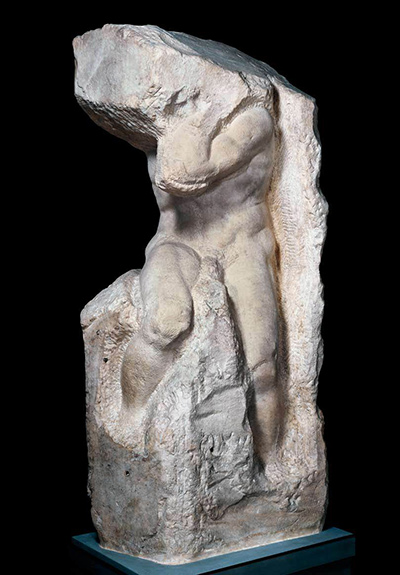
The Atlas Slave appears to carry the block from which it is being carved. A massive weight presses above the head; the shoulders bunch beneath it; the torso twists while the legs remain partly absorbed by rough marble. The familiar title recalls Atlas bearing the heavens, but Michelangelo’s figure has no securely documented mythological identity. What can be seen is stranger: stone reads at once as burden, setting and unfinished material.
The marble belongs to the four Prisoners now in the Galleria dell’Accademia in Florence. The museum dates the group broadly from 1519 to 1534 and connects it with successive plans for the Tomb of Pope Julius II. When the project was reduced, the figures were left unfinished in Michelangelo’s studio.[1] The Atlas Slave is therefore both a powerful image of constrained strength and physical evidence of a commission that lost the architectural place prepared for it.
At a Glance
- ArtistMichelangelo Buonarroti
- TitleAtlas Slave or Atlas Prisoner
- GroupAtlas, Awakening, Bearded and Young Slave
- DatingBroadly 1519–1534 with the four Florence figures
- MaterialMarble
- MuseumGalleria dell’Accademia in Florence
- Original projectThe funerary monument commissioned by Julius II
- Defining featureThe body appears compressed beneath a large block above the head
- StateUnfinished
- Later historyLeft in Michelangelo’s studio, displayed in the Boboli Gardens, transferred to the Accademia in 1909
- Final-tomb distinctionNever installed in the monument at San Pietro in Vincoli
- Title caution“Atlas” is a later name prompted by appearance, not proof that the figure represents the ancient Titan
Contents
- A Body Beneath Its Own Stone
- Anatomy of a Burden
- The Block as Positive Form
- The Florence Prisoners
- A Survivor of the Julius II Project
- Is the Figure Really Atlas?
- Unfinished, Abandoned and Expressive
- Not One of the Louvre Slaves
- Artist Up Close
A Body Beneath Its Own Stone
The upper block dominates the first impression. Instead of opening a clear silhouette around the head and shoulders, the marble bears down upon them. The figure seems to brace against the weight, creating the resemblance to Atlas that gave the sculpture its name.[1]
Below this burden, the body is far from passive. The torso shifts laterally and rotates. One side expands into a broad flank while the other contracts. The legs establish an unequal support, though their contours remain interrupted by stone. Force travels downward as well as upward: the figure bears the block because its whole body is compressed beneath it.
In a finished sculpture, surrounding marble would ordinarily have been cut away to clarify silhouette, separate limbs and open spaces between the body and support. Here the unremoved mass remains an active participant. It can look like a load the figure must carry, even though historically it is also the material from which head, arms and adjacent forms might have been further developed.
This double reading distinguishes Atlas from the other Prisoners. The title of the Awakening Slave makes the block seem like sleep or inertia being escaped. In Atlas, the block seems already to possess weight and direction. Emergence becomes labour.
Anatomy of a Burden
The body does not answer the upper mass symmetrically. One side of the torso opens more fully while the other remains compressed. This unevenness prevents the figure from becoming a simple human column. Weight is received through a living structure capable of twisting, tiring and adjusting.
The head is particularly difficult to read because the block denies it a free outline. Instead of crowning the figure, it becomes a point of maximum pressure. The shoulders seem to take over the work of expression: raised and bunched, they communicate effort before facial features can be clearly seen.
Below, the hips translate burden into counter-movement. The shift of the pelvis prevents the load from travelling down a perfectly vertical spine. Legs that remain partly unresolved nevertheless establish a grounded resistance. The sculpture feels heavy not because the marble is large—every monumental statue is heavy—but because anatomy appears to register its weight.
This bodily logic distinguishes visual observation from allegory. No myth is needed to see labour. The Atlas association then enriches that observation by giving cosmic scale to a pressure already present in the pose.
The Block as Positive Form
Ordinarily, viewers describe uncarved marble as what is “left over.” In Atlas, that language is inadequate. The block has a silhouette, direction and apparent force. It creates the conditions under which the body can be seen.
Above the head, stone reads as a load. Beside the torso, it reads as enclosure. Around the lower limbs, it reads as material awaiting differentiation. These functions change continuously. The same mass can be burden from one angle and unrealised anatomy from another.
The sculpture thereby exposes a fundamental fact of carving: a figure is made through removal. Michelangelo could not add an arm if too much stone had already disappeared. Preserving the block maintained options, while every cut narrowed them. The unfinished work lets viewers experience that irreversible decision-making unusually directly.
It is tempting to imagine a complete statue hidden inside, requiring only liberation. Yet the block did not contain one predestined form. Poses, supports, surface finish and architectural relations were created through successive choices. Atlas is compelling because several possible futures remain materially present, not because a finished answer waits intact beneath the roughness.
The Florence Prisoners
The four Accademia marbles are named Atlas, Awakening, Bearded and Young Slave. Their present grouping reflects a shared tomb history and later museum life, but it does not prove that Michelangelo carved them in the order suggested by their varying finish.[1]
The Accademia gives the group a broad 1519–1534 range. That span accommodates interrupted work and repeated changes in the Julius commission. A rougher body need not be earlier, and a clearer face need not be later. Different zones could be advanced according to the block, the intended view or a revised purpose.
All four remained in Michelangelo’s studio after the project was reduced. They later entered a new setting in the Boboli Gardens, where unfinished funerary figures became outdoor ornaments, and were transferred to the Accademia in 1909.[1] Their present alignment on the approach to David is a powerful museum sequence, not a reconstruction of the papal tomb.
That display encourages visitors to see artistic creation unfolding: figures appear to emerge progressively as one walks toward a supremely finished statue. The experience is legitimate as modern curatorship, but it can make the Prisoners look like illustrations of a predetermined theory. Their unfinished states began in the less orderly history of work interrupted and architecture abandoned.
The garden and gallery settings have thus each emphasised a different quality. Outdoors, rough stone could answer foliage, weather and grotto-like architecture. Indoors, controlled comparison turns every tool mark into evidence of process. Neither context is neutral, and neither recreates the lost tomb.
A Survivor of the Julius II Project
Julius II first commissioned Michelangelo to design his tomb in 1505. The project extended across approximately forty years and ended in a wall monument unveiled in 1545.[2] Between those dates, its intended site, scale, contracts and population of sculpture changed repeatedly.
An early tomb design at the Met conveys the scale of the initial ambition, while its debated attribution history and differences from literary accounts show why no reconstruction can stand unquestioned for the lost first project.[7] Later drawings propose bound figures around lower architectural zones, but the exact place of each Florence Prisoner is not secured by the group’s present titles.
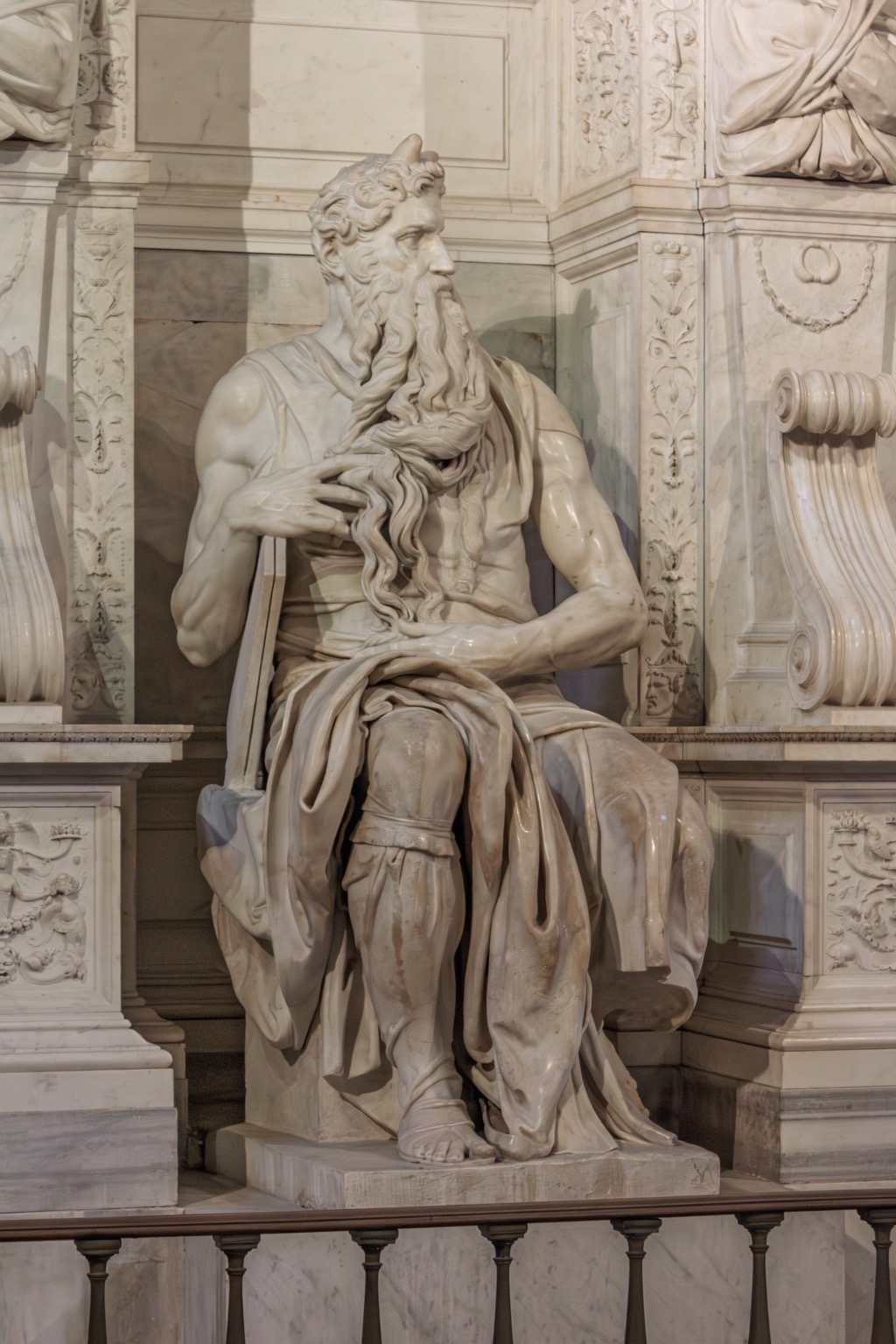
The Accademia’s institutional boundary is the most reliable: the four were made for the Julius mausoleum and abandoned after reduction.[1] They should not be described as statues removed from the monument now in Rome. That final ensemble at San Pietro in Vincoli is centred on Moses and uses a different programme.[3]
The Atlas Slave nevertheless preserves the architectural thinking of the larger project. Its vertical pressure, incomplete lateral spaces and body aligned against a block make sense for sculpture conceived in relation to supports. Even without a certain niche, the figure shows how human anatomy could animate structural weight.
Is the Figure Really Atlas?
The Greek Atlas was condemned to hold up the heavens. Michelangelo’s figure seems to bear an overhead mass, so the nickname is visually persuasive.[1] But no attribute, inscription or surviving programme securely identifies the Titan.
The name changes what viewers see. Once told “Atlas,” they may imagine the block as the cosmos and the bent body as punishment. Without the title, the same stone might appear to contain raised arms, an unfinished head or a figure pushing free.
Conventional titles are useful when treated as histories of looking. They distinguish one Prisoner from another and record the feature that made it memorable. They become misleading only when a descriptive resemblance hardens into proven iconography.
The accompanying term “Slave” deserves similar care. The Italian Prigioni can be translated as Prisoners, and neither label provides a named historical identity. These figures were imagined as bound or captive bodies within a Renaissance funerary programme; they should not automatically be recast as documentary images of modern slavery.
Unfinished, Abandoned and Expressive
The Atlas Slave is literally unfinished. Broad areas remain at a rough stage, the silhouette is not fully released and the upper mass retains unrealised possibilities. Its abandonment after reductions to the tomb gives that state a clear historical context.[1]
Modern viewers have made the surface central to Michelangelo’s non-finito: the expressive condition in which a sculpture’s incompletion can seem meaningful in itself. The metaphor of a soul or idea struggling to leave the block feels almost unavoidable here. Yet its emotional power does not prove that Michelangelo selected this exact state as final.
Several causes can coexist. Michelangelo’s method produced dramatic transitional surfaces. The block may have posed constraints. A revised design removed the need for the figure. Later viewers and displays then made its interrupted carving legible as a complete aesthetic experience.
The National Gallery of Denmark’s study of Michelangelo’s incomplete work helps by separating originals from casts, facsimiles and reconstruction models.[4] A cast may preserve form at the time it was taken; a model may propose a tomb setting. Neither settles what still-unworked stone would have become.
Close looking should therefore distinguish states rather than label all roughness alike. Some passages establish anatomy; others retain quarry-like mass; still others show intermediate toolwork. The boundary between figure and block changes around the sculpture, which is precisely why a single photograph can misrepresent its degree of emergence.
Not One of the Louvre Slaves
The Dying Slave and Rebellious Slave at the Louvre belong to an earlier 1513–1515 phase and are much more fully resolved.[5][6] Their bands and opposed poses have generated interpretations of captivity, mourning and the soul bound to matter. Those meanings cannot simply be transferred to Atlas.
The comparison is useful because it demonstrates how the tomb’s bound figures changed. The Louvre bodies detach clearly enough to be read as autonomous nudes; the Florence Prisoners remain materially entangled with stone. One group now occupies Paris, the other Florence, and neither was installed in the final Roman monument.
The two groups also create different relations with time. The Louvre pair present actions held at a dramatic pitch. The Florence marbles present making itself as an interrupted duration. In Atlas, action and making converge: the figure’s labour beneath the block resembles the sculptor’s labour upon it.
They are related products of the same long project, not six members of an unchanging set. Differences of date, intended architecture, completion and afterlife must remain visible. The Getty’s specialist publication establishes why drawings, contracts, sculpture and restoration evidence all have to be brought together before exact project stages are asserted.[8]
Artist Up Close
The Atlas Slave reveals Michelangelo’s ability to make an obstruction feel anatomically answered. The upper block is not merely blank background; shoulders, spine, hips and legs respond to it. What remains uncarved gives the visible body its pressure.
That relationship makes incompletion more than an absence. We can acknowledge that the commission stopped while also recognising that the surviving state has acquired extraordinary coherence. History left the work unfinished; looking turns that condition into an encounter with weight.
Frequently Asked Questions
Discussion
How does the Atlas Slave change when seen as an Accademia object rather than a reconstructed tomb figure?
Reader Insights
How does the title Atlas Slave shape interpretation before a viewer knows the tomb history?
What changes when the sculpture is understood as a Florence Prisoner rather than a Louvre Slave?
How should public writing balance unfinished surface, abandoned commission and later museum display?
Join the Conversation
Set the Atlas Slave beside the other Florence Prisoners, the Louvre Slaves and Moses. Which comparison best clarifies the Julius II tomb project?
References
- Galleria dell’Accademia di Firenze, Atlas”:, View source.
- Metropolitan Museum of Art, Michelangelo: Divine Draftsman and Designer — Exhibition Galleries”:, View source.
- Roma Capitale / Turismo Roma, Michelangelo’s Locations”:, View source.
- National Gallery of Denmark, Michelangelo Imperfect — English Guide:, View source.
- Musée du Louvre, Imprisoned in Stone — The Louvre’s Slaves”:, View source.
- Musée du Louvre, The Dying Slave”:, View source.
- Metropolitan Museum of Art, Design for the Tomb of Pope Julius II della Rovere”:, View source.
- J. Paul Getty Museum / Getty Publications, Michelangelo’s Tomb for Julius II: Genesis and Genius:, View source.