


 by Tom Gurney
Tom Gurney BSc (Hons) is an art history expert with over 20 years experience
Published on June 19, 2020 / Updated on November 6, 2025
Email: tomgurney1@gmail.com / Phone: +44 7429 011000
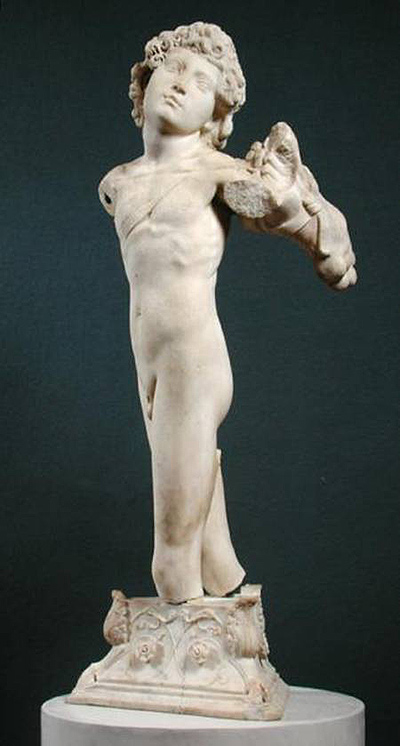
Michelangelo's Cupid at the Metropolitan Museum of Art
Michelangelo's Cupid has survived as a body interrupted. The marble youth stands in a complex turn, a quiver at his back, but his arms and lower legs are lost, his surface is damaged, and later restoration once completed him in ways that changed how the figure was read. He has been called Apollo, Cupid and the Young Archer. For much of the twentieth century, he stood outdoors in New York as the centre of a mansion fountain, his early history largely forgotten.
The Metropolitan Museum of Art now catalogues the sculpture as Cupid, carved by Michelangelo in Florence about 1490.[1] Its identification was revived in the mid-1990s by Kathleen Weil-Garris Brandt and tested through exhibition and an international symposium. The Met reports that scholarly consensus accepted it as designed and carved by the youthful Michelangelo.[2]
This is a rediscovery story, but not a sudden miracle. Names, attributes, damage, gardens, art dealing, restoration and architecture all shaped what scholars could see. The marble returned to Michelangelo only when those histories were brought together.
At a Glance
- ArtistMichelangelo Buonarroti
- Current titleCupid
- Former modern titleYoung Archer
- DateAbout 1490
- MediumMarble
- Dimensions94 × 33.7 × 35.6 centimetres
- WeightApproximately 80.3 kilograms
- Current locationMetropolitan Museum of Art, New York, on loan from the French State
- ConditionFragmentary; arms and parts of the legs are lost, and past restoration altered the silhouette
- AttributeA quiver; no surviving evidence of wings
- First known recordJacopo Galli's house in Rome in 1556, where it was called Apollo
- RediscoveryIdentified as Michelangelo in the mid-1990s by Kathleen Weil-Garris Brandt
- Institutional conclusionAccepted by the Met following focused research, a 2009 exhibition and a 2012 international symposium
Contents
- A Youth Turning in Space
- Cupid, Apollo or Young Archer?
- Is This the Cupid Owned by Jacopo Galli?
- The Problem of the Date
- Damage and the Loss of Action
- Restoration and the Illusion of a Complete Archer
- Stefano Bardini and the 1902 Sale
- Stanford White and the Payne Whitney Fountain
- Kathleen Weil-Garris Brandt's Recognition
- The Met Exhibition and 2012 Symposium
- Ownership and the French-American Loan
- Looking at Cupid Today
- Why Cupid Matters
A Youth Turning in Space
Even in fragmentary form, the figure is difficult to contain within one front view. Weight and turn travel through hips, torso and shoulders. The chest does not face in precisely the same direction as the pelvis, and the head changes the axis again. The body is being organised for an action no longer completely visible.
The missing arms matter. An archer's gesture depends on the relation among bow, drawing hand, chest and gaze. Without them, viewers supply imagined movements from the quiver and turn. Earlier restorers also supplied physical answers, making the sculpture appear more complete while narrowing interpretation.
The quiver is the main surviving iconographic clue. It can belong to Apollo, divine archer and god of music and prophecy, or to Cupid, whose arrows provoke desire. No wings are visible, and the Met notes no evidence that the youth ever had the traditional wings of Cupid.[1]
The body itself is idealised rather than portrait-like. Youth is expressed through smooth transitions and relatively soft musculature, yet the pose has structural energy. This balance made both divine names plausible.
Michelangelo's early art repeatedly treats the youthful male body as a problem of potential. Strength is present before full heroic development. Here the fragment intensifies that condition: action feels imminent because its instruments and limbs are absent.
Cupid, Apollo or Young Archer?
Titles are arguments. When the sculpture was recorded in Jacopo Galli's Roman house in 1556, it was identified as Apollo.[1] That name responded logically to a beautiful nude youth with a quiver. By 1650, when installed in a niche at the Villa Borghese, it was called Cupid.[1]
The later title may preserve recognition of a work Galli was known to own: a Cupid by the young Michelangelo. It may also reflect a changed reading in a garden, where the god of love was a familiar decorative presence.
“Young Archer” became useful in modern discussion because it described what could be seen without choosing between gods. Yet neutrality has a cost. It can detach the object from historic records that make the Cupid identification meaningful.
The Met now controls the title as Cupid. This does not pretend the iconography is visually obvious. Its object record explicitly acknowledges the ambiguity and absence of wings.[1] The title represents the best union of attributes and provenance.
This history demonstrates why old names should not be discarded carelessly. Apollo and Cupid preserve different stages of reception. “Young Archer” records modern caution. The present title emerges from all three rather than erasing them.
Is This the Cupid Owned by Jacopo Galli?
Jacopo Galli was a Roman banker, collector and crucial early patron of Michelangelo. He helped the young sculptor navigate commissions and owned important works. A 1556 inventory places the marble youth in his house under the name Apollo.[1]
Other evidence indicates that Galli possessed a Cupid carved by Michelangelo. The conjunction of owner, youthful archer and later Cupid title is central to the identification. It supplies provenance where a purely stylistic argument would be more vulnerable.
The record is not a modern photograph. Names in inventories can change; descriptions may be brief; more than one related figure could exist. The standing Cupid also needs to be separated from Michelangelo's lost Sleeping Cupid, whose famous antiquing and collection history followed another route.
The strength of the case lies in accumulation. The marble's early Roman ownership aligns with a documented patron. Its form and date fit Michelangelo's youth. The later Villa Borghese identity reconnects it with Cupid. Modern study found the carving consistent with his early practice.[2]
This is why provenance can change what the eye sees. A damaged garden figure with a quiver might belong to many Renaissance sculptors. A figure traceable to Galli, known owner of Michelangelo's Cupid, becomes a much more specific candidate.
The Problem of the Date
The Met dates the sculpture about 1490, placing it among Michelangelo's earliest known works.[1] At roughly fifteen, he had moved from Ghirlandaio's painting workshop toward sculpture in the Medici garden at San Marco, where antique fragments and Bertoldo di Giovanni's guidance shaped his training.
Such an early date makes the body's command remarkable but not inexplicable. Michelangelo's formative environment offered direct engagement with ancient sculpture and with Florentine relief and bronze traditions. Early biographies deliberately present his talent as precocious.
The sculpture's Roman record is much later than its proposed carving. A gap of more than sixty years separates making from the 1556 inventory. Identification must therefore use style and later ownership to bridge missing early provenance.
Some aspects of the figure can be read within Michelangelo's adolescence: the intense study of an ideal youth, a pose developed around an ancient subject and the willingness to make the body turn beyond a stable frontal stance. Yet an “early look” is not a date by itself.
The Met's conclusion follows extended scholarly review rather than age alone. Its 2012 symposium addressed Michelangelo and Florence in the 1490s, locating the figure within a broader network of objects, drawings, workshops and patronage.[2]
Damage and the Loss of Action
By 1902 the sculpture was gravely damaged.[1] Arms were lost, lower limbs were broken, and the surface had endured outdoor exposure and intervention. These losses remove the parts most likely to identify action.
A complete archer could reveal whether one hand drew a bow, held an arrow or performed another gesture. Feet could establish stance and support. Attachments might show attributes. Fragmentation forces title and reconstruction to depend on indirect evidence.
Damage also changes style. A clean break can make a torso seem intentionally compact. Weathering softens transitions, obscuring tool work. Restored elements can introduce the proportions and gestures of another period.
Responsible viewing separates original marble, loss and later addition where possible. It avoids praising a silhouette that Michelangelo never made or criticising an awkward join produced by restoration.
At the same time, the damaged state is part of the work's history. The sculpture was not preserved as a canonical masterpiece because it was not recognised as one. Its treatment as garden ornament and fountain figure increased vulnerability. Lost identity produced material consequences.
Restoration and the Illusion of a Complete Archer
Restoration can make a fragment easier to enjoy and harder to understand. When missing limbs are supplied, the viewer receives a coherent action rather than an open question. The new silhouette can become so familiar that it is remembered as the Renaissance sculpture itself.
For the marble youth, an archer restoration was especially persuasive because the quiver already suggested bow and arrow. Added arms could translate a possible identity into an apparently visible fact. Once the body “performed” archery, the descriptive title Young Archer seemed self-evident.
Removing or distinguishing additions reverses that logic. The quiver remains original evidence; the exact arm action does not. A fragmentary torso may once have drawn a bow, rested, reached for an arrow or combined with another support. The range of possibilities widens.
Restoration also affects attribution. Scholars compare pose, proportion and the continuity of movement. If later limbs are included unconsciously, they may create awkwardness blamed on the original artist or elegance credited to him. Condition mapping is therefore not separate from connoisseurship.
The fountain phase added another layer. Mounts and water apparatus required stability and visual legibility in an architectural setting. Interventions useful to the mansion were not designed to preserve a fifteenth-century carving as archaeological evidence.
Today's gallery display gains honesty from incompletion. It lets the surviving marble establish what Michelangelo made while documentation explains later uses. The result may look less narratively complete, but it is historically fuller.
Stefano Bardini and the 1902 Sale
The Florentine dealer Stefano Bardini recognised the damaged marble as Michelangelo when he offered it at auction in London in 1902.[1] His attribution did not hold. It was forgotten or discounted as the sculpture entered a new decorative context.
Bardini's role complicates the idea of a single 1990s discovery. The Michelangelo possibility had already been articulated, just as Cupid had been an old title at the Villa Borghese. Rediscovery involved recovering earlier recognitions and testing them anew.
Dealers could possess acute connoisseurial knowledge, but sales attributions also served commercial value. Bardini's judgment is evidence of historical perception, not final authentication. Its neglect may reflect scepticism, inadequate documentation, the object's poor condition or changing market confidence.
The 1902 moment also separated the figure from Italy. Once sold into an English-language market and then taken to New York, connections with Galli and Borghese became less visible. A new ownership story replaced the Roman one.
The sculpture's title and identity travelled unevenly. Physical movement was clear; scholarly memory was not.
Stanford White and the Payne Whitney Fountain
The American architect Stanford White acquired the marble and installed it as the centrepiece of a fountain in the rotunda entrance of the Payne Whitney Mansion at 972 Fifth Avenue.[2] The mansion had been commissioned as a wedding gift for Payne and Helen Whitney.
This setting valued the figure as Italian Renaissance atmosphere and architectural decoration. Water, marble and a grand interior transformed the fragment into part of a designed ensemble. Its damage could even enhance the aura of age.
Fountain installation imposed a new viewpoint. Rather than being examined independently in a gallery, the youth belonged to a basin and room. Later additions and mounting helped it perform that decorative function.
In 1952 the mansion became the home of the Cultural Services of the French Embassy.[2] The sculpture therefore passed into French state stewardship without leaving New York. It remained visible, even from the street, yet its Michelangelo identity was largely unrecognised.
“Hidden in plain sight” accurately describes public accessibility but can oversimplify. The marble was not invisible; the evidence around it was disconnected. Its environment encouraged viewers to see a fountain figure rather than a displaced Renaissance object.
Kathleen Weil-Garris Brandt's Recognition
In the mid-1990s, New York University professor Kathleen Weil-Garris Brandt identified the figure as Michelangelo's lost Cupid and announced a “Michelangelo on Fifth Avenue.”[2] The proposal was greeted with both interest and scepticism.
Her recognition depended on seeing through restoration and setting. The damaged youth had to be mentally separated from the fountain, compared with early Michelangelo and reconnected with the records of Galli's Cupid.
This is connoisseurship at its most productive: not a mystical flash but a trained perception that generates testable historical questions. Was the marble old enough? Did restoration conceal original form? Could its provenance be traced? Did secure early works share its construction?
The Met curator James David Draper supported serious investigation when others remained doubtful.[2] Debate over a major attribution is essential because Michelangelo's fame creates powerful incentives for belief.
The result was not immediate universal acceptance. More than a decade passed before the sculpture entered a focused museum exhibition and a further scholarly forum. That duration matters. It allowed an exciting proposal to accumulate criticism and evidence.
The Met Exhibition and 2012 Symposium
The French State lent the sculpture to the Metropolitan Museum in 2009 for a focused exhibition addressing Michelangelo's authorship.[2] Moving it from fountain to gallery changed both conservation and argument. Viewers could inspect the original from multiple angles and compare it within a history of Renaissance sculpture.
In 2012 the Met hosted the international two-day symposium “Michelangelo and Florence in the 1490s.” The museum reports that this process established scholarly consensus and that the figure was accepted as designed and carved by the young Michelangelo.[2]
Consensus is not a physical property of marble. It describes the outcome of expert comparison after evidence has been exposed to debate. Future research can refine date, title and restoration even when authorship is broadly accepted.
The Met subsequently used Cupid as a touchstone in Carmen C. Bambach's 2017 exhibition Michelangelo: Divine Draftsman and Designer.[2] Its position changed from uncertain curiosity to an object capable of organising understanding of the early career.
The museum's language is now direct: Michelangelo, Cupid, about 1490. That conclusion should control the page while the history of former doubt remains part of why it is intellectually important.
Ownership and the French-American Loan
The sculpture remains property of the French State's Ministry of Foreign and European Affairs and is lent to the Met.[1] The initial museum loan began in 2009 and was renewed for another decade in 2019.[2]
This unusual arrangement preserves the mansion's diplomatic history while giving the object museum conditions and scholarly visibility. France owns a Florentine marble discovered in its New York cultural building and displayed in an American museum.
The loan also demonstrates that location and ownership are different. “At the Met” does not mean “in the Met collection.” Credit lines matter because they preserve the chain through which a rediscovered work became publicly accessible.
At the Met, the figure serves as the museum's sole marble sculpture by Michelangelo on view in North America, according to its 2019 announcement.[2] That rarity increases attention but should not determine interpretation.
Looking at Cupid Today
Begin by separating surviving body from imagined action. Follow the turn through hips, waist and chest. Notice how the figure refuses a perfectly frontal presentation even though its limbs are missing.
Then locate the quiver and consider both titles. Ask what makes Cupid more persuasive than Apollo and how much the answer depends on provenance rather than iconography.
Study the breaks. They are not blank inconveniences; they identify precisely what cannot be known. A missing arm may have changed the entire silhouette. Avoid completing it unconsciously from the word “archer.”
Move around the back and sides. Early Michelangelo is often understood through reliefs, but this figure organises a free-standing body in the round. The torso's changing axes become clearer with movement.
Finally, remember the fountain. The fragment now appears isolated and precious, but much of its modern life was architectural. Its identity has depended on changing environments as much as changing labels.
Why Cupid Matters
The Cupid matters because it expands Michelangelo's earliest sculptural development. The turn of a youthful body, studied through antique mythology, anticipates a career in which anatomy and movement became primary expressive means.
Its history also demonstrates the material price of misrecognition. Garden and fountain use damaged the work and encouraged restorations. Canonical status arrived after losses that no attribution can reverse.
At the same time, rediscovery was cumulative. The Galli inventory, Borghese title, Bardini attribution, Brandt's recognition, Met exhibition and symposium each contributed. No single piece of evidence carried the whole result.
The figure remains ambiguous in subject even after authorship has gained consensus. It has a quiver and no wings; it was Apollo before it was Cupid. That unresolved iconography is not a contradiction. A work can recover its maker more securely than its original name.
Frequently Asked Questions
Discussion
What details, sources or comparisons stand out to you in Cupid?
Reader Insights
Which formal detail changes how the work reads?
Which documented source or collection history feels most useful?
Which related Michelangelo work should readers compare next?
Join the Conversation
Add a source-led observation, comparison or question for other readers.
References
- Metropolitan Museum of Art, Michelangelo Buonarroti: Cupid,” object record 236774:, View source.
- Metropolitan Museum of Art, Marble Sculpture by Michelangelo to Remain at The Met for Another 10 Years,” 24 May 2019:, View source.