


 by Tom Gurney
Tom Gurney BSc (Hons) is an art history expert with over 20 years experience
Published on June 19, 2020 / Updated on November 6, 2025
Email: tomgurney1@gmail.com / Phone: +44 7429 011000
Michelangelo's River God Model
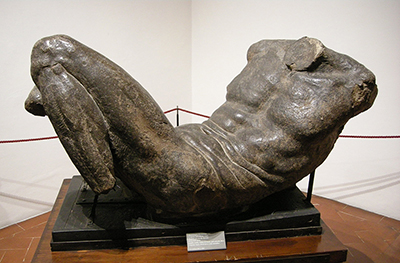
Michelangelo's River God is neither a finished statue nor a small sketch. It is a large, fragile body built from unfired clay, river sand, animal hair, vegetable fibres, wood, wire and metal mesh. The reclining male measures 65 by 40 by 70 centimetres—large enough to test how a monumental figure would occupy the floor of the Medici Chapel, yet still a working model for marble that was never carved.
Casa Buonarroti dates it about 1524–1527 and identifies it as the only surviving large-scale preparatory model for sculpture accepted as Michelangelo's own work.[1] It was intended for one of four river gods beneath the ducal tombs in the New Sacristy at San Lorenzo, probably at the left foot of Lorenzo de' Medici's monument.
The figure's survival is extraordinary because its material was designed for development, not five centuries of museum life. Its repairs, internal support and incomplete body record how an architectural sculpture existed between concept and execution. The planned marble is absent; the model has become the work through which the idea survives.
At a Glance
- ArtistMichelangelo Buonarroti
- TitleRiver God Model
- DateAbout 1524–1527
- MaterialsUnfired clay, river sand, animal hair, vegetable fibres, wood, iron wire and metal mesh
- Dimensions65 × 40 × 70 centimetres
- Current locationCasa Buonarroti, Florence
- InventoryGallerie 1890, no. 1802
- PurposeLarge preparatory model for a reclining river god in the New Sacristy of San Lorenzo
- Probable positionOn the chapel floor at the left foot of Lorenzo de' Medici's tomb
- Project statusThe intended marble river gods were never executed
- UniquenessThe only surviving large sculptural model accepted by Casa Buonarroti as an autograph Michelangelo
- Conservation historyA first restoration is recorded in 1590; the object belonged for centuries to the Accademia del Disegno
Contents
- A Body Made to Lie Low
- Four Rivers for the Medici Tombs
- The Place Below Lorenzo's Tomb
- Model and Companion Drawing
- Why Clement VII Asked for Large Models
- Building a Figure from Unfired Materials
- From Model to Marble
- Antique River Gods
- Why the River Gods Were Never Carved
- The Models Still in the Chapel
- Restoration and the Accademia del Disegno
- Rediscovering the Model's Structure
- How to Look at the River God
- Why the River God Model Matters
A Body Made to Lie Low
The figure reclines rather than standing or sitting upright. Its long torso turns above bent legs, creating an elongated mass that could spread across the base of a wall monument. Head and extremities are incomplete or lost, so the body's main action is carried by chest, abdomen, pelvis and thighs.
Low placement changes anatomy. A figure on the floor below a tomb would be seen from above and across the chapel. Proportions and turns needed to remain legible at oblique angles, while the body could not block passage or compete vertically with the seated duke and reclining Times of Day.
The river god's pose gives it weight appropriate to water. Classical river personifications commonly appear as mature reclining men, their long bodies suggesting the horizontal course of streams. Urns, reeds or aquatic creatures may identify a particular river, but no such finished attributes survive here.
Michelangelo uses the type as architecture. The body would fill a difficult zone where wall, sarcophagus, floor and viewer meet. Reclining anatomy becomes a transition between monument and occupied room.
The model allows that spatial intelligence to be seen before marble fixed it. Its limbs remain broad, and missing parts keep alternative solutions open. This was a body being positioned, not a reduced collectible designed for autonomous display.
Four Rivers for the Medici Tombs
Michelangelo planned four river gods, two beneath each of the ducal tombs of Giuliano and Lorenzo de' Medici.[1] They would have extended the monuments downward from the sarcophagi to the chapel floor.
The existing tomb figures already organise layers of time and identity. Seated dukes occupy niches above; Night, Day, Dawn and Dusk recline over curved sarcophagus lids. River gods would introduce water, earth and geographic or cosmic order below them.
Their exact iconography remains uncertain. Four rivers could evoke the rivers of Paradise, classical geography, the underworld, Florence and the Medici domains, or a general natural world beneath the passage of time. No final inscription or completed attribute settles the programme.
The absence of marbles has encouraged symbolic systems more exact than the evidence. The model confirms reclining river personifications and intended location. It does not name each waterway.
Four low bodies would also change the chapel physically. The present open floor allows viewers to approach the tombs. Completed rivers would have made architecture more crowded and the boundary between monument and spectator more forceful.
The Place Below Lorenzo's Tomb
Casa Buonarroti associates the surviving model with the left side at the foot of Lorenzo de' Medici's tomb. A British Museum drawing records a design for the companion figure on the right.[1]
Pairing is essential. One reclining body would answer another across the tomb's centre, creating asymmetrical balance rather than exact mirroring. The direction of torsos, bent legs and heads could lead the eye inward or outward.
The left position helps explain the model's directional turns. What appears arbitrary on a museum plinth may have been calibrated to the tomb's architecture and to the neighbouring figure.
Models are especially valuable for such relations. A drawing can test outline but cannot occupy a tabletop or chapel mock-up. A three-dimensional body can be moved, rotated and observed against an architectural scheme.
The planned pair also warns against judging the surviving model as a complete composition. It is one component of a lost ensemble, and its most important formal conversation would have occurred across empty space.
Model and Companion Drawing
The British Museum drawing connected with the right-hand river god provides a useful cross-media comparison. Paper lets Michelangelo establish a reclining contour rapidly, test limb overlaps and position the body in relation to architectural lines. The large clay model lets mass, projection and support answer those ideas in real space.
The two need not represent consecutive final steps. Michelangelo could revise one side while working on the other, and the paired figures were likely designed to vary. A line that appears effortless on paper might prove structurally awkward in clay; a broad clay turn could prompt a new graphic solution.
Together they show why an architectural sculptor required more than one kind of preparation. Drawing coordinates figure and monument at a glance. Modelling tests the bodily volume that will obstruct or open actual space.
The comparison also helps define what is lost. We possess one substantial body and one graphic proposal for a companion, not a full set of four models. Any digital or physical reconstruction must invent the other tomb's river gods and many extremities.
Presenting drawing and model side by side is therefore most valuable as a lesson in design methods. It should not produce the illusion that the whole floor programme can be restored without gaps.
Their different states are evidence in themselves: design advanced unevenly across a complex ensemble rather than from one complete master plan reproduced part by part.
Why Clement VII Asked for Large Models
Michelangelo rarely made sculptural models at this scale. Casa Buonarroti records that Pope Clement VII, the Medici patron, specifically requested life-size models for the New Sacristy figures.[1]
The request served practical and managerial purposes. A large model let patron and artist assess a figure before expensive marble was selected and carved. It clarified scale within architecture and could guide assistants.
Casa Buonarroti notes that execution of the models could be entrusted at least partly to others.[1] This does not dislodge Michelangelo's authorship of the surviving design, but it reminds us that large project models can contain collaborative labour.
The model mediates among three levels: Michelangelo's idea, workshop production and patronal approval. It is both creative object and contract tool.
Large scale also reduces the gap between model and intended statue. Small wax can suggest movement while suppressing structural problems. A model approaching the marble's bodily volume tests whether limbs, support and viewpoint will work in the room.
Building a Figure from Unfired Materials
The composite recipe is a feat of practical sculpture. Raw clay supplies modelling substance; sand moderates shrinkage and texture; hair and vegetable fibre reinforce it like aggregate; wood, wire and mesh create an armature that supports projecting masses.[1]
Unfired clay remains chemically and physically vulnerable. Moisture can soften it; dryness can crack it; gravity can deform it; organic fibres age; metal corrodes and expands. Unlike terracotta, it never acquired strength through kiln firing.
The internal armature allowed Michelangelo to build a large body without making it solid and impossibly heavy. Mass could be added, pressed, cut and revised around a skeleton.
Surface marks record modelling differently from marble. Fingers and tools displace soft material; they do not remove a hard block. Volume can grow as well as diminish. This additive freedom lets an artist search before committing to irreversible carving.
The mixture was utilitarian rather than precious. That such ingredients now constitute a unique museum masterpiece reverses their original hierarchy. The unmade marble would have been permanent; the provisional clay survived.
From Model to Marble
A large model could guide measurement and contour, but it was not a mechanical mould for the marble. The final sculptor still had to translate soft, supported material into a block whose veins, flaws and limits determined every cut.
Michelangelo could use points and proportional systems to transfer dimensions. Assistants might rough out masses while he revised crucial transitions. The model communicated intention across labour.
Translation would also refine anatomy. Broad clay limbs could become precise knees, muscles and drapery or attributes. Structural supports necessary in marble might alter the pose.
Because the river god was never carved, we cannot know how far the model represented a final state. It may preserve one approved solution or an advanced experiment still subject to change.
The temptation to call it unfinished marble in another material should be resisted. Its roughness belongs to modelling purpose. A working object can be complete enough for its task without looking like a finished statue.
Antique River Gods
Classical sculpture provided the visual type of a mature male reclining near water. Roman river gods often lean on an urn from which water flows; a cornucopia signals fertility; reeds, fish and local plants identify place.
Their bodies are large and abundant because rivers nourish land. Repose implies continuous flow rather than sleep. The personification turns geography into anatomy.
Michelangelo knew antique sculpture directly and through collections in Florence and Rome. He did not simply copy one river god. The model intensifies twist and bodily compression for a specific architectural zone.
Within a Christian funerary chapel, the pagan type could be reinterpreted. Nature, time and territorial identity all stood beneath Medici commemoration. The exact theological relation remains open because the programme was abandoned.
The model's classical ancestry helps explain its broad, low mass; the New Sacristy explains its particular turn.
Why the River Gods Were Never Carved
The New Sacristy evolved across years of political disruption, changing plans and competing demands. Michelangelo worked there from 1521 until his permanent departure from Florence in 1534, leaving significant elements incomplete.[1]
The Sack of Rome, expulsion and restoration of the Medici, the siege of Florence and Michelangelo's work on fortifications interrupted the project. Patronal priorities also shifted.
River gods were expendable within a narrowing programme. The essential ducal figures, Times of Day, Madonna and patron saints could communicate dynastic and religious meaning without filling every planned zone.
Their omission changed the monument from the conception embodied by the model. It created the emptier floor modern visitors may experience as intentional. Absence is historically produced, not necessarily designed.
The surviving clay shows that unexecuted did not mean casual. Michelangelo and Clement invested in a large physical solution before abandoning the marble stage.
The Models Still in the Chapel
Anton Francesco Doni's I Marmi includes a mid-sixteenth-century exchange about great clay sketches lying low in the chapel. The response says they were intended as two large marble figures Michelangelo wanted to make.[1]
This testimony places large models at San Lorenzo after Michelangelo's departure. They remained close to the architecture they were meant to complete, visible as residue of an unrealised plan.
The plural suggests more than the one surviving figure. Its companion or other river models later disappeared. Raw clay could collapse, be discarded or be damaged during changes to the chapel.
Doni's account is especially valuable because it records how early viewers understood the objects: not independent works, but “bozze,” material beginnings pointing to absent marbles.
The survivor's later move to institutional ownership transformed that status. What once signalled incompletion became singular evidence.
Restoration and the Accademia del Disegno
A first restoration is documented in 1590, only decades after Michelangelo's death.[1] The early need for repair confirms how fragile the unfired composite already was.
The model belonged for centuries to the Accademia del Disegno, the Florentine institution founded under Medici patronage in 1563. There it could function as artistic relic, teaching object and evidence of Michelangelo's design process.
Restoration of unfired clay is interpretively difficult. Missing parts may tempt completion; weak material requires support; coatings can alter colour and surface. Internal armature may corrode beyond reach.
Every repair helps the object survive while potentially changing what is read as Michelangelo's touch. Conservation history should therefore be understood as part of the model, not an invisible service.
Its eventual place at Casa Buonarroti joins it to the family collections and to other small models whose autograph status varies. The institution's object record gives the River God exceptional standing: large, autograph and unique.[1]
Rediscovering the Model's Structure
Modern conservation and technical examination clarified the unusual materials beneath the surface. Identifying fibres, hair, wood, wire and mesh reveals that the body is engineered rather than simply piled clay.
This knowledge changes viewing. A crack is not only damage; it may expose movement between wet clay and rigid armature. A rough surface may reflect aggregate. A missing extremity can show where internal support failed.
Restoration campaigns have also recovered the object's spatial coherence after centuries of deformation. Yet responsible presentation distinguishes original modelling from structural intervention.
Technical research is especially important because the model cannot be handled freely. Imaging can map its interior and allow comparative study without physical stress.
How to Look at the River God
Begin with its lowness. Imagine the body beneath a wall tomb rather than upright in a display case. Ask how the torso would lead your eye toward Lorenzo's monument.
Move around the model and observe where anatomy dissolves into support. Missing head, arms or legs do not erase the central twist. Chest, abdomen and pelvis still organise the pose.
Look at surface variation. Soft modelling, coarse inclusions and repaired passages belong to different physical histories. This is not clay imitating polished marble.
Then consider scale. It is large enough for armature and bodily engineering to matter, yet smaller than the proposed marble. The work occupies a bridge between hand-held model and architectural figure.
Finally, picture its companion. The isolated survivor once belonged to a pair and a set of four. Its present autonomy is a result of loss.
Why the River God Model Matters
The model matters because it preserves Michelangelo's sculptural thought in a material that normally disappears. Soft modelling, composite reinforcement and architectural scale reveal a process hidden behind finished marble.
It also restores an absent layer of the New Sacristy. The chapel was planned with bodies extending onto the floor. The surviving monument is therefore one historical resolution, not the complete measure of Michelangelo's ambition.
Its conservation history is part of its meaning. Restored as early as 1590, protected by the Accademia and studied at Casa Buonarroti, the model survives through continuous recognition of its vulnerability.
Most powerfully, it reverses the usual hierarchy between preparation and completion. No river god marble exists. The provisional object is now permanent, carrying an entire unrealised population in one reclining body.
Frequently Asked Questions
Discussion
What details, sources or comparisons stand out to you in River God?
Reader Insights
Which formal detail changes how the work reads?
Which documented source or collection history feels most useful?
Which related Michelangelo work should readers compare next?
Join the Conversation
Add a source-led observation, comparison or question for other readers.
References
- Casa Buonarroti, Dio fluviale,” object record:, View source.
- British Museum, model of a river god, object H_1859-0719-2, comparative context:, View source.