


 by Tom Gurney
Tom Gurney BSc (Hons) is an art history expert with over 20 years experience
Published on June 19, 2020 / Updated on November 6, 2025
Email: tomgurney1@gmail.com / Phone: +44 7429 011000
The Rothschild Bronzes and the Michelangelo Attribution
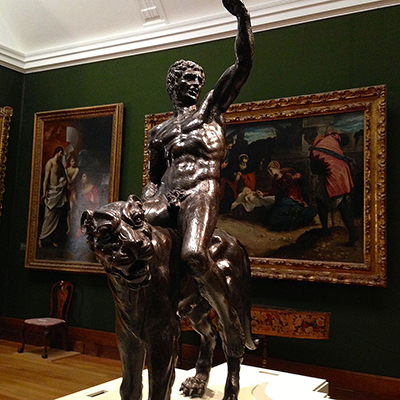
Two nude men ride powerful feline beasts. One rider is young; the other is older and bearded. Neither uses saddle or reins. Their torsos turn, their arms rise, and the panther-like animals stride below them with open mouths. The bronze groups answer one another without becoming duplicates, as though youth and age have been set into parallel versions of the same dangerous encounter.
Known as the Rothschild Bronzes, the pair entered modern scholarship without signatures, documents or an agreed artist. They had been called Michelangelo when they were exhibited in the nineteenth century, but that attribution was quickly doubted. In the twentieth and early twenty-first centuries they were assigned to several other sculptors and circles. Then, after an art historian recognised a related mounted figure in a Renaissance drawing, an interdisciplinary project at the Fitzwilliam Museum in Cambridge proposed that the bronzes were modelled by Michelangelo around 1506–1508.[1]
If correct, they would be the only surviving bronzes by Michelangelo. That possibility has made them famous, but consequence is not evidence. The attribution rests on a cumulative argument involving drawing, anatomy, composition, metal, casting and reconstruction. It has also attracted serious objections. The responsible story is therefore not that two lost Michelangelos have simply been found. It is how scholars build—and contest—an artistic identity when the most decisive forms of proof are absent.
At a Glance
- Proposed artistMichelangelo Buonarroti
- StatusA prominent but contested attribution; the works are unsigned and undocumented
- TitleRothschild Bronzes
- Proposed dateAbout 1506–1508
- MediumBronze
- SubjectsTwo nude male riders, one young and one older and bearded, mounted on panther-like feline beasts
- ScaleLarge statuettes, each approaching a metre in height
- OwnershipPrivate collection
- Research and displayStudied and shown on loan at the Fitzwilliam Museum, Cambridge, in 2014–2015
- Modern provenance landmarkBought in Venice by Julie de Rothschild in 1877; offered at Sotheby’s in 2002 as mid-sixteenth-century Florentine bronzes
- Why the attribution mattersNo bronze sculpture is otherwise generally accepted as a surviving original by Michelangelo
Contents
- Two Riders, Two Beasts
- Why Bronze Is a Special Problem in Michelangelo’s Career
- From Venice to the Rothschild Collection
- The Drawing That Reopened the Question
- The Fitzwilliam Research Project
- Anatomy as Evidence
- Modelling the Impossible Seat
- Metal, Casting and Date
- The Case for About 1506–1508
- Objections to the Michelangelo Attribution
- How an Attribution Is Built
- What the Bronzes Reveal Even If the Question Remains Open
- Pendants Made for Movement and Comparison
- Why the Rothschild Bronzes Matter
Two Riders, Two Beasts
The pair depends on repetition with variation. Both groups combine an idealised nude male with a fantastical or exotic animal. Both riders lift one arm and twist above the moving beast. Yet age distinguishes them. One has the smoother body and face of youth; the other has a beard and a more mature physique. The contrast may suggest two life stages rather than two named individuals.
The animals are equally important. They resemble panthers or other great cats, but their bodies and heads participate in the imaginative vocabulary of Renaissance decorative beasts. Their paws advance while their necks reach forward. The riders do not sit with the stable equipment of horsemen. They grip animated backs directly, so the junction between human thighs and animal movement becomes a sculptural challenge.
Seen together, the bronzes create a mirrored rhythm. They can face inward like pendants, producing a dialogue across space, or turn outward as matching guardians. The raised arms expand their silhouettes above the dense horizontal animals. The spiralling human forms pull the eye around each group.
The absence of reins, weapons and clear attributes makes the subject difficult to name. The riders have been connected generally with Bacchic imagery, where panthers belong to the world of Bacchus, intoxication and untamed nature. They might be mythological attendants, allegories or inventions designed primarily to display bodies in unstable motion. A precise narrative has not been securely demonstrated.
That openness affects attribution. Without a commission or iconographic programme, scholars cannot match the pair to a documented subject in Michelangelo’s career. The case must begin with how the groups are conceived and made.
Why Bronze Is a Special Problem in Michelangelo’s Career
Michelangelo worked in bronze, but his documented bronzes have not survived securely. Early in his career he made a bronze David for the French royal representative in Florence. Later, in Bologna, he produced a colossal seated bronze portrait of Pope Julius II for the façade of San Petronio. Political enemies destroyed the papal statue after control of the city changed, and its metal was reused.[1]
These losses establish that Michelangelo understood large-scale bronze practice. They also leave a frustrating gap. Marble, drawing, painting and architecture can be studied through accepted originals, while bronze sculpture is known through records, later echoes and disputed candidates.
The Rothschild Bronzes fit that gap in medium but not in documented subject. They are much smaller than the lost Julius monument and have no secure connection with the bronze David. Their survival would broaden Michelangelo’s sculptural range, showing him developing paired statuettes of mythological energy at roughly the time he was moving between Florence, Bologna and Rome.
That attractive historical fit must be handled carefully. A missing category can make a candidate feel necessary. But the fact that Michelangelo’s bronzes were lost does not increase the probability that any particular unsigned bronze is his. It only explains why an attribution, if persuasive on independent evidence, would be exceptionally important.
From Venice to the Rothschild Collection
Julie de Rothschild bought the bronzes in Venice in 1877. They were shown in Paris the following year as works by Michelangelo, but the name did not go unchallenged.[2] Nineteenth-century collectors and dealers often worked within fluid attributional traditions, especially for Renaissance bronzes whose small scale encouraged movement between palaces, markets and collections.
The Rothschild ownership supplied the modern title but not an early history. There is no documented chain leading from a Renaissance workshop to the Venetian sale. That gap weakens attempts to attach the groups to a particular commission and leaves room for changing opinions based on style.
Over time, names proposed for the pair included Jacopo Sansovino, Benvenuto Cellini, Tiziano Aspetti, Willem van Tetrode and artists in their circles. These suggestions placed the bronzes broadly within the sophisticated culture of sixteenth-century Italian and northern European figure sculpture. Each comparison emphasised different features: muscular nudes, complex viewpoints, small-bronze technique or the transformation of Michelangelesque figures into collectable objects.
When the groups appeared at Sotheby’s in 2002, they were catalogued as Florentine works of the mid-sixteenth century associated with the circle of Cellini. They sold for £1.8 million.[2] This was not a sale of accepted Michelangelos. The present attribution arose afterward from renewed comparison and technical research.
The provenance therefore contains a historical loop. Michelangelo’s name was attached in 1878, rejected, and proposed again under different scholarly conditions more than a century later. The early label is not confirmation of the modern case. It shows that the resemblance was noticed before the present evidence was assembled.
The Drawing That Reopened the Question
The crucial visual catalyst was a drawing connected with Michelangelo’s circle. Paul Joannides recognised within it a small study of a muscular nude riding a feline beast, compositionally close to the bronzes.[1] Because the sheet is associated with an artist who copied or responded to Michelangelo, the mounted figure raised the possibility that a lost design by Michelangelo stood behind both drawing and sculpture.
This kind of evidence is indirect. A drawing made by an associate or follower can preserve a composition no longer known in the master’s hand. Renaissance artists routinely copied admired inventions, and a minor motif on paper may be the only witness to a lost model. The resemblance can therefore be historically meaningful.
It is not, however, equivalent to a signed preparatory drawing for the bronzes. The direction of transmission is uncertain. The draughtsman could have copied a Michelangelo design, another sculpture, a workshop model or a broader motif circulating among artists. The bronze and drawing might share a source without the bronze being made by Michelangelo.
The drawing became important because it made a specific connection worth testing. It did not conclude the attribution. The Fitzwilliam project treated it as one strand within a wider investigation involving visual, anatomical and technical evidence.[1]
The Fitzwilliam Research Project
The bronzes were loaned to the Fitzwilliam Museum in 2014–2015, where a team led by Victoria Avery and Paul Joannides examined the proposed Michelangelo connection. Their work brought together art historians, conservators, scientists, anatomists, modellers and founders.[1]
The team used close visual comparison, three-dimensional recording, metal analysis, examination of casting procedures, anatomical study and full-scale experimental reconstructions. Results were presented in a 2015 publication and symposium, and a substantially developed argument appeared in the 2018 book Michelangelo: Sculptor in Bronze.[1][2]
This interdisciplinary structure is one of the project’s strengths. Attributional claims can become circular when a figure is labelled Michelangelo because it looks powerful and its power is then explained by the label. Measurements and reconstruction force some claims into testable physical questions. Could the poses be developed from models in the proposed way? Do the bodies contain anatomical habits recurring in secure work? Are the alloys and casting methods compatible with the date?
Each method also has limits. Scientific analysis can indicate when and how a bronze was made, but an alloy does not carry an artist’s name. Reconstruction can demonstrate that a procedure is plausible, not that it occurred in one workshop. Anatomical recurrence depends on interpretation as well as measurement. The project’s conclusion is strongest when independent strands converge and weakest when one type of evidence is asked to do another’s job.
The Fitzwilliam’s own account preserves that distinction. It presents Michelangelo as a proposed attribution and states that research continues.[1] Public excitement around the exhibition sometimes sounded more conclusive, but the institutional research record remains an argument rather than a recovered signature.
Anatomy as Evidence
Michelangelo’s sustained study of the human body makes anatomy central to any attribution. The riders are not generic decorative nudes. Their muscles respond to difficult seated twists, raised arms and pressure against moving animals. The older rider’s torso and the younger figure’s back offered especially rich fields for comparison.
Anatomist Peter Abrahams participated in the research, examining details of muscular construction and comparing them with features in Michelangelo’s accepted figures.[1] Such study can identify unusually specific choices: where a muscle swells under rotation, how the abdominal wall changes with a twist, or how the back responds when an arm lifts.
These recurrences may support a shared visual intelligence. Michelangelo did not merely learn a standard diagram of the body; he repeatedly reimagined anatomy under strain. A sculptor copying his surfaces without understanding their structural causes might produce convincing muscles individually but fail to coordinate them across a pose.
Yet anatomical accuracy is not exclusive authorship. Other Renaissance sculptors studied living bodies, antique sculpture and Michelangelo’s works. Assistants and followers could internalise his solutions. Bronze casting also introduces distance between the modeller’s initial wax or clay and the final metal surface, with founders, chasers and later restorers potentially altering details.
Anatomy is therefore comparative evidence, not a biometric signature. It gains force when a distinctive bodily solution aligns with composition, date and technique. It loses force when resemblance is described only in broad terms such as muscularity or power—qualities shared by an entire Michelangelesque tradition.
Modelling the Impossible Seat
The riders’ contact with their beasts is physically strange. A nude body astride a broad feline back must open at the hips, accommodate the animal’s movement and remain visually stable without tack. The raised arm then shifts the torso’s balance. The pose combines observation with invention.
Three-dimensional study allows scholars to examine this construction beyond chosen photographs. Rotating scans can compare axes through shoulders, pelvis and knees. They reveal whether apparent distortions from one view resolve into coherent transitions from another. This matters for Michelangelo, whose sculpture often demands movement around the body.
The bronzes also show how paired invention can proceed from variation. The older and younger riders are not simply one model with a changed head. Their bodies answer age, turn and animal differently. If one artist designed both, the pair records a controlled experiment in related poses.
Andrew Lacey’s experimental reconstructions tested how models and casts might have been produced. The Getty’s technical atlas documents one reconstruction and its role in exploring Renaissance bronze practice.[3] Recreating a work at scale can expose problems hidden in verbal description: armatures, joins, wall thickness, weight distribution and the translation of pliable model into hollow metal.
Experimental archaeology is most valuable when framed as a test. A successful cast proves that a proposed sequence can work. It does not show that Michelangelo personally followed it. The reconstruction makes the bronzes’ manufacture more intelligible and helps distinguish technically plausible claims from romantic ones.
Metal, Casting and Date
Scientific examination can address whether the two works belong together materially and whether their manufacture is consistent with early sixteenth-century practice. Researchers led by Robert van Langh studied the metal and casting evidence as part of the Fitzwilliam project.[1]
Bronze is an alloy, and its composition varies with workshop recipes, recycled metal and casting requirements. Analysis can detect broad compatibility or anachronism. Radiographic and surface evidence can reveal casting joins, repairs and working after the metal cooled. The internal structure may preserve decisions invisible from outside.
For the Rothschild Bronzes, technical findings were used to support an Italian Renaissance date and the coherence of the pair. The research team argued that the method was compatible with the proposed period around 1506–1508 and with an artist exploring ambitious figure groups.[2]
Compatibility is the key word. Many founders could work within the same technological world. Michelangelo would also have required specialist foundry collaboration; modelling and casting were not necessarily performed by one person. Metal analysis can challenge a nineteenth-century forgery theory or a much later date, and it can link the two groups technologically. It cannot distinguish Michelangelo from every capable contemporary.
The proposed early date remains especially consequential. Earlier cataloguing placed the bronzes around the middle of the century, when Michelangelo’s influence had spread widely and sculptors such as Cellini developed sophisticated bronze practices. Moving them to 1506–1508 reduces some follower explanations but demands strong evidence. The attribution and date support each other, so scholars must beware of allowing them to become circular.
The Case for About 1506–1508
The project places the bronzes in a short, mobile phase of Michelangelo’s career. He had completed David in Florence, received the commission for the Sistine Ceiling in 1508, and was engaged in the turbulent tomb project for Julius II. His Bolognese bronze of the pope was modelled and cast in 1506–1508.[1]
That documented experience makes an experiment in smaller bronzes technically conceivable. Contact with northern Italian sculptural traditions could also have encouraged the paired format and complex movement. The dating aligns the works with Michelangelo’s intense exploration of heroic male anatomy before and during the first Sistine designs.
Supporters connect the riders’ torsions with drawings and figures from this period. The associated mounted-beast drawing provides a possible echo of the invention. The bronzes’ modelling and casting evidence is presented as compatible with the same years.[1][2]
But historical opportunity is not documentation. Michelangelo’s movements and major commissions were closely recorded, and no surviving source mentions the pair. Small private objects can escape archives more easily than monuments, yet two technically demanding bronzes would still require time, material and collaboration.
The proposed date is therefore a synthesis: style, drawing, technical compatibility and career context meet around an early-sixteenth-century hypothesis. Its persuasiveness depends on accepting the specificity of the visual comparisons. Critics who see a later assemblage of Michelangelesque motifs reach a different date and authorship from much of the same visible object.
Objections to the Michelangelo Attribution
The proposal has never been universally accepted. Frank Zöllner argued that the comparisons with Michelangelo’s drawing and sculptural practice were insufficiently convincing.[2][4] His objection reaches the centre of the case: if the correspondences are broad rather than specific, the technical evidence can establish Renaissance bronzes without identifying their modeller.
Nicholas Penny described the groups as pastiches composed from elements that do not form a fully unified invention.[2] On this view, the bronzes may quote the bodily language associated with Michelangelo while lacking the structural necessity of his strongest designs. A raised arm, twisting torso and powerful thigh can each appear Michelangelesque; their assembly need not be Michelangelo’s.
Michael Riddick has proposed Francesco da Sangallo as an alternative author, connecting the bronzes with a sculptor whose work and family context brought him close to Michelangelo’s Florentine world.[5] This proposal is itself an attributional argument rather than a documentary solution, but it demonstrates that “not Michelangelo” need not mean anonymous mediocrity.
Other historical labels—Sansovino, Cellini, Aspetti and Tetrode—remind us how widely Michelangelo’s bodily inventions circulated. Later sixteenth-century sculptors made elaborate bronzes for collectors who valued multiple viewpoints, learned subjects and virtuoso surfaces. The pair can be situated convincingly in that culture even without the most famous name.
The lack of secure early provenance remains a common weakness in all proposals. No workshop record or early inventory anchors the groups before the nineteenth century. The bronzes themselves must bear almost the entire argument, and visual attribution is most vulnerable where an influential master produced many followers.
These objections do not make the Fitzwilliam project futile. They clarify what remains unproved. A strong attribution should survive not by suppressing alternatives but by explaining why its combination of evidence is more specific than theirs.
How an Attribution Is Built
The Rothschild Bronzes offer an unusually clear lesson in attribution because the evidence types can be separated.
Provenance establishes the pair’s documented modern life from 1877, but not its Renaissance origin. Connoisseurship compares form, anatomy and invention with accepted works, but judgment varies. The related drawing creates a historical link, but its own relation to the sculptures is indirect. Technical analysis supports period and making, not personal identity. Reconstruction tests procedures, not biography. Documentary knowledge proves that Michelangelo could work in bronze, but does not mention these objects.
The affirmative case says these strands converge: an early-sixteenth-century pair, anatomically and compositionally close to Michelangelo, related to a drawing in his orbit, technically compatible with his known bronze-working phase and too specifically conceived to be a later imitation. The negative case says the convergence is created by flexible comparisons: Renaissance technology and Michelangelesque anatomy identify a context, while the undocumented drawing and composite style fail to identify the master.
Neither position should be caricatured as science against opinion. Scientific findings require historical interpretation, and visual judgments can be disciplined by exact comparison. Nor should disagreement be treated as embarrassment. It is the mechanism through which an exciting claim is tested.
Museum language matters here. “By Michelangelo” presents resolution. “Attributed to Michelangelo” indicates a reasoned but unsettled identification. “Proposed as Michelangelo” describes the Fitzwilliam project most accurately. Repeating that distinction does not weaken the bronzes; it lets readers understand why they are important.
What the Bronzes Reveal Even If the Question Remains Open
The works reveal the range of Renaissance responses to the male nude. Their riders are neither saints nor civic heroes. They are bodies subjected to movement, age and unstable contact with beasts. The pair turns anatomical knowledge into an ornamental and perhaps mythological spectacle.
They also demonstrate bronze’s different possibilities from marble. Extended arms and separated contours can be cast around a strong internal structure. Dark reflective surfaces join human and animal forms while highlights fragment them. A viewer can circle the work, discovering new alignments between limbs, backs and feline heads.
Their modern history shows how a name changes an object. In 2002 they were valuable Florentine bronzes connected with Cellini’s circle. Under the Michelangelo proposal they became potential unique survivors capable of altering a canonical career. Physical objects remained the same while scholarly, financial and public meanings expanded.
Finally, the research project models the productive use of technology in art history. Scans, alloy data and reconstructions do not replace looking or archives. They make particular claims more precise. Even a future rejection of the attribution would not erase what the investigation established about the bronzes’ manufacture and bodies.
Pendants Made for Movement and Comparison
The fact that two related groups survive is more than a convenience. Renaissance collectors valued pendants because paired objects could establish symmetry while rewarding discrimination. A viewer was invited to move between likeness and difference: young against old, one turn against another, one animal's stride against its companion's.
This comparative structure gives the bronzes a likely domestic or courtly logic even though their original destination is unknown. They are substantial enough to command a room but small enough to be approached, circled and rearranged. Unlike a public monument fixed to an architectural site, a bronze statuette can generate intimate acts of looking. Its dark surface changes with handling, distance and light.
Pairing also complicates the question of models. The two works could have developed from a common small study, from two separately posed figures, or through deliberate revision of the first composition into the second. Examination of their shared measurements and different solutions may reveal whether they were conceived as a unit from the beginning. Technical consistency supports their association, but a matching pair could involve more than one modeller within a workshop.
Their survival together has helped protect the intelligence of the comparison. If only the young rider remained, age would not appear to be part of the idea. If only the bearded rider survived, viewers might search for a named elder or god. Together they make variation itself the clearest subject: the human body changes, while the perilous act of mastering—or merely accompanying—animal force remains.
Why the Rothschild Bronzes Matter
The pair matters because it places artistic authorship under productive pressure. A famous name cannot be secured by excitement, and uncertainty does not make close research pointless. Between those positions lies the real work of attribution.
The bronzes are ambitious, unusual and technically accomplished. Their two riders transform a shared concept across youth and age. Their animals make the human body respond to a support very different from floor, seat or horse. Their surfaces preserve the collaboration between modelling, mould, metal, casting and finishing.
The Michelangelo proposal is substantial. It was developed through years of interdisciplinary study and published in detail. It is also contested by scholars who question the specificity of the drawing and stylistic comparisons and who see credible alternative makers. Both facts should remain visible at once.
If future evidence confirms the attribution, the works will fill one of the largest material gaps in Michelangelo’s career. If it does not, they will remain important evidence of how powerfully his art shaped Renaissance bronze. At present their greatest value may be precisely this double capacity: they make a persuasive claim imaginable and certainty difficult.
Frequently Asked Questions
Discussion
What details, sources or comparisons stand out to you in Rothschild Bronzes?
Reader Insights
Which formal detail changes how the work reads?
Which documented source or collection history feels most useful?
Which related Michelangelo work should readers compare next?
Join the Conversation
Add a source-led observation, comparison or question for other readers.
References
- Fitzwilliam Museum, Michelangelo: A Discovery,” research project:, View source.
- The Art Newspaper, Rothschild Bronzes ‘definitely’ by Michelangelo, new book claims,” 14 November 2018:, View source.
- J. Paul Getty Museum, Guidelines for the Technical Examination of Bronze Sculpture, Visual Atlas 005, experimental reconstruction:, View source.
- Frank Zöllner, Warum die Bronzen in Cambridge nicht von Michelangelo sind,” Die Welt, 9 February 2015:, View source.
- Michael Riddick, A Proposal that the Rothschild Bronzes Attributed to Michelangelo Are Instead the Work of Francesco da Sangallo,” RenBronze, 2020:, View source.
- *Michelangelo: Sculptor in Bronze* (2018), table of contents:, View source.
- Victoria Avery and Paul Joannides, Michelangelo: Sculptor in Bronze, Warwick Research Archive Portal:, View source.