 by Tom Gurney
Tom Gurney BSc (Hons) is an art history expert with over 20 years experience
Published on June 19, 2020 / Updated on August 8, 2026
Email: tomgurney1@gmail.com / Phone: +44 7429 011000
Dawn by Michelangelo
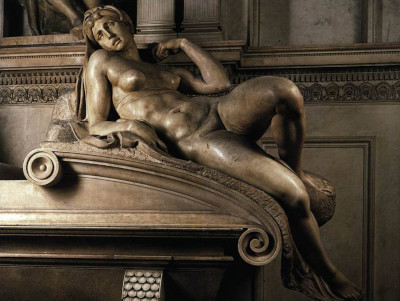
Morning does not arrive easily on Michelangelo’s Tomb of Lorenzo de’ Medici. It wakes through a marble body that twists upward while still bearing the heaviness of sleep. The head lifts, the torso rotates, and the limbs negotiate a sloping sarcophagus that offers no comfortable bed. This is Dawn—Aurora in Italian—not as radiant sky, but as the physical effort of becoming conscious.
The female personification reclines beneath Lorenzo, Duke of Urbino, in the New Sacristy of San Lorenzo.[1][2] She is paired with Dusk, while Night and Day occupy Giuliano’s tomb across the chapel.[3] Together the four Times create a daily cycle around two idealised Medici rulers. Each deserves an individual encounter, because Michelangelo did not repeat one body under four labels. Dawn has her own threshold: she is neither asleep nor fully awake.
At a Glance
- ArtistMichelangelo Buonarroti
- TitleDawn, or Aurora
- DateCreated during the New Sacristy campaign, mainly in the 1520s and early 1530s
- MediumMarble
- SubjectFemale personification of morning’s arrival
- MonumentTomb of Lorenzo de’ Medici, Duke of Urbino
- Companion on the sarcophagusDusk[1]
- Chapel counterpartsNight and Day on Giuliano de’ Medici’s tomb
- LocationLorenzo’s monument inside Florence’s Museo delle Cappelle Medicee[2][3]
- PoseReclining but twisting upward from a state resembling sleep
- Programme cautionThe figure belongs to a chapel-wide allegory of time; no single surviving text explains every detail of her pose
- Condition cautionUneven finish belongs to an interrupted monumental campaign and should not be assigned one psychological cause
Contents
- Morning as a Threshold
- The Tomb of Lorenzo
- A Body Rising Sideways
- Face and the Return to Consciousness
- The Female Nude in a Funerary Setting
- Aurora: Goddess, Name and Personification
- The Sarcophagus Is Not a Bed
- Dawn and Dusk
- Dawn, Night and the Problem of Sleep
- Design Through Drawings and Models
- Finish and the Interrupted Chapel
- Chapel Light and Literal Dawn
- How to Look at Dawn
- Why Dawn Matters
- Artist Up Close
Morning as a Threshold
Dawn is not simply early daylight. It is a passage between darkness and day, sleep and wakefulness, unawareness and renewed labour. Michelangelo chooses the transitional instant rather than a settled state. This immediately distinguishes the figure from the more complete polarities of Night and Day.
Her body makes transition visible. The head and upper torso begin one motion while lower limbs retain another relation to the sarcophagus. The resulting torsion feels unresolved because waking is unresolved. Consciousness returns unevenly.
The metaphor is universal but not generic. On a tomb, every awakening evokes its opposite: the dead do not rise with the morning in ordinary human time. The Christian setting holds a further possibility of resurrection, but the figure itself personifies natural time rather than serving as a direct image of a resurrected body.
The Tomb of Lorenzo
The object record identifies Aurora as part of Lorenzo’s tomb.[1] Correct ownership matters. Lorenzo here is the Duke of Urbino, the pensive armoured figure above—not Lorenzo the Magnificent, whose shared memorial lies under the Medici Madonna.
The companion figure, Dusk, reclines on the other side. Their pairing creates the beginning and ending of daylight around the duke’s sarcophagus. Lorenzo appears removed in thought, while temporal change presses visibly beneath him.
The arrangement is hierarchical but ambiguous. The ruler occupies the upper niche and the Times lie below, yet their enormous bodies and difficult poses seize attention. Time is placed under Medici memory and simultaneously threatens to overwhelm it.
A Body Rising Sideways
Michelangelo does not represent awakening by making Dawn stand. She remains recumbent, but the torso twists and the head begins to rise. This mixed orientation lets repose and effort occupy one figure.
The marble body is large relative to its support. Knees, hips, abdomen, shoulders and neck form a sequence of adjustments across the curved lid. No simple horizontal axis can contain them. The pose requires the viewer to follow movement through the whole body.
That movement is not acrobatic display. Each change has expressive consequence. A body turning away from sleep must find leverage, and the sarcophagus supplies uncertain resistance. Michelangelo makes the mechanics of waking emotionally legible.
Face and the Return to Consciousness
The face does not announce joy at the new day. Its effect is often read as strained, distant or reluctant. Such words should remain descriptions of viewing rather than diagnoses of a marble mind. What can be seen is a head emerging from a pose of lowered awareness.
The surrounding hair and less uniformly resolved surfaces affect that perception. Light does not settle into a smooth, fixed expression. Features can seem to appear gradually as illumination changes, repeating the figure’s theme at the level of visibility.
Morning is therefore not an external landscape reflected on a face. It happens as the face becomes available to the world.
The Female Nude in a Funerary Setting
Michelangelo gives dawn a female body, pairing her with the male Dusk. Gender differentiates the figures and participates in a larger chapel pattern: female Night, male Day, female Dawn, male Dusk. The alternation creates variety without providing a simple theological code.
The nude body invokes classical personification, where abstract forces take ideal human form. It also exposes vulnerability. Armour protects the duke above; Dawn meets time without social costume.
Her monumental physique resists delicacy. Michelangelo does not make morning a light maiden floating into the room. He gives the transition muscle, weight and fatigue. Time is beautiful, but it is labour performed by bodies.
Aurora: Goddess, Name and Personification
The Italian title Aurora also recalls the ancient Roman goddess of dawn, counterpart to Greek Eos. That classical inheritance helps explain why morning can appear as a female body, but Michelangelo gives her no elaborate mythological episode. She does not drive a chariot or scatter flowers before the sun.
The omission keeps the figure legible at two levels. “Aurora” carries antique poetry and the prestige of classical personification; “Dawn” names a daily experience available without mythological learning. On a Christian tomb, that flexibility is valuable. A pagan name can serve a universal meditation on time without displacing the chapel’s sacred programme.
Michelangelo’s restraint also returns attention to embodiment. Rather than narrating what the goddess does to the sky, he asks what dawn does to a body. Waking replaces mythology as the central event.
The Sarcophagus Is Not a Bed
Although Dawn reclines, the support is curved and funerary. It cannot provide the horizontal stability of a couch. The body must actively remain upon it, and that need prevents sleep from becoming comfortable repose.
The mismatch between living-seeming flesh and burial architecture is the tomb’s central tension. A figure associated with renewal lies on a container of death. Morning begins on the surface beneath which mortality is remembered.
Structural necessity becomes metaphor without losing its practical fact. The sarcophagus supports a heavy marble figure; its sloping design also makes temporal awakening precarious.
Dawn and Dusk
The paired figures are both thresholds, yet they move in opposite temporal directions. Dawn gathers toward consciousness. Dusk releases the day into evening. Their bodies need not mirror one another because beginning and ending feel different.
Gender and age sharpen the distinction. Dawn’s female body twists upward; Dusk’s mature male body settles. One concentrates emerging effort, the other spent strength. Michelangelo translates chronology into anatomical disposition.
Together they make Lorenzo’s tomb a monument to transition rather than stable noon or complete darkness. The duke’s own pensive withdrawal appears suspended between their movements.
Dawn, Night and the Problem of Sleep
Night on Giuliano’s tomb is more fully surrendered to sleep, accompanied by attributes that identify darkness. Dawn has begun to leave that condition. Comparing them isolates the moment Michelangelo chose for morning.
A later sculptural copy of Night recorded by VIVE demonstrates how widely Michelangelo’s nocturnal figure circulated in later reception.[8] The comparison is useful because it shows the fame of the sleeping type against which Dawn’s partial awakening can be measured. A copy does not replace the original chapel context or prove direct derivation for every later reclining nude.
Sleep, death and sculpture have long been connected because marble can resemble a body at rest while remaining permanently still. Dawn disturbs that analogy. Her stone seems to wake, even though stone cannot move.
Design Through Drawings and Models
British Museum studies for free-standing and double Medici tombs show Michelangelo testing configurations before the wall monuments took their surviving form.[5][6] These are developmental records, not finished blueprints for Dawn.
The distinction matters because the allegory’s final pose responds to the actual sarcophagus, wall and companion. A figure imagined in another tomb scheme might have required different support or direction. Monumental design evolved as relationships were tested.
The Metropolitan Museum’s exhibition galleries and scholarly publication place Michelangelo’s drawing and design practice within a career where ideas moved across media.[4][7] Paper could explore bodily torsion rapidly; clay could test volume; marble and architecture imposed irreversible, full-scale limits.
Finish and the Interrupted Chapel
The national programme record describes a New Sacristy shaped by changing plans and incomplete execution.[3] Dawn belongs to that history. Some surfaces achieve greater resolution than others, and later installation complicates any assumption of a single uninterrupted carving campaign.
Modern admiration of Michelangelo’s non-finito can make roughness seem automatically deliberate. Here the safest account separates visible effect from historical motive. Uneven carving makes the body appear to emerge at different speeds, which suits an image of waking. That correspondence does not prove it was the sole reason work stopped.
The sculpture remains powerful because the established pose carries meaning before polish becomes uniform. Michelangelo secured transition at the level of mass.
Chapel Light and Literal Dawn
The figure changes as light moves through the New Sacristy. Projections catch illumination, recesses deepen and unfinished areas scatter brightness. The body’s personification of dawn is therefore continually renewed by actual optical conditions.
This does not mean a modern visitor sees the exact lighting Michelangelo planned at every hour. Openings, maintenance and artificial illumination shape the current experience. The stable principle is that a relief of light and shadow animates the fully dimensional body.
A photograph can make every plane equally available. In the chapel, visibility arrives gradually. Looking becomes analogous to waking.
How to Look at Dawn
Begin where the figure meets the sarcophagus. Trace the points that bear or redirect weight, then follow the twist through abdomen, chest, shoulders and neck. This grounds allegory in mechanics.
Next compare the head with the lower body. Ask which parts seem awake and which remain surrendered to repose. Then widen the view to Dusk and Lorenzo above.
Finally cross the room to Night and Day. The four Times become intelligible as a cycle only through movement by the spectator. Michelangelo makes viewing temporal.
Why Dawn Matters
Dawn matters because Michelangelo gives an invisible transition physical necessity. Morning is not a coloured sky or symbolic torch. It is a body struggling toward consciousness on an unstable support.
The figure also enriches the tomb’s memorial argument. Natural cycles continue beneath a dead duke, making renewal both hopeful and indifferent. Every dawn promises return; none restores the particular life commemorated above it.
Most of all, the sculpture demonstrates how Michelangelo could make anatomy think. Twist, pressure and incomplete visibility produce the idea before any label is read. Aurora is time felt from within a body.
Artist Up Close
Michelangelo designed Dawn while moving between architecture, marble carving, drawings and models in the New Sacristy. He also worked amid unstable Medici politics that eventually drove him from Florence for the last time in 1534. The figure should not be decoded as his private awakening or despair. Its achievement is larger and more disciplined: bodily knowledge is turned into an allegory that serves one tomb, one chapel and a universal experience of beginning again.
Frequently Asked Questions
Discussion
How does Michelangelo make a figure that represents morning feel both symbolic and physically present?
Reader Insights
Where does Dawn look most like a figure waking, and where does the marble still resist full movement?
Compare Dawn with Dusk first, then with Night and Day. What changes when the two tomb pairings stay separate?
Which details make Dawn feel like an allegory of time, and which details make her feel like a physical body under pressure?
Join the Conversation
Set Dawn beside Dusk, Night and Day. Which figure seems most awake to time, and which seems most burdened by it?
References
- Catalogo generale dei Beni Culturali, Aurora”:, View source.
- Musei del Bargello, Cappelle Medicee”:, View source.
- Catalogo generale dei Beni Culturali, Michelangelo e la Sagrestia Nuova in Firenze — Un progetto innovativo”:, View source.
- The Metropolitan Museum of Art, Michelangelo: Divine Draftsman and Designer — Exhibition Galleries”:, View source.
- British Museum, The Medici Tombs in the New Sacristy: Studies for a Free-standing Sepulchral Monument”:, View source.
- British Museum, The Medici Tombs in the New Sacristy: A Study for a Double Tomb with Figures”:, View source.
- The Metropolitan Museum of Art, Michelangelo: Divine Draftsman and Designer”:, View source.
- VIVE — Vittoriano and Palazzo Venezia, The Night”:, View source.