


 by Tom Gurney
Tom Gurney BSc (Hons) is an art history expert with over 20 years experience
Published on June 19, 2020 / Updated on November 6, 2025
Email: tomgurney1@gmail.com / Phone: +44 7429 011000
The Palestrina Pietà
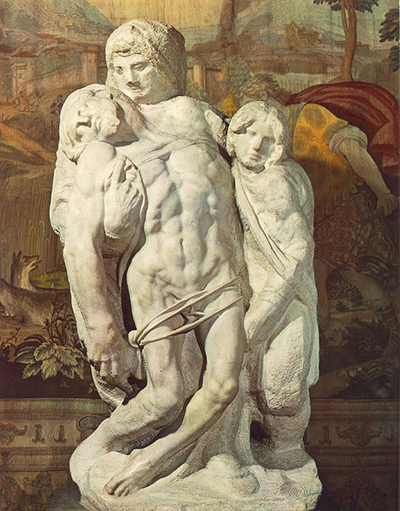
The Palestrina Pietà is one of the most imposing and most difficult works associated with Michelangelo. Nearly two and a half metres high, it presents the dead Christ upright rather than laid across the Virgin’s lap. His long body sinks between two attendants, identified by the Galleria dell’Accademia as the Virgin Mary and Saint John the Evangelist. They support him beneath the arms and at the shoulders, but their help does not overcome the downward pull of his weight. The group is less an image of settled mourning than of a body being held at the limit of what the living can sustain.
The sculpture is displayed in the Galleria dell’Accademia in Florence and dated by the museum to about 1550–1560.[1] Its traditional attribution to Michelangelo remains disputed. The Accademia notes that most scholars have accepted it, but the work is absent from early biographies and documents, and its proportions, shallow carving and gentle treatment have led others to see the hand of a pupil or follower. Italy’s national cultural catalogue therefore uses the careful designation “attributed to Michelangelo.”[2]
That qualification belongs at the centre of the sculpture’s history. The Palestrina Pietà is not best understood by choosing certainty where the evidence does not permit it. Its reused ancient marble, compressed composition, undocumented early life and politically charged acquisition all help explain why it continues to invite both close admiration and close doubt.
At a Glance
- ArtistAttributed to Michelangelo Buonarroti; authorship disputed
- TitlePalestrina Pietà
- DateAbout 1550–1560, according to the Galleria dell’Accademia
- MediumMarble, reused from an ancient architectural element
- HeightApproximately 251 centimetres
- FiguresThe dead Christ supported by the Virgin Mary and Saint John the Evangelist
- Current locationGalleria dell’Accademia, Florence
- InventoryScult. 1319
- Former locationBarberini Chapel of Santa Rosalia, Palestrina
- Documentary problemNo known commission, early biography or contemporary archival record securely connects the sculpture with Michelangelo
- Modern transferNegotiated for sale abroad in 1937, prevented from export, acquired for the Italian state and installed at the Accademia in 1939
Contents
- A Dead Christ Who Cannot Stand
- Three Figures in a Shallow Block
- The Work of Support
- The Late Pietà as a Field of Experiment
- Why the Attribution Is So Difficult
- An Ancient Stone Given a Christian Body
- The Mystery of Palestrina
- The 1937 Sale and the Question of National Possession
- Looking at Finish and Incompletion
- How to See the Sculpture in the Accademia
- A New Identity in a Michelangelo Museum
- Why the Palestrina Pietà Matters
A Dead Christ Who Cannot Stand
The central figure determines the group. Christ is shown frontally, his bare torso lengthened and his knees weakened beneath him. His head falls to one side. The arms do not form a triumphant cross or gesture freely; they depend on the two figures behind and beside him. The body seems momentarily upright only because others bear it.
This makes the image different from the familiar type in which the Virgin cradles Christ across her knees. In Michelangelo’s Vatican Pietà, completed around 1498–1499, the dead body forms a broad diagonal across Mary’s monumental seated form. The composition transforms physical support into an almost impossible calm. At Palestrina, support itself becomes the event. The attendants struggle to preserve a vertical arrangement that gravity is undoing.
Christ’s extraordinary length contributes to that instability. His torso, thighs and lower legs do not resolve into the compact proportions of an independent standing figure. They stretch down the narrow marble, while the upper body spreads across the attendants. The anatomy can appear disproportionate when judged as an autonomous nude. Seen as a figure collapsing under its own weight, the elongation also becomes expressive.
The distinction matters because perceived disproportion has played a role in the attribution debate. An unusual body is not automatically an inept one. Yet an expressive explanation cannot by itself prove authorship. The sculpture asks viewers to hold both possibilities: that its distortions were designed to communicate the burdens of death, and that some may record a sculptor whose procedures differed from Michelangelo’s.
Three Figures in a Shallow Block
The Virgin and Saint John are not fully separate bodies placed around Christ. They emerge from a comparatively shallow field and remain closely bound to the stone behind them. Their heads rise on either side of Christ’s, creating a compressed triangular summit. Below, arms, drapery and the dead body overlap rather than opening freely into space.
The arrangement often feels closer to high relief than to a group carved fully in the round. This is partly a consequence of the material. The back of the block preserves foliate and egg-and-dart ornament, revealing that the marble began as an ancient architectural element.[1] Its earlier function gave the sculptor a broad but restricted mass. A deep, freely projecting ensemble could not be extracted from it in the same way as from a newly quarried block chosen for a three-dimensional group.
Reuse was neither unusual nor inherently compromising in Renaissance and early modern Italy. Ancient stone could be valuable, prestigious and immediately available. It also imposed decisions. Here the pre-existing slab encouraged a frontal image whose figures share depth and support.
That material history helps explain the group’s relief-like character, but it cannot settle who carved it. A master could adapt boldly to a narrow block; a follower could imitate a master within the same limits. The surviving antique ornament establishes what the marble was before it became a Pietà. It does not preserve the name of the person who transformed it.
The Work of Support
The two attendants differ in function from the youthful Virgin of the Vatican Pietà. Neither offers a broad lap or stable throne. They stand behind Christ, receiving the weight at shoulder level as the body descends between them. Their gestures make death physically communal: the living are not merely witnesses but bearers.
Mary, identified at one side of Christ, inclines toward him. Saint John balances her presence on the other side. Their faces and draperies have often been described as gentler and less forcefully articulated than figures securely accepted as Michelangelo’s. The modelling passes softly between planes, and the group lacks the sharp alternation between polished flesh, drilled shadow and tense contour found in some of his earlier marbles.
Softness can be read in several ways. It may reflect incomplete execution, surface alteration, the restrictions of the block or the participation of another hand. It may also suit a late devotional image in which grief is expressed through shared physical dependence rather than display. None of these readings should be turned into documentary fact.
What can be seen is a carefully organised chain of weight. Christ’s head and chest fall; the attendants counter that movement; the lower body continues downward. Their support is necessary and visibly insufficient. The image therefore turns the theological subject of lamentation into a sculptural problem: how can dead weight remain before the viewer without appearing alive?
The Late Pietà as a Field of Experiment
Michelangelo returned repeatedly to the Pietà in his last decades. The Florentine or Bandini Pietà, worked over a long period and damaged by the artist himself, gathers Christ, the Virgin, Mary Magdalene and Nicodemus into an unstable pyramidal group. The late Rondanini Pietà reduces body and support to radically slender, interdependent forms. Neither provides a simple template for Palestrina.
The comparison is useful because it shows that Michelangelo did not preserve one settled solution. His late treatments reconsidered who holds Christ, whether the body descends or reclines, how figures merge, and how much finish is necessary for an image to remain legible. The Palestrina group belongs naturally to that field of questions.
Its upright Christ is especially close in concept to late works concerned with descent. He is not presented securely after the action has ended. His position appears transitional—as though deposition, carrying and lamentation have been compressed into one difficult instant. The attendants form a living framework around a body whose joints can no longer answer them.
Yet thematic fit is evidence of compatibility, not proof of hand. A pupil or sculptor in Michelangelo’s orbit would know his late religious concerns and could develop them. Indeed, the enormous authority of his designs made imitation and adaptation inevitable. The stronger the work’s relation to his ideas, the more carefully conception must be distinguished from execution.
Why the Attribution Is So Difficult
The most serious problem is documentary silence. The Accademia describes the Palestrina Pietà as the only large-scale sculpture attributed to Michelangelo that receives no mention in early biographies or archival documents.[1] Giorgio Vasari and Ascanio Condivi recorded numerous projects, including unfinished and unrealised ones. Their silence does not make Michelangelo’s authorship impossible, but it removes the kind of external support available for many major works.
No secure contract identifies a patron. No contemporary letter follows the carving. No early account explains why such a large group left Rome or Florence for Palestrina. No recorded payment establishes workshop participation. The sculpture therefore has to carry an unusual amount of its own attribution through style and material examination.
Arguments in favour begin with the bodily invention. Christ’s elongated, heavy descent and the tight interdependence of figures can be connected with Michelangelo’s late sculptural thought. The work’s scale and ambition also exceed those of a casual imitation. For scholars who accept it, the unconventional composition is evidence of a master still testing the limits of the Pietà.
Arguments against focus on execution. Critics have found the anatomy less controlled, the modelling unusually graceful or generalised, and the composition too shallow and even to match Michelangelo’s secure work. They have proposed a pupil or follower, sometimes allowing that the design itself could derive from him. These observations do not all point to the same alternative artist, which is one reason the traditional attribution has endured.
The question is not adequately answered by a checklist of “Michelangelesque” muscles or poses. Renaissance workshops circulated drawings, models and solutions. An assistant might execute a master’s design; a close follower might combine remembered motifs; Michelangelo might intervene unevenly in a block worked by others. Authorship can be layered even when a museum label must be brief.
The responsible label is therefore the one the state catalogue uses: attributed to Michelangelo.[2] It acknowledges the sculpture’s deep relation to his art without presenting inference as a signed fact.
An Ancient Stone Given a Christian Body
The reused architectural marble creates a second history beneath the Christian image. On the back, the survival of classical ornament confirms that the block once belonged to a built environment. Its motifs were designed to be read as decoration, repeated rhythmically along an architectural member. The sculptural group overturns that regularity.
On the front, three bodies disrupt the block’s former geometry. Drapery covers and exposes; heads rise unevenly; Christ’s legs pull the composition down. The conversion of architecture into anatomy is not merely economical. It makes a durable object from one cultural order carry a central mystery of another.
The Renaissance often understood antiquity through acts of reuse as well as study. Ancient fragments were collected, restored, recut and incorporated into new buildings. In the Palestrina Pietà, the old ornament has not been completely erased. The back preserves evidence that a Christian devotional sculpture was materially continuous with a pagan or civic architectural past.
This double identity complicates ideas of artistic intention. The sculptor did not begin with limitless marble. He responded to dimensions, prior carving and perhaps damage. Shallow figures may therefore arise from a practical intelligence rather than a failure to conceive them more fully. At the same time, practical adaptation cannot explain every anatomical or stylistic feature. Material history narrows the debate without closing it.
The Mystery of Palestrina
The group takes its modern name from Palestrina, the hill town east of Rome where it stood in the Barberini Chapel of the church of Santa Rosalia. The Barberini family became princes of Palestrina in the seventeenth century and reshaped important parts of the town’s religious and political landscape.
How the sculpture reached the chapel is unknown. The state catalogue’s research notes that a mid-seventeenth-century description of Palestrina did not mention it, suggesting that its arrival may have been later.[2] That absence is not an exact arrival date, but it cautions against inventing an original Barberini commission.
Nor is there evidence that Michelangelo carved the group specifically for Palestrina. Its ancient block may have been found or acquired in Rome; the sculpture could have travelled through collections before reaching Santa Rosalia. Without records, these are possibilities rather than a recoverable itinerary.
Its chapel setting nevertheless shaped its identity for generations. A work lacking an early title or documented patron became the Palestrina Pietà because place supplied what the archive did not. The name marks a known chapter of reception, not necessarily the site of origin.
That distinction is important across art history. Geographic names often sound as though they identify commissions, but they may record later ownership or display. Palestrina gave the sculpture visibility and continuity. It did not solve its authorship.
The 1937 Sale and the Question of National Possession
By the 1930s, financial pressures on the Barberini family placed the sculpture’s future in question. In 1937 a sale was negotiated through the dealer Rudolf Heinemann for the Metropolitan Museum of Art in New York.[3] The proposed export turned an uncertainly attributed devotional sculpture into a matter of national cultural policy.
Italian authorities prevented the work from leaving the country. With private financial assistance, the state acquired it, and the group was transferred to the Galleria dell’Accademia in 1939.[3] There it entered a museum already powerfully associated with Michelangelo through David and the Prisoners.
The state’s cultural record stresses that the episode was entangled with Fascist propaganda.[3] Preventing an alleged Michelangelo from going abroad could be presented as a defence of national genius and patrimony. Attribution, market value and political symbolism reinforced one another: the greater the name, the more consequential the rescue; the more celebrated the rescue, the more firmly the name could appear established.
This does not mean the attribution was manufactured in 1937. The sculpture had already been connected with Michelangelo. It means that its public identity acquired political uses that should not be mistaken for scholarly evidence. A regime’s desire to possess a masterpiece cannot prove who carved it.
The museum transfer also changed how the group was seen. In Santa Rosalia it belonged to a religious interior and local history. At the Accademia it entered a comparative sequence of Florentine sculpture. Viewers could test its surface, anatomy and unfinished passages against works securely documented to Michelangelo. The new context made the attribution both more authoritative in public and more open to scrutiny.
Looking at Finish and Incompletion
The Palestrina Pietà is not finished to a uniform degree. Some bodily passages are clearly established, while other areas remain broad, shallow or unresolved. It can be difficult to decide whether this unevenness records interruption, deliberate restraint, workshop division or later condition.
Michelangelo’s unfinished sculptures have often been surrounded by a mythology in which rough stone automatically expresses spiritual struggle. The Palestrina group requires greater caution because authorship itself is uncertain. Its unfinished appearance cannot be used first to prove Michelangelo and then interpreted as evidence of his personal philosophy.
Close looking is more useful. The relative completion of Christ’s torso draws attention to the body on which the subject depends. The attendants can appear less individuated, strengthening their role as supports rather than independent protagonists. Areas bound to the backing stone preserve the constraints of the ancient slab.
If different hands participated, changes in resolution may help future technical study distinguish them. If one sculptor worked throughout, those changes may reveal a sequence of priorities. In either case, unfinished surfaces are physical evidence before they are metaphor.
How to See the Sculpture in the Accademia
The group rewards a frontal approach because its main action is organised across a narrow plane. Begin with Christ’s head and follow the body downward. Notice how little internal muscular effort answers the attendants’ support. Then trace their arms back toward their own bodies and ask where the weight appears to pass.
Move sideways to observe how shallow the ensemble is. Heads and limbs that seem separate from the front remain closely attached to the block. The gap between relief and free-standing sculpture becomes visible. If the display permits a view toward the back or side, remember the surviving ancient ornament: the Christian figures occupy only the latest phase of the marble’s life.
Comparison with the Accademia’s Prisoners should be controlled. Those figures demonstrate Michelangelo’s ability to organise bodies within partially worked blocks, but they belonged to a different commission and sculptural logic. Similar roughness is not a fingerprint. More revealing are specific questions: how does a shoulder meet a torso, how does weight pass through a bent knee, and how does a figure detach from supporting stone?
The work should also be seen as a group, not three isolated anatomical tests. Its emotional effect comes from interdependence. Christ cannot stand; Mary and John cannot fully raise him; all three remain contained by a stone whose former architectural purpose is still materially present.
A New Identity in a Michelangelo Museum
The Accademia did not provide a neutral destination. Its identity had already been transformed by the arrival of David in the nineteenth century and by the display of Michelangelo's unfinished Prisoners. Installing the Palestrina Pietà there in 1939 placed an uncertain object within an exceptionally persuasive field of accepted works.
This setting offers real scholarly value. Scale can be compared directly. The passage from rough stone to articulated anatomy can be studied without relying only on reproductions. Viewers can test whether particular forms feel structurally related to Michelangelo's methods or merely share the broad muscular vocabulary spread by his fame.
The same setting can also exert pressure. Museum sequences often imply certainty through proximity: objects displayed beneath one artist's name begin to look like a coherent family before individual evidence is considered. The Palestrina group requires the opposite order. Its own material, documented history and stylistic problems must be examined first; comparison should then refine the question rather than decide it in advance.
The move from Santa Rosalia also altered the work's use. In a chapel, the subject could guide prayer and commemoration even if no viewer knew the carver. In a museum famous for Michelangelo, authorship becomes a dominant question. The devotional image turns into an attributional test.
Both identities remain historically true. The sculpture was a sacred presence at Palestrina and is now a major object of connoisseurship in Florence. Remembering the first prevents the second from consuming the work. Whatever name belongs on its label, the group was made to confront viewers with death, support and grief—not simply to advertise a hand.
Why the Palestrina Pietà Matters
The sculpture matters whether Michelangelo carved all of it, designed it for another hand, influenced an independent follower or had no direct role. Its scale and strange bodily arrangement make it an important response to the late Renaissance problem of representing Christ’s dead weight.
Its uncertainty is also historically instructive. Attribution is not a ceremonial label bestowed once and preserved forever. It is an argument built from documents, provenance, style, technique and comparison, each with different limits. Here the documents are unusually silent, the provenance begins late, the material explains some formal features, and stylistic judgments divide.
The work’s modern history adds another layer. A chapel object became a national museum possession through an export dispute mobilised by a dictatorship. Michelangelo’s name carried aesthetic, financial and political power even where the authorship remained debatable.
Most of all, the group gives uncertainty a compelling form. Three figures emerge from a repurposed slab. Two try to sustain the third. Their support is visible but never secure. The sculpture’s own place in Michelangelo’s career is held in a comparable suspension: not unsupported, not settled, and impossible to dismiss.
Frequently Asked Questions
Discussion
What details, sources or comparisons stand out to you in Palestrina Pietà?
Reader Insights
Which formal detail changes how the work reads?
Which documented source or collection history feels most useful?
Which related Michelangelo work should readers compare next?
Join the Conversation
Add a source-led observation, comparison or question for other readers.
References
- Galleria dell’Accademia di Firenze, Pietà di Palestrina”:, View source.
- Catalogo Generale dei Beni Culturali, Pietà” (historic or artistic property record 0900281987):, View source.
- Catalogo Generale dei Beni Culturali, Lo spostamento della Pietà di Palestrina,” in Mussolini e la Pietà di Palestrina: un caso di propaganda fascista:, View source.