 by Tom Gurney
Tom Gurney BSc (Hons) is an art history expert with over 20 years experience
Published on June 19, 2020 / Updated on August 8, 2026
Email: tomgurney1@gmail.com / Phone: +44 7429 011000
Michelangelo’s Young Slave
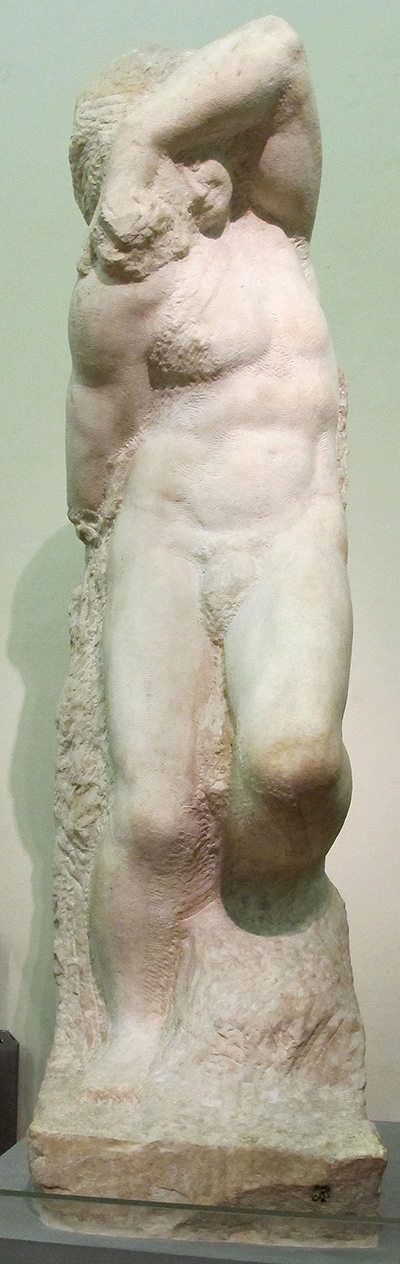
Michelangelo’s Young Slave is unusually clear about action while remaining radically incomplete. The left arm lifts, the right disappears behind the body, both legs flex and the torso turns. At 256 centimetres high, the figure is monumental, yet its roughed-out head and interrupted contours prevent it from becoming an autonomous heroic nude.[1]
The Galleria dell’Accademia dates the object to 1530 within the broader 1519–1534 history of the four Florence Prisoners. All were made for changing versions of Pope Julius II’s tomb and left unfinished after the programme was reduced.[1][2] The marble preserves a late stage of the commission in which a body of extraordinary scale had acquired motion without acquiring a final architectural place.
At a Glance
- ArtistMichelangelo Buonarroti
- TitleYoung Slave or Young Prisoner
- Object date1530 in the Accademia data sheet
- MaterialMarble
- Height256 centimetres
- Current locationGalleria dell’Accademia, Florence
- Original purposeA figure for the Tomb of Pope Julius II
- GroupOne of four Florence Prisoners
- PoseRaised left arm, concealed right arm, flexed legs and turning torso
- SurfaceUpper body emerging more clearly; head and other passages roughly worked with visible tool traces
- Later historyStudio, Boboli Gardens and Accademia from 1909
- Title caution“Young” describes apparent age rather than a securely identified subject
Contents
- Monumental Scale, Contracted Movement
- A Colossus Seen at Human Distance
- The Roughed Head and the Developed Torso
- The Date 1530 and the Wider Group
- The Julius Tomb Context
- The Ignudi Comparison
- Youth Without a Portrait
- Where Does the Body End?
- Non-Finito Without a Myth
- Paris and Florence: Two Prisoner Histories
- Artist Up Close
Monumental Scale, Contracted Movement
The figure exceeds ordinary human height, but scale does not produce stability. Both legs flex, lowering and compressing the body. The torso rotates above them, and the raised left arm breaks the vertical boundary.[1]
The right arm is harder to recover because it passes behind or remains hidden within the form.[1] This unequal visibility makes the action feel enclosed. One limb approaches clear gesture while the other is absorbed by the block and the body’s rotation.
The upward arm can suggest stretching, warding, binding or an attempt to find space. No attribute or surrounding narrative chooses among them. What remains secure is the way the gesture lengthens one side of the torso and produces a chain of movement through chest, abdomen and hip.
Flexed legs prevent that upward reach from becoming liberation. They gather weight and keep the figure low. The combination of raised arm and bent knees gives the body contradictory impulses: expansion above, compression below.
At monumental scale, these directions would have animated architecture strongly. The figure’s outline could answer a vertical support while its torso introduced rotation. In the unfinished museum object, the block supplies the resistance once expected from a larger structural setting.
A Colossus Seen at Human Distance
At 256 centimetres, the figure’s scale is easy to underestimate in reproduction.[1] A rectangular photograph gives no bodily measure, while the Accademia permits visitors to compare their own height with flexed legs that still rise above them.
The scale changes the tool traces. Marks that look delicate in an image are the residue of blows across a large volume. The torso’s turn required not just anatomical knowledge but control of tons of stone, with every removal affecting balance, support and the survival of projecting limbs.
Because the legs bend, the full block implies an even greater potential height. Michelangelo compresses a colossal body rather than simply extending it upward. This makes the figure well suited to an architectural zone where bodily energy had to remain contained by a vertical order.
The visitor’s low or level viewpoint also affects the unfinished head. Facial ambiguity is intensified when the upper passages are seen above eye height. In a proposed tomb setting, the head may have required emphatic forms rather than intimate detail. Since the intended position changed, that relationship cannot be reconstructed with certainty.
The Roughed Head and the Developed Torso
The Accademia identifies the upper body as emerging while the head remains roughly worked.[1] This inversion matters. A viewer can follow muscular structure before receiving a finished face through which to assign personality.
The body is therefore young largely by proportion and conventional title, not through fully resolved physiognomy. Smoothness cannot be used as a simple sign of age. The absence of facial completion keeps identity generic even as the pose becomes specific.
Tool traces remain visible across less developed zones.[1] They do not all belong to one operation. Pointed tools could remove stone rapidly; tooth chisels could regularise planes; finer work would refine transitions. The surviving surface holds several moments of that sequence without revealing an inevitable next step.
The contrast between torso and head also warns against a linear belief that Michelangelo always completed faces first. He could establish the principal bodily movement, test projection and retain material around vulnerable extremities. Carving priorities depended on the particular block and proposed setting.
Viewed from changing angles, anatomy appears and disappears. A plane that reads as shoulder from the front may merge with support from the side. The unfinished sculpture makes recognition active: viewers assemble a body from work completed to unequal depths.
The Date 1530 and the Wider Group
The Accademia’s object sheet gives 1530 for the Young Slave, while its group account places the four Florence Prisoners across 1519–1534.[1][2] These dates are compatible when their different functions are respected. One identifies this object; the other acknowledges extended and interrupted group work.
The four titles distinguish visual character. Atlas seems crushed beneath an upper burden. Awakening appears to stir from the stone. Bearded acquires mature identity through the head. Young combines clearer torsion with a comparatively unresolved face.[1][2]
Their different states are not a secure chronological ladder. More visible anatomy could reflect emphasis rather than lateness. Work might have resumed on one block while another remained untouched. The broad range prevents finish from being mistaken for a date stamp.
The group’s present arrangement likewise shapes comparison. In the Accademia, the Prisoners line the approach toward David. Visitors may experience them as sequential stages leading to a finished masterpiece, but that narrative belongs to museum display rather than Michelangelo’s tomb design.[2]
The Julius Tomb Context
The original commission began in 1505 and changed for approximately four decades. The Metropolitan Museum describes the reduced wall monument as unveiled in 1545.[3] Early ambitions for St Peter’s gave way to successive agreements, different architectural solutions and fewer figures.
Surviving drawings do not provide a simple lost plan into which Young Slave can be inserted. The Met’s early design is itself an object with a debated attribution history, and later copies or reconstructions must remain labelled.[8] The exact place intended for this marble is therefore less secure than its general purpose.
The Accademia links the Florence group to Julius’s mausoleum and says reduction left it unfinished.[2] That history explains why a monumental figure dated around 1530 never entered an installed programme.
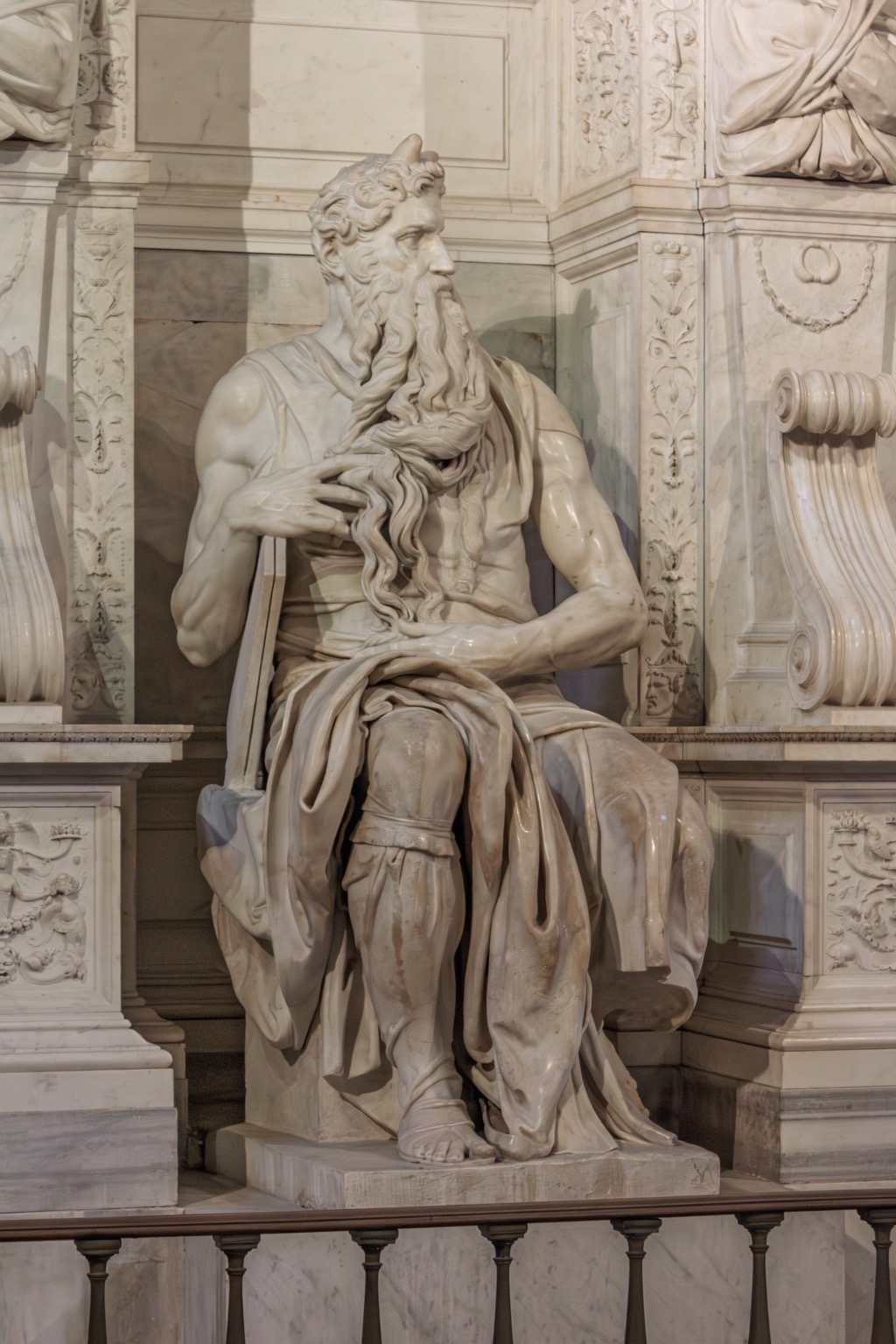
The final monument at San Pietro in Vincoli centres on Moses and excludes the Prisoners.[4] Young Slave is not a fragment taken from that wall. It belongs to a discarded solution whose scale and bodily rhythm differed from the one completed.
Specialist scholarship has to reconcile contracts, drawings, sculpture and workshop evidence across the whole project.[9] An object study can be precise about what survives while leaving its exact hypothetical niche open.
The Ignudi Comparison
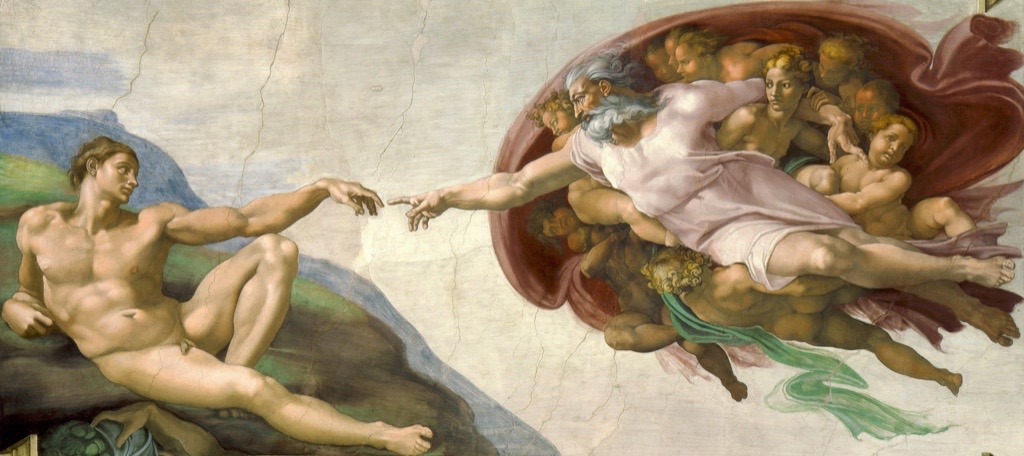
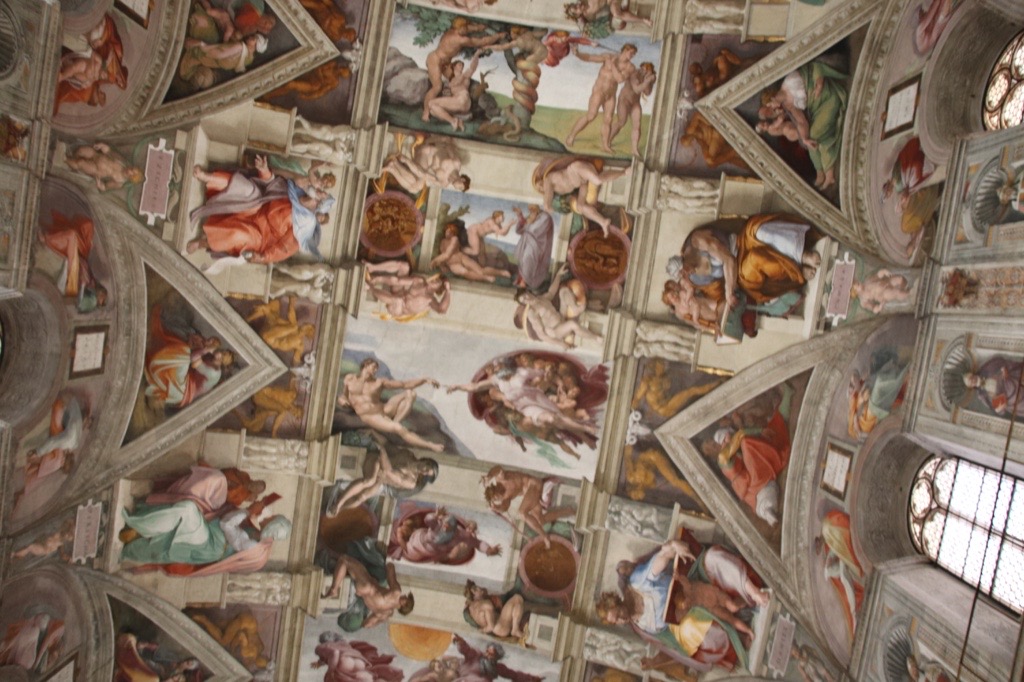
The Accademia compares the sculpture’s vigorous torsion with Michelangelo’s ignudi, the monumental nude youths painted on the Sistine ceiling.[1] The relationship is formal rather than a claim that the Prisoner repeats one specific ceiling figure.
Both demonstrate how Michelangelo could make a male torso organise complex movement. Limbs pull in different directions while the abdomen mediates between chest and pelvis. Anatomical exaggeration clarifies rotation at a scale meant to be read from a distance.
The media change everything. Painted ignudi inhabit fictive architecture and can seem to project from the ceiling without bearing real weight. Young Slave is an actual marble body whose unremoved stone restricts depth and gesture. What painting can imply through foreshortening, sculpture must negotiate through physical mass.
The comparison also places the 1530 object within a longer development. Michelangelo did not leave the monumental nude behind after the Sistine ceiling. He reworked its potential under the different pressures of a funerary commission, a standing block and incomplete carving.
Youth Without a Portrait
“Young” describes a bodily type rather than a biography. The proportions, relatively smooth torso and absence of a developed beard make the name plausible, but the roughed head cannot supply the individuality of a portrait.[1]
Youth intensifies the sculpture’s frustrated potential. A body associated with vigour and growth is held in flexion, unable to complete its upward reach. This is an effect of the present form, not proof that Michelangelo planned a personification of youth.
Within a repeated group, apparent differences of age could create variety and widen meaning. Mature and youthful captives might suggest universality without representing specific men. The tomb’s original programme remains too uncertain to convert this possibility into a fixed code.
The title’s restraint is therefore useful. It identifies what viewers notice first while leaving room for the work’s other identities: monumental nude, abandoned architectural figure, record of carving, Boboli object and Accademia masterpiece.
Where Does the Body End?
The raised arm appears more independent than the concealed right one, and the torso more coherent than the head. These differences make the border between body and surrounding stone move from zone to zone.
A finished silhouette would tell viewers exactly what belongs to the figure. Here perception must decide whether a ridge is anatomy, support or material awaiting removal. That uncertainty becomes particularly intense around the hidden arm and flexed legs, where overlaps are not fully opened.
Michelangelo had to preserve sufficient marble to protect structural strength. Thin wrists, ankles or detached limbs are vulnerable, especially at large scale. The remaining mass is thus not only an aesthetic opponent; it may be practical support and stored possibility.
The Young Slave makes creation look like emergence because its decisive bodily axis is already present. But emergence is not automatic. Every clearer contour records a risk taken, while every rough mass records a choice postponed or a project interrupted.
Non-Finito Without a Myth
The Young Slave offers unusually direct evidence of sculptural process. Developed anatomical planes sit beside roughed masses and tool marks. The figure seems to emerge because viewers can still see the material conditions that a finished statue normally suppresses.
That effect has encouraged the famous metaphor that Michelangelo liberated bodies already present in stone. It captures the experience of looking but risks making every cut inevitable and every abandoned surface intentional.
The tomb’s reduction provides a historical cause for work to cease.[2] The artist did not need to declare the marble finished for it to survive at this stage. Its modern aesthetic completeness is partly an achievement of reception.
The SMK guide’s distinction among original works, casts, facsimiles and reconstructions helps maintain this boundary.[5] Copies can disclose shape or support hypothetical arrangements, but they cannot prove which rough zone would have become a limb, support or drapery.
The unfinished head is especially resistant to romantic certainty. It does not reveal a soul awaiting release so much as a set of unmade decisions. Age, expression, hair and final orientation remain suspended while the torso already moves.
Paris and Florence: Two Prisoner Histories
The Louvre’s Dying and Rebellious Slave were made around 1513–1515 for an earlier reduced scheme.[6][7] They are more fully separated from their blocks and form a memorable pair of yielding and resisting actions.
The Florence group is later and more radically unfinished. Its members did not follow the Louvre pair into French collections. They remained in Michelangelo’s studio, were later installed in the Boboli Gardens and entered the Accademia in 1909.[2]
These distinctions matter more than the shared title. Six related tomb sculptures do not form one unchanging set. Their architecture, dates, finishes and later lives diverge. Young Slave owns its particular combination of clear torsion, monumental height and withheld face.
Artist Up Close
Michelangelo could establish bodily intention before resolving identity. The raised arm and flexed legs make action clear, while the roughed head prevents the figure from settling into a single personality or emotion.
The sculpture shows that finish is not distributed according to what modern viewers value most. Torso, limb and block were part of an architectural calculation. The resulting interruption allows us to see movement being constructed rather than merely represented.
Frequently Asked Questions
Discussion
How does the raised arm change the way viewers understand the figure's unfinished state?
Reader Insights
How does the raised arm change the way viewers understand the figure's unfinished state?
What is gained by treating the Young Slave as an individual sculpture rather than only as part of the Florence group?
How should public writing handle the difference between object-record dates and broader group date ranges?
Join the Conversation
Set the Young Slave beside Atlas Slave, Awakening Slave and Bearded Slave. Which comparison best clarifies the Florence Prisoners group?
References
- Galleria dell’Accademia di Firenze, Young Slave”:, View source.
- Galleria dell’Accademia di Firenze, Atlas”:, View source.
- Metropolitan Museum of Art, Michelangelo: Divine Draftsman and Designer — Exhibition Galleries”:, View source.
- Roma Capitale / Turismo Roma, Michelangelo’s Locations”:, View source.
- National Gallery of Denmark, Michelangelo Imperfect — English Guide:, View source.
- Musée du Louvre, Imprisoned in Stone — The Louvre’s Slaves”:, View source.
- Musée du Louvre, The Dying Slave”:, View source.
- Metropolitan Museum of Art, Design for the Tomb of Pope Julius II della Rovere”:, View source.
- J. Paul Getty Museum / Getty Publications, Michelangelo’s Tomb for Julius II: Genesis and Genius:, View source.