 by Tom Gurney
Tom Gurney BSc (Hons) is an art history expert with over 20 years experience
Published on June 19, 2020 / Updated on August 8, 2026
Email: tomgurney1@gmail.com / Phone: +44 7429 011000
Giuliano de’ Medici by Michelangelo
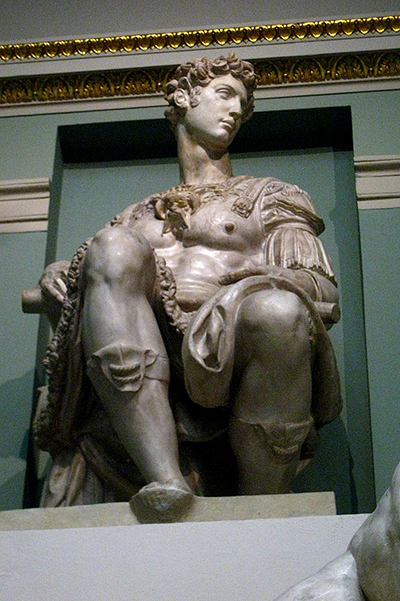
Giuliano sits as though command has paused but not ended. His armoured body is open, his head elevated and his hands occupy the space before him with the assurance of public action. Across the New Sacristy, Lorenzo withdraws into shadow; Giuliano offers himself to the room. Michelangelo fashioned neither man as a literal likeness. Together they create opposing ideals of rule.
The figure represents Giuliano de’ Medici, Duke of Nemours, who died in 1516. He is not Giuliano, brother of Lorenzo the Magnificent, killed during the Pazzi conspiracy.[1][2] The earlier Giuliano shares the memorial beneath the Medici Madonna. The duke sits above Night and Day on his own tomb wall. As with Lorenzo, genealogy, sculpture and architecture must be read together.
At a Glance
- ArtistMichelangelo Buonarroti
- SubjectGiuliano de’ Medici, Duke of Nemours
- DateDeveloped across Michelangelo’s work in the sacristy, approximately 1520–1534
- MediumMarble
- FormIdealised seated ruler in classical armour
- MemorialGiuliano’s wall tomb in the New Sacristy
- Paired personificationsNight and Day[3][4]
- SettingSan Lorenzo’s New Sacristy, administered as part of Florence’s Medici Chapels[1][5]
- Character typeActive, outward and commanding in contrast with the pensive Lorenzo opposite
- Portrait cautionThe sculpture represents ducal status and ideal character rather than a demonstrably exact face
- Identity cautionNot the fifteenth-century Giuliano murdered in 1478
- Attribute problemObjects held in the hands have prompted varied interpretations; they should not be made to support an undocumented, single allegory
Contents
- Two Men Named Giuliano
- An Ideal Commander
- The Open Face
- Hands, Baton and the Problem of Attributes
- Armour as a Second Body
- Night and Day Below the Duke
- The Famous Night
- The Unfinished Day
- An Architecture of Readiness
- Plans That Changed
- Opposite Lorenzo
- Toward the Madonna Wall
- Portraiture and the Future
- Command Held in Suspension
- Gender and Hierarchy on the Tomb
- How to Look at Giuliano
- Why Giuliano de’ Medici Matters
- Artist Up Close
Two Men Named Giuliano
Giuliano, Duke of Nemours, was the son of Lorenzo the Magnificent and younger brother of Pope Leo X. His short-lived rank and early death made him part of the family memorial programme shaped under Medici papal patronage. Michelangelo’s statue gives that dynastic role a classical permanence.
His uncle shared his name and died violently in Florence decades earlier. That elder Giuliano is commemorated with Lorenzo the Magnificent on the chapel’s sacred wall. The younger duke receives the architectural distinction of an individual monument. The difference reflects generation and programme, not simply personal importance.
Naming the duke correctly prevents a common interpretive error. The seated warrior is not a posthumous image of the Pazzi victim, and Night and Day do not recline on the Magnifici sarcophagus. Each wall establishes its own identities before participating in the whole room.
An Ideal Commander
Giuliano’s armour resembles no practical inventory of his personal equipment. It belongs to an ideal, classicising vocabulary of command. Breastplate, strong torso and balanced seat turn a Medici duke into a timeless captain.
The national catalogue frames the New Sacristy’s rulers as idealised within the wider programme.[2] Their distinct physiognomies matter less as biographical records than their contrast in disposition. Michelangelo uses the body to personify forms of power.
Giuliano’s type is outward. His head is available to light, his chest opens, and his limbs communicate readiness rather than enclosure. “Active life” is a useful philosophical description of that effect. It is not evidence that the historical duke behaved precisely as the statue does.
The Open Face
Unlike Lorenzo’s eyes, submerged beneath an overhanging helmet, Giuliano’s face receives the room more directly. The gaze does not retreat into a pocket of shadow. Light gives the head a public legibility consistent with the figure’s command.
The expression is controlled rather than theatrical. Giuliano does not shout, smile or display rage. Authority resides in availability: he seems prepared to look, decide and act. The calm face disciplines the body’s latent energy.
This balance helps the statue avoid becoming an illustration of aggression. Michelangelo presents action as a capacity held in reserve. Giuliano occupies the moment before command becomes deed.
Hands, Baton and the Problem of Attributes
The duke’s hands engage objects traditionally interpreted in relation to command, perhaps including a baton. Their exact meanings have generated different proposals, and it is safer to begin with how they organise the pose. One hand projects forward and the other balances the body, opening space around the torso.
An attribute can specify office, virtue or action, but it can also be restored, damaged or misunderstood. In a memorial portrait, a baton readily signals military command without identifying a particular campaign. Other held forms should not be turned into a secret political code unless documentary evidence warrants it.
The hands make Giuliano active even while seated. Lorenzo’s raised hand closes thought around the face. Giuliano’s distribute intention into the surrounding air. This contrast is sculptural before it is philosophical.
Armour as a Second Body
Michelangelo treats armour as structure rather than costume decoration. It enlarges and clarifies the torso, makes the shoulders more authoritative and translates flesh into public office. Beneath it, the body remains perceptible through balance and turn.
Hard surface and living anatomy produce a controlled tension. Armour promises protection and force, while the uncovered head and articulating hands preserve human presence. The ruler is both institution and person.
The classicising design removes Giuliano from transient fashion. Like an ancient commander recalled in marble, he becomes suitable for a memorial intended to outlast those who knew his actual appearance.
Night and Day Below the Duke
The sarcophagus carries Night and Day, whose object records secure their identity within Giuliano’s monument.[3][4] Night is a female figure in sleep, accompanied by symbolic forms associated with darkness. Day is an immense male nude whose powerful body and unfinished head resist easy completion.
Their opposition is broader than clock time. Night withdraws into unconsciousness; Day turns with difficult energy. One closes, one opens. Giuliano’s wakeful command rises above both.
The relationship should not be reduced to the flattering claim that the duke rules day and night. In a tomb, temporal totality also marks loss. Every day passes into darkness; every night returns toward light; the dead do not re-enter that cycle. Michelangelo makes time magnificent and indifferent beneath memorial power.
The Famous Night
Night has often attracted more independent fame than the duke she accompanies. Her closed eyes, folded body and emblems invite poetry and meditation. Yet detaching her from the tomb changes her meaning. She reclines on a sarcophagus because Giuliano is dead.
Her physical arrangement is not peaceful in a simple sense. The body twists and rests across a sloping, curved support. Sleep is monumental but structurally uneasy. That unease prevents night from becoming mere respite.
When viewed with Giuliano, her withdrawal intensifies his readiness. Closed female sleep below and open male command above form a gendered and hierarchical contrast characteristic of the monument’s symbolic order.
The Unfinished Day
Day displays a different incompletion. Its torso is massively developed, while the head remains broad and unresolved. Official catalogue evidence ties the figure securely to Giuliano’s tomb even though its surface withholds a finished face.[4]
That condition draws attention away from individual expression and toward bodily force. Day becomes presence without portrait. Michelangelo’s uneven finish allows light to break across the head while the torso holds greater anatomical clarity.
It would be unwise to state that the unfinished face deliberately symbolises daylight too bright to see, despite the interpretation’s poetic appeal. The chapel’s interrupted execution supplies a practical history. The present effect is evocative; the original motive remains uncertain.
An Architecture of Readiness
Giuliano sits within a niche whose geometry intensifies his frontal availability. Columns, mouldings and recess frame the body and distinguish it from the reclining figures below. The wall alternates enclosure with projection.
His vertical seated pose resolves the broad diagonals of Night and Day. Their bodies stretch across the sarcophagus, threatening to slip beyond stable support; the duke gathers the design back toward its centre. Architecture makes their unequal orientations coherent.
The statue therefore cannot be understood as a movable portrait placed conveniently above a tomb. Niche, body, sarcophagus and personifications form one visual mechanism.
Plans That Changed
Michelangelo considered other arrangements for Medici memorials before the wall tombs took their present form. British Museum drawings preserve free-standing and double-tomb studies that document alternative ways of joining figures and architecture.[6][7]
These sheets reveal a process, not a lost final answer. They should not be overlaid mechanically onto the built wall to prove that every present statue had the same intended location from the start. The New Sacristy developed through revision.
A Metropolitan Museum study of Michelangelo’s disegno provides the broader context for this movement among drawn thought, sculptural models and architectural form.[8] Giuliano’s monument is one resolved stage within a larger field of possibilities.
Opposite Lorenzo
Michelangelo made the dukes into a pair through contrast. Giuliano is often associated with action, Lorenzo with contemplation. One opens to the room; the other contracts into shadow. Their armour links them, while gesture and illumination divide them.
The opposition resembles Renaissance discussions of active and contemplative life, but no inscription locks the tombs to a single philosophical scheme. The statues create those categories visually. Viewers perform the comparison by turning across the chapel.
Their paired Times of Day complete a larger cycle. Night and Day occupy Giuliano’s tomb; Dawn and Dusk belong to Lorenzo’s. The two walls together encompass full temporal passage beneath idealised Medici rule.
Toward the Madonna Wall
The third principal wall centres the Medici Madonna above a joint burial for the Magnificent and his brother, the earlier Giuliano.[1][2] This sacred group changes the status of the ducal images. They are not the chapel’s ultimate focus.
Giuliano’s outward readiness can be understood as participating in a spatial order directed toward Mary and Christ. The Christian centre gives dynastic memory a redemptive horizon. Cosmas and Damian, Medici patron saints, mediate family identity and sacred intercession.
The younger duke’s monument thus belongs to a room where secular authority, natural time and salvation are staged in distinct but connected sculptural languages.
Portraiture and the Future
Michelangelo designed for spectators who would never have met Giuliano. An exact likeness could preserve individual appearance, but its evidential value would fade as living memory vanished. An ideal commander supplied a more legible role across centuries.
That choice makes the tomb both more universal and more dependent on labels. Without historical identification, the armoured youth could be any ancient captain. The inscriptional and architectural context restores the Medici name; the ideal body enlarges it.
Portraiture here is a collaboration between specific commemoration and timeless type. The duke’s fame survives not in the uniqueness of his nose but in a position within Michelangelo’s total design.
Command Held in Suspension
The pose is most compelling when understood between action and rest. Giuliano is seated, the condition of a ruler enthroned or commemorated, but his torso and hands refuse complete repose. Michelangelo captures command as readiness rather than as a narrated order.
That suspension suits funerary sculpture. The historical duke can no longer act, yet the memorial must preserve his capacity for rule. A statue shown charging into battle would trap him in one event; a completely relaxed portrait would weaken authority. The poised body converts lost agency into permanent potential.
This is also why Giuliano remains more than the easy opposite of “thoughtful Lorenzo.” His activity is controlled, not explosive. Both rulers hold energy in reserve. Michelangelo differentiates where that energy appears to point—out into the civic world for Giuliano, inward toward mental space for Lorenzo.
Gender and Hierarchy on the Tomb
The wall also arranges gendered bodies. An armoured male ruler presides above a female Night and male Day. Their nudity belongs to allegory, while his armour belongs to social identity. Michelangelo uses difference in dress, sex, posture and finish to separate mortal rank from universal time.
The hierarchy is clear but not simple. The duke occupies the privileged niche, yet Night and Day often command greater visual attention through scale and bodily complexity. The subordinate allegories can outshine the commemorated subject. Monumental design therefore produces a productive tension between dynastic purpose and sculptural fascination.
How to Look at Giuliano
Approach the monument from the whole wall. Let Night and Day establish the sarcophagus’s breadth, then allow their diagonals to lead upward toward the seated figure. This reveals why his compact frontality matters.
Compare left and right sides of the body. Follow the hands and any held forms, but resist naming an object before its contours justify the claim. Then step across the room to Lorenzo. Shadow, gesture and attitude become clearer through opposition.
Finish at the Madonna wall. The chapel is designed to be read by turning, just as Michelangelo’s figures often turn within themselves. No single tomb exhausts the ensemble.
Why Giuliano de’ Medici Matters
The statue matters because it makes action visible without depicting an act. Giuliano sits, yet his hands, open face and armoured torso fill the space with readiness. Michelangelo transforms potential into character.
It matters because its idealisation exposes the purpose of funerary portraiture. The sculpture does not recover a lost face. It creates a version of ducal authority capable of standing above personified time.
And it matters because the image is relational. Night and Day, Lorenzo opposite and the sacred group across the chapel produce Giuliano’s identity. Removed from those relationships he remains a compelling figure; restored to them he becomes the active pole of an entire memorial chamber.
Artist Up Close
Michelangelo’s New Sacristy required him to invent not only separate statues but a family of differences. Male and female, waking and sleeping, active and contemplative, sacred and secular all had to coexist in a small room. Giuliano demonstrates that skill at its most economical. An armour shell, open face and disposition of hands are enough to distinguish one ideal ruler from another. Yet the historical Michelangelo worked amid changing Medici politics and ultimately left Florence in 1534, ensuring that assistants and later arrangements participated in the chapel’s completion.[2][5]
Frequently Asked Questions
Discussion
How does Michelangelo make a memorial portrait depend on the architecture around it?
Reader Insights
How does Giuliano's outward posture change the mood of the tomb wall?
Does the contrast between Giuliano above and Night/Day below make the monument feel controlled or unstable?
How does the New Sacristy setting change the meaning of an ideal portrait sculpture?
Join the Conversation
Set Giuliano above Night and Day. Does the tomb wall feel more like a portrait, an allegory of time or an architectural idea?
References
- Musei del Bargello, Cappelle Medicee”:, View source.
- Catalogo generale dei Beni Culturali, Michelangelo e la Sagrestia Nuova in Firenze — Un progetto innovativo”:, View source.
- Catalogo generale dei Beni Culturali, Notte”:, View source.
- Catalogo generale dei Beni Culturali, Giorno”:, View source.
- Ministero della Cultura, Firenze — Cappelle Medicee: Un ascensore per Michelangelo”:, View source.
- British Museum, The Medici Tombs in the New Sacristy: Studies for a Free-standing Sepulchral Monument”:, View source.
- British Museum, The Medici Tombs in the New Sacristy: A Study for a Double Tomb with Figures”:, View source.
- The Metropolitan Museum of Art, Michelangelo: Divine Draftsman and Designer”:, View source.