


 by Tom Gurney
Tom Gurney BSc (Hons) is an art history expert with over 20 years experience
Published on June 19, 2020 / Updated on November 6, 2025
Email: tomgurney1@gmail.com / Phone: +44 7429 011000
The Drunkenness of Noah by Michelangelo
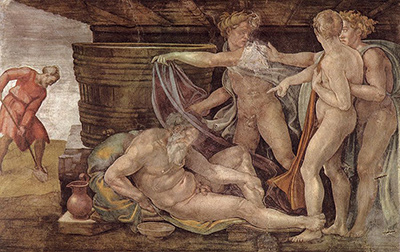
The nine central Genesis stories on Michelangelo’s Sistine ceiling end without triumph. Noah, survivor of the Flood and maker of sacrifice, lies naked and incapacitated beside a wine vessel. One son exposes or points toward his father while two others raise a covering. At the far side, a smaller episode shows labour in the vineyard. Renewal after catastrophe has led not back to Eden but to another scene of knowledge, exposure and divided response.
The Vatican Museums place The Drunkenness of Noah ninth in the altar-to-entrance progression.[1] It is physically encountered last, though it belongs to the entrance-end half Michelangelo painted earlier in the campaign.[2] Its modest domestic shame closes a sequence that began with the separation of light from darkness. The reduction in scale is deliberate and unsettling.
At a Glance
- TitleThe Drunkenness of Noah
- Maker and techniqueMichelangelo Buonarroti; fresco
- SiteEntrance-end compartment in the central Genesis series of the Sistine Chapel vault
- Project datesThe ceiling was undertaken for Julius II between 1508 and 1512[2]
- Scriptural sourceGenesis 9:20–27[5]
- Central sequence positionNinth and last from altar toward entrance[1]
- EpisodesNoah’s vineyard labour and his drunken exposure with his sons
- Principal figuresNoah, Ham, Shem and Japheth, conventionally identified from the biblical subject
- Primary contrastProductive cultivation at the edge; incapacity and family reaction at the centre
- Moral structureOne son looks and reports; two approach backward to cover their father[5]
- Chronology cautionPosition at the narrative end does not make it Michelangelo’s final ceiling scene
- Viewing cautionThe outer vineyard episode may disappear in a crop centred on the nude Noah
Contents
- The Biblical Episode
- Two Moments in One Field
- Noah Reclining
- The Three Sons
- Cloth as Moral Action
- Looking and Refusing to Look
- An Architecture of Domestic Shame
- From the Flood to Wine
- The Final Noah Scene
- Last in Reading, Early in Making
- The Full Bay and Its Ignudi
- Restoration and Reproduced Colour
- A Difficult Afterlife of the Biblical Text
- Why The Drunkenness of Noah Matters
- Artist Up Close
The Biblical Episode
Genesis describes Noah as a man of the soil who plants a vineyard, drinks its wine, becomes drunk and lies uncovered inside his tent. Ham sees his father’s nakedness and tells his brothers. Shem and Japheth take a garment, walk backward and cover him without looking.[5]
When Noah wakes and learns what happened, he pronounces a curse upon Canaan, Ham’s son, while blessing the relations of Shem and Japheth. The passage is brief but ethically and historically difficult, especially because later interpreters grotesquely misused it to justify racial slavery. Nothing in Michelangelo’s fresco should be recruited into that later distortion.
The painted scene centres on exposure and response. It shows different ways of looking at vulnerability: pointing or announcing, averting the gaze and providing protection.
Noah’s drunkenness is neither the Flood’s heroic survival nor the altar’s ordered offering. The patriarch is fallible, and the renewed world contains shame within the family chosen to preserve humanity.
Two Moments in One Field
At the left edge, a clothed figure works the ground, traditionally understood as Noah cultivating the vineyard. The scale is smaller, and the action occurs beyond the principal shelter.
Inside the main space, time has advanced. Noah lies nude after drinking, and his sons respond. Michelangelo uses continuous narrative again, showing the patriarch at work and then incapacitated without a formal dividing frame.
The pairing links cause and consequence but does not reduce agriculture itself to sin. Planting is productive labour; uncontrolled drinking transforms its fruit into vulnerability.
Because the vineyard figure is marginal, tight reproductions often remove him. What remains then looks like a single domestic episode without its prehistory. The complete width restores Michelangelo’s compressed temporal structure.
Noah Reclining
Noah occupies the lower centre, his large nude body arranged across drapery. One arm bends toward the ground or head, while legs and torso expose him to the standing sons. A vessel near him identifies the aftermath of drinking.
His anatomy remains monumental, but its condition differs from the ceiling’s heroic nudes. Weight has lost purposeful direction. The body is strong in form and powerless in action.
This contrast prevents moral character from being read directly from ideal physique. Noah can be righteous survivor, sacrificing patriarch and drunken father without Michelangelo changing him into a caricature of physical weakness.
The reclining pose also echoes Adam and other prone figures across the ceiling. Yet this is not creative sleep. It is a human incapacity brought about within history, after labour and wine.
The Three Sons
Three younger men stand around Noah. One nude figure points or gestures openly toward the exposed body. Two clothed figures coordinate a mantle, directing their movement so that they can cover their father while averting their eyes.
The biblical narrative supports identifying the brothers as Ham, Shem and Japheth at group level.[5] Exact left-to-right naming can vary with description and reproduction orientation, so action is more secure than positional labels.
Michelangelo makes their ethical distinction legible through limbs and cloth. The pointing figure opens the spectacle. The others create a screen.
Their bodies overlap closely, turning the moral choice into a physical negotiation. Covering requires cooperation. Each must hold the garment and respond to the other while avoiding the sight before them.
Cloth as Moral Action
The dark mantle stretched above Noah is the scene’s most important object after the wine vessel. It is not merely drapery added to vary colour. In Genesis, the garment enables Shem and Japheth to protect their father’s dignity.[5]
Michelangelo suspends the act before completion. Noah remains exposed, and the cloth has not yet descended fully. Viewers see ethical intention in progress.
The garment’s broad diagonal also joins the standing sons across space. Their hands turn fabric into a shared instrument, contrasting with the isolating point of the third brother.
Across the larger ceiling, drapery can enlarge divine flight or display complex design. Here its use is intimate and corrective. Cloth restores a boundary that drunkenness has undone.
Looking and Refusing to Look
The episode is fundamentally about sight. Ham sees; Shem and Japheth arrange their bodies to avoid seeing while still acting.[5] Michelangelo must paint this difference in an image that asks everyone in the chapel to look.
That paradox places the observer in an uncomfortable position. Noah’s nakedness is visible because the fresco represents it, yet the narrative praises those who do not turn exposure into spectacle.
The sons’ gestures offer contrasting models. Pointing isolates and publicises. Covering recognises vulnerability and limits vision.
This distinction makes the fresco unusually self-aware. It does not condemn all sight; compassionate action depends on understanding what has happened. It questions how looking is converted into humiliation or care.
An Architecture of Domestic Shame
The central episode takes place beneath or before a dark, shelter-like structure. Unlike the open world of The Flood, the setting feels enclosed and close.
Noah has survived the destruction outside the ark only to become vulnerable inside a human dwelling. Safety from water does not produce moral security.
The shallow space presses the sons near their father. There is little room for distance, making response unavoidable. Family members cannot remain neutral observers at the edge.
The shift from universal catastrophe to interior shame is one of the ceiling’s sharpest changes of scale. Michelangelo ends world history’s opening sequence with a household.
From the Flood to Wine
Genesis connects the episode to the renewed earth. Noah leaves the ark, sacrifices, receives covenantal assurance and becomes a cultivator.[5] Agriculture signifies continuation, but its product creates a new danger.
The vine therefore belongs to civilisation as well as intoxication. Human beings work the soil, transform its yield and become responsible for the uses of what they make.
Michelangelo’s marginal labourer is important precisely because he precedes the fall into stupor. The same person moves from agency to incapacity.
This repetition parallels the transformed Adam and Eve in the temptation-expulsion fresco. Once again, one field compares the body before and after an act.
The Final Noah Scene
The Vatican groups Sacrifice of Noah, The Flood and Drunkenness of Noah at the close of the central progression.[1] The group moves from ritual order to catastrophe to family disorder in physical arrangement, even though sacrifice follows the Flood in the biblical account.
Noah’s final scene denies a simple heroic conclusion. The survivor does not restore permanent innocence. His sons’ divided conduct becomes the seed of further conflict.
This closing note connects the Noah group back to Adam and Eve. Exposure, shame and damaged relations recur after the waters have supposedly renewed the world.
The ceiling’s Genesis history is therefore cyclical without being repetitive. Similar human conditions return through new bodies, families and circumstances.
Last in Reading, Early in Making
The scene’s position near the entrance makes it last in the altar-to-entrance narrative order.[1] It also places it in the section completed by August 1510, before Michelangelo finished the altar-side half in 1512.[2]
This crossing of directions is vital. The last biblical episode overhead belongs broadly to the earlier part of the working campaign.
It would be misleading to call Drunkenness of Noah Michelangelo’s final ceiling work merely because it closes the central stories. Programme sequence and production chronology answer different questions.
The dense, relatively small figures also belong to the visual character of the entrance-end Genesis compartments. Comparison with later, larger forms is informative so long as subject and bay size are considered alongside experience.
The Full Bay and Its Ignudi
A complete reproduction shows the narrative rectangle surrounded by four monumental ignudi, medallions and painted architectural members.[2] Their exposed bodies create a striking outer frame for Noah’s shame.
The ignudi do not belong to the tent or participate in the biblical action. They occupy the ceiling’s fictive architectural order. Nonetheless, their idealised nudity changes how the smaller central body is perceived.
Noah’s exposure is narrative and involuntary; the ignudi display bodies as part of the vault’s monumental ornament. One kind of nakedness cannot simply explain the other.
Cropping down to the centre clarifies the family episode but removes this layered contrast. The whole bay preserves Michelangelo’s ability to make distinct representational worlds coexist.
Restoration and Reproduced Colour
The Vatican records the chapel’s modern conservation within a long material history.[3][4] Cleaning made the strong contrasts of flesh, garments and architectural framing more visible to contemporary audiences.
Digital files vary in tone, crop and rotation. The dark shelter may swallow detail in one image and become reddish-brown in another. Noah’s body can appear pale or warm according to exposure.
These variations should not encourage claims that one reproduction alone preserves the exact original look. They call for attention to stable relations and to the fresco’s physical placement.
Surface losses and repairs visible in close views also belong to the work’s afterlife. Michelangelo’s design persists through a material object that has endured five centuries of chapel conditions.
A Difficult Afterlife of the Biblical Text
The curse following the episode falls upon Canaan in Genesis, not upon an invented racial category.[5] Later pro-slavery interpreters distorted the passage into the so-called “curse of Ham,” projecting racial ideology onto the text.
The fresco predates modern racial slavery’s full ideological systems and does not encode that later doctrine through skin colour. Reading it responsibly requires refusing the false tradition that made the story a warrant for enslavement.
Michelangelo’s visible emphasis is immediate and familial: exposure, gesture, cloth and response. The bodies are differentiated by pose and role, not arranged as a racial taxonomy.
Historical reception may be acknowledged, but it should not be mistaken for the scene’s sixteenth-century subject.
Why The Drunkenness of Noah Matters
The fresco matters because it closes the Genesis centre on human vulnerability rather than divine spectacle. The cosmic sequence narrows to one exposed father and three sons deciding how to act.
It matters because vision becomes ethical. The difference between humiliation and care lies not only in what is seen but in what the sons do with that knowledge.
Most importantly, Noah’s failure prevents the Flood from functioning as a simple reset. Violence has been judged and life preserved, yet shame and division return. Michelangelo’s ending is sober precisely because its protagonist is not.
Artist Up Close
Michelangelo makes the body carry reputation and its collapse simultaneously. Noah’s muscular form recalls the ceiling’s grandeur, but pose and circumstance strip it of command. Around him, the sons turn ethics into choreography: one points, two lift cloth and avert their faces. The artist does not need an inscription to distinguish cruelty from care. A few arms and a stretched mantle make the choice visible.
Frequently Asked Questions
Discussion
What matters most in Michelangelo's Drunkenness of Noah: its place as the final Noah scene, its family episode, or its unsettled ending to the Genesis sequence?
Reader Insights
How does the ending change the tone of the central Genesis sequence?
What changes when the story moves from collective catastrophe to family vulnerability?
Why might the sequence close without a simple triumphant resolution?
Join the Conversation
Compare this scene with Sacrifice of Noah and The Flood, and ask how Michelangelo shifts from renewal and catastrophe to human aftermath.
References
- Vatican Museums, Central Stories”:, View source.
- Vatican Museums, Sistine Chapel Ceiling”:, View source.
- Vatican Museums, Sistine Chapel History”:, View source.
- Vatican Museums, The Sistine Chapel Twenty Years Later: New Breath, New Light”:, View source.
- United States Conference of Catholic Bishops, Genesis, Chapter 9”:, View source.