


 by Tom Gurney
Tom Gurney BSc (Hons) is an art history expert with over 20 years experience
Published on June 19, 2020 / Updated on November 6, 2025
Email: tomgurney1@gmail.com / Phone: +44 7429 011000
The Sacrifice of Noah by Michelangelo
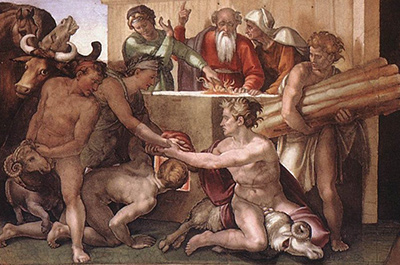
Michelangelo’s Sacrifice of Noah replaces the airborne creator and heroic solitude of the opening Genesis scenes with a crowded human ritual. Family members carry wood, restrain animals, tend a flame and gather around a block-like altar. The field is busy with hands and burdens. Survival after catastrophe is translated into collective work.
In Genesis, Noah offers burnt offerings after leaving the ark, and God promises not to destroy the earth again in the same way.[5] On the Sistine ceiling, however, the sacrifice is encountered before The Flood when the nine stories are followed from altar toward entrance.[1] That mismatch is not an error to conceal. It is essential to understanding how Michelangelo’s physical programme and biblical chronology differ.
At a Glance
- SubjectNoah’s offering after the Flood, from Genesis 8:18–22[5]
- ArtistMichelangelo Buonarroti
- Medium and settingFresco in the central Genesis band of the Sistine Chapel ceiling
- Patron and campaignPope Julius II; 1508–1512[2]
- Central sequence positionSeventh from altar toward entrance[1]
- Biblical positionAfter the Flood, despite appearing before it in the ceiling’s physical order
- Principal motifA family group working around an altar with fire, animals and wood
- Narrative groupThe three Noah episodes closing the nine central stories[1]
- Identity cautionNoah is central to the subject, but assigning every secondary figure a fixed individual name exceeds the institutional evidence
- Chronology cautionThis entrance-end work formed part of the vault section unveiled in 1510; no exact day of execution follows from that milestone[2]
- Viewing cautionFigures at the outer edges may be lost in tight crops, changing the apparent balance of labour
Contents
- The Biblical Offering
- An Altar at the Centre
- Noah and the Family Group
- Animals, Burden and Exchange
- The Bearer of Wood
- A Scene of Many Hands
- Why the Sacrifice Comes Before the Flood
- The Three Noah Scenes
- Working Order and the Early Half
- Density at Architectural Distance
- The Surrounding Decorative System
- Restoration and the Material Fresco
- Sacrifice After Catastrophe
- Why The Sacrifice of Noah Matters
- Artist Up Close
The Biblical Offering
After the waters subside, Noah, his family and the animals leave the ark. Noah builds an altar and offers burnt offerings from clean animals and birds. God responds with a promise concerning the earth’s future cycles.[5]
The act belongs to the aftermath of survival. It is thanksgiving, sacrifice and the opening of a renewed relation between humanity and the created world. The accompanying divine promise gives the ritual significance beyond the immediate family.
Michelangelo does not represent God speaking above the altar or the rainbow covenant that appears in the following chapter. He concentrates on the human action of preparing and making the offering.
That decision gives the scene a grounded quality. The sacred event emerges through bodies lifting, holding, reaching and tending. Ritual is shown as material labour.
An Altar at the Centre
A rectilinear altar or hearth anchors the upper centre. Flames rise from its surface while an elderly bearded figure and companions attend the offering. The architecture is simple and block-like, a stable core amid the crowded movement.
The fire is small in area but narratively decisive. It identifies the action as sacrifice rather than ordinary butchery or preparation. The figures’ gestures converge upon it even when their bodies face different directions.
Michelangelo places the altar slightly behind the most prominent foreground workers. This overlap produces depth without a spacious landscape. Human bodies act as the principal architecture around the sacred centre.
The rectangular structure also contrasts with the organic forms surrounding it: curved animal backs, bent knees, bundled logs and turning heads. Order is established at the point where offering is consumed.
Noah and the Family Group
An elderly bearded man behind the altar is conventionally recognised as Noah, fitting the subject and patriarchal role. Other figures cluster close to him, including an older woman and younger assistants.
Their gestures suggest instruction, attention and participation rather than a single isolated priestly act. One raises a hand, another bends toward the flame, and others bring what the rite requires.
Genesis names Noah’s wife, sons and sons’ wives as those who leave the ark, but it does not give the women personal names.[5] The fresco need not be converted into a fixed portrait chart. Family identity at group level is secure; each individual assignment is less so.
This restraint helps preserve what Michelangelo actually makes visible: generational variety, shared effort and a household reorganising itself around worship after disaster.
Animals, Burden and Exchange
At the left, a horned bovine and a ram press close to the figures. In the foreground, a kneeling youth handles another animal while extending an object toward a seated or kneeling companion. The bodies of humans and animals interlock tightly.
These creatures refer to the clean animals used for offering in Genesis.[5] They also remind the observer that survival and sacrifice are materially connected. The rescued animal world supplies the rite through which Noah gives thanks.
Michelangelo avoids sentimental distance. Hands grip horns, hides and objects; a large animal head pushes near a human torso. Weight, resistance and proximity are palpable.
The exchange across the foreground creates a horizontal link. One figure reaches, another receives, and the sacrificial process becomes a chain of coordinated tasks rather than a single emblem.
The Bearer of Wood
At the right, a muscular youth carries a heavy bundle of logs. The cylinders project across his body, and his bent posture registers their weight.
Wood is both practical fuel and a compositional device. The parallel logs introduce a strong diagonal-horizontal mass that balances the animals at the opposite side. Their regularity echoes the altar’s constructed geometry.
The youth’s action occurs at the margin of the ritual, yet Michelangelo makes it visually commanding. Preparation matters. Before flame and offering can be sustained, material must be gathered and carried.
This figure exemplifies the artist’s ability to dignify subsidiary labour. Theological significance does not eliminate physical effort; it depends upon it.
A Scene of Many Hands
Hands organise the fresco. They point upward, tend the flame, grasp animal bodies, pass an object and steady wood. No single gesture dominates in the manner of God’s hand in Creation of Adam.
This distribution suits a post-Edenic human world. Divine creation has given way to collective survival and ritual. Meaning arises through coordination among imperfect people.
The crowded arrangement can appear confusing in a small reproduction. Following the hands clarifies the action: materials move inward toward the altar, and attention rises toward the fire.
The method also distinguishes the scene from The Flood. There, multiple groups struggle in scattered desperation. Here, a dense group acts toward one centre. Crowding becomes cooperation rather than panic.
Why the Sacrifice Comes Before the Flood
The Vatican lists Sacrifice of Noah as the seventh central story, followed by The Flood and The Drunkenness of Noah.[1] Genesis places the offering after the Flood, so the first two Noah scenes are reversed relative to the text.[5]
Several compositional and programmatic explanations have been proposed for the ceiling’s arrangement, but the secure fact is the divergence itself. It should not be “fixed” by claiming that the sacrifice occurred before the catastrophe.
The physical sequence may encourage thematic rather than strictly chronological reading. Offering becomes an image of worship and hope before the observer confronts the vast catastrophe nearby. The arrangement also responds to the changing sizes and structural demands of ceiling compartments.
Those are interpretive possibilities, not a surviving explanation from Michelangelo. The ceiling’s order remains deliberate even when its rationale is not reduced to one statement.
The Three Noah Scenes
The final central group turns from cosmic and human origins to one family’s survival and failure.[1] Sacrifice of Noah presents ordered ritual; The Flood multiplies bodies under catastrophe; The Drunkenness of Noah narrows again to exposure and fractured family response.
Across the triad, scale and moral tone shift. Public worship, mass death and domestic shame succeed one another in the ceiling’s spatial arrangement.
Noah is therefore not simply a consistently heroic protagonist. He can act as righteous survivor and sacrificing patriarch, then appear vulnerable in drunkenness. Michelangelo’s sequence preserves the instability of human history after the fall.
The sacrifice’s cooperative energy gains poignancy from that larger movement. Renewal is genuine but not permanent innocence.
Working Order and the Early Half
The Noah scenes lie toward the entrance end of the vault and belong to the half Michelangelo completed first, by August 1510.[2] Their place late in the altar-to-entrance narrative therefore corresponds broadly to an earlier stage of execution.
Again, broad phase is not a precise panel date. Fresco work includes cartoons, transfer, plaster sections and adjacent decorative components. The Vatican chronology defines major campaign boundaries rather than a complete daily sequence.
The entrance-side scenes are often discussed in relation to Michelangelo’s developing approach to scale and simplification. Such comparisons can be useful when tied to visible differences, but they should not become a rigid story in which every change is dated exactly by style alone.
The surviving work supports a more careful conclusion: the Noah group and later altar-side cosmic scenes emerged in different halves of an evolving monumental undertaking.
Density at Architectural Distance
The sacrifice contains many figures and objects within a relatively compact field. At close range, animal horns, logs, flame and individual expressions can be separated. From the floor, the scene reads first as a dense mass arranged around a pale altar.
That difficulty is part of the ceiling’s rhythm. Not every central story offers the same immediate simplicity. The Noah panels confront the observer with human multiplicity after the monumental divine figures of Creation.
Smarthistory notes the scale and visual abundance of the vault as a whole.[6] A viewer must continually move between recognition and partial loss. The sacrifice’s meaning emerges more slowly than the iconic gap between Adam and God.
This slower legibility rewards guided looking. Find the flame, trace the wood and animals, then reconstruct the circle of workers.
The Surrounding Decorative System
The central field sits within painted architectural members and near nude youths, medallions and other parts of the vault’s larger programme.[2] Cropping can make it appear like a self-contained rectangular history painting.
The surrounding bodies echo the narrative’s physicality without belonging to Noah’s household. They operate at another representational level within Michelangelo’s fictive architecture.
This distinction matters because a wide reproduction may include partial limbs outside the Genesis compartment. Those are not extra attendants accidentally omitted from the story. They belong to the bay.
The ceiling depends on such nested frames. Biblical time occupies one zone; monumental nudes and prophetic figures inhabit others; painted architecture holds them together.
Restoration and the Material Fresco
The Vatican’s history of the chapel records modern restoration within centuries of use, repair and observation.[3][4] The present surface is the product of Michelangelo’s fresco technique and its long material afterlife.
Close photographs reveal cracks, joins and changes of texture that can be nearly invisible from below. Conservation images help scholars study process, but they can also make damage seem more dominant than it is in the architectural experience.
Colour reproduction affects the scene’s hierarchy. Warm flesh and ochres can merge; red garments may become emphatic; the small flame can brighten or recede. Screens provide access, not a neutral substitute for place.
Stable analysis returns to structure: altar at the centre, labour around it, animal and wood masses to either side.
Sacrifice After Catastrophe
The biblical narrative makes the offering a response to survival. Noah does not sacrifice to cause the Flood’s end; he builds the altar after dry ground returns and the ark is emptied.[5]
That chronology changes the emotional meaning. The busy scene is not ordinary routine. Every animal and family member belongs to a remnant that has passed through destruction.
The rite also looks forward. God’s response concerns the continuing rhythms of seedtime and harvest, cold and heat, summer and winter, day and night.[5] After the violent interruption of the Flood, temporal order is promised again.
Michelangelo does not inscribe those words. The steady altar and coordinated work provide a human image of restored order.
Why The Sacrifice of Noah Matters
The fresco matters because it makes worship inseparable from labour. Fire requires wood, animals must be handled and a family must coordinate. Michelangelo’s sacred history is built from bodies doing difficult things.
It matters because its ceiling position exposes the difference between textual chronology and monumental arrangement. That difference invites careful interpretation instead of casual assumption.
Most of all, the scene creates hope without restoring Eden. The family gathers and the offering rises, but the neighbouring panels retain catastrophe and future shame. Renewal exists within a fallen history.
Artist Up Close
Michelangelo often concentrates attention on a single colossal figure, but here he composes intelligence across a group. No hand controls the whole. One person brings fuel, another manages an animal, others exchange, tend or witness. The sacred centre depends on this choreography. His anatomical art becomes social: weight passes between bodies, tasks interlock, and ritual takes shape from coordinated human effort.
Frequently Asked Questions
Discussion
What matters most in Michelangelo's Sacrifice of Noah: the ritual act, its place among the Noah scenes, or the difference between ceiling order and biblical order?
Reader Insights
How does the sacrifice subject change the tone after the Fall?
What changes when physical ceiling order and biblical order are kept separate?
How does this page help connect the Eden and Noah episodes?
Join the Conversation
Compare this scene with Expulsion from Paradise and The Flood, and ask how Michelangelo shifts from rupture to survival and renewal.
References
- Vatican Museums, Central Stories”:, View source.
- Vatican Museums, Sistine Chapel Ceiling”:, View source.
- Vatican Museums, Sistine Chapel History”:, View source.
- Vatican Museums, The Sistine Chapel Twenty Years Later: New Breath, New Light”:, View source.
- United States Conference of Catholic Bishops, Genesis, Chapter 8”:, View source.
- Smarthistory, Michelangelo, Ceiling of the Sistine Chapel”:, View source.