


 by
Tom Gurney
Tom Gurney BSc (Hons) is an art history expert with over 20 years experience
Published on June 19, 2020 / Updated on October 22, 2026
Email:
tomgurney1@gmail.com
/ Phone:
+44 7429 011000
Christ and the Disciples at Emmaus: Introduction
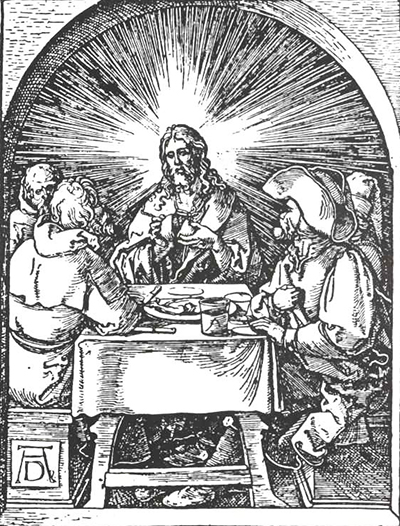
A burst of light fills the arched recess behind Christ, almost overwhelming the little room in which he sits. Below it, supper remains ordinary: a cloth covers the table, dishes and drinking vessels crowd its surface, and two travellers occupy the benches. Albrecht Dürer's Christ and the Disciples at Emmaus , also called Christ in Emmaus , brings a revelation into this close domestic space. The Metropolitan Museum of Art dates the woodcut to about 1510 and identifies it as part of the Small Passion . Its small scale makes the contrast between the familiar furnishings and Christ's extraordinary presence especially concentrated. [1]
At a Glance
- Design date About 1510 [1]
- Process Woodcut [1]
- Series Small Passion [1]
- Met impression, sheet12.7 × 9.8 cm [1]
This work across Albrecht Dürer’s career
Young Hare
1502Praying Hands
1508Melencolia I
1514Four Apostles
1526Contents
- Recognition at the table
- A room built around light
- A woodcut and a small book
- From Dürer's table to Pontormo's
- Frequently Asked Questions
Recognition at the table
The story comes from Luke 24:13–35. On the day of the Resurrection, two disciples walk towards Emmaus, discussing Christ's death and reports of his empty tomb. Jesus joins them, but they do not recognise him. He explains the scriptural meaning of the events, then accepts their invitation to stay as evening approaches. At the meal he takes bread, blesses it, breaks it and gives it to them. Recognition and disappearance follow together: their eyes open, and he vanishes. They return to Jerusalem to tell the others. [12]
Only one traveller, Cleopas, is named in Luke. Dürer's two foreground figures should therefore be understood as the two disciples of this episode without confidently assigning a biblical name to each. Their journey has reached a place of rest, yet their bodies remain alert. The large hat and hanging pouch of the man on the right keep the idea of travel visible beside the table. The encounter has interrupted an ordinary evening.
Christ is still bodily present. His hands meet over the bread, and his face is directed towards us, while the companions turn towards him from either side. In his Te Papa essay, Mark Stocker cites Walter Strauss's interpretation of the scene as the instant of recognition immediately before Christ disappears. Strauss connects the untouched meal with the disciples' arrested reactions. That reading gives a sense of time to the still image: the setting looks settled, but the event cannot last. [13]
The two men do not react identically. On the left, the nearer disciple presents his back and shoulder to the viewer, turning his bearded head towards Christ. His arm stretches across the table's edge. Opposite him, the traveller bends inward beneath an enormous brim, one hand raised against his chest. Dürer makes recognition legible through the relation between bodies, hands and faces. We see Christ between these unequal responses, with enough of each disciple concealed to make us look around him mentally.
A room built around light
The arch gives the scene a broad, enclosing curve. Christ's radiance occupies its interior, with long strokes spreading from the white area around his head into a dense black field. The light seems to expand upwards and sideways until the architecture contains it. Far below that expansive fan, the hands and bread form a much smaller centre of attention. The eye moves between the spectacular sign of divinity and the modest action through which the disciples know their companion.
These two centres work at different speeds. The radiance is immediately visible, even when the print is seen from a distance. The fingers, vessels and changing expressions require close examination. Dürer thereby gives the viewer an advantage over the men at supper: Christ's identity is announced before we have finished studying their recognition. The picture can be understood quickly, then explored slowly.
The table helps organise that exploration. Its pale hanging cloth makes a broad, relatively quiet shape beneath the cluster of hands and dishes. A few curved and diagonal strokes turn the fabric at its edges; the folds do not compete with the faces above. In front, the bench and the dark space under the table establish a foreground through which we approach the meal. The furniture has weight, and the feet and garments below the cloth keep the figures attached to the floor. Radiance and physical substance coexist within a few inches of printed paper.
Half-hidden heads at the sides extend the gathering beyond its three main figures. They make the room feel inhabited without displacing the encounter at the table. Their partial visibility is effective: we can read the principal action while remaining aware of people at the margins. Dürer uses the same compression in the foreground, where the seated bodies and furniture nearly press against the picture's boundaries. There is little room to stand back.
The monogram on the bench at lower left provides another small discovery. Its upright letters belong visually among the straight edges of the furniture, beneath the loose contours of clothing and hair. Even the signature participates in the room's construction. At the same time, the unoccupied near side of the table faces the viewer. Stocker's essay quotes Carolyn Brinkley's devotional reading of this opening as a place offered to the beholder, and of the extra figures as an enlarged community around Christ. That is an interpretation of the design's invitation, whose visual basis is the accessible table edge between the seated men. [13]
A woodcut and a small book
The richness of the room comes from black ink and the paper left unprinted. In a woodcut, the printable lines stand above the parts cut away from the block. This relief process differs from engraving, in which ink is held in incised lines on a metal plate. Here, tightly gathered strokes darken the recess, the underside of the table and the travellers' clothing. More open passages allow the paper to describe the cloth and faces. The great light above Christ depends on the surrounding darkness: its brightness is made from a calculated distribution of printed marks and untouched surface. [14]
The title Small Passion describes the scale of the publication, not a story confined to the Crucifixion. Bridwell Library's 1511 volume is a portable devotional book in small quarto format, with 38 leaves: a title page, 36 narrative woodcuts and a colophon. Benedictus Chelidonius supplied accompanying Latin verses. Emmaus is the thirty-second narrative image. Its position makes the recognition of the risen Christ part of the continuing story of redemption. The meal belongs to the aftermath of suffering, when Christ's presence has to become known anew. [15] [13]
The book format also changes how the image can be experienced. A reader encounters a sequence, with text as well as pictures, and can return to an individual scene. The woodcut's distinct arrangement makes it readily recognisable within that succession: an arched chamber, a radiant central figure and a table flanked by travellers. Its details reward the intimacy of a small volume held close.
The survival of the series' printing materials gives this printed world a further physical history. The British Museum holds 35 of the 37 Small Passion blocks. Its account of the Entombment block records that the remaining blocks were in Venice by 1612, when Daniel Bissuccio published an Italian edition. A block could thus carry an image into another language and another century. This is different from a later artist making a new matrix after Dürer's design. [16]
Individual impressions have their own histories too. The Met's Emmaus , accession 19.73.202, entered as a gift from Junius Spencer Morgan in 1919; its recorded sheet measures 12.7 × 9.8 cm. Te Papa's impression, 1964-0001-1, was given by Sir John Ilott in 1964, and its record gives an image size of 12.7 × 9.8 cm. The matching figures describe different measured boundaries on separate objects. The design survives in multiple collections, each preserving a particular printed sheet. [1] [13]
From Dürer's table to Pontormo's
Pontormo's Supper at Emmaus of 1525 offers a substantial example of the composition's later life. Now in the Uffizi, the oil painting measures 230 × 173 cm and was commissioned for the guest quarters of the Galluzzo Charterhouse. Uffizi curator Monica Alderotti explicitly connects its composition with Dürer's Small Passion image. A design suited to a little book could provide the starting point for a painting taller than a person. [17]
The relationship is visible in the placement of Christ behind the table and the two travellers seated across its near corners. Pontormo also retains the conspicuous hat on the right. Yet the atmosphere changes. Dürer's radiating strokes fill the upper chamber with energy; Pontormo's figures emerge against a dark background, with Christ's blue clothing between the warm red and green garments of his companions. The painted cloth descends between large bare feet, while a vessel near the floor adds another domestic interruption. The arrangement has been reconsidered through colour, scale and the occupants' actions.
Even the moment represented is open to comparison. Chrysa Damianaki proposes that Pontormo shows a stage before recognition, pointing particularly to the left disciple's absorption in another task. She contrasts this with Dürer's more immediate revelation. Her reading makes a useful distinction within an acknowledged borrowing: an artist can preserve a composition while altering its dramatic timing. It also encourages us to attend to the gestures themselves instead of assuming that every Emmaus scene records precisely the same second. [18]
Pontormo's own studies further complicate the idea of a simple transfer. In her catalogue entry for Two Seated Young Men , Maud Guichané connects the Rotterdam drawing with the development of the painted disciples, while arguing that the drawing was initially an independent study. She traces a process involving other sheets as well as Dürer's influence. Borrowed organisation and newly worked-out poses could contribute to the same painting. [19]
Other artists circulated the image through print. The British Museum owns an engraved copy after this woodcut, accession 1845,0809.569. Its catalogue tentatively dates it to 1550–1600 but expressly says that the date needs confirmation. The distinction between a later impression from an existing block and a separately engraved copy matters here: each gave Dürer's invention another material life. [20]
The invention remains compelling at its original small scale. A hand against the chest, bread held between fingers, a pouch resting beside a bench: these details make the revelation occur among recognisable things. Above them, the arch gathers a light that seems far larger than the room. Dürer holds both experiences together, allowing the viewer to return from the blaze to the table, where the decisive action is taking place.
Frequently Asked Questions
Artworks directory
These 187 records include individual works, reverse sides, detail views, paired panels and reconstructed arrangements. Three additional catalogue images repeat works already listed. Related views are not counted as separate originals; qualified attributions and published dating are retained.
Discussion
Look again at the images and ideas explored in Christ and the Disciples at Emmaus. These editorial prompts invite your observations.
Reader Insights
Which detail or idea in Christ and the Disciples at Emmaus most changed your reading, and why?
How does the discussion of “Recognition at the table” affect your understanding?
What comparison would you bring to the discussion of “From Dürer's table to Pontormo's”?
Join the Conversation
Share a detail, comparison or question about Christ and the Disciples at Emmaus below.
References
- The Metropolitan Museum of Art , Christ in Emmaus, from “The Small Passion” , ca. 1510, 19.73.202. View source .
- ALBERTINA, Selbstbildnis als Dreizehnjähriger, inv. 4839 (German). View source.
- Metropolitan Museum, Four Horsemen from The Apocalypse, 19.73.209 (English). View source.
- Bayerische Staatsgemäldesammlungen, Selbstbildnis im Pelzrock, inv. 537 (German). View source.
- ALBERTINA, Feldhase, inv. 3073 (German). View source.
- ALBERTINA, Das große Rasenstück, inv. 3075 (German). View source.
- Metropolitan Museum, Adam and Eve, 19.73.1 (English). View source.
- ALBERTINA, Betende Hände, inv. 3113 (German). View source.
- Metropolitan Museum, Knight, Death, and the Devil, 43.106.2 (English). View source.
- Metropolitan Museum, Melencolia I, 43.106.1 (English). View source.
- Bayerische Staatsgemäldesammlungen, inventory 545: current collection record (German; descriptive citation). View source.
- Luke 24:13–35 , King James Version , Bible Gateway. English translation. View source .
- Mark Stocker , Christ in Emmaus. From: The small Passion , 1964-0001-1, Museum of New Zealand Te Papa Tongarewa, December 2016. Includes interpretations quoted from Walter Strauss and Carolyn Brinkley. View source .
- Suzanne Boorsch and Nadine M. Orenstein , The Print in the North: The Age of Albrecht Dürer and Lucas van Leyden , The Metropolitan Museum of Art Bulletin 54, no. 4 (Spring 1997), pp. 3–4. View source .
- Bridwell Library , SMU, Passio Christi , Nuremberg: Albrecht Dürer, 1511, item 11012, Books and Prints by Albrecht Durer . English catalogue record; book in Latin. View source .
- The British Museum , Small Passion: The Entombment of Christ , printing block, 1839,0608.3.44, curator's comments, including entry from Dürer and His Legacy (2002). View source .
- Monica Alderotti , Supper at Emmaus by Pontormo, 1525, 1890 n. 8740, Uffizi Galleries. View source .
- Chrysa Damianaki , “Pontormo (Jacopo Carucci, detto il),” in Adriano Prosperi, with Vincenzo Lavenia and John Tedeschi, eds., Dizionario storico dell'Inquisizione , vol. III (Pisa: Edizioni della Normale, 2010), pp. 1234–38, especially p. 1234. Italian. View source .
- Maud Guichané , Two Seated Young Men , Pontormo, I 117 recto (PK), Italian Drawings 1400–1600 , Museum Boijmans Van Beuningen. English catalogue entry. View source .
- The British Museum , Christ at Emmaus , engraved copy after Albrecht Dürer, 1845,0809.569. View source .
- Germanisches Nationalmuseum, Barbara Dürer (German and English). View source.
- Web Gallery of Art, Tucher–Rieter reverse (English). View source.
- National Gallery of Art, Portrait of a Clergyman (English). View source.
- Dürer Art, Portrait of a Man (English). View source.
- Hessen Kassel Heritage, Elsbeth Tucher (German). View source.
- Web Gallery of Art, Hans Tucher (English). View source.
- Germanisches Nationalmuseum, Emperor Maximilian I (German and English). View source.
- National Gallery of Art, Lot and His Daughters, reverse (English). View source.
- Bayerische Staatsgemäldesammlungen, Glim Lamentation (German). View source.
- Museo Nacional del Prado, Portrait of a Man (Spanish). View source.
- Bayerische Staatsgemäldesammlungen, Madonna of the Carnation (German). View source.
- Städel Museum, Job on the Dungheap (German). View source.
- Wallraf-Richartz-Museum, Piper and Drummer (German). View source.
- Italian Ministry of Culture / Uffizi, Head of Saint James (Italian). View source.
- Klassik Stiftung Weimar, Dresden Altarpiece (German). View source.
- Staatliche Museen zu Berlin, Girl with a Red Beret (German and English). View source.
- Dresden State Art Museums / Roland Enke, Bernhard von Reesen (German). View source.
- Royal Collection Trust, Burkhard von Speyer (English). View source.
- Dresden State Art Museums, Seven Sorrows of the Virgin (English). View source.
- Bayerische Staatsgemäldesammlungen, Mater Dolorosa (German). View source.
- Bayerische Staatsgemäldesammlungen, Lucretia (German). View source.
- Städel Museum, Young Woman with Her Hair Down (English). View source.
- ALBERTINA, Portrait of a Young Man (German). View source.







