by
Tom Gurney
Tom Gurney BSc (Hons) is an art history expert with over 20 years experience
Email:
tomgurney1@gmail.com
/ Phone:
+44 7429 011000
Edward Fiennes de Clinton by Hans Holbein the Younger: Introduction
A broad cap spreads above a narrow, delicately shaded face. Beneath it, Edward Clinton looks towards the right, his eyes directed beyond the edge of the sheet. His mouth is closed; a fine moustache and a small patch of beard supply touches of warm colour. The shoulders occupy much of the drawing, yet their lightly indicated clothing allows the face to hold our attention.
Holbein's portrait belongs to the Royal Collection, which dates it about 1532–43. Clinton was then a young man: the long career associated with his name still lay largely ahead. The drawing preserves a particular appearance without telling us the occasion of the sitting. [1]
At a Glance
- Artist Hans Holbein the Younger.
- Current collection title Edward Fiennes de Clinton, 9th Lord Clinton, 1st Earl of Lincoln (1512–1585) .
- Date about 1532–43.
- Medium black and coloured chalks on pale pink prepared paper.
- Dimensions 22.0 × 14.5 cm, sheet of paper.
- Collection Royal Collection.
- Object number RCIN 912198.
- Inscription “Clinton” at upper left, added in the eighteenth century. [1]
This work across Hans Holbein the Younger’s career
Dead Christ in the Tomb
1521–22 [3]Sir Thomas More
1527 [4]Georg Giese
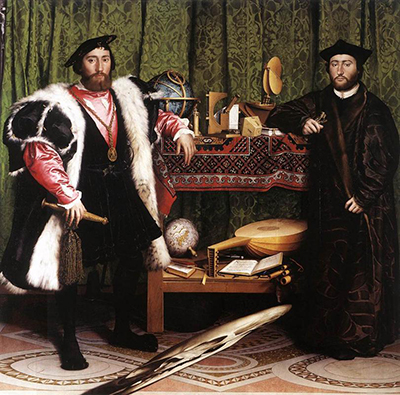
1532 [5]The Ambassadors
1533 [6]Contents
- A Face Seen at an Angle
- The Cap and Its Feather
- Colour Already in the Paper
- Clothing in Lighter Lines
- Clinton Before the Earldom
- A Name Added Later
A Face Seen at an Angle
The three-quarter view lets Holbein show both the contour of Clinton's nose and the fuller expanse of the nearer cheek. One eye sits close to the bridge of the nose; the other has room to extend beneath its gently curved brow. Small differences in the two eyes make the turn convincing. The surrounding paper remains largely empty, leaving those adjustments especially clear.
Look at the passage from the cheek towards the ear. Here the shadow becomes more pronounced, separating the face from the hair behind it. Across the front of the face, changes of tone are quieter. The nose and mouth emerge through slight adjustments rather than heavy enclosing lines. This restraint gives the drawing an intimacy that does not depend on an inviting expression. Clinton remains absorbed in a direction of his own.
The Cap and Its Feather
The cap supplies the portrait's largest dark shape. Its slanting oval spreads almost across the sheet, with a curved band running above the forehead. It balances the long, relatively slender face beneath it. Hair gathers below the cap beside the ear, making a darker bridge between headwear and skin.
The feather is easier to overlook. Pale strokes rise and spread above the cap, close to the upper edge. The Royal Collection explicitly identifies this detail as a feather. [1] Its lightness contrasts with the denser marks of the cap itself: a small flourish that changes the silhouette without competing with the eyes.
Colour Already in the Paper
The support is part of what we see. The Royal Collection describes a pale pink preparation beneath black and coloured chalks. [1] A warm middle tone therefore exists before the separate features are added. In the face, the lightly worked areas can remain close in colour to the surrounding sheet, while darker touches articulate eyes, nostrils and the line between the lips.
Royal Collection conservators Rachael Smith and Victoria Button explain that Holbein's prepared pink papers helped him establish a complexion efficiently. Chalk could supply fine lines or broader shading according to its point and the pressure applied. These are features of his wider practice; they do not establish an exact sequence of marks on Clinton's sheet. [8] Here the visible result is a likeness built with remarkably little separation between flesh and paper.
Watch: Holbein’s portraits and working methods
Explore museum films on Holbein’s drawings, painted portraits and close-looking details.
Hans Holbein at the court of Henry VIII
A Royal Collection Trust film exploring Holbein’s work at Henry VIII’s court.
Watch on YouTubeClothing in Lighter Lines
Below the face, the drawing changes pace. The shoulders and chest are mapped through long contours and abbreviated interior marks. A curving neckline, overlapping edges and small decorative details give the costume structure, but much of its surface is left open. Our eye can travel through these thin lines before returning to the more substantial tones of the head.
Smith and Button describe Holbein's portrait studies as working drawings for possible paintings or miniatures, often giving more attention to faces than clothing. [8] Clinton's sheet fits that broader pattern visually. The lightly described costume does not allow us to reconstruct a particular finished painting or prove that one was completed.
Clinton Before the Earldom
The sitter's full title can pull the mind forward by several decades. Royal Museums Greenwich records that Clinton had been a royal ward and became a courtier of Henry VIII. His military service against Scotland and France began in 1540; he became Lord Admiral under Edward VI in 1550 and Earl of Lincoln under Elizabeth I in 1572. [9]
Holbein's drawing precedes those last two honours. Its broad date range, about 1532–43, places Clinton roughly in his twenties or early thirties, rather than the seasoned Elizabethan office-holder suggested by the later title. [1] [9] The distinction matters when looking at the face. We are seeing an earlier Clinton, without needing to read the achievements of his later life back into his expression.
A Name Added Later
“Clinton” appears neatly at the upper left. The Royal Collection dates that handwriting to the eighteenth century, so it belongs to the sheet's subsequent history, rather than the encounter between artist and sitter. [1] Its dark letters are now a conspicuous part of the image, but they should not be mistaken for Holbein signing or naming his subject.
The drawing itself travelled through several collections. Its recorded provenance begins with Henry VIII and Edward VI and includes the Arundel and Lumley collections; it was acquired by Charles II by 1675. [1] The sheet therefore brings together different kinds of time: Holbein's observation of a young courtier, successive generations of ownership, and a later hand adding the name by which viewers could recognise him.
Artworks directory
Explore paintings, drawings, prints and designs, including works without a separate article. Related studies and versions have their own entries; workshop works and copies are labelled. Print designs and series are grouped rather than repeated for every impression.
Frequently Asked Questions
The Royal Collection dates the sheet about 1532–43. That is an approximate range, not a documented year or day of sitting. [1]
No. Elizabeth I created him Earl of Lincoln in 1572, decades after the drawing. The longer title identifies the man through his later career. [9]
The current collection record specifies black and coloured chalks on pale pink prepared paper. It does not list pen, ink or silverpoint for this sheet. [1]
The inscription “Clinton” is eighteenth-century handwriting, according to the Royal Collection. It was added long after Holbein's lifetime. [1]
Discussion
Look again at the images and ideas explored in Edward Fiennes de Clinton by Hans Holbein the Younger. These editorial prompts invite your observations.
Reader Insights
Compare the two eyes and their distance from the nose. Which small differences make the turn of the head convincing?
Trace the pale strokes above the cap. How much does this lightly drawn detail change the portrait's outline?
Move from the shaded cheek down to the open contours of the chest. Where does the drawing begin to feel like a record of clothing rather than a fully modelled body?
Join the Conversation
Which detail makes Clinton most present to you: the eyes, the softly indicated mouth, the cap or the barely developed clothing? Describe the marks that lead you to that choice.
References
- Royal Collection Trust , Edward Fiennes de Clinton, 9th Lord Clinton, 1st Earl of Lincoln (1512–1585) , Hans Holbein the Younger, about 1532–43, RCIN 912198; collection record, description and provenance. View source .
- Kunstmuseum Basel, Bildnis des Bonifacius Amerbach, 1519, inventory 314 (in German) . View source .
- Kunstmuseum Basel, Der tote Christus im Grab, 1521–22, inventory 318 (in German) . View source .
- The Frick Collection, Sir Thomas More, 1527, accession 1912.1.77, collection record . View source .
- Gemäldegalerie Berlin, Georg Gisze . View source .
- Susan Foister, The Ambassadors, The German Paintings before 1800 (2024) . View source .
- Susan Foister, Christina of Denmark, Duchess of Milan (2024) . View source .
- Rachael Smith and Victoria Button, Royal Collection Trust , Holbein's portrait drawings , sections on prepared papers, chalk and clothing. View source .
- Royal Museums Greenwich , Edward Fiennes de Clinton, 1512–85, 1st Earl of Lincoln , BHC2841; biographical account accompanying the later portrait. View source .
- Würth Collection, Holbeins Schutzmantelmadonna, inventory 14910, current owner account (in German) . View source .
- Metropolitan Museum, Dance of Death series . View source .
- Kunstmuseum Basel, Bildnis der Frau des Künstlers mit den beiden ältesten Kindern, about 1528–29, inventory 325 (in German) . View source .
- Kunsthistorisches Museum Wien, Next Generation, Jane Seymour, about 1536–37, inventory 881 (in German) . View source .