by
Tom Gurney
Tom Gurney BSc (Hons) is an art history expert with over 20 years experience
Published on June 19, 2020 / Updated on October 22, 2026
Email:
tomgurney1@gmail.com
/ Phone:
+44 7429 011000
Wing of a Blue Roller by Albrecht Dürer: Introduction
A wing fills the square almost from edge to edge. Its long, pointed feathers descend towards the lower left; the shorter ones gather above them in overlapping rows. Blue spreads across the centre, interrupted by a pale band and enclosed by darker tips. At the right, loose brown feathers and a small red patch disturb that orderly fan. Dürer gives the fragment enough variety of shape and colour to hold attention without a setting or a complete bird.
The ALBERTINA dates Wing of a Blue Roller , inventory 4840, to about 1500. It measures 19.6 × 20 centimetres: watercolour and opaque colour, heightened with white, on fine, smoothed, polished parchment. The visible 1512 was added later, probably by another hand. [1] [2] [3]
At a Glance
- Current date About 1500 [1]
- Support Smoothed and polished parchment [1]
- Materials Watercolour, opaque colour and white heightening [1]
- Collection ALBERTINA, Vienna [1]
This work across Albrecht Dürer’s career
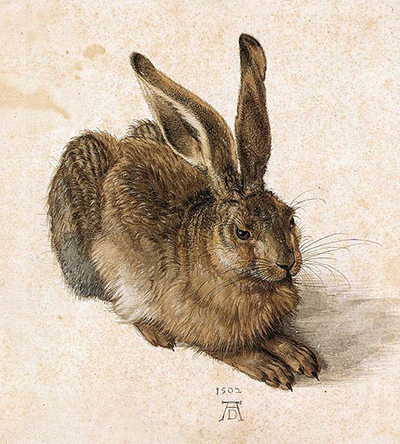
Young Hare
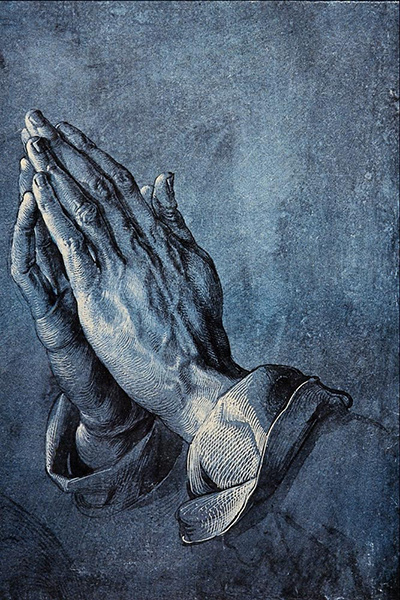
1502Praying Hands
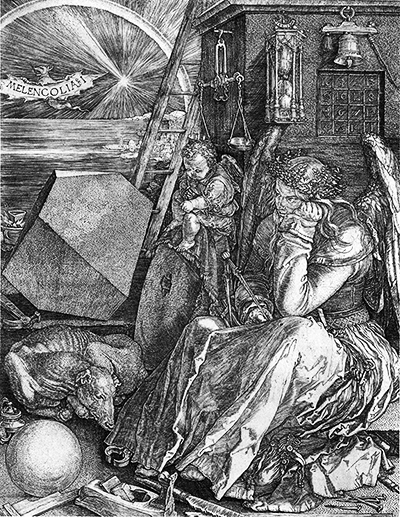
1508Melencolia I
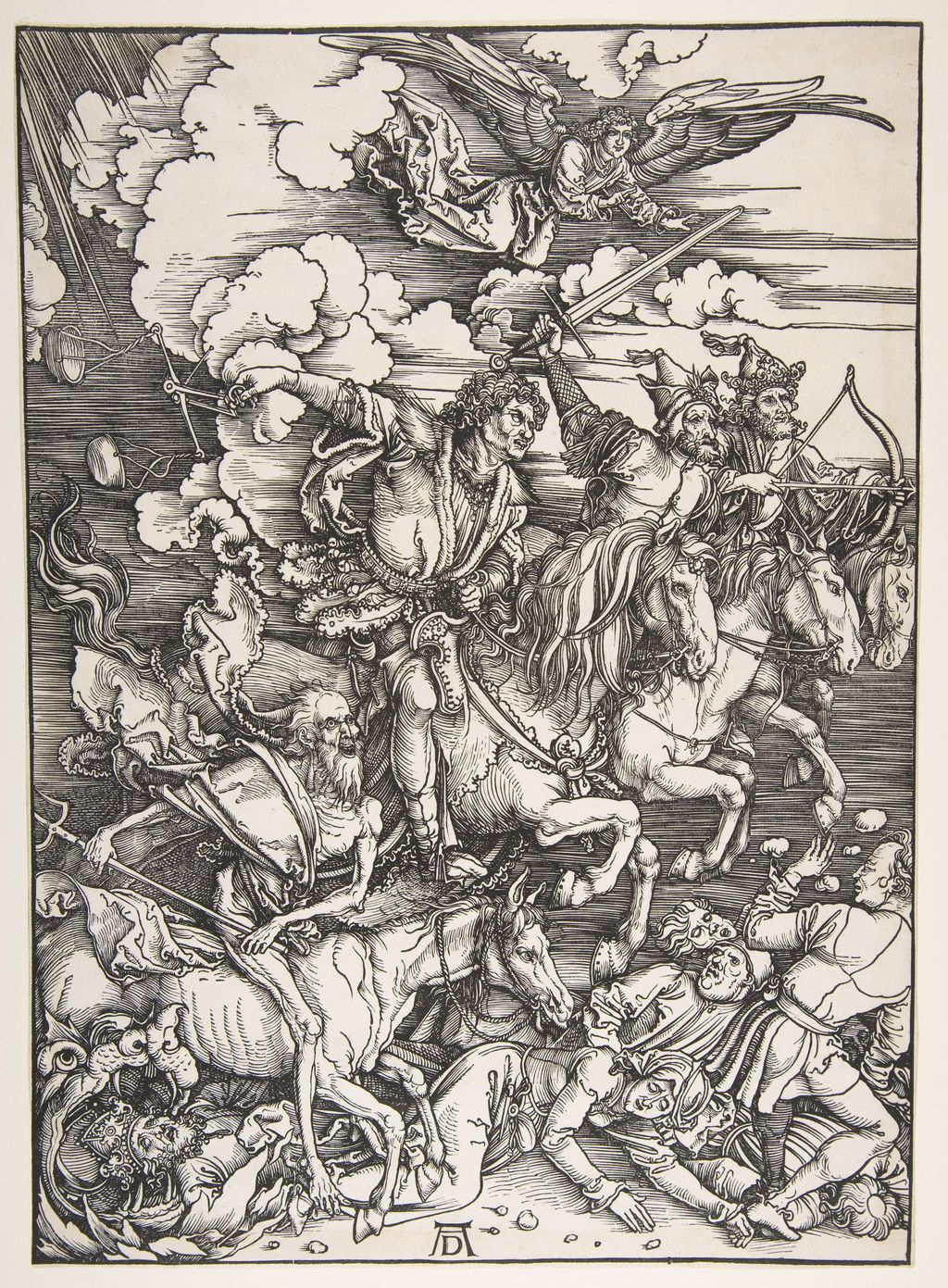
1514Four Apostles
1526Contents
- Following the feathers
- Colour and surface
- A part beside the whole
- A finished study and an uncertain date
- Copying and collecting
- Frequently Asked Questions
Following the feathers
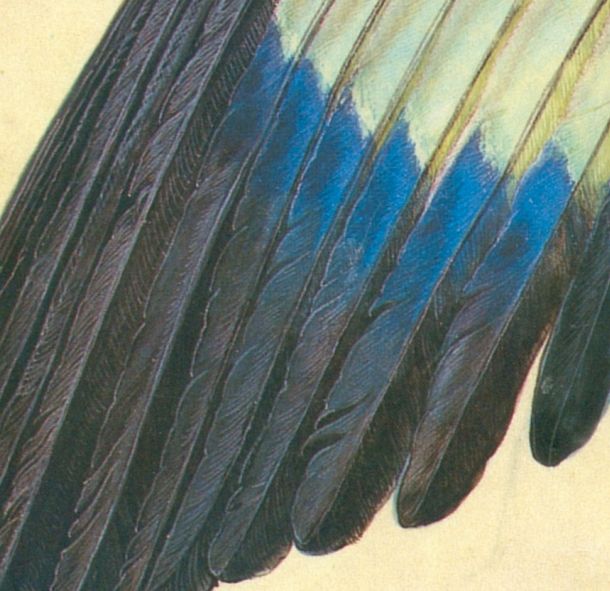
The longest feathers make a striking lower boundary. Their narrow ends point in different directions, leaving slivers of background between them. Each has a light central line, with much finer marks spreading towards its edges. The lines are particularly clear where they cross the darkest colour. Some tips look almost sharp enough to cut; others curve back into the fan. Following this lower outline takes the eye through a succession of small changes within a large, immediately recognisable shape.
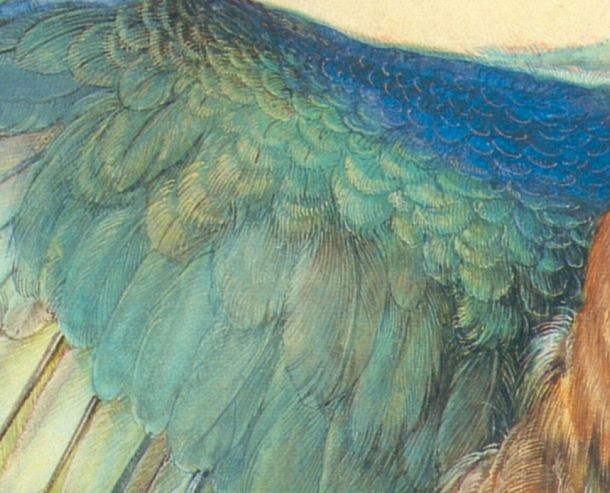
The pale band above the dark tips creates another rhythm. It is broken into separate panels by the feather shafts, and its lower edge forms a row of irregular points. Blue begins at different heights on neighbouring feathers. That unevenness prevents the band from becoming a rigid stripe. Above it, broad grey-green feathers overlap like rounded scales. Higher still, smaller curved marks gather into a dense blue covering, where it becomes harder to isolate one feather from the next.
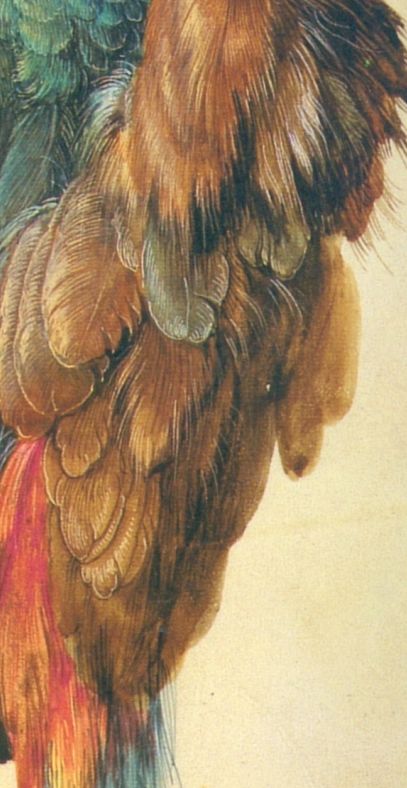
Near the upper left, a little white opening breaks the continuous surface. A reddish mark sits beside it. Across the top, the outline rises gently to a low crest, then slopes towards the much looser right edge. Here, fine strands project beyond the main shape. The warm brown feathers have pale edges and dark interiors, while the long red passage below them ends in thin, untidy threads. The painting accommodates smooth surfaces, compact rows and fraying ends within one connected form.
The ALBERTINA interprets the upper-right red as a severance wound and the white gap as damage from net capture, involving a lost alula feather. This is a reconstruction of the injury; no capture account accompanies the sheet. [1]
Annotated Details from Wing of a Blue Roller
Follow the overlapping feathers from the long dark tips to the smaller blue-green and russet forms.
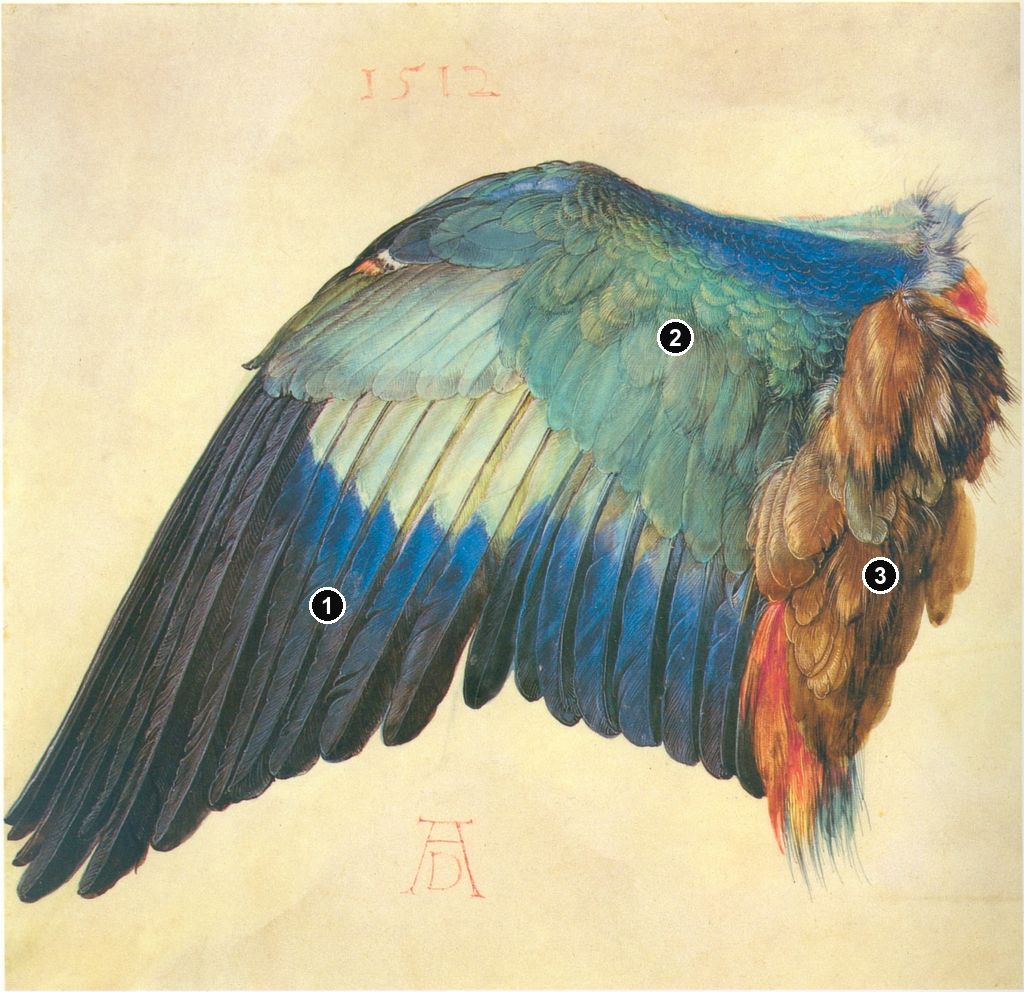
Details from WING OF A BLUE ROLLER
Open each detail to compare the direction of the fine marks and the boundaries between colours.
Light bands across dark feathers
Pale bands cross the long feathers before giving way to saturated blue and dark tips. Fine lines run along each feather, changing direction as its surface curves.
Overlapping blue-green shapes
Small rounded feathers overlap above longer pointed forms. Their edges make a stepped pattern, with yellow-green marks appearing within the broader blue areas.
Russet beside blue
Warm brown and orange passages meet the blue edge of the wing. Thin bright lines separate the overlapping shapes, then lengthen into loose strands near the bottom.
Colour and surface
At close range, colour and line perform different tasks. Broad patches establish the blue, green and brown areas, while light strokes separate parts that would otherwise merge. Along a dark feather, a small pale line can describe both its central shaft and a change of surface. On the shorter upper feathers, repeated curves suggest the rounded ends. Dürer varies the scale and direction of these marks as the visible texture changes.
The quiet, pale background is equally effective. There is no cast shadow anchoring the wing to a table and no surrounding object to establish a room. The feather tips meet open space. Their dark outline makes their lengths and intervals conspicuous, while the fine strands on the right almost dissolve into the background. The arrangement encourages looking across the whole fan and then moving close enough to examine an individual edge.
Marie-Pierre Salé places this sheet within a longer history of painting in water-based colour. Her account notes that coloured washes already appeared in German drawings before Dürer. She distinguishes that practice of adding colour to drawing from his finished, autonomous watercolours, including landscapes and urban views. This is useful context for the wing's concentrated finish: a small work in this medium can have its own pictorial purpose. It need not derive its importance from the larger painting for which it might have been a study. [2]
Young Hare , dated 1502, offers a close comparison in handling texture. Its brown and white marks turn with the animal's rounded body, changing direction around the face, chest and legs. In the wing, long feather shafts and overlapping edges organise the marks into more distinct compartments. The two pictures invite a similar movement between a convincing overall surface and the many strokes that construct it. The wing makes that movement unusually vivid through its broad changes of colour. [13]
A part beside the whole
The related Dead Blue Roller , ALBERTINA 3133, is a separate, larger sheet, also dated about 1500. It measures 27.4 × 19.8 centimetres. The species is the European roller, Coracias garrulus . Its polished parchment carries watercolour and opaque colour with white and gold heightening. That gold belongs to the whole-bird record; the wing's description specifies white. [20] [21] [3]
The ALBERTINA describes breast gold lines imitating iridescence on the whole bird. [1]
In the whole-bird image, the beak points sharply upwards and the neck extends towards it. The breast forms a long, pale centre between the blue wings. A hanging foot and the narrowing tail carry the vertical movement downwards. The separate wing spreads in the opposite direction, opening the plumage into a broad diagonal. The whole bird's wings hang in narrow strips beside the breast, whereas the isolated wing occupies nearly the entire square. Pale green repeats in both images, distributed differently across their contrasting shapes.
The whole bird presents its underside; the isolated sheet spreads a left wing's upper surface. They are not securely linked to one specimen. The museum leaves suspension or a flat resting surface open. Its 2003 essay contrasts inscription-based dating with comparisons to earlier works, and proposes Ptolemy's geography/chorography distinction between whole and particular region as an analogy. This is scholarly interpretation, not Dürer's recorded programme. [20] [2]
A finished study and an uncertain date
The wing's completeness has not made its purpose or chronology entirely straightforward. In his 1988 Getty catalogue, George R. Goldner cited Fritz Koreny's objection that its colouring was brighter than the natural bird's. Goldner used the example in arguing that scientific exactness alone could not determine the authorship of nature studies. He also cited Koreny's separation of this wing from the wing in Dürer's engraving Nemesis . A highly finished animal study could be independent, without serving as a direct preparatory model. These are positions in a scholarly argument; they do not document the wing's original destination. They help us distinguish the knowledge an artist acquires through study from a literal pattern transferred into another work. [22]
The visible inscription has encouraged different labels. Margaret Doyle's 2013 National Gallery of Art brochure captioned the sheet “c. 1500 or 1512.” The current ALBERTINA record chooses about 1500. [23]
An earlier encounter with the dating problem survives in Joseph Heller's 1827 catalogue. Under the Vienna collection he described the whole bird, admiring the care given to the smallest feather and the splendour of its colours. He then listed its wing, also on parchment, with an inscription including 1512. In his own collection at Bamberg he recorded another wing, carrying 1513. He praised that sheet's minute execution and brilliant colours, and linked it to the Imhoff collection. [24]
Heller recognised the difficulty posed by two such impressive versions. In the Vienna entry he insisted on the originality and beauty of his own sheet, yet proposed a closer comparison to decide which might be a copy by Hans Hoffmann. His confidence and uncertainty coexist on the same page. Fine execution could persuade a collector of a drawing's quality while leaving its precise authorship unresolved. His catalogue preserves the problem as he understood it, rather than providing a present-day verdict on the two works. [24]
The Staatsbibliothek Bamberg now catalogues Heller's sheet, I A 13h, as Hoffmann after Dürer. Franziska Ehrl's description draws on Heller's correspondence with the dealer Carl Wilhelm Silberberg: he acquired it in 1821 after initially considering it an original. The record separates Dürer's invention from the later execution. Heller's admiration therefore remains valuable evidence of reception, but his attribution and Imhoff identification cannot simply be attached to the Vienna original. A repeated composition, inscription and admired finish have to be considered alongside the history of each physical sheet. [25]
Copying and collecting
The Germanisches Nationalmuseum's account of Hoffmann distinguishes exact copies, free variations and independent nature studies. He had access to the Imhoff Dürer collection and used both his own initials and Dürer's monogram for different audiences. His work answered collectors' demand for Dürer imagery. That variety of practice makes individual examination essential: a copy may acknowledge its model openly, while another repetition can leave authorship less clear. [26]
An acknowledged example is Hoffmann's Dead Blue Roller of 1583, Cleveland 1946.217. It repeats the whole bird in watercolour and gouache with touches of gold on laid paper. Cleveland points to his prominent monogram and date as evidence that it was not intended to pass as Dürer's original, proposing homage as its purpose and Imhoff sponsorship as a possibility. [27]
The Imhoff papers offer a different kind of evidence. Johann Carl Sigmund Kiefhaber's 1803 publication of the Imhoff documents includes a list of works within a book. Amid portraits, figure studies and other subjects it names a bird on parchment, then “a wing on parchment,” followed by a small hare. The wing is the twentieth drawing in that sequence. The list gives neither its date nor a description of its blue colouring. Its brevity is a useful reminder of what an inventory can preserve: the subject, support and place within an assembled collection, with much left unsaid. [28]
The accompanying letter, dated 30 December 1588, gives the transaction a human setting. Anna Imhoff described her late husband's long effort and expenditure in assembling the collection and his wish that it remain with the family. Despite that obligation, the family agreed to send the works to the emperor. She distinguished the art book, entrusted to Joachim König, from paintings sent with a carrier because König's wagon lacked room. This is the family's account of dispatch from Nuremberg; it does not establish that every object arrived in Prague that day. [28]
The ALBERTINA traces the wing through Rudolf II in 1588, the imperial treasury, the court library from 1783 and Duke Albert's collection in 1796, retaining a caveat about the library's omission from Cahier III . [1]
Heller described the later exchange of drawings from the court library for prints in Albert's collection. He also praised their new mounting on backing sheets and credited the inspector Franz Lefevre, whose welcome to visiting and local viewers he commended. These remarks connect collecting with the practical presentation of drawings. A work once recorded within a book could be encountered as an individually mounted sheet. Heller's testimony concerns the collection's arrangement in his time; it is not a technical condition report on the wing. [24]
The painting's present isolation suits its subject unusually well. The blank surround lets us follow the longest feather all the way to its tip, then return through the pale band to the tightly patterned blue above. The red and brown at the right remain part of that same, carefully differentiated surface. A fragment has become a complete field of attention, with contrasting textures held together in a small space.
Frequently Asked Questions
Artworks directory
These 187 records include individual works, reverse sides, detail views, paired panels and reconstructed arrangements. Three additional catalogue images repeat works already listed. Related views are not counted as separate originals; qualified attributions and published dating are retained.
Discussion
Look again at the images and ideas explored in Wing of a Blue Roller by Albrecht Dürer. These editorial prompts invite your observations.
Reader Insights
Which detail or idea in Wing of a Blue Roller by Albrecht Dürer most changed your reading, and why?
How does the discussion of “Following the feathers” affect your understanding?
What comparison would you bring to the discussion of “Copying and collecting”?
Join the Conversation
Share a detail, comparison or question about Wing of a Blue Roller by Albrecht Dürer below.
References
- ALBERTINA , Der Flügel einer Blauracke , 4840, record and Heinz Widauer’s 2008 essay. German/English. View source .
- Marie-Pierre Salé , L’Aquarelle , publisher's excerpt (2020), pp. 4–5. French. View source .
- Charles Ephrussi, Albert Dürer et ses dessins (Paris: A. Quantin, 1882). Original French edition. View source.
- Campbell Dodgson, Catalogue of Early German and Flemish Woodcuts Preserved in the Department of Prints and Drawings in the British Museum, vol. 1 (London: British Museum, 1903). Original English edition. View source.
- Heinrich Wölfflin, Die Kunst Albrecht Dürers, second enlarged edition (Munich: F. Bruckmann, 1908), pp. 110, 298. Original German edition. View source.
- T. Sturge Moore, Albert Dürer (London: Duckworth and Co.; New York: Charles Scribner’s Sons, 1905), part III, portrait discussion and caption of the 1500 Munich self-portrait. Original English edition. View source.
- Albrecht Dürer, family writings, in William Martin Conway, Literary Remains of Albrecht Dürer (Cambridge, 1889), pp. 34–35, 77–79. Historical English translation. View source.
- S. R. Koehler, A Chronological Catalogue of the Engravings, Dry-Points and Etchings of Albert Dürer (New York: Grolier Club, 1897). Original English edition. View source.
- Moriz Thausing, Albert Dürer: His Life and Works, edited by F. A. Eaton, vol. II (London: John Murray, 1882), pp. 16–18. English edition. View source.
- ALBERTINA, Selbstbildnis als Dreizehnjähriger, inv. 4839 (German). View source.
- Metropolitan Museum, Four Horsemen from The Apocalypse, 19.73.209 (English). View source.
- Bayerische Staatsgemäldesammlungen, Selbstbildnis im Pelzrock, inv. 537 (German). View source.
- ALBERTINA , Feldhase , 3073, object record. German/English. View source .
- ALBERTINA, Das große Rasenstück, inv. 3075 (German). View source.
- Metropolitan Museum, Adam and Eve, 19.73.1 (English). View source.
- ALBERTINA, Betende Hände, inv. 3113 (German). View source.
- Metropolitan Museum, Knight, Death, and the Devil, 43.106.2 (English). View source.
- Metropolitan Museum, Melencolia I, 43.106.1 (English). View source.
- Bayerische Staatsgemäldesammlungen – Alte Pinakothek München, Vier Apostel: Hll. Johannes Ev. und Petrus, 1526, inv. 545 (German).. View source.
- ALBERTINA , Tote Blauracke , 3133, metadata and 2003 catalogue essay, pp. 272–274. German/English. View source .
- National Gallery of Art Press Office, Albrecht Dürer: Master Drawings, Watercolors, and Prints from the Albertina, exhibition checklist (updated 18 January 2013), p.10, cat.38–39. English. View source.
- George R. Goldner , European Drawings 1 (Getty, 1988), no. 129, pp. 287–290, especially p. 288. English. View source .
- Margaret Doyle , Albrecht Dürer: Master Drawings, Watercolors, and Prints from the Albertina (2013), PDF pp. 14–15. English. View source .
- Joseph Heller , Das Leben und die Werke Albrecht Dürer's , vol. 2, part 1 (Bamberg: Kunz, 1827), pp. 33, 82, 98–99, 117–118. German; present writer's English paraphrases. View source .
- Staatsbibliothek Bamberg / Franziska Ehrl , Der Flügel einer Blauracke , I A 13h, Graphikportal record. German. View source .
- Germanisches Nationalmuseum , Hans Hoffmann. Ein europäischer Künstler der Renaissance , 10 May 2022, pp. 1–3. German. View source .
- Cleveland Museum of Art , Hans Hoffmann after Dürer, Dead Blue Roller , 1583, 1946.217. English. View source .
- Johann Carl Sigmund Kiefhaber, ed., Nachrichten zur ältern und neuern Geschichte der freyen Reichsstadt Nürnberg: ein Beytrag zur Geschichte der Reichsstädte in Teutschland, vol.1 (Nuremberg: Lechner, 1803), first quarter, pp.6–9,14–16. Original German historical edition of correspondence and inventory.. View source.
- Burlington Fine Arts Club, Exhibition of Early German Art (London: Burlington Fine Arts Club, 1906). Original English catalogue. View source.
- Maud Cruttwell, Andrea Mantegna, London: George Bell and Sons, 1901, pp. 110–112. View source.
- Moriz Thausing, Dürer: Geschichte seines Lebens und seiner Kunst (Leipzig: E. A. Seemann, 1876). Original German edition. View source.
- Hans W. Singer, Drawings of Albrecht Dürer (London: G. Newnes; New York: C. Scribner’s Sons, 1906), p. 8; Little Owl (Schönbrunner and Meder no. 829). Original English edition. View source.
- ALBERTINA, Innsbruck von Norden, inv. 3056, current record and Christof Metzger’s 2012 essay, pp. 140–141. German. View source.
- Germanisches Nationalmuseum, Barbara Dürer (German and English). View source.
- Web Gallery of Art, Tucher–Rieter reverse (English). View source.
- National Gallery of Art, Portrait of a Clergyman (English). View source.
- Dürer Art, Portrait of a Man (English). View source.
- Hessen Kassel Heritage, Elsbeth Tucher (German). View source.
- Web Gallery of Art, Hans Tucher (English). View source.
- Germanisches Nationalmuseum, Emperor Maximilian I (German and English). View source.
- National Gallery of Art, Lot and His Daughters, reverse (English). View source.
- Bayerische Staatsgemäldesammlungen, Glim Lamentation (German). View source.
- Museo Nacional del Prado, Portrait of a Man (Spanish). View source.
- Bayerische Staatsgemäldesammlungen, Madonna of the Carnation (German). View source.
- Städel Museum, Job on the Dungheap (German). View source.
- Wallraf-Richartz-Museum, Piper and Drummer (German). View source.
- Italian Ministry of Culture / Uffizi, Head of Saint James (Italian). View source.
- Klassik Stiftung Weimar, Dresden Altarpiece (German). View source.
- Staatliche Museen zu Berlin, Girl with a Red Beret (German and English). View source.
- Dresden State Art Museums / Roland Enke, Bernhard von Reesen (German). View source.
- Royal Collection Trust, Burkhard von Speyer (English). View source.
- Dresden State Art Museums, Seven Sorrows of the Virgin (English). View source.
- Bayerische Staatsgemäldesammlungen, Mater Dolorosa (German). View source.
- Bayerische Staatsgemäldesammlungen, Lucretia (German). View source.
- Städel Museum, Young Woman with Her Hair Down (English). View source.
- ALBERTINA, Portrait of a Young Man (German). View source.