


 by
Tom Gurney
Tom Gurney BSc (Hons) is an art history expert with over 20 years experience
Published on June 19, 2020 / Updated on October 22, 2026
Email:
tomgurney1@gmail.com
/ Phone:
+44 7429 011000
Dead Blue Roller by Albrecht Dürer: Introduction
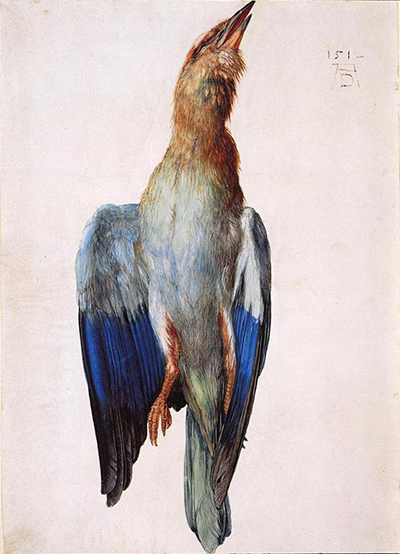
Dürer’s Dead Blue Roller , also called Dead Bluebird , shows a European roller, Coracias garrulus , from beneath. The ALBERTINA in Vienna dates its 27.4 × 19.8 cm drawing, inventory 3133, to about 1500. [1]
The bird’s beak points upwards, almost touching the top edge, while its tail reaches towards the bottom. Between these two ends the body forms a long, irregular column. The wings fall on either side, dark at their tips and brilliantly blue farther up. An empty, pale background makes every small change along the outline conspicuous: the bristles beneath the beak, a rounded shoulder, the projecting claws, the uneven ends of the feathers. Nothing distracts from the strange combination of fragile body and durable image.
At first the arrangement can look almost symmetrical. Longer looking reveals how much it depends on differences. The wing on the left of the picture opens more broadly than its counterpart. The neck curves gently towards the right. One foot is fully exposed, its toes hanging together beneath the reddish upper leg; the other leg follows the body more closely and partly disappears beside the wing. These inequalities keep the bird from becoming a decorative emblem. They give it the awkward particularity of an individual specimen.
The head is especially arresting. The slender upper and lower parts of the beak separate to reveal a warm interior. Below them, short pale strokes gather into a small tuft under the jaw. Darker marks surround the closed eye, while the back of the head dissolves into a fine, uneven fringe. The lifted beak draws attention upwards, but the slack feet and lowered wings lead it back down. The picture holds those opposing directions together without providing a story about how the bird died.
At a Glance
- Current date About 1500 [1]
- Materials Watercolour and opaque colour, heightened with white and gold [1]
- Collection ALBERTINA, Vienna; 3133 [1]
This work across Albrecht Dürer’s career
Young Hare
1502Praying Hands
1508Melencolia I
1514Four Apostles
1526Contents
- Blue feathers and precious materials
- A whole bird and a separate wing
- The date written on the sheet
- Collectors, copies and another artist’s signature
- Frequently Asked Questions
Blue feathers and precious materials
Blue is the picture’s strongest colour, yet much of its surface belongs to quieter hues. The neck is predominantly warm brown. The central breast passes through pale green and grey, with yellowish touches that seem to catch the light. Narrow reddish areas beside the belly echo the throat. The outer feathers deepen from saturated blue into something close to black. This variety matters because the colour follows the bird’s structure: it describes the difference between a rounded breast, an overlapping cover of smaller feathers and the long blades of the wings.
Across the breast, tiny strokes bend and change direction. They suggest a soft covering that follows the swelling body beneath it. On the wings, longer lines separate firmer feathers; some run almost parallel before converging towards the tips. The tail is another texture again, a narrow, tapering cluster in which the green-blue surface is threaded with darker marks. Dürer makes the whole bird readable at a glance, then gives the eye enough variation to move from one small passage to another.
The support is finely smoothed and polished parchment. Dürer used watercolour and opaque colour, with white and gold heightening. The ALBERTINA identifies fine gold lines in the breast as a means of suggesting the plumage’s iridescent sheen. [1]
That use of metal adds a material complication to the illusion. A feather that changes appearance in light has to be represented on a surface whose own appearance can change in light. Gold allows the picture to offer an actual reflective accent as well as painted brightness. A reproduction can show the placement of warm or pale marks, but it cannot reproduce every effect of viewing the sheet under changing illumination. The blues and greens remain essential; the metal adds another kind of response to the feather surface.
The pale background also does substantial work. It gives the darkest feather tips a sharp boundary while allowing the light breast to emerge more gently. There is no painted landscape to establish scale, weather or season. The eye has to find its bearings within the body itself. A viewer can trace the separate feathers, but can also step back and see the narrow silhouette as one continuous shape.
The precise arrangement remains uncertain. Heinz Widauer’s catalogue essay considers a bird suspended against a wall, while acknowledging that the absent attachment also permits the possibility of a specimen lying on a flat surface. [1]
The image does not show a nail, string or supporting tabletop that would settle the matter. Its upright presentation on the page encourages a sense of hanging, yet a vertical image can equally show something observed from above. That uncertainty is worth retaining when looking at the body. The drawing records the visible underside with extraordinary attention, while withholding the practical setting in which it became available to the artist.
A whole bird and a separate wing
The ALBERTINA also owns Dürer’s Wing of a Blue Roller , inventory 4840, a separate parchment study measuring 19.6 × 20 cm. It shows the upper surface of an extended left wing. Its red area at the right is interpreted by the museum as a wound left by severing. [12]
Seen together, the two sheets offer different ways into the same subject. The whole bird has a long vertical shape; the wing spreads across an almost square field. In the wing drawing the dark flight feathers open into an irregular fan, while smaller green and blue feathers gather above them. The warm browns and reds at its right edge make a stronger concentrated counterweight to the blues than the scattered warm passages on the complete bird. Details partly concealed or compressed beside the body become much easier to follow when the wing is opened out.
Their connection does not establish that both drawings were made in one sitting or from the same individual bird. Their materials also differ: gold is recorded for the complete bird, while the wing’s medium is watercolour, opaque colour and white heightening. Widauer cautions that the wing has no demonstrable direct reuse in Dürer’s surviving work, despite the many wings in his religious and allegorical compositions. [12]
Widauer’s 2003 essay relates the two studies to Ptolemy’s distinction between representing a whole territory and examining a part. This analogy offers complementary forms of knowledge, without establishing Dürer’s intention. [1]
Its appeal is easy to understand when looking between the sheets. The detached wing makes distinctions available that the body obscures, but the whole bird shows how the wing belongs to an organism. Each view supplies something the other leaves out. There is no need to assume an intended scientific publication to recognise the value of that exchange between an overall shape and its parts.
The date written on the sheet
The faint inscription at the upper right includes “1512” and an AD monogram. Its presence has helped keep that year attached to the image even as catalogues have reconsidered when the painting itself was made. In her 2025 Dürer.online entry, Franziska Ehrl notes that Walter Koschatzky questioned the authenticity of the inscription in 1971. The current corpus dates the drawing to about 1500 on stylistic, technical and compositional grounds. [13]
Earlier scholarship connected the fine execution with Dürer’s work of the early 1510s. Arguments for an earlier date instead compared the studies with his nature drawings around 1500 and with wings in his early compositions. [1]
Ehrl’s account also distinguishes uncertainty about the inscription from the history of the attribution. Some earlier scholars doubted Dürer’s authorship; the current corpus and owning museum accept it. These are related questions, but they require different evidence. A disputed date written beside a picture need not make the picture itself a later imitation. [13]
“About 1500” places the work in Dürer’s career with uncertainty built into it. The visible “1512” remains part of the sheet’s history, without securely dating the moment when Dürer painted the bird.
The museum suggests that an authentic inscription could belong to a later review of Dürer’s holdings. [1]
Dürer’s later writing offers a useful context for such scrutiny. In the third book of his treatise on human proportion, published in 1528, he makes nature the artist’s essential foundation, while also explaining that long practice stores knowledge which can be used without copying every figure directly from life. William Martin Conway’s 1889 translation preserves both parts of the argument. The roller gives visible substance to the labour of looking: the artist has discriminated between textures, directions and colours until a small body can sustain prolonged attention. The treatise does not document this particular drawing’s making, but it helps explain why observation and artistic judgement belong together. [14]
Collectors, copies and another artist’s signature
The drawing’s later history brought that achievement before collectors and imitators. It passed through the collections of Willibald Imhoff and Emperor Rudolf II before entering that of Duke Albert of Saxe-Teschen. Rudolf acquired it in 1588; Duke Albert in 1796. Its survival reflects the collectors’ interest in Dürer’s drawings as objects to preserve and consult. [13] [1]
Hans Hoffmann gained access to the Imhoff collection and made close copies as well as variations on Dürer’s works. The Germanisches Nationalmuseum’s 2022 exhibition placed this activity within a wider career of portraits, religious pictures and independent nature studies. Hoffmann became Rudolf II’s court painter in 1585, bringing his skill in imitation into the same imperial environment that would acquire the original roller. [15]
One identifiable repetition is now in the Cleveland Museum of Art: Hoffmann’s Dead Blue Roller of 1583, inventory 1946.217. It is executed in watercolour and gouache with touches of gold on laid paper, rather than the original’s parchment. Cleveland points to Hoffmann’s own conspicuous monogram and date as evidence that this version was presented as his work; possible sponsorship by the Imhoff family remains a suggestion. [16]
The Cleveland sheet closely preserves the lifted beak, long belly, lowered wings and hanging toes. In its reproduction, the pale breast appears particularly emphatic against the warmer brown neck. The bird’s shape is immediately recognisable, yet the inscription below it changes the encounter: another painter has put his own name and a later year beside this celebrated arrangement. The date 1583 belongs to Hoffmann’s copy. It is entirely separate from the contested “1512” on the Vienna original.
Other repetitions raise more difficult questions. Ksenija Tschetschik-Hammerl’s study of monograms stresses that Hoffmann’s imitation cannot be understood through a single motive. He advertised his own skill as well as using Dürer’s initials. She also warns against using the dubious sales recorded by Imhoff’s grandson in the seventeenth century as proof that the earlier collector commissioned fraudulent drawings. The roller’s copying history needs those distinctions between making an acknowledged repetition, imitating an admired predecessor and subsequently selling a work under the wrong name. [17]
The confusion extended well beyond the sixteenth century. Alison E. Wright records that Alfred Morrison bought two related bird drawings as Dürers in 1865, under the names Dead Jay and Wing of a Kingfisher . They are now associated with the wider group of Hoffmann versions and differ substantially from the ALBERTINA sheets. Wright treats their close observation of another specimen as a possibility. Neither Morrison’s acquisitions nor Hoffmann’s Cleveland copy should be mistaken for Dürer’s original. [18]
That long history of looking and copying brings attention back to the bird itself. Its beak is open, its feet slack and its wings heavy, yet the surface remains full of small visual events. A pale feather catches against a dark one; a line bends around the breast; blue gives way to green and brown. The drawing preserves both the body’s stillness and the lively activity of looking closely at it.
Frequently Asked Questions
Artworks directory
These 187 records include individual works, reverse sides, detail views, paired panels and reconstructed arrangements. Three additional catalogue images repeat works already listed. Related views are not counted as separate originals; qualified attributions and published dating are retained.
Discussion
Look again at the images and ideas explored in Dead Blue Roller by Albrecht Dürer. These editorial prompts invite your observations.
Reader Insights
Which detail or idea in Dead Blue Roller by Albrecht Dürer most changed your reading, and why?
How does the discussion of “Blue feathers and precious materials” affect your understanding?
What comparison would you bring to the discussion of “Collectors, copies and another artist’s signature”?
Join the Conversation
Share a detail, comparison or question about Dead Blue Roller by Albrecht Dürer below.
References
- ALBERTINA , Tote Blauracke , Albrecht Dürer, inv. 3133. Current catalogue record and Heinz Widauer’s essay from Albrecht Dürer , ed. Klaus Albrecht Schröder and Maria Luise Sternath, Vienna, 2003, pp. 272–274. German, with English introductory text. View source .
- ALBERTINA, Selbstbildnis als Dreizehnjähriger, inv. 4839 (German). View source.
- Metropolitan Museum, Four Horsemen from The Apocalypse, 19.73.209 (English). View source.
- Bayerische Staatsgemäldesammlungen, Selbstbildnis im Pelzrock, inv. 537 (German). View source.
- ALBERTINA, Feldhase, inv. 3073 (German). View source.
- ALBERTINA, Das große Rasenstück, inv. 3075 (German). View source.
- Metropolitan Museum, Adam and Eve, 19.73.1 (English). View source.
- ALBERTINA, Betende Hände, inv. 3113 (German). View source.
- Metropolitan Museum, Knight, Death, and the Devil, 43.106.2 (English). View source.
- Metropolitan Museum, Melencolia I, 43.106.1 (English). View source.
- Bayerische Staatsgemäldesammlungen, inventory 545: current collection record (German; descriptive citation). View source.
- ALBERTINA , Der Flügel einer Blauracke , Albrecht Dürer, inv. 4840. Current catalogue record and Heinz Widauer’s entry in Die großen Meister der Albertina , ed. Klaus Albrecht Schröder, 2008, no. 6. German, with English introductory text. View source .
- Franziska Ehrl , Tote Blauracke , Dürer.online, 2 April 2025. German. View source .
- Albrecht Dürer , third book of the treatise on human proportion, 1528, in William Martin Conway, Literary Remains of Albrecht Dürer , Cambridge University Press, 1889, pp. 246–248, especially p. 247. English translation of German text. View source .
- Germanisches Nationalmuseum , Hans Hoffmann. Ein europäischer Künstler der Renaissance , exhibition press release, 10 May 2022, pp. 1–3. German. View source .
- Cleveland Museum of Art , Dead Blue Roller , Hans Hoffmann after Albrecht Dürer, 1583, inv. 1946.217. English. View source .
- Ksenija Tschetschik-Hammerl , “Das Dürer-Monogramm als Gegenstand der Nachahmung im 16. und frühen 17. Jahrhundert”, kunsttexte.de , 3/2018, pp. 1–4 and notes 10–17, pp. 18–19. German. View source .
- Alison E. Wright , “Stampeding cattle, absurd horses and high-bred sheep: Alfred Morrison as patron and collector of animal art”, in Caroline Dakers, ed., Millionaire Shopping: The Collections of Alfred Morrison, 1821–1897 , UCL Press, 2025, pp. 277–279. English. View source .
- Germanisches Nationalmuseum, Barbara Dürer (German and English). View source.
- Web Gallery of Art, Tucher–Rieter reverse (English). View source.
- National Gallery of Art, Portrait of a Clergyman (English). View source.
- Dürer Art, Portrait of a Man (English). View source.
- Hessen Kassel Heritage, Elsbeth Tucher (German). View source.
- Web Gallery of Art, Hans Tucher (English). View source.
- Germanisches Nationalmuseum, Emperor Maximilian I (German and English). View source.
- National Gallery of Art, Lot and His Daughters, reverse (English). View source.
- Bayerische Staatsgemäldesammlungen, Glim Lamentation (German). View source.
- Museo Nacional del Prado, Portrait of a Man (Spanish). View source.
- Bayerische Staatsgemäldesammlungen, Madonna of the Carnation (German). View source.
- Städel Museum, Job on the Dungheap (German). View source.
- Wallraf-Richartz-Museum, Piper and Drummer (German). View source.
- Italian Ministry of Culture / Uffizi, Head of Saint James (Italian). View source.
- Klassik Stiftung Weimar, Dresden Altarpiece (German). View source.
- Staatliche Museen zu Berlin, Girl with a Red Beret (German and English). View source.
- Dresden State Art Museums / Roland Enke, Bernhard von Reesen (German). View source.
- Royal Collection Trust, Burkhard von Speyer (English). View source.
- Dresden State Art Museums, Seven Sorrows of the Virgin (English). View source.
- Bayerische Staatsgemäldesammlungen, Mater Dolorosa (German). View source.
- Bayerische Staatsgemäldesammlungen, Lucretia (German). View source.
- Städel Museum, Young Woman with Her Hair Down (English). View source.
- ALBERTINA, Portrait of a Young Man (German). View source.







