 by Tom Gurney
Tom Gurney BSc (Hons) is an art history expert with over 20 years experience
Published on June 19, 2020 / Updated on August 21, 2026
Email: tomgurney1@gmail.com / Phone: +44 7429 011000
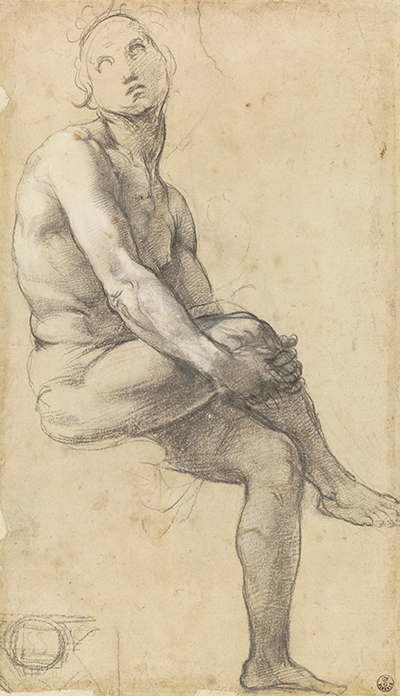
Raphael's preparatory study for Adam in the Disputa turns a single sheet into two kinds of thought. A large seated nude occupies its centre, modelled in black chalk and white lead. At the upper left, a much smaller architectural sketch tests a possible arrangement for the vault of the same Vatican room.[1]
The drawing dates from early 1509, near the beginning of Raphael's work for Julius II in the Stanza della Segnatura. It prepares Adam for the heavenly assembly in the fresco commonly called the Disputation of the Holy Sacrament.[1][2]
Its exact identity is Uffizi Department of Prints and Drawings, inventory 541 E recto. That precision distinguishes this nude-and-architecture sheet from other studies for Adam, the Disputa and the room's decoration.
At a Glance
- ArtistRaphael
- Museum titlePreparatory study for Adam in “Disputation of the Holy Sacrament”, architectural sketch
- Dateearly 1509
- CollectionUffizi Galleries, Department of Prints and Drawings
- Inventory541 E recto
- Mediumnatural black chalk and white lead on paper
- Dimensions357 × 210 mm
- Main subjectseated nude study for Adam
- Secondary subjectquick possible design for the vault of the Stanza della Segnatura
- Related frescoDisputation over the Most Holy Sacrament, Vatican Palace
- Principal ancient comparisonthe Spinario, or Boy with Thorn
- Artistic contextRaphael's study of Leonardo, Michelangelo and ancient sculpture at the beginning of his Roman career
Contents
- One sheet, two scales
- The meaning of 541 E recto
- Raphael's arrival in Rome
- The Stanza della Segnatura
- The fresco's title
- Adam's position in the fresco
- Why Adam belongs there
- The seated nude
- Natural black chalk
- White lead
One sheet, two scales
The contrast between figure and architecture is immediate.
Adam occupies most of the vertical page, his body developed through graduated light and shadow. The vault idea is tiny and rapid, closer to diagram than finished elevation.
Their coexistence shows Raphael moving between human and environmental design without requiring separate paper for every thought.
The sheet records a room being imagined from body to ceiling.
The meaning of 541 E recto
541 E is the Uffizi inventory number, while “recto” identifies the front of the paper.[1]
Catalogues often abbreviate recto as r. and the reverse as v. for verso. These terms prevent a sketch on one side from being confused with whatever appears on the other.
The exact identifier is more stable than a shortened popular title.
It anchors medium, dimensions, date and image to one physical object.
Raphael's arrival in Rome
Raphael reached Rome in late 1508 and soon began decorating Julius II's new apartment.[1]
He was about twenty-five, already successful in Umbria and Florence but newly exposed to the scale of papal ambition. The Stanza della Segnatura became his first major Vatican statement.
The Adam study belongs to this transition.
It shows an artist applying lessons gathered elsewhere to a programme that would transform his career.
The Stanza della Segnatura
Julius II originally used the room as a private library and study.[3]
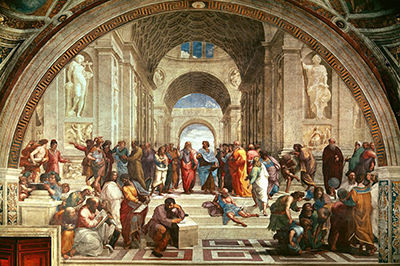
Its frescoes organise Theology, Philosophy, Poetry and Justice across walls and vault. The Disputa represents supernatural truth, while the School of Athens presents rational truth; Parnassus and the Virtues complete the wider structure.[3]
Raphael had to make individual figures serve this encompassing programme.
Adam is one body within a visual theology of human history and salvation.
The fresco's title
The name Disputa can suggest an argumentative debate.
The familiar title Disputa can mislead: the Vatican Museums prefers Triumph of Religion as a more exact description of the fresco.[2] Heaven and earth are ordered around the Trinity, the Holy Spirit and the Eucharist.
Figures on the clouds form the Church Triumphant; theologians and believers below form the Church Militant.[2]
Adam's place belongs to the heavenly register, not to a quarrel among people on earth.
Adam's position in the fresco
In the completed wall, Adam sits among Old Testament patriarchs, prophets, apostles and martyrs.[2]
From the viewer's left, he appears after Saint Peter and before Saint John the Evangelist. This sequence joins biblical beginnings to the apostolic church.
His near-nudity distinguishes him from robed neighbours and recalls humanity before ordinary social dress.
The individual study prepared that bodily difference while preserving his place within an ordered assembly.
Why Adam belongs there
Adam represents the first man and the origin of humanity's fallen condition.
Within a Christian fresco centred on redemption and the Eucharist, his presence establishes the history that salvation answers. The old creation appears beneath the restored order of Christ.
His thoughtful pose suits retrospective knowledge: he belongs to paradise, fall, mortality and promised restoration at once.
Raphael avoids turning him into a mere chronological label.
The seated nude
Adam leans into a compact pose with one leg bent and the torso turning above it.
The body is monumental without standing. Folded limbs create a stable base, while head and shoulders establish attentive inward movement.
Raphael studies how flesh compresses at joints and how the rib cage turns against the pelvis.
The pose allows anatomical knowledge and meditative character to develop together.
Natural black chalk
The Uffizi identifies the principal medium as natural black chalk.[1]
Chalk can produce a fine contour, broad shadow or soft transition depending on pressure and handling. Raphael builds the nude from tonal relationships rather than enclosing every part in a hard line.
Darker accents articulate depth beneath limbs and around the face. Lighter passages allow the paper to participate.
The body emerges gradually instead of appearing cut out.
White lead
White lead supplies selected highlights.[1]
On a toned or naturally warm sheet, added white can mark where light strikes most strongly. It expands the range beyond black chalk and bare paper.
The material has different physical properties from dry white chalk and can be applied with a binder.
Its placement helps Raphael imagine a figure already responsive to the illumination of the fresco.
Chiaroscuro and volume
Chiaroscuro means the organisation of light and dark to make form legible.
Raphael uses it softly here. Transitions across torso and limbs avoid abrupt partitions, giving the nude a continuous atmosphere.
The Uffizi connects this tonal fusion with lessons from Leonardo during Raphael's Florentine years.[1]
Light is not only descriptive. It contributes to the figure's reflective emotional state.
The Spinario
The pose has been connected with the famous antique Boy with Thorn, or Spinario.[1]
That sculpture shows a seated youth bending over one foot to remove a thorn. Its compact arrangement of crossed or folded limbs offered Renaissance artists a celebrated ancient solution.
Raphael does not copy its action literally. Adam is not pulling a thorn.
He transforms the spatial logic of an antique nude into a biblical ancestor absorbed in a different meaning.
Drawing from antiquity without imitation
Ancient sculpture supplied authority, anatomical clarity and compositional memory.
Raphael could borrow a pose, change age and expression, and place the result within Christian history. Recognition enriched invention without determining it completely.
The process resembles translation more than replication.
The Spinario's concentrated seated body becomes Adam's meditation on human imperfection.
Michelangelo nearby
Michelangelo was working on the Sistine Chapel ceiling within the same Vatican complex.
His designs for powerful nude youths offered Raphael a living challenge. The Uffizi notes affinities between Adam and Michelangelo's drawings for the ignudi.[1]
Raphael studied muscular construction and bodily force without adopting Michelangelo's emotional register unchanged.
Proximity encouraged artistic attention, not a simple contest with one winner.
Meditation rather than tension
The Uffizi distinguishes Michelangelo's dramatic inner tension from Raphael's more meditative figure.[1]
Adam's body is fully present, but its power does not erupt into struggle. Head, torso and folded limbs turn force inward.
That restraint suits his place among the blessed and ancient witnesses in the fresco.
Raphael makes knowledge of the Fall felt as concern rather than theatrical despair.
Leonardo's emotional lesson
Raphael's time in Florence exposed him to Leonardo's investigations of expression and tonal unity.
Here, emotion is not written only in eyebrows or mouth. The entire body participates: lowered head, compressed posture and enveloping shade create reflective gravity.[1]
Leonardesque influence therefore concerns both feeling and technique.
Raphael adapts it to the lucid demands of a large Roman fresco.
Ideal face and observed body
The face is idealised, yet the nude depends on close anatomical attention.[1]
Raphael balances type and observation. Adam must represent humanity's first father rather than one contemporary sitter, but his torso and limbs need convincing weight.
Idealisation removes distracting individuality without emptying the figure of emotion.
The result is universal because it remains bodily specific.
The quick architectural sketch
At the upper left, Raphael drew a small possible arrangement for the room's vault.[1]
Its speed contrasts with the modelled Adam. Lines divide an architectural field and test how overhead decoration might be organised.
The sketch should not be cropped mentally from the sheet as irrelevant scribble.
It records Raphael thinking simultaneously about the figure's destination and the larger room containing it.
Wall and vault together
The Stanza's vault allegories correspond to subjects on the walls beneath.[3]
Theology aligns with the Disputa, Philosophy with the School of Athens, Poetry with Parnassus and Justice with the Virtues. Planning the ceiling therefore affected how the room's ideas were read.
Even a quick vault diagram participates in the complete programme.
Raphael's design intelligence moved across architectural boundaries rather than treating each fresco as an isolated picture.
Scale change as mental agility
Adam is studied at the scale of a human figure; the vault is reduced to a diagram.
Raphael shifts between them without confusing their purposes. Tonal modelling answers how a body receives light, while a few lines answer how fields occupy a ceiling.
The two scales reveal complementary forms of abstraction.
One makes flesh present; the other makes space manageable.
From sheet to wall
The drawing did not move to fresco through one automatic transfer.
Raphael still had to integrate Adam with neighbouring figures, clouds, colour and the wall's curvature. Cartoons or other intermediate designs could establish the final outlines.
The study functioned as a reservoir of bodily and emotional information.
Its value lay in solving Adam deeply enough that he could survive translation into a vast ensemble.
Differences from the finished Adam
Comparison should look beyond a pass-or-fail resemblance.
The wall figure exists at distance and among many bright robes. Contour and gesture must read collectively, while the sheet can linger over soft shadow.
Changes may reflect scale, transfer, painting process or a final adjustment in relation to Saint Peter and Saint John.
The drawing preserves the intensity of an individual problem before surrounding theology absorbed it.
The Uffizi Department of Prints and Drawings
The sheet belongs to the Uffizi's Gabinetto dei Disegni e delle Stampe, one of the world's major graphic collections.[1]
Drawings require controlled light and careful handling, so they are not necessarily on permanent display. Digital records make identity and scholarship accessible while protecting the paper.
The inventory system distinguishes recto and verso and connects the object with conservation history.
Access should be checked before visiting specifically to see the sheet.
Why this study matters
The drawing captures Raphael at the opening of his Roman achievement.
He transforms an antique seated pose, responds to Michelangelo's nearby bodies and carries Leonardo's tonal and emotional lessons into a figure suited to papal theology. Those influences remain distinct enough to be recognised and integrated enough to become his own.
The small vault sketch expands the meaning further. Raphael was not only perfecting one nude; he was organising a room in which body, architecture and intellectual programme had to correspond.
Inventory 541 E recto therefore reveals two essential capacities on one piece of paper: sustained human observation and rapid command of monumental space.
Artist Up Close
Begin with the inventory entry: confirm 541 E recto, early 1509, natural black chalk and white lead.[1]
Follow the darkest chalk under the limbs and compare it with the soft transitions across the torso.
Look for the limited white heightening and ask how it establishes the direction of light.
Compare Adam's folded pose with the antique Spinario, then identify what Raphael changed in action and expression.[1]
Finally, do not overlook the small vault sketch. Relate it to the theological allegories above the Stanza's four great walls.[3]
Frequently Asked Questions
Discussion
What detail most changes how you read Study for Adam in the Disputa?
Reader Insights
Which source detail gives the page its strongest anchor?
Which visual or historical distinction should readers keep in mind?
How does this page change the wider picture of Raphael's career?
Join the Conversation
Share your reading below.
References
- Uffizi Galleries, “Preparatory study for Adam in ‘Disputation of the Holy Sacrament’, architectural sketch,” inventory 541 E recto View source.
- Vatican Museums, “Disputation over the Most Holy Sacrament,” View source.
- Vatican Museums, “Room of the Segnatura,” View source.