 by Tom Gurney
Tom Gurney BSc (Hons) is an art history expert with over 20 years experience
Published on June 19, 2020 / Updated on August 21, 2026
Email: tomgurney1@gmail.com / Phone: +44 7429 011000
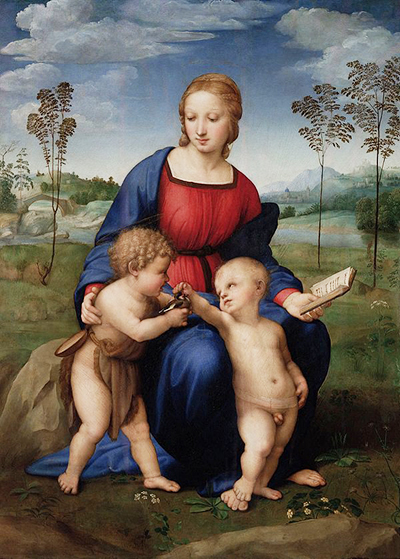
Raphael's Madonna of the Goldfinch turns a child's encounter with a bird into a meditation on love and foreknowledge. The young John the Baptist offers a goldfinch to Jesus, who reaches to stroke it. Mary shelters both children within the broad triangle of her body, watching their exchange while holding a small sacred book.[1][2]
Painted before February 1506, the panel belongs to Raphael's first years in Florence. Vasari says it was made for the marriage of Lorenzo Nasi and Sandra di Matteo Canigiani, celebrated on 23 February. The subject joins familial tenderness to a sign of Christ's future suffering: the goldfinch's red face evokes the blood of the Passion.[1]
The serenity is inseparable from a violent material history. In 1547 the Nasi house collapsed in a landslide and the wooden panel broke into seventeen pieces. It was reassembled with wooden inserts and long metal nails, then repeatedly repaired. A ten-year modern conservation project had to distinguish Raphael's work from centuries of joining, filling, repainting and deformation.[1][3]
At a Glance
- ArtistRaphael
- Full titleMary, Christ and the Young John the Baptist
- Common titleMadonna of the Goldfinch; Italian: Madonna del Cardellino
- Datebefore 23 February 1506
- Mediumoil on wood
- Dimensions107 × 77.2 cm
- Traditional commissionwedding of Lorenzo Nasi and Sandra di Matteo Canigiani
- Sacred groupMary watches as the young Baptist offers a bird to Christ
- Central attributea goldfinch offered by John to Christ
- Catastrophic damageNasi house collapse, 1547
- Recorded condition after collapseseventeen fragments
- Major modern treatmentten-year project completed in 2008
- Current locationUffizi Galleries, Florence, Raphael and Michelangelo Room
- Inventory number1890 no. 1447
Contents
- A wedding picture for the Nasi family
- A pyramid made from bodies
- Mary as witness and structure
- John offers the goldfinch
- Christ touches the bird
- Why a goldfinch?
- The sacred book
- Looks, hands and silent exchange
- Florence, Leonardo and sfumato
- The landscape and distant air
A wedding picture for the Nasi family
Vasari records that Raphael made the picture for Lorenzo Nasi on the occasion of his marriage to Sandra, daughter of Matteo Canigiani.[1] The couple's wedding provides an unusually precise terminus: 23 February 1506.
The work was suited to a Florentine merchant household rather than a church altar. Its scale allows close, private viewing, and its holy figures inhabit an accessible landscape instead of an elaborate celestial court.
A marriage gift featuring mother and children could carry hopes for affection, continuity and family life. Yet Raphael does not reduce sacred motherhood to a secular domestic portrait. Book, Baptist and bird place the group within salvation history.
Lorenzo Nasi belonged to a wealthy wool-merchant family. Raphael's Florentine years brought him into contact with patrons whose homes became settings for refined devotional art.[1][3]
The panel's intimacy therefore has a social context. It joins personal possession, wedding commemoration and prayer in an object designed to reward repeated looking.
Later disaster would make the association with the Nasi house materially fateful. The home that first sheltered the painting also became the site of its fragmentation.
A pyramid made from bodies
Mary's head forms the apex of a broad triangular group. Her shoulders and arms widen toward the two children, whose bodies create a stable base.
The geometry is clear without making the family rigid. John kneels and leans toward Christ; Jesus shifts attention to the bird; Mary turns slightly as she watches. Curves and diagonals animate the triangle from within.
Raphael had encountered pyramidal composition in Florentine art, especially through Leonardo. The Uffizi relates the design to Leonardo's lost cartoon for the Virgin and Child with Saint Anne, displayed at Santissima Annunziata, and to Michelangelo's Bruges Madonna.[1]
These comparisons explain the artistic environment, not the finished painting by themselves. Raphael's solution is distinguished by the open meadow, the equal emotional importance of both children and the bird passed between them.
The pyramid also acts as shelter. Mary's body encloses the exchange without physically separating the boys from the landscape. Stability is maternal as well as geometric.
The group feels spontaneous because no line is purely abstract. An arm supporting a child, a hand holding a book and a knee meeting the ground perform practical actions while building the design.
Mary as witness and structure
Mary sits directly on the ground or a low natural support, a type often called a Madonna of Humility. Her position brings sacred majesty into contact with earth.
She watches rather than intervenes. The children control the immediate encounter, while her arms and body ensure its safety.
One hand supports or steadies Christ. The other holds a small book associated with faith and sacred knowledge.[1] Reading is paused so that attention can pass to the children.
Her face combines affection with seriousness. She knows more than they appear to know, and the bird makes that knowledge visible to the viewer.
Mary's clothing supplies the largest areas of colour. Red and blue gather the landscape around a stable human centre, while softer modelling keeps garments from becoming hard geometric blocks.
She is both participant and frame. Raphael makes maternal presence the condition in which prophecy can appear as play.
John offers the goldfinch
The young Baptist stands or kneels close to Mary and extends the bird toward Jesus. The gesture is careful, almost ceremonial, yet credible as a child's fascination with a small living creature.[2]
John's role throughout Christian art is to prepare and identify Christ. Here he does so before either child can speak, using an attribute rather than a pointing adult hand.
The offering also establishes a social relation. John does not keep the bird as his own possession; he presents it for Christ to touch.
His body leans into the group, reinforcing the diagonal from the lower side toward the centre. Attention moves with him.
The Baptist's future austerity is only lightly anticipated. He remains a child, close in scale to Jesus, but the animal-skin garment and goldfinch associate him with prophetic purpose.
Raphael balances theological identity with natural observation. John's earnestness belongs equally to sacred offering and childhood concentration.
Christ touches the bird
Jesus reaches toward the goldfinch with trust rather than fear. The action makes future suffering present in a form he can gently caress.
The gesture has often been read as willing acceptance of the Passion. It can also be seen more immediately: a child responds to something held out by another child.
Raphael gains power by refusing to choose between those levels. Human naturalness carries symbolic meaning rather than being displaced by it.
Christ's body turns across Mary's protective centre toward John. This crossing prevents the group from becoming three frontal figures.
His attention completes a circuit. John looks and offers; Christ looks and touches; Mary looks down at both. The viewer follows the same sequence.
The bird is small enough that it must be discovered. Once found, it reorganises the entire scene around touch, colour and future knowledge.
Why a goldfinch?
The European goldfinch has a vivid red marking around its face. Christian imagery associated that red with Christ's blood and the crown of thorns.[1][2]
Legends sometimes explained the marking through a bird attempting to remove a thorn during the Crucifixion and being stained by blood. Whether or not every viewer recalled a specific tale, the red bird could evoke the Passion.
Goldfinches were also familiar, lively birds that could be kept and observed. Their symbolic usefulness did not erase their ordinary presence in Renaissance life.
Raphael paints the bird as both sign and animal. It is fragile enough to make the children's hands seem careful, and colourful enough to be legible within the group.
Its fate is not depicted. The symbolism depends on association rather than narrative violence, allowing prophecy to remain folded into tenderness.
The common title gives the bird enormous retrospective importance. Yet it occupies only a tiny portion of the panel, a reminder that close looking can reveal what naming has already taught us to seek.
The sacred book
Mary holds a small book, a traditional sign of devotion and faith. The Uffizi also associates it with foreknowledge of Christ's sacrifice.[1]
The text is not meant to be read word for word. Its presence establishes a world of scripture against which the children's silent exchange gains meaning.
Book and bird offer two different forms of knowledge. One is written and held by Mary; the other is living and passed between the boys.
Mary has looked away from the page. Sacred meaning has moved from reading into embodied relation before her.
The closed or partly open pages also provide a small geometric counterweight to organic forms. Their straight edges answer the loose meadow and curved bodies.
In a private household, the painted book could reflect actual devotional reading performed near the picture.
Looks, hands and silent exchange
The Uffizi emphasises the intense circulation of gazes and gestures among the three figures.[1] This network gives the panel vitality within a stable pyramid.
No figure confronts the viewer. The group is absorbed in its own relation, inviting observation rather than demanding direct response.
Hands perform distinct tasks: Mary supports and holds, John offers, Christ reaches. None is ornamental.
The absence of speech focuses attention on touch. John's hand protects the bird; Christ's fingers approach; Mary's hold secures the child.
Facial expressions are gentle but differentiated. John brings earnest concentration, Christ curiosity and Mary quiet understanding.
Raphael's achievement lies in making theology pass through ordinary social intelligence. Each body knows what to do in relation to the others.
Florence, Leonardo and sfumato
Raphael worked in Florence from 1504 to 1508, studying major local artists while building relationships with leading merchant families.[1]
Leonardo's influence can be seen in the pyramidal grouping, subtle transitions and atmospheric landscape. Sfumato softens boundaries so that flesh and distant air do not appear cut from the world around them.[1]
Raphael does not adopt Leonardo's psychological ambiguity wholesale. His figures are clearer in relation and more open in devotional meaning.
Fra Bartolomeo and Perugino also contributed to his developing sense of proportion and harmonious grouping, while Michelangelo offered powerful models of bodily construction.[1]
The Florentine period is best understood as active synthesis. Raphael could encounter a solution, identify its principle and adapt it to a different emotional and patronal task.
The Goldfinch is therefore neither purely Umbrian nor a Florentine imitation. Its calm clarity meets a new bodily cohesion and atmospheric softness.
The landscape and distant air
The figures occupy a meadow that recedes toward water, paths, architecture and a pale horizon. Nature provides a human-scale world around the sacred group.
Raphael uses aerial perspective to dissolve distant forms into atmosphere.[1] Colours cool and contours soften as space recedes.
The landscape is not empty backdrop. Its horizontal spread contrasts with the vertical triangle, making the group feel placed within a larger world.
Small plants and stones near the foreground reward intimate viewing. Distant structures suggest habitation without competing with the children.
The horizon passes behind the figures at a level that helps separate heads and shoulders. Compositional usefulness and natural description coincide.
Peace in the setting intensifies the bird's prophetic meaning. Future suffering appears within an undisturbed spring-like world.
The 1547 collapse
On 12 November 1547, according to the Opificio delle Pietre Dure, Palazzo Nasi in Via de' Bardi collapsed after a landslide. The painting was buried in the ruins and broken into seventeen fragments.[3]
Vasari described the pieces being recovered from debris and reassembled at the request of Lorenzo's son Battista. The survival of the image was an act of family care as much as technical repair.[4]
The catastrophe fractured paint, ground and wooden support. It also distorted the panel's surface, creating structural problems that continued through later centuries.
No document names the first restorer. Attribution to Ridolfo del Ghirlandaio is a scholarly proposal based on his connection with Raphael and later technical study, not an archival certainty.[3][4]
The reassembly used wooden pieces and long metal nails.[4] These methods returned the panel to view but introduced materials and stresses that later conservators had to understand.
The picture's present wholeness is therefore constructed. Seams are historical facts even where skillful treatment makes them less visually disruptive.
Reassembling seventeen pieces
Repairing a shattered panel involves more than fitting a puzzle. Wood fibres, ground and paint do not break into clean, lossless edges.
The early intervention had to stabilise fragments, fill gaps and repaint missing portions. Later coatings and adjustments accumulated over the first repairs.
Long nails visible in X-radiographs document the force used to secure pieces.[4] Wooden inserts filled structural absences. Over time, wood movement reopened fractures and deformed the surface.
The resulting object contains Raphael's original materials, sixteenth-century reconstruction and later campaigns in overlapping layers.
This complexity makes simple language such as “restored to the original” misleading. No intervention can recover paint destroyed in 1547.
What conservation can do is stabilise what remains, distinguish additions and improve the coherence through which viewers encounter surviving colour and form.
What modern imaging revealed
The ten-year project employed X-radiography, computed tomography, ultraviolet fluorescence, infrared imaging, reflectography, multispectral study and other non-invasive methods.[3][4]
X-rays revealed fractures and the numerous long nails inserted during the early reconstruction. Tomography and surface measurement helped map deformation and internal structure.[4]
Infrared reflectography found a full-scale preliminary design beneath the paint. Figures changed relatively little between drawing and completion, while the landscape changed more substantially.[4]
An invented bridge at the left and a tower with a cylindrical building at the right were altered in the finished picture, where the right became more open. Mary's neckline and John's ear also differ between underdrawing and paint.[4]
These discoveries separate two histories. Raphael revised his composition before completion; later damage and repair altered it after completion.
Imaging makes both visible without assuming that every hidden line is a correction or every surface irregularity belongs to Raphael.
The ten-year conservation project
The Opificio project combined scientific study, structural repair and careful treatment of the painted surface. It concluded in 2008 after about ten years.[3][4]
Conservators consolidated fractures that had reopened and partly improved distortions in the wood. Cleaning reduced altered later material that obscured Raphael's colour.[4]
Losses were filled and visually integrated so that damage did not dominate the group, while the history of the object remained documented.
The team had to decide how to treat early repairs that had themselves become historically significant. Distinguishing Raphael, probable sixteenth-century work and subsequent additions was central.[3]
Recovered colour changed appreciation of atmosphere, garments and flesh. Yet visual renewal rested on structural work beneath the surface.
The treatment made the painting a public example of conservation as interpretation grounded in material evidence rather than cosmetic renewal.
From the Nasi to the Medici and Uffizi
The panel probably remained with the Nasi family until the male line ended with Francesco di Lorenzo's death in 1639.[3][4]
Soon afterwards it entered the collection of Cardinal Giovan Carlo de' Medici, where it is recorded in 1646–47.[1]
The indebted cardinal's possessions were later sold, and the picture appears to have been retained within the Medici family through Cardinal Carlo de' Medici. It eventually reached the grand-ducal collection.[4]
In 1704 the painting entered the Uffizi and was displayed among the celebrated works of the Tribuna.[4]
Its status had shifted from wedding picture to dynastic treasure and museum masterpiece. The damage history did not reduce its value; survival itself became part of its fame.
Today the Uffizi displays it in the room devoted to Raphael and Michelangelo, reconnecting the panel with the artistic encounters of early sixteenth-century Florence.[1]
How to look at the Madonna of the Goldfinch
Begin with the bird. Notice how little space it occupies and how many hands, eyes and meanings converge there.
Follow John's offering into Christ's touch, then move upward to Mary's attentive face.
Find the small book and compare written knowledge with the living emblem held below it.
Look into the distance for forms that soften into air, then return to the carefully bounded pyramid.
Finally, remember the seventeen fragments, nails and reopened seams beneath present serenity. The image's calm survived through reconstruction rather than material untouchedness.
Why the painting matters
The Madonna of the Goldfinch is one of Raphael's clearest demonstrations that symbolism can inhabit natural behaviour. Nothing about the children needs to stop being tender for their exchange to foreshadow sacrifice.
Its physical history also changes what wholeness means. The panel is not valuable because it escaped time. It survives because several generations decided that a shattered image still merited attention, ingenuity and care. Early repairs were forceful by modern standards, but without them the seventeen pieces might have dispersed. Recent conservation did not pretend to return the object to an untouched morning in 1506. It stabilised the damaged support, clarified Raphael's surviving paint and made the long history of the work intelligible.[3][4]
That distinction matters when looking at the serene surface. Harmony here is neither a fiction nor proof of perfect preservation. It is an artistic order strong enough to remain legible across rupture. The bird passes carefully between small hands while, beneath the painted meadow, fragments remain joined by a history of human decisions.
It also records a decisive Florentine synthesis: Leonardesque unity and atmosphere, Michelangelesque bodily presence, Umbrian clarity and Raphael's own social intelligence.
Its survival gives that harmony another dimension. A painting about protective love was itself recovered, joined and cared for after architectural disaster.
Artist Up Close
Look at Christ's fingertips as they approach the goldfinch's red-marked head.
Notice Mary's downward gaze and the way her shoulders complete the triangle around the children.
Then search the surface for slight disruptions caused by fractures. Raphael's image and its rescue are present together.
Frequently Asked Questions
Discussion
What detail most changes how you read Madonna of the Goldfinch?
Reader Insights
Which source detail gives the page its strongest anchor?
Which visual or historical distinction should readers keep in mind?
How does this page change the wider picture of Raphael's career?
Join the Conversation
Share your reading below.
References
- Uffizi Galleries, “Mary, Christ and the Young John the Baptist, Known as the ‘Madonna of the Goldfinch’,” inventory 1890 no.1447. View source.
- Uffizi Galleries, “The Madonna of the Goldfinch by Raphael,” institutional video introduction. View source.
- Opificio delle Pietre Dure, “Raffaello, Madonna del Cardellino, 1506, Le Gallerie degli Uffizi, Firenze,” completed conservation project. View source.
- Italian Ministry of Culture, “L'amore, l'arte e la grazia—Raffaello: La Madonna del Cardellino restaurata,” 2008. View source.