 by Tom Gurney
Tom Gurney BSc (Hons) is an art history expert with over 20 years experience
Published on June 19, 2020 / Updated on August 21, 2026
Email: tomgurney1@gmail.com / Phone: +44 7429 011000
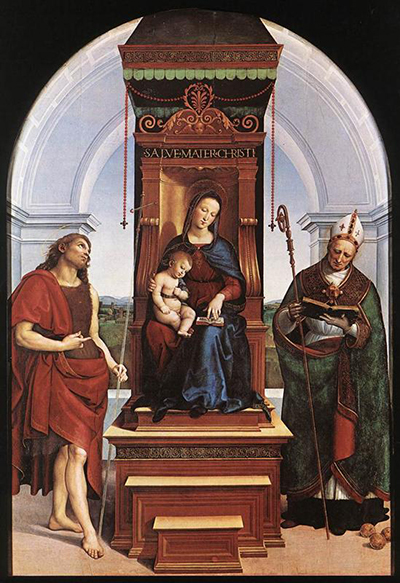
Raphael's Ansidei Madonna stages sacred conversation as concentrated attention. The Virgin sits high on a carved throne with the alert Christ Child upright on her lap. She follows a line in an open book and draws his gaze toward the page. On either side, John the Baptist points toward the child while Saint Nicholas of Bari bends over another book.[1]
Painted in 1505 for the Ansidei family chapel in the Servite church of San Fiorenzo, Perugia, the panel is both monumental and remarkably quiet. No figure speaks through an open mouth. Gesture, reading and direction of sight create the conversation.
Technical examination has transformed understanding of its architecture. Raphael first planned sky and landscape behind the enthroned group, then replaced them with a pale vaulted sacred enclosure. An incised grid already dividing the panel into harmonious thirds helped him fit the new setting so convincingly that it appears fundamental to the original idea.[1]
At a Glance
- ArtistRaphael
- Full titleThe Madonna and Child with Saint John the Baptist and Saint Nicholas of Bari
- Common titleThe Ansidei Madonna
- Date1505
- Mediumoil on wood, probably poplar
- Dimensions216.8 × 147.6 cm
- Original ensemblemain panel of the Ansidei Altarpiece
- Original locationAnsidei chapel, Servite church of San Fiorenzo, Perugia
- Main figuresthe Virgin Mary, Christ Child, Saint John the Baptist and Saint Nicholas of Bari
- Throne inscription
SALVE MATER CHRISTI, “Hail, Mother of Christ” - Removed from San Fiorenzo1768
- Purchased for the National Gallery1885
- Current locationNational Gallery, London
- Inventory numberNG1171
Contents
- The Ansidei chapel in San Fiorenzo
- A sacra conversazione
- The Virgin reading with Christ
- SALVE MATER CHRISTI
- Coral beads and jewelled crosses
- John the Baptist points to Christ
- Saint Nicholas of Bari reads
- The carved wooden throne
- The architecture was added later
- The grid of harmonious thirds
The Ansidei chapel in San Fiorenzo
The altarpiece was made for a chapel belonging to the Ansidei family in San Fiorenzo. The church was served by the Servites, an order with a strong dedication to the Virgin.[1]
Family chapel commissions joined public worship to commemoration. The enthroned Virgin and saints addressed the congregation, while the altar and its painted base developed the programme through liturgy and narrative.
The main panel did not stand alone. Beneath it was a predella with scenes related to the saints above. The surviving Saint John the Baptist Preaching occupied the area below John; a shipwreck associated with Saint Nicholas lay beneath the bishop, but that compartment is lost.[2]
This vertical correspondence made the altar readable in two modes. The large upper field presented a timeless gathering suitable for distance. Smaller narratives at the base rewarded approach and explained saintly identities through action.
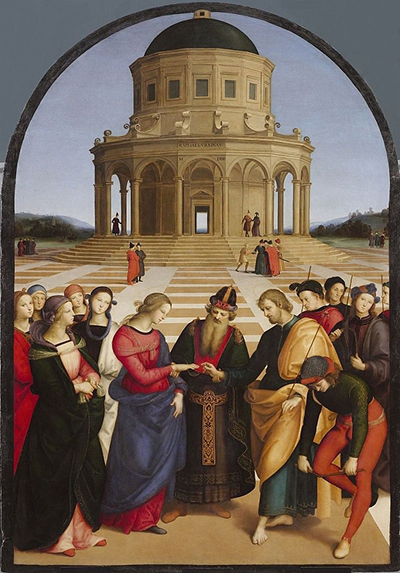
Raphael was about twenty-two. The painting belongs to the same productive Umbrian period as the Marriage of the Virgin, but its challenge is different. Instead of opening an immense square, he must build a stable sacred presence within a tall, narrow panel.
A sacra conversazione
The arrangement is a sacra conversazione, or sacred conversation: the Virgin and Child appear with saints in a unified space rather than separated into the compartments of a traditional polyptych.[1]
“Conversation” does not require speech. John points, Nicholas reads, Mary guides the child through a page, and the child turns attentively. Meaning passes among bodies through gesture and gaze.
The unity of space is crucial. The throne, canopy and later-added architecture bring figures from different historical moments into one sacred present. John the Baptist, an adult forerunner of Christ, stands beside Christ as an infant; Nicholas, a fourth-century bishop, joins them without narrative explanation.
Such temporal impossibility is the point. The gathering is devotional rather than historical, making saints available as witnesses and intercessors around the Virgin and Child.
Raphael gives each figure a distinct mode of knowledge. Mary reads with the child; John recognises and indicates; Nicholas studies inwardly. Sacred truth is encountered through guidance, prophecy and contemplation.
The Virgin reading with Christ
Mary sits frontally but does not stare outward. A small open book rests on her knee, and her finger follows the text. The infant turns toward the indicated passage.[1]
The gesture is tender without becoming casual. Mary is both mother and teacher. Christ appears physically young yet alert, able to attend to words associated with his future.
The National Gallery proposes that the passage contains an allusion to his sacrifice, but the exact words are not legible or securely identified.[1] The book's function is clearer than its text: it introduces foreknowledge into infancy.
Reading also slows the image. Unlike an action scene, the panel asks the viewer to dwell on concentrated attention. Mary's hand moves only enough to trace a line.
The child's upright posture distinguishes him from a sleeping or playful baby. He participates in the act, turning the throne into a place of instruction as well as majesty.
Mary's lowered gaze makes authority gentle. She does not proclaim from above; she directs attention to a page, modelling the contemplative reading expected before the altar.
SALVE MATER CHRISTI
Across the upper part of the throne appears the Latin greeting SALVE MATER CHRISTI: “Hail, Mother of Christ.”[1]
The inscription addresses Mary and helps define the work's devotional use. The National Gallery relates it to recitation of the rosary.[1]
Words are therefore present at several levels. The painted book contains unreadable text; the throne provides a legible salutation; worshippers outside the picture may answer through prayer.
The inscription belongs to the furniture of the sacred scene rather than floating as a separate caption. Raphael makes language architectural.
Its position above Mary reinforces her status without replacing Christ as the focus indicated by John. “Mother of Christ” defines her honour relationally.
The greeting also changes looking into address. The viewer does not merely identify a seated woman; the painted words offer the opening of a devotional encounter.
Coral beads and jewelled crosses
A string of coral beads hangs from the throne and ends in jewelled crosses. It resembles a rosary and carries a colour traditionally associated with blood.[1]
Coral in Renaissance images of children could be precious ornament, protective object and sign of future Passion. Here its red accents hang near an inscription prompting Marian prayer.
The beads form a delicate vertical against the throne's monumental structure. Their scale invites close approach after the larger figures have been understood.
The crosses prevent the ornament from remaining purely decorative. They connect the infant's present body with the death John anticipates through his own cross.
Material richness is controlled. Jewels and coral do not turn the scene into courtly display detached from devotion; they function as mnemonic objects.
The hanging strand also joins image and practice. A painted rosary-like object could remind worshippers of a real sequence of prayers recited before the altar.
John the Baptist points to Christ
John stands at the left, dressed in camel skin beneath a mantle. He points toward the infant Christ, fulfilling his identity as forerunner.[1]
In his other hand he holds a rock-crystal cross and looks toward it. His gesture names the child; his gaze anticipates the child's death.
The adult Baptist beside an infant Christ compresses sacred chronology. He is not shown as Jesus' near-contemporary cousin within an earthly episode but as the prophetic voice who reveals meaning across time.
His extended finger is one of the panel's clearest lines. It interrupts the static throne and directs attention inward.
The lost original display strengthened this action vertically. In the predella below, a smaller John preached to a crowd and pointed upward. That gesture led to the main-panel Baptist, who in turn pointed toward Christ.[2]
The altar therefore created a chain: painted preacher below, saintly forerunner above, infant Saviour at the centre. Museum separation once broke that visual argument, though both surviving panels are now in the National Gallery.
Saint Nicholas of Bari reads
Nicholas stands at the right, slightly withdrawn behind the throne. His bishop's mitre and crozier identify his office, while three golden balls at his feet identify the saint.[1]
The balls refer to the purses of gold he secretly gave as dowries for the daughters of an impoverished nobleman, saving them from exploitation.[1]
Nicholas does not point or look toward Christ. His furrowed brow and lowered eyes show concentrated reading. This apparent inwardness balances John's outward declaration.
His book also answers Mary's. Two acts of reading flank the throne, but their relationships differ. Mary shares her page with the child; Nicholas studies alone.
The bishop's placement behind the throne gives him less immediate access to the centre, yet crozier, mitre and gold establish a strong vertical and material presence.
The lost predella scene beneath him showed a shipwreck connected with one of his posthumous miracles.[2] Contemplative bishop above and active miraculous aid below presented complementary identities.
The carved wooden throne
The Virgin's throne rises through the centre with steps, carved uprights and an overhead canopy. It transforms seated motherhood into majesty.
Raphael treats it as both furniture and architecture. The seat belongs within the painted enclosure, but its high back and canopy create a more intimate sanctuary around Mary and Christ.
The throne provides surfaces for inscription and hanging beads. Devotional signs are built into the structure rather than distributed randomly.
Its strict centrality organises the saints. John and Nicholas are not equidistant decorative supports; they respond differently, but the throne gives their difference a stable axis.
The child sits high enough to become the true focus of the gathering. Mary's lap and throne combine human support with ceremonial elevation.
Wood painted on wood also creates a subtle material fiction. Raphael's probable poplar panel becomes the support on which an elaborate carved throne is imagined.[1]
The architecture was added later
The pale grey architecture behind the figures appears essential: a parapet, pilasters and barrel-vaulted space define the sacred enclosure. Technical examination shows that Raphael did not plan it from the beginning.[1]
Sky and landscape originally extended behind the group. Raphael painted the architecture over that earlier setting.[1]
This discovery changes the panel from an example of a single perfect conception into evidence of radical revision. The most stabilising element arrived after the central figures and their geometric framework had been planned.
The National Gallery suggests that Raphael may have added the vault to compensate for the Ansidei Chapel's plainness.[1] This is a plausible explanation, not a documented motive.
Whatever prompted the change, the new architecture makes the gathering more explicitly sacred and enclosed. It reduces the openness of landscape while giving throne and saints a common structural home.
Raphael's achievement lies partly in concealment. Viewers without technical evidence would have little reason to suspect that the calm background is a second idea.
The grid of harmonious thirds
Before painting, Raphael incised a geometric grid into the panel. Horizontal and vertical divisions organise the design in thirds.[1]
The grid helped position major features. When architecture replaced the landscape, Raphael reused the established system: the parapet stands about one-third of the way up, while mouldings occupy the two-thirds level.[1]
Revision therefore did not require abandoning the underlying order. A planning tool created for one setting could coordinate another.
The grid explains why late architecture feels inevitable. Its lines respond to the same proportions governing the figures and throne.
Technical construction remains subordinate to experience. The viewer does not normally see a diagram; one feels balance, spacing and hierarchy.
The evidence also qualifies a familiar idea of Raphael's effortless harmony. The picture contains incised measurement, an abandoned background and a major repainting—decisions resolved so completely that labour becomes calm.
Colour and the architecture of attention
Raphael distributes saturated reds, blues and greens against pale stone. The architectural grey gives the figures chromatic force without introducing competing ornament.
Mary's mantle establishes the largest field of sacred colour. John's garment and Nicholas's episcopal dress create answering accents at the sides.
The throne's warmer wood separates the central group from the cool vault. Material colour helps nested spaces remain legible: architecture around throne, throne around Virgin, Virgin around child.
Small gold notes—the balls, jewelled crosses and details—reward close looking. They do not rival the large chromatic masses.
Colour also differentiates modes of attention. John's more active silhouette and drapery suit his pointing gesture, while Nicholas's denser presence supports inward study.
The result is rich but never scattered. Raphael uses colour as another proportional system.
The surviving predella connection
Only one painted predella scene is known to survive: Saint John the Baptist Preaching, now National Gallery NG6480.[2]
It would have stood beneath John in the main panel. The Gallery says the base scenes were probably painted across a single horizontal plank after it had already been framed.[2]
The Saint Nicholas compartment showed a shipwreck and appears lost. Other original elements may also have disappeared; the surviving scene should not be mistaken for the entire base.
The preaching panel repeats John's camel skin and red mantle. His upward gesture creates a deliberate visual relation with the larger Baptist above.[2]
The two surviving parts now share a museum room, allowing a partial recovery of the altar's vertical meaning. Yet modern frames, spacing and eye level differ from San Fiorenzo.
Remembering the base changes the Madonna's stillness. Beneath the timeless gathering once ran scenes of proclamation and miracle.
From Perugia to Blenheim Palace
The main panel remained in the Ansidei chapel until 1768. Colin Morison bought it from the church and sold it in London that year to Lord Robert Spencer on behalf of his brother George, fourth Duke of Marlborough.[1]
The painting was taken to Blenheim Palace, where it became one of the most celebrated Italian pictures in a British aristocratic collection.
Removal separated the principal field from its chapel, altar and predella. The monumental Madonna could be admired as an autonomous masterpiece while the narrative base followed a different path.
The current nineteenth-century English frame belongs to this later history, not Raphael's original ensemble.[1]
At Blenheim, the panel's scale and regal throne suited a palace gallery, but the shift from Servite worship to country-house display changed how its inscriptions, rosary references and saintly programme functioned.
The 1885 National Gallery purchase
In 1885 the National Gallery bought the Ansidei Madonna from George Spencer-Churchill, eighth Duke of Marlborough, using a special Parliamentary Grant.[1]
The purchase made the painting a matter of national cultural policy. Funds beyond the Gallery's ordinary means were authorised to secure a work already famous in Britain.
The main panel entered the collection almost a century before the surviving predella scene. Saint John Preaching was acquired only in 1983.[2]
Their staggered arrival mirrors the disassembly of many Renaissance altars. Major central images were prized early; small narrative bases could remain dispersed or misclassified.
Reunion within one institution does not restore original material unity, but it allows comparison across scale and function. The same John can again be followed from preaching below to recognition above.
How to look at the Ansidei Madonna
Begin with Mary's finger on the book. Follow the child's attention to the page, then move outward to John's pointing hand.
Find the coral beads and jewelled crosses hanging from the throne. Their small scale brings the Passion into the centre of infancy.
Compare Nicholas's inward reading with John's outward declaration.
Then examine the pale vault and imagine sky behind the figures. The architecture that looks foundational was Raphael's later decision.
Finally, picture the preaching scene below John and a shipwreck beneath Nicholas. The quiet gathering once rested on narrative action.
Why the painting matters
The Ansidei Madonna is one of Raphael's grandest early demonstrations that stillness can be intellectually active. Reading, pointing, inscription and prophecy make contemplation into exchange.
Its technical history is equally important. A major revision does not fracture the composition because Raphael integrates it through an existing proportional grid.
The panel reveals harmony as a process, not an untouched first thought. Beneath its serene architecture lies another world of sky and landscape, and beneath its visible lower edge once ran stories now mostly lost.
Artist Up Close
Look at Mary's fingertip and the child's turned head. A minute teaching gesture commands a monumental panel.
Follow John's index finger inward, then his eyes downward to the crystal cross.
Finally, trace imaginary thirds across the background. Raphael used the same hidden order to absorb a completely new architecture.
Frequently Asked Questions
SALVE MATER CHRISTI mean?Discussion
What detail most changes how you read Ansidei Madonna?
Reader Insights
Which source detail gives the page its strongest anchor?
Which visual or historical distinction should readers keep in mind?
How does this page change the wider picture of Raphael's career?
Join the Conversation
Share your reading below.
References
- National Gallery, London, “The Ansidei Madonna,” NG1171. View source.
- National Gallery, London, “Saint John the Baptist Preaching,” NG6480. View source.