


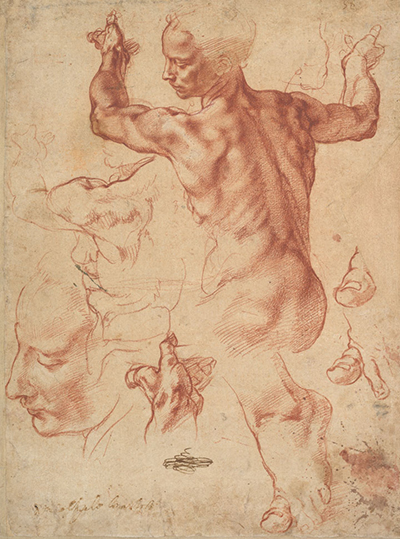

Michelangelo’s Studies for the Libyan Sibyl
A young man turns on a narrow sheet of paper, his raised arms and twisted back already carrying the immense weight of prophecy. Around him, Michelangelo tries the movement again in fragments: a profile, a hand, several feet, a knee. The finished figure will be a woman seated high on the Sistine ceiling, clothed in brilliant colour and lifting an enormous book. Here, before gender, costume and architecture settle into place, the invention begins as a disciplined inquiry into a body changing direction.
Made around 1510–11, Studies for the Libyan Sibyl is one of Michelangelo’s most revealing surviving drawings.[1] Its famous red-chalk face gathers a principal life study and concentrated anatomical details; its reverse preserves looser black-chalk ideas for the same figure. The two sides disclose not a smooth march from first thought to final fresco, but a creative process in which pose, balance, action and identity are repeatedly tested.
At a Glance
- WorkStudies for the Libyan Sibyl on the front; further studies for the Sibyl and a small seated figure on the reverse
- ArtistMichelangelo Buonarroti
- DateAbout 1510–11[1]
- MaterialsRed chalk with small white-chalk accents on the front; soft black chalk, or possibly charcoal, on the reverse[1]
- Dimensions28.9 × 21.4 centimetres[1]
- Current homeThe Metropolitan Museum of Art, New York, accession 24.197.2[1]
- PurposePreparatory studies for the Libyan Sibyl on the Sistine Chapel ceiling
- Principal modelA young male studio assistant, translated into the monumental female seer[1]
- Notable detailsSeparate profile head, hand, repeated feet and toes on the front; seated nude, knee and small figure on the reverse
- Ceiling phaseConnected with the later eastern campaign of the vault, probably near the beginning of 1511[1]
- Finished actionThe Sibyl turns while stepping down and preparing to close an enormous book of prophecy[1][2]
Contents
- A Whole Figure Made Through Parts
- The Turn of the Back
- Why Michelangelo Used a Male Model
- From Studio Youth to Ancient Prophetess
- The Book That Is Not Yet Drawn
- The Profile Head
- Hands, Feet and the Intelligence of Extremities
- The Reverse: An Earlier Thought?
- Red Chalk as Flesh and Thought
- Drawing for Fresco
- The Later Ceiling Campaign
- The Finished Libyan Sibyl
- Prophecy as Physical Labour
- A Sheet with Its Own History
- Copies and Questions of Attribution
- From Singular Sheet to Printed Image
- How to Look at the Drawing
- Artist Up Close
Annotated Details from Studies for the Libyan Sibyl
The annotated view keeps the recto sheet intact while isolating how Michelangelo studies a turning body in parts: torso and raised arms, head and neck, separate limb studies, and the book or seat construction that helps explain the finished Sibyl.
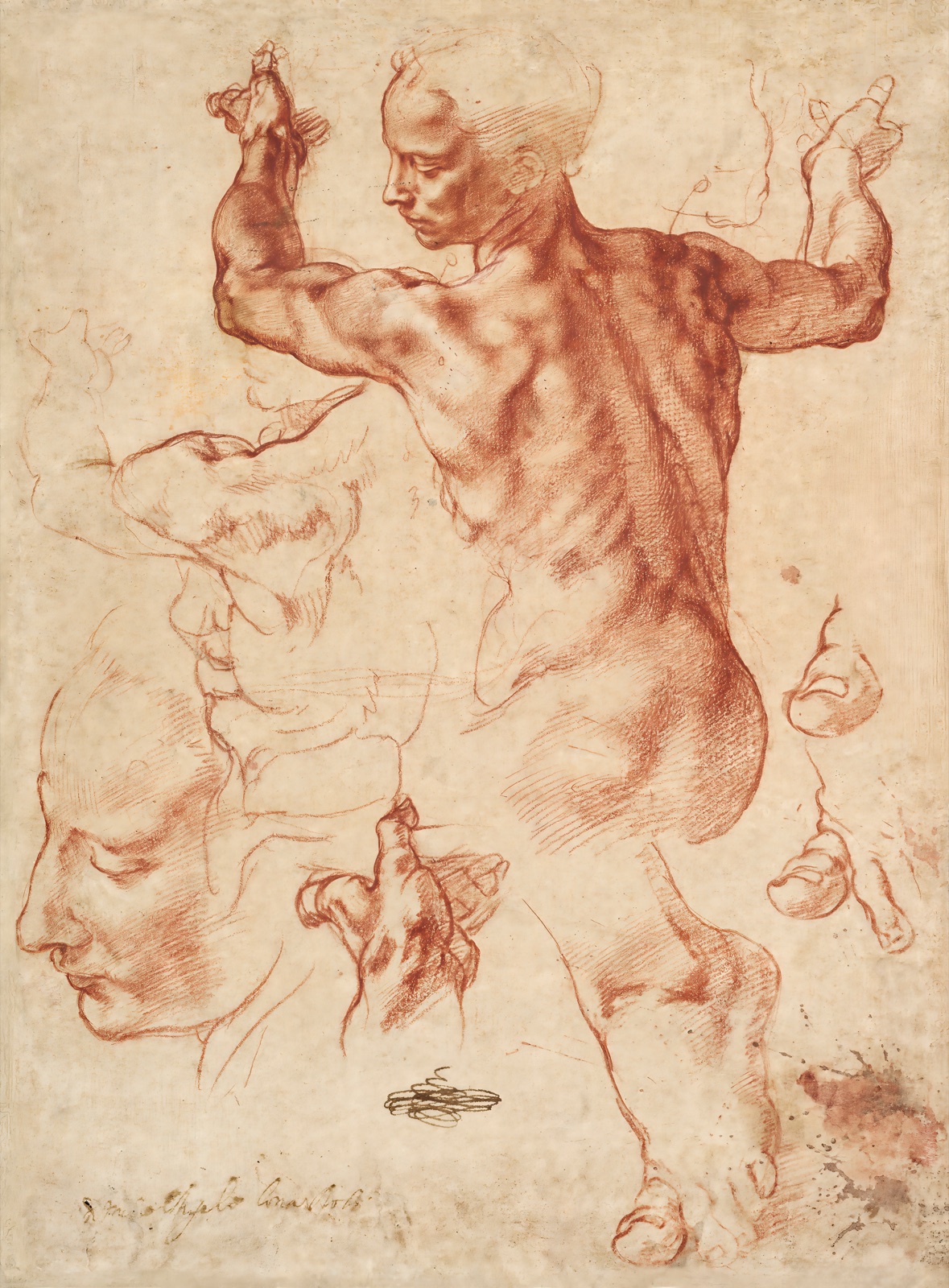
Details from STUDIES FOR THE LIBYAN SIBYL
Close looking highlights the drawing's working evidence while keeping image-source and rights notes in the references.
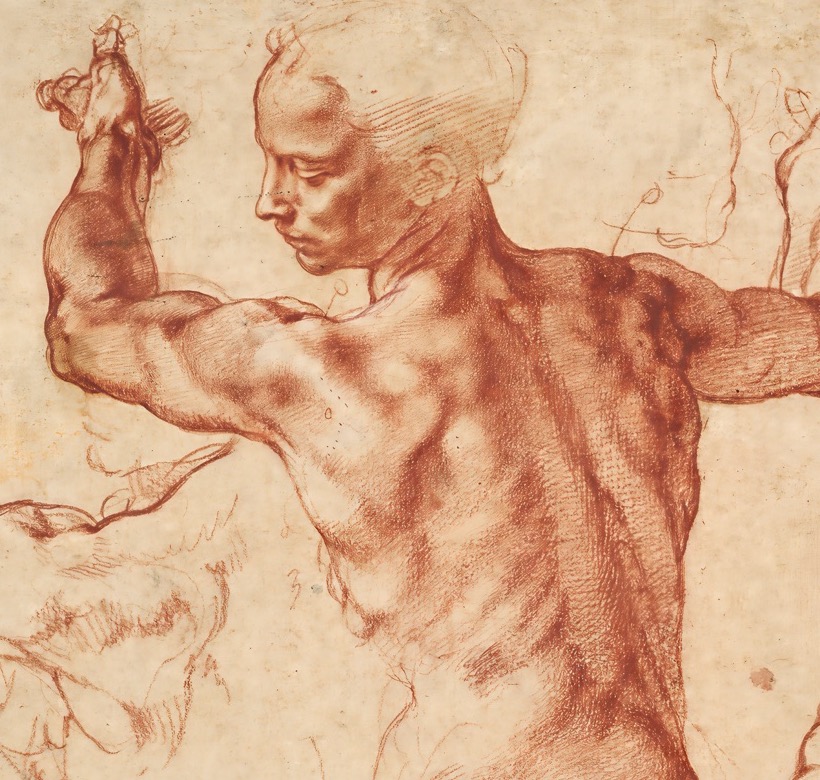
Turning torso and raised arms
The main study searches for the torque of the back and shoulders that later supports the Sibyl's monumental turn on the ceiling.
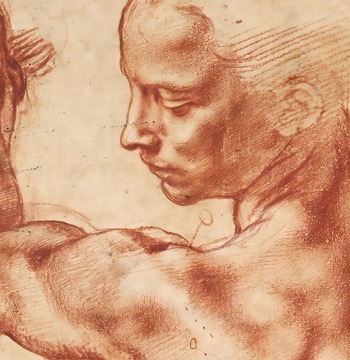
Head and neck
The head study fixes direction and concentration, while the neck links expression to the larger rotation of the upper body.
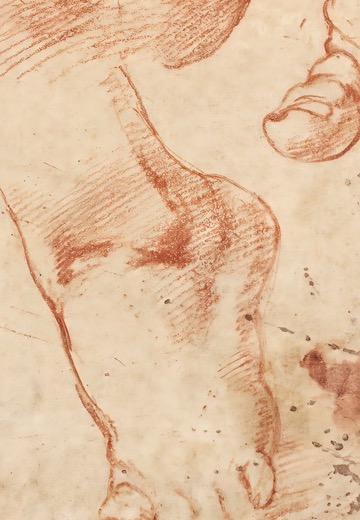
Lower-leg and foot study
The separate lower-leg and foot study shows Michelangelo testing weight and support apart from the main torso study.
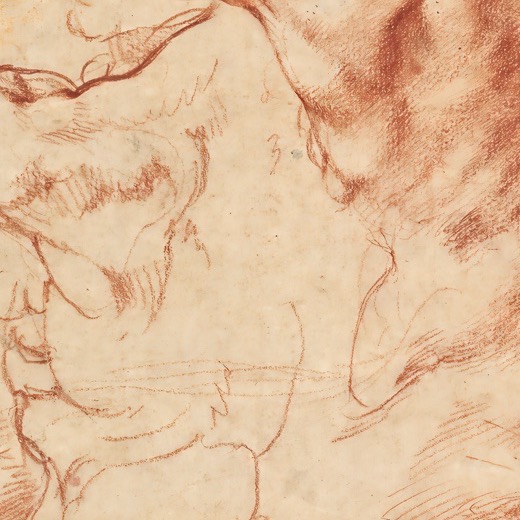
Book, seat and working lines
The lighter construction lines suggest the book and support that give the finished Libyan Sibyl her difficult turning task.
A Whole Figure Made Through Parts
The largest study occupies the centre and upper half of the front. A seated youth is seen chiefly from behind. His head turns into profile, both elbows rise, and the upper body rotates so that the shoulders move on different planes.
This is not a neutral inventory of muscles. The anatomy exists because an action must be made credible. The future Sibyl will reach towards a book behind her while shifting her weight as if to descend from her throne. Michelangelo therefore needs to understand what happens when the pelvis remains seated, the chest turns and the arms lift.
The surrounding fragments answer problems that the principal pose cannot fully solve. A large profile head at lower left moves closer to the finished seer’s facial character. A carefully modelled hand tests the grip or contact needed around the book. Repeated studies of the left foot and toes investigate the precarious transfer of weight.[1]
Nothing here is ornamental surplus. Each fragment isolates a hinge in the movement.
The Turn of the Back
Michelangelo makes the back the drawing’s chief expressive field. Its musculature is neither symmetrical nor displayed like an anatomical diagram. One shoulder advances, the other recedes; the spine bends through the turn; broad planes narrow around the waist.
Red-chalk hatching follows and crosses these changes. Some marks curve with the body, while others deepen the shadow between masses. The sharpened point defines contour and internal structure; the side of the chalk creates broader passages.[1]
Two small circles indicate the prominence of muscles above the shoulder blades. They are unusually explicit signs of attention, closer to visual notes than finished modelling. Tiny white accents on the left shoulder intensify the light, although the Metropolitan Museum cautions that these may be later retouching.[1]
That qualification matters. The brilliance of the shoulder can be admired without assigning every surviving touch to Michelangelo.
Why Michelangelo Used a Male Model
The finished Libyan Sibyl is a woman, yet the principal model is visibly male. Renaissance workshops commonly used male assistants for demanding figure studies, and Michelangelo’s preference for strongly articulated musculature made such practice especially productive.
The transformation is not a failure to observe the female body. It is an act of construction. Michelangelo first secures the mechanical truth of a difficult pose: the pull across the shoulders, the resistance in the waist, the pressure of toes against the ground. He then alters that bodily information for a female prophetic figure clothed and enlarged within the vault.
The reverse may preserve a different stage. Its central seated nude has softer anatomical forms that the Metropolitan Museum considers possibly feminine.[1] If so, the sheet records movement between kinds of model rather than a single fixed identity.
Gender is one of several variables Michelangelo adjusts. Scale, dress, setting and sacred character are also still to come.
From Studio Youth to Ancient Prophetess
In the finished fresco, the Libyan Sibyl belongs to the five classical seers paired with seven Hebrew prophets around the ceiling. Christian tradition interpreted such ancient prophetesses as witnesses who anticipated Christ beyond the history of Israel.
Michelangelo gives the Libyan seer youth, physical strength and arrested movement. She turns away from an immense open volume, apparently preparing to close or lower it, while one foot searches for the step below.[1][2]
The studio youth provides the architecture of that turn, but not its complete meaning. In the chapel, braided hair, exposed shoulders, layered garments and attendants convert bodily exertion into prophetic action. The model’s concentrated pose becomes the instant in which knowledge is handled as something literally weighty.
The drawing therefore stands between observation and invention. It begins from a particular body but refuses to end there.
The Book That Is Not Yet Drawn
The principal study makes sense only in relation to an absent object. The arms are raised because the Sibyl will reach around an enormous book.
Michelangelo does not need to render that volume here. Its dimensions and position are already implied by the spacing of the elbows, the turn of the head and the opening between hands. Negative space becomes functional.
This absence exposes the discipline of preparatory drawing. A study may omit the most conspicuous object in the final scene because the artist is solving a different problem. The body is treated as a system of forces responding to an imagined weight.
In the fresco, the book’s scale makes the Sibyl appear both powerful and momentarily burdened. On the sheet, the same burden is present as posture before it is present as form.
The Profile Head
At lower left, a separate head appears in profile. It is larger and more self-contained than the model’s head in the central pose.
The brow, nose, mouth and chin are established with concise red lines. The eye looks forward beneath a firm brow, and the neck begins to turn beneath the jaw.
The Metropolitan Museum notes that these features lie closer to the finished Sibyl than the youth’s face in the main study.[1] The observation reveals a crucial separation of tasks. One pose can supply bodily mechanics while another study develops character.
Michelangelo does not force a single sitting to answer every need. He combines discoveries made at different moments into an apparently unified painted being.
The finished seer’s face is neither an anonymous attachment nor a portrait copied unchanged. It is selected, adjusted and integrated.
Hands, Feet and the Intelligence of Extremities
The lower part of the front contains a highly worked left hand, while the right side holds three investigations of the left foot and toes.[1]
These extremities carry disproportionate responsibility. The hand must make the relationship with the great book believable. The foot must explain how the seated figure can be poised between rest and descent.
Repeated toes may seem minor beside the magnificent back, but they solve the pose’s balance. The finished foot presses and extends rather than resting flat. Its articulation allows the body above to appear caught in transition.
Michelangelo’s method is additive without being mechanical. A hand studied alone does not become a detachable component pasted onto the fresco. Its gesture changes when joined to arm, book and turning torso.
The fragment is complete as an inquiry, incomplete as a person.
The Reverse: An Earlier Thought?
The back of the sheet is quieter and more elusive. In soft black chalk, or perhaps charcoal, Michelangelo drew a large seated nude in profile, a smaller figure above and a study of the right knee.[1]
The central figure already twists, but the handling is looser than on the red-chalk front. Contours search rather than declare. Hatching suggests volume without the sustained finish given to the celebrated back.
The Metropolitan Museum proposes that this side may have been drawn first. Early Sistine studies often use soft black chalk, whereas red chalk becomes prominent in preparations for later parts of the vault.[1] Material sequence supports the possibility, but cannot transform it into certainty.
If the reverse came first, the sheet preserves an unusually legible change from a broad idea to concentrated life study. If not, it still shows Michelangelo reconsidering the same bodily problem in another medium and degree of resolution.
Red Chalk as Flesh and Thought
Michelangelo had used red chalk before the Sistine undertaking, but the later ceiling studies brought the medium to exceptional intensity.[1]
Its warmth assists the illusion of living skin, yet colour alone does not explain its usefulness. A sharp chalk can produce a taut contour, delicate interior modelling and dense shadow. Turned on its side, it can soften an entire plane.
The principal back displays this range. Thin strokes describe the edge of shoulder and arm. Parallel hatchings make surfaces bend. Darker accumulations deepen the furrow beside the spine and the recess beneath an arm.
Because the marks remain visible, bodily form and the act of finding it coexist. The youth seems solid, but the means of creating that solidity never disappears.
The result has the presence of sculpture without pretending that paper has become stone.
Drawing for Fresco
The intimate sheet served a work nearly three times life-size.[1] That shift of scale demanded more than enlargement.
The ceiling’s curved surface, distant viewpoint and wet-plaster technique required clear masses and decisive contours. Michelangelo could study subtle anatomical transitions in the studio, then simplify or amplify them for visibility far below.
The Libyan Sibyl occupied twenty separate daily plaster sections. Her design was transferred through pricking and pouncing a full-scale cartoon, a process in which powdered pigment passed through small holes to establish outlines on fresh plaster.[1]
The surviving drawing is therefore several stages removed from the painted surface. It is neither the full-size transfer design nor a reduced duplicate of the fresco.
Its value lies precisely in that distance. We see the questions that preceded the public certainty of the vault.
The Later Ceiling Campaign
Michelangelo painted the ceiling in two broad campaigns as the scaffolding moved eastwards from the entrance towards the altar.[1]
The Libyan Sibyl belongs to the later part, when figures grew larger and the artist’s command of fresco had become more assured. The Metropolitan Museum dates the red-chalk studies with particular probability to the winter of 1511, when conditions favoured drawing rather than work on wet plaster.[1]
Chronology is not merely a date attached to the object. It helps explain the sheet’s confidence. The difficult turn is studied minutely, yet the large pose already possesses monumental coherence.
Years of sculptural practice and the first ceiling campaign meet in the red lines. Michelangelo is still testing, but no longer learning the fundamentals of the vault.
The Finished Libyan Sibyl
On the ceiling, the Sibyl sits between painted architectural supports. Her yellow-orange dress glows against lavender and pale draperies; her bare shoulders carry the memory of the studied male back. Two youthful attendants occupy the space behind her.[2]
The enormous open book rests high, compelling her arms to reach backwards. Her face turns towards its leaves even as her feet begin to descend.
Colour clarifies distinctions that chalk could not provide. Fabric wraps the hips and legs, separating clothed volume from exposed flesh. Braided hair gives the head a formal identity absent from the studio youth.
Yet the drawing remains audible beneath every transformation. The rotation of shoulders, pressure through the foot and interval between raised arms survive as the fresco’s structural argument.
The painted splendour does not conceal preparation; it fulfils it.
Prophecy as Physical Labour
The Sibyl’s book is not a light attribute held for recognition. Its scale makes reading and closing it into work.
Michelangelo gives intellectual authority a body. Prophecy requires turning, reaching, balancing and bearing weight. The seer’s knowledge is neither passive inspiration nor decorative wisdom.
The study makes that conception especially clear because sacred costume and setting have not yet arrived. What remains is the muscular grammar of attention.
The young model is not performing prophecy in any literal sense. He is supplying the exertion through which Michelangelo will make prophetic consciousness visible.
This translation helps explain why the drawing has an emotional force independent of the fresco. Concentration has been located in the entire body.
A Sheet with Its Own History
The drawing entered the Metropolitan Museum in 1924, purchased with support from the Joseph Pulitzer Bequest after negotiations in which the painter John Singer Sargent assisted.[1]
Its front had already lived a complicated material life. Prolonged exposure darkened that side of the paper, and a fixative applied to the red chalk intensified differences of light and shade. The reverse preserves more of the paper’s original off-white tone. There are stains and an old triangular loss near the right edge.[1]
These changes warn against imagining an untouched window into 1511. The object seen now carries centuries of display, handling, collecting and treatment.
Even so, both sides retain an extraordinary range of pressure and revision. Survival has altered the sheet without cancelling its evidence.
Copies and Questions of Attribution
A late sixteenth-century red-chalk copy in the Uffizi follows the New York studies while rearranging details and adding a right foot absent from the original front.[1]
Its dependence is revealing. It reproduces even damage to the original paper, demonstrating close access to the sheet. At the same time, omissions—such as the small shoulder circles—show how quickly analytical marks could be lost when a study became an object of imitation.
The front has also attracted attribution disputes, despite the reverse being consistently accepted as Michelangelo’s. The Metropolitan Museum defends the unity and authorship of the sheet through technique, associated drawings, early numbering and family provenance.[1]
Such debate does not reduce connoisseurship to indecision. It identifies the kinds of evidence through which a drawing’s history is argued.
From Singular Sheet to Printed Image
An anonymous Italian engraving of about 1560–70 records the Libyan Sibyl after Michelangelo.[3] Brown wash marks areas of shading on what may be a proof impression, suggesting that translation into print involved its own trial and adjustment.[3]
The engraving belongs to the fresco’s broader transmission rather than to Michelangelo’s preparation. It reverses the direction of study: where the red-chalk sheet moves from posed body towards painted seer, the print begins with an already famous painted invention and makes it portable.
That distinction prevents every related work from becoming part of one undifferentiated creative process. The drawing helps Michelangelo invent; the later print helps others encounter and circulate what he invented.
Together they frame the chapel figure’s changing existence—from a private bodily problem, to a monumental fresco fixed high in Rome, to an image capable of travelling through impressions.
How to Look at the Drawing
Begin with the principal back, but do not allow its finish to monopolise the sheet. Follow the shoulders into the imagined reach, then look down to the feet that make the turn possible.
Compare the model’s head with the separate profile. The difference shows Michelangelo replacing observation selectively rather than copying one body entire.
Then mentally turn the paper. The softer reverse loosens what the front appears to settle. It restores uncertainty to a work often reproduced as a single iconic image.
Finally, compare both faces with the ceiling. Look for structures that persist and appearances that change: male to female, nude to clothed, small to colossal, studio exercise to ancient seer.
The deepest pleasure lies not in choosing drawing over fresco, but in watching invention cross the distance between them.
Artist Up Close
Michelangelo was about thirty-five when he made these studies and deep into the undertaking that transformed his reputation as a painter. He had approached the Sistine ceiling with formidable experience in sculpture but comparatively limited experience on so vast a fresco surface.
The sheet overturns any myth that monumental genius worked by instantaneous vision. Its repeated feet, separate head and double-sided trials disclose patient division of a problem.
They also reveal continuity between Michelangelo’s arts. He thinks through the body as a sculptor might—weight, torsion, projection—while exploiting effects unique to chalk. The line can hesitate, return and intensify without the irreversible cutting of marble.
What appears effortless above the chapel is here recovered as labour: exacting, economical and alive to revision.
Frequently Asked Questions
Discussion
How does the drawing separate the observed model from the represented Sibyl?
What makes the Libyan Sibyl's twisting pose feel so convincing?
How do fragments on paper become a unified ceiling figure?
Join the Conversation
Compare these studies with Michelangelo's other Sibyl drawings and finished ceiling figures.
References
- The Metropolitan Museum of Art, Studies for the Libyan Sibyl (recto); Studies for the Libyan Sibyl and a Small Sketch for a Seated Figure (verso),” accession 24.197.2,, View source.
- Vatican Museums, Libyan Sibyl,” Sistine Chapel collection,, View source.
- The Metropolitan Museum of Art, The Libyan Sibyl,” anonymous Italian engraving after Michelangelo, accession 2017.124,, View source.
