by
Tom Gurney
Tom Gurney BSc (Hons) is an art history expert with over 20 years experience
Published on June 19, 2020 / Updated on October 22, 2026
Email:
tomgurney1@gmail.com
/ Phone:
+44 7429 011000
Self-Portrait at Thirteen: Introduction
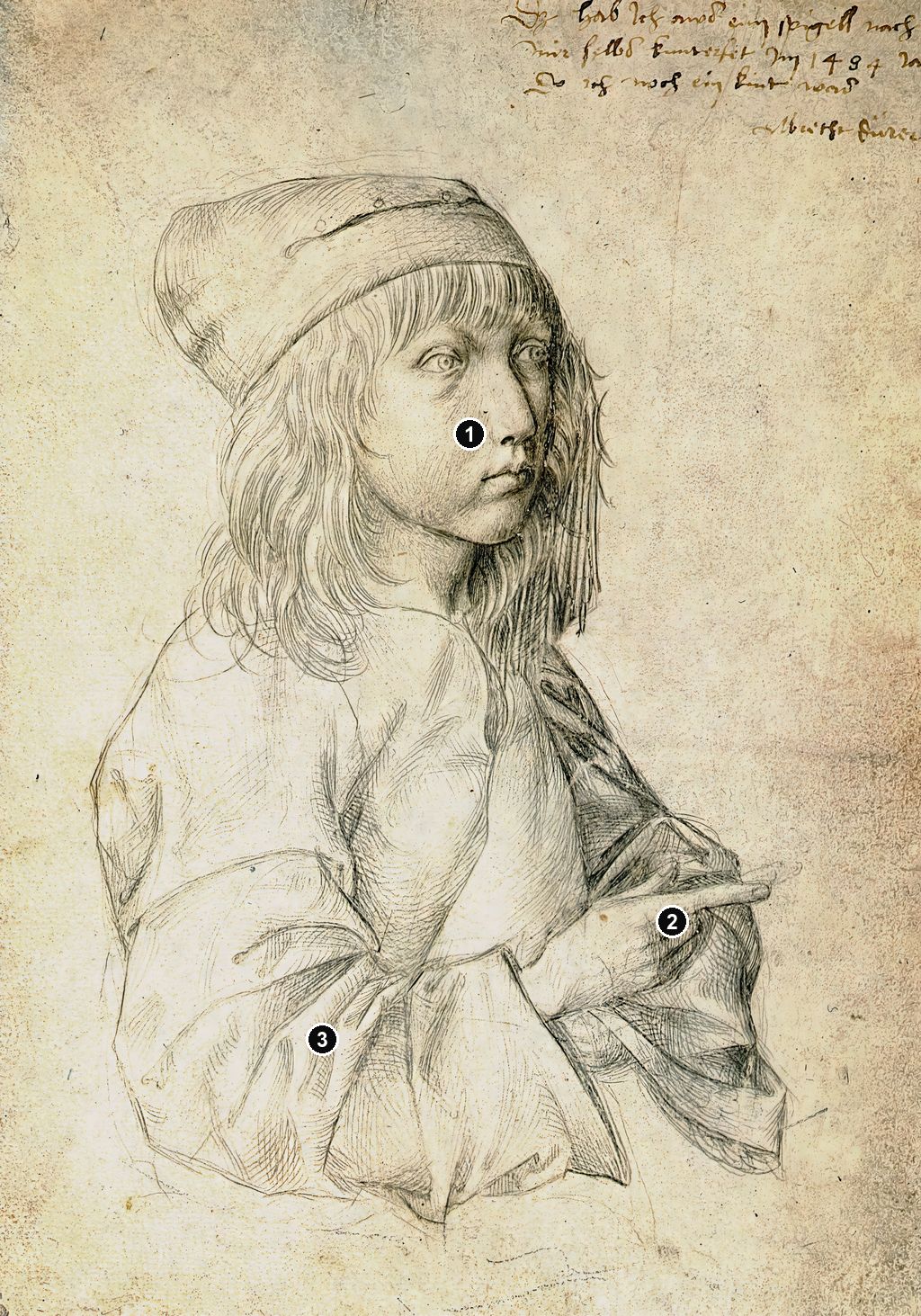
The eyes hold us before we have worked out the pose. A cap curves over the forehead, hair falls around a narrow face, and a raised forefinger leads towards the empty paper on the right. Below, a large sleeve gathers into a cuff. The head and the hand seem remarkably present, although almost everything we see consists of fine lines.
Dürer made this self-portrait in 1484, aged thirteen. His earliest known surviving work belongs to Vienna’s ALBERTINA (4839): silverpoint on paper with white ground, 27.3 × 19.5 cm. [1] [2]
At a Glance
- Date 1484 [1]
- Medium Silverpoint on prepared paper [1]
- Size 27.3 × 19.5 cm [1]
- Collection ALBERTINA, Vienna, inventory 4839 [1]
This work across Albrecht Dürer’s career
Young Hare
1502Praying Hands
1508Melencolia I
1514Four Apostles
1526Contents
- A face made from lines
- Working with silverpoint
- The mirror and the remembered child
- Learning in a goldsmith’s household
- A childhood likeness in a collector’s book
- Copying the young artist
- Returning to his own appearance
- Frequently Asked Questions
A face made from lines
The two sides of the head behave differently. On our left, long waves of hair open out over the shoulder, with bare intervals between their loops. On our right, the hair makes a narrow, darker strip beside the cheek. Between them, the face turns slightly towards the right edge. The near eye is more fully exposed; the other is drawn into the narrowing space beside the nose.
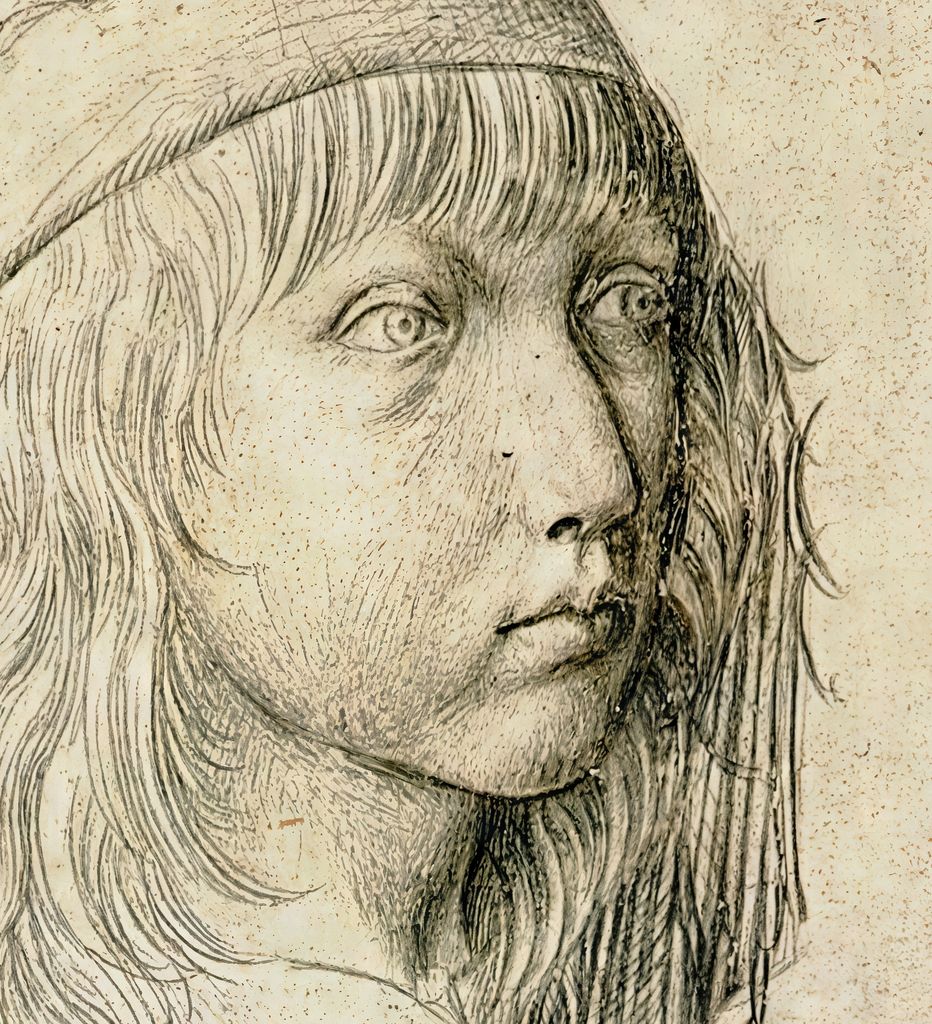
Follow the shading beneath that nearer eye. Short, slanting strokes spread into the cheek, becoming more widely spaced towards its centre. The bridge of the nose remains comparatively pale. A few stronger marks articulate the nostril and the meeting of the lips, while the shadow below the chin continues into the neck. There is no continuous dark outline enclosing every feature. Dürer gives some edges weight and lets others emerge through small changes in the density of strokes. [2]
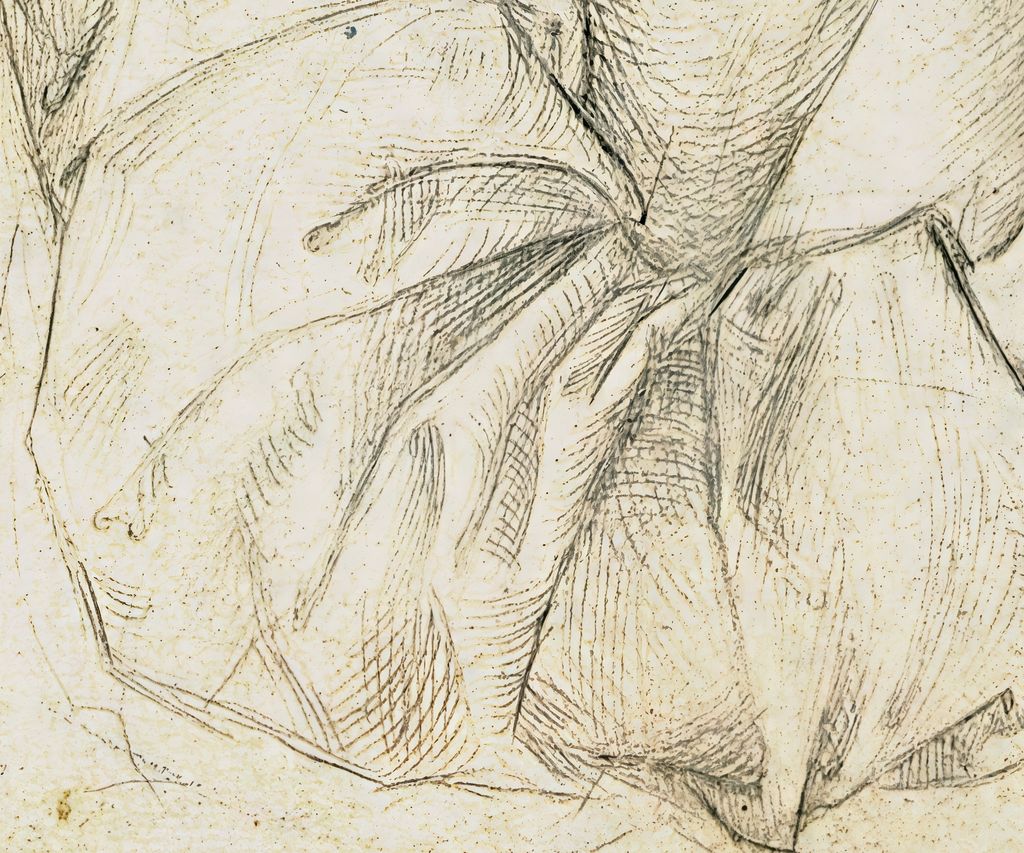
The clothing uses a different rhythm. Along the outer sleeve, broad curves enclose large, lightly marked areas. Near the wrist, the lines crowd together, turn sharply and meet the cuff’s almost straight edges. Beneath the pointing hand, a little stack of angular folds becomes particularly dark. Looking from cheek to sleeve makes the variety within this restricted medium apparent: the same sort of line can suggest a soft transition across skin or an abrupt crease in cloth.
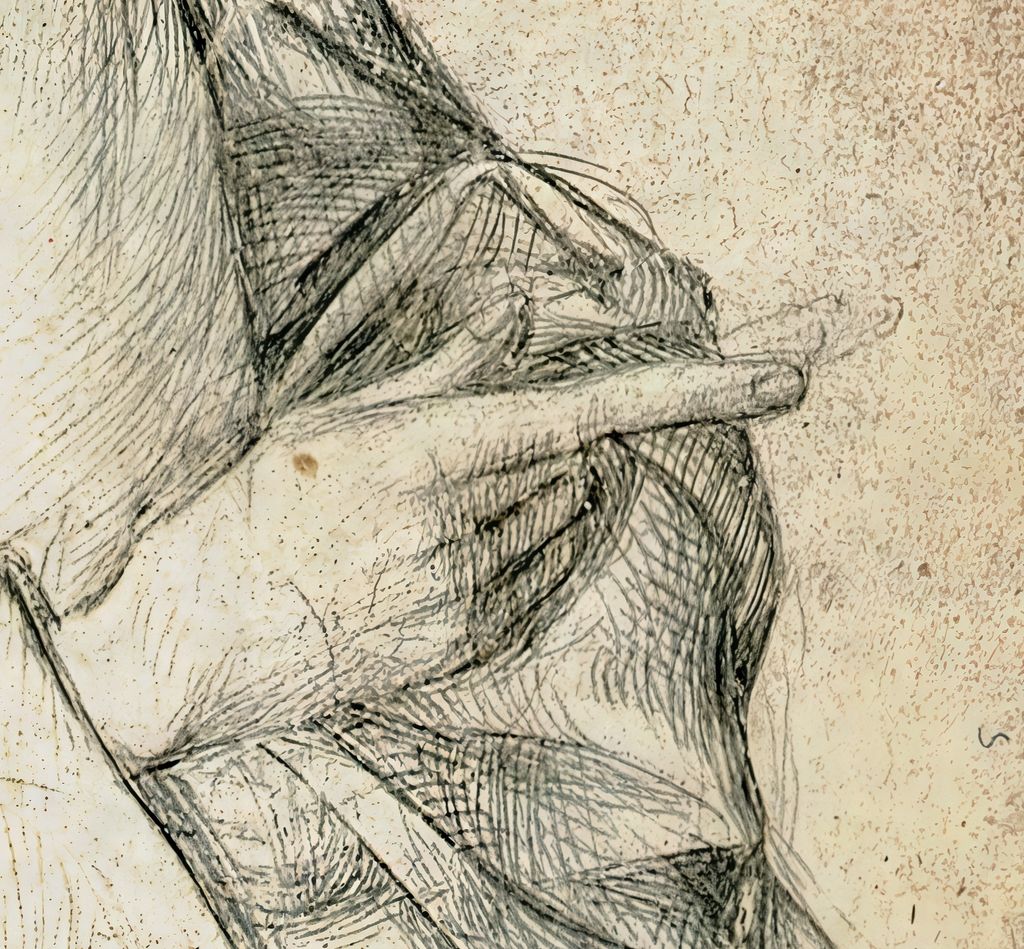
The forefinger is a long, tapering shape, with a small dark accent where the nail ends. The fingers behind it turn back towards the palm. Below them, the cuff cuts across the wrist, and its projecting lower corner makes the change from hand to sleeve especially abrupt. This is a complicated arrangement to draw: several small forms overlap, while the arm beneath them has to be understood through clothing.
Widauer finds an oversized hand, hair-like cap tassel and spatially uncertain folds; the gesture’s target remains unknown. [1]
Annotated Details from Self-Portrait at Thirteen
Follow the fine lines around the face, the extended hand and the folds of the sleeve.
Details from SELF-PORTRAIT AT THIRTEEN
Open the details to compare the direction and density of the marks.
Lines around the face
Short lines gather beside the nose and beneath the lower lip. Longer strands curve down from the fringe, framing the lighter areas of the cheek.
The extended hand
The long upper finger projects beyond the bent fingers below it. Curving contours lead back across the hand towards the narrow cuff.
Folds across the sleeve
Closely spaced marks darken the narrow folds near the elbow. Wider stretches of pale paper separate those shadows along the hanging fabric.
Working with silverpoint
Silverpoint belongs to a much older teaching tradition. In Cennino Cennini’s treatise, available in Mary Merrifield’s 1844 translation, a pupil begins with a prepared wooden tablet and a polished silver point. Cennini recommends starting so lightly that the first marks are scarcely visible, then returning over them to build shadows. Dark passages receive repeated strokes; light passages receive fewer. His instructions make the gradual accumulation of lines part of learning to control the hand. [20]
Cennini also describes a method for working on paper: first establish proportions in charcoal, brush away unsuccessful attempts, and only then fix the outlines and shadows with a silver point. The charcoal can subsequently be swept away. This is a historical example of how an artist could combine a revisable first stage with more lasting marks. It does not establish that Dürer followed this particular recipe, or that charcoal lies beneath this portrait. [20]
Widauer identifies pale preliminary outlines reinforced at the cap, arm and forefinger: revision despite silverpoint’s limited erasability. [1] [2]
A silverpoint portrait asks us to attend to small differences. The white intervals between adjacent strokes are as necessary to the cheek’s illumination as the darker groups beneath the jaw. At the hair’s edge, isolated lines remain readable as individual strands. In a tight fold they merge into a dark knot. Close looking turns an apparently delicate, uniform drawing into a surface of varied weights, intervals and directions.
The mirror and the remembered child
The words above the head introduce another moment in the sheet’s life. Dürer identifies the reflected model as himself, gives the year 1484 and says that he was still a child. William Martin Conway, discussing the inscription in his 1889 Literary Remains of Albrecht Dürer , explicitly describes its handwriting as mature. His historical English translation brings out its retrospective character: the speaker looks back at the circumstances of making the image. [7]
The year written on the sheet therefore belongs to the act being remembered. It does not require us to imagine a thirteen-year-old simultaneously composing the later annotation. Drawing and writing have different tasks here. The lines construct a visible likeness; the words preserve a name, a date and a method. They make the sheet intelligible to someone who never saw its maker as a child. [7]
The mirror supplies a practical reason for the concentrated gaze. The person being represented was also the person trying to represent him. Looking at a reflection and looking down at a sheet are different actions; making the portrait required relating one to the other. The result gives us an impression of a sustained encounter, without recording the pauses, changes of attention or duration of the work. [7]
Neither the inscription as translated by Conway nor the visible drawing identifies a room or an object at the end of the pointing finger. We can follow the gesture across the paper without completing it with an invented destination. Its effect is clear enough: the face concentrates attention inward, while the finger sends it out towards an unoccupied edge. [7]
Learning in a goldsmith’s household
Dürer’s family history, assembled in 1524, gives his own account of the education preceding his painter’s apprenticeship. In Conway’s translation he recalls that his father sent him to school, then took him away after he had learned to read and write and taught him goldsmithing. Once he could work neatly, he found himself drawn towards painting and put that preference to his father. The father regretted the training time already spent, but eventually agreed. [7]
Dürer dates the next arrangement precisely: on St Andrew’s Day, 30 November 1486, his father bound him to Michael Wolgemut for three years. The self-portrait precedes that agreement by two years. These are the adult artist’s recollections of a family decision, preserved through a historical translation. They place the drawing within an education already under way, before the formal change of profession. [7]
Margaret Doyle’s National Gallery of Art brochure explains the practical connection. A goldsmith’s pupil learned to shape and decorate metal and to draw designs for objects. Doyle relates the portrait’s closely spaced, separately legible parallel lines to that early experience of incising images on metal. This is a useful account of a possible technical foundation, rather than a record of a particular lesson given while the portrait was made. [21]
A childhood likeness in a collector’s book
By the late sixteenth century, the boy’s face was being kept among other images of the Dürer family. An Imhoff collection list published by Johann Carl Sigmund Kiefhaber in 1803 describes Dürer’s likeness as a child, drawn with a silver stylus. It appears after two entries for his wife and before a veiled woman, other portraits and religious subjects. The list heads this group as a book containing Dürer’s works. The childhood image was one sheet within a gathered collection. [8]
That setting changes the scale at which we imagine its survival. A drawing now encountered as a single famous image once had neighbours in a book. The inventory’s brief wording singles out childhood and the silver implement, preserving two details that still shape our understanding. It gives no explanation of the finger and no account of the original sitting. [8]
The ALBERTINA records the sheet’s passage from Imhoff to Rudolf II in 1588, then through the imperial treasury, the court library from 1783, and Duke Albert’s collection in 1796. [1] [22]
Joseph Heller’s 1827 catalogue supplies an early published account of the wider transfer from the imperial library to Albert: drawings were exchanged for prints. He also reports that the new owner had drawings placed on new mounts, crediting inspector Franz Lefevre with their arrangement. Heller’s account conveys how collecting involved presentation and care as well as possession; it does not specify a separate remounting procedure for this particular sheet. [23]
Heller placed the childhood portrait first in his list of drawings in Albert’s collection. He transcribed the mirror inscription and pointed readers back to the childhood likeness in his printed Imhoff inventory. The opening position makes his description a small piece of reception history: the beginning of Dürer’s career also provided an entrance to a collection of his drawings. [23]
Copying the young artist
The British Museum preserves Hans Hoffmann’s 1576 copy, SL,5218.1. Its museum-authored account describes an inscription on a separate sheet attached below: Hoffmann dated his copying to 4 February 1576 and identified the famous Dürer as the source, before repeating Dürer’s mirror inscription in imitated handwriting. The explanatory addition distinguishes the later act of copying from the childhood act it commemorates. It also shows that the written identification travelled with the likeness: both the face and Dürer’s account of making it were worth reproducing. [24]
Daniel Fröschl reused the youthful likeness within Maria mit Kind , now KHM Gemäldegalerie 1932. The Kunsthistorisches Museum’s collection record identifies a youth portrait of Dürer and the date 1484 in its lower right corner, on parchment mounted on wood. It dates the work around 1600; its 2022 exhibition list instead places the combined entry under the dates after 1603 and 1607. The precise dating thus varies between the museum’s publications. The example nevertheless shows the face entering a devotional composition, a different use from Hoffmann’s close copy. [25]
Returning to his own appearance
Dürer’s later self-portraits keep changing the relationship between face, dress and hands. In the Louvre painting of 1493, a red cap with a dangling tassel breaks up the head’s outline, while the hands hold a branching plant against dark space. [26]
In the Prado’s 1498 painting, the elaborate black-and-white clothing, joined gloved hands and landscape through a window give the sitter a more expansive setting. [27]
The 1500 Self-Portrait in a Fur Coat in Munich brings the head squarely to the front. Long hair spreads on either side, and one hand rises into the fur near the centre of the chest. Compared with the young boy’s sideways turn and outward-pointing finger, its arrangement closes attention around the face and hand. [13]
The early drawing remains absorbing on its own terms. Look back at the open spaces between the strands of hair, the shaded pocket beneath the chin and the sleeve’s sharply gathered folds. Its economy makes each mark conspicuous. We can see an image being worked out, then read the later words that helped keep its beginnings alive.
Frequently Asked Questions
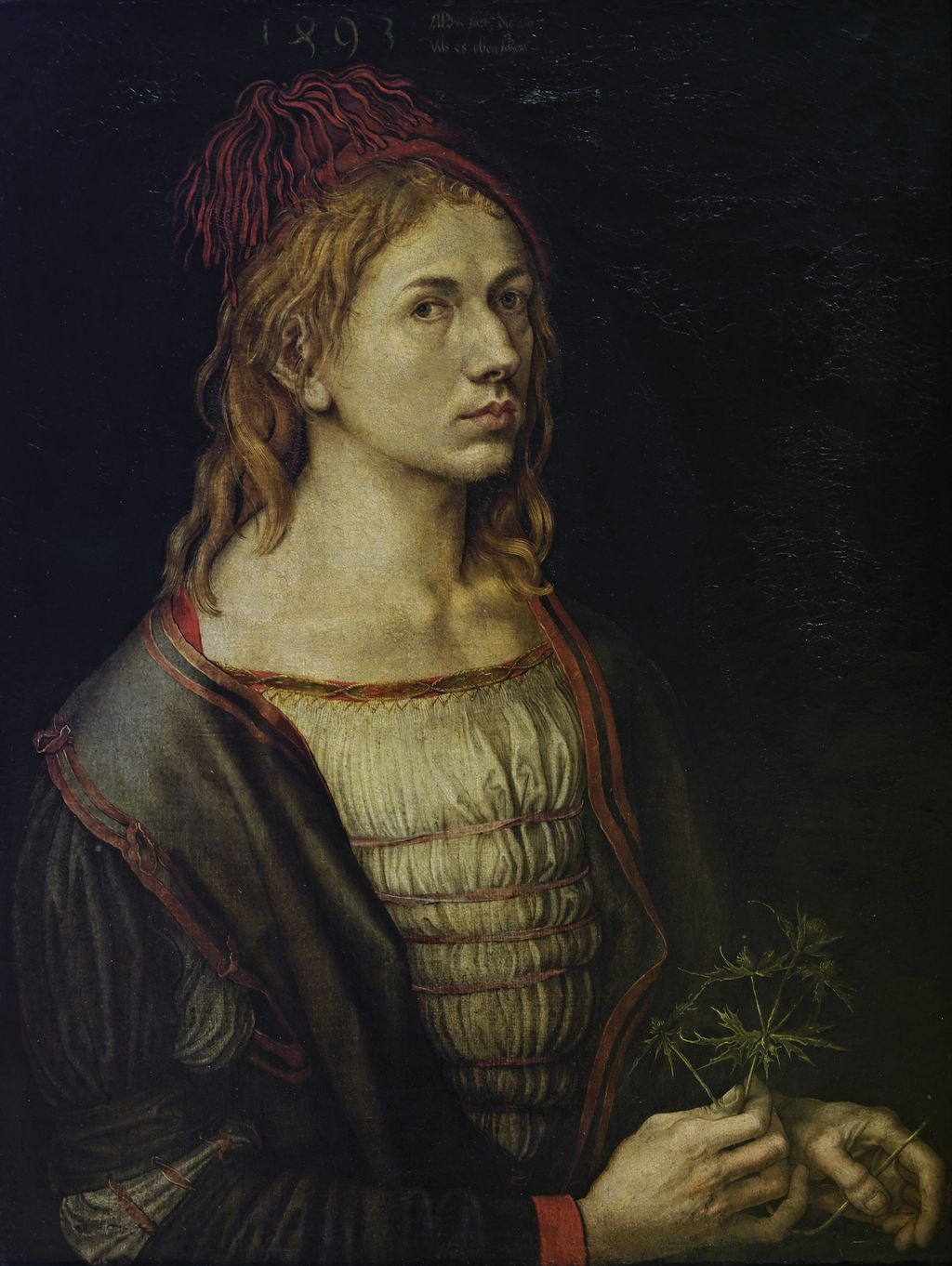
A red cap and a branching plant give the 1493 self-portrait a different arrangement.
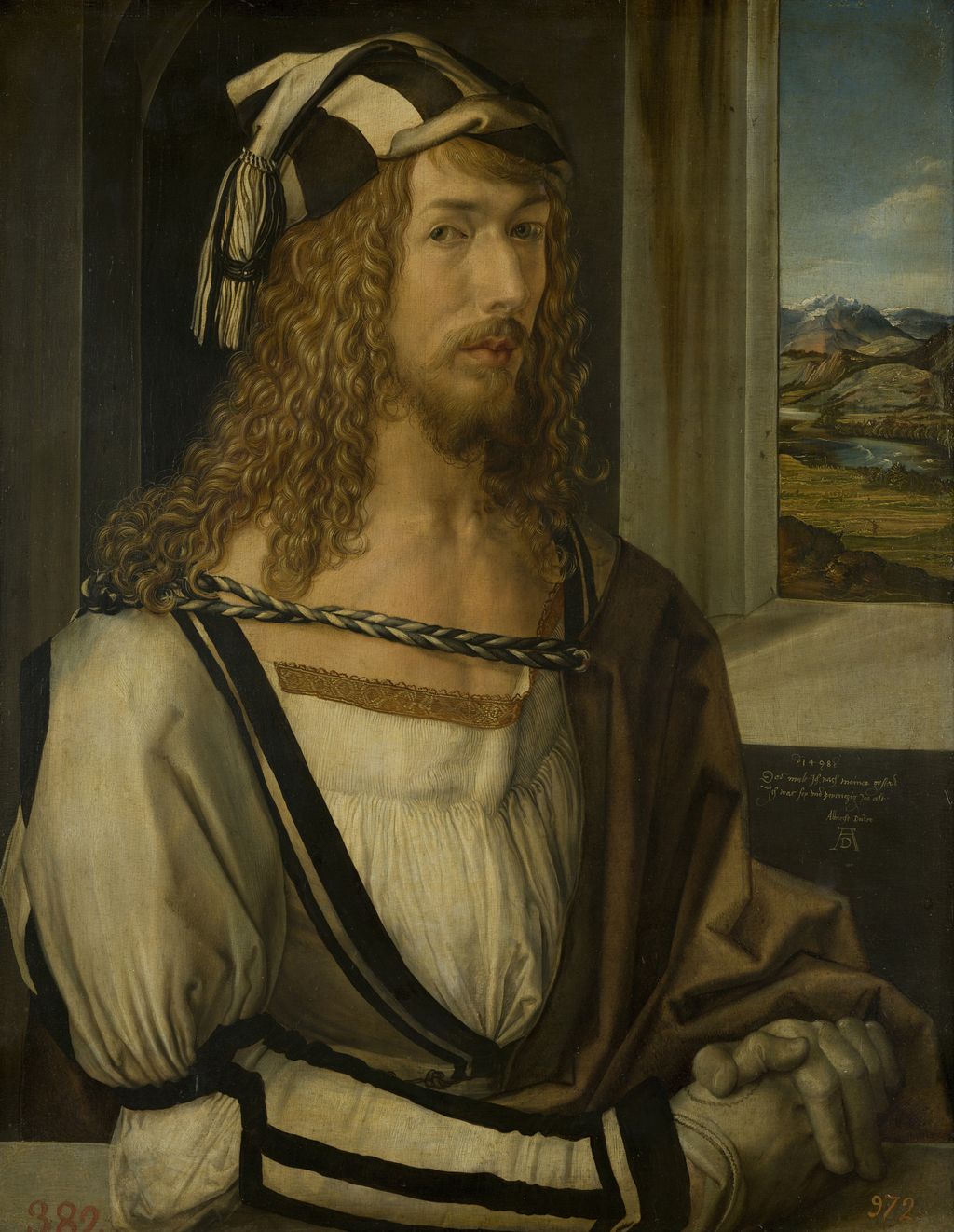
Black-and-white clothing, joined hands and a window organise the 1498 self-portrait.
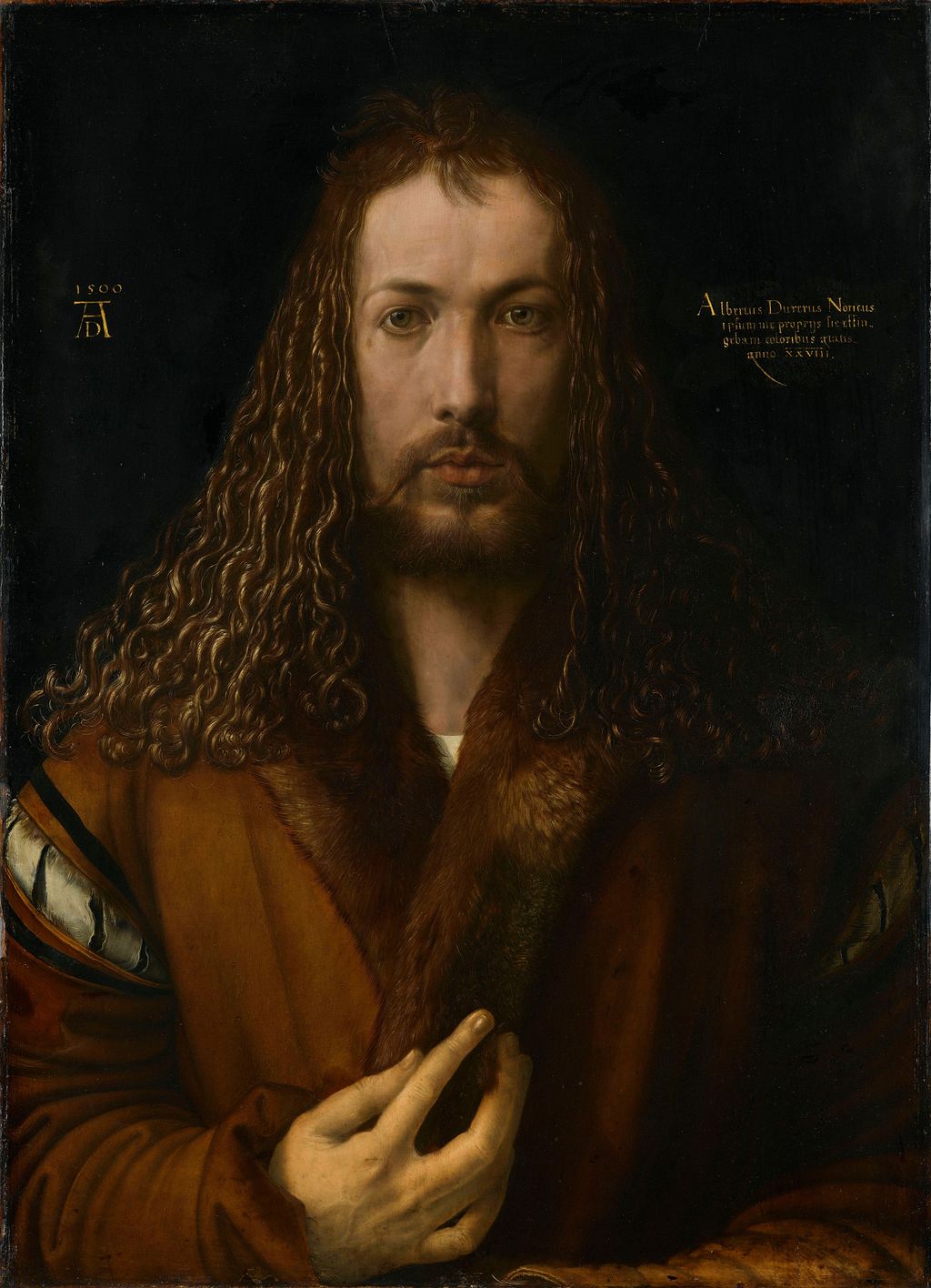
The 1500 self-portrait brings face, long hair and one raised hand towards the centre.
Artworks directory
These 187 records include individual works, reverse sides, detail views, paired panels and reconstructed arrangements. Three additional catalogue images repeat works already listed. Related views are not counted as separate originals; qualified attributions and published dating are retained.
Discussion
Look again at the images and ideas explored in Self-Portrait at Thirteen. These editorial prompts invite your observations.
Reader Insights
Which detail or idea in Self-Portrait at Thirteen most changed your reading, and why?
How does the discussion of “A face made from lines” affect your understanding?
What comparison would you bring to the discussion of “Returning to his own appearance”?
Join the Conversation
Share a detail, comparison or question about Self-Portrait at Thirteen below.
References
* ALBERTINA records (German/English); Albrecht Dürer, exhibition catalogue, ed. Klaus Albrecht Schröder and Maria Luise Sternath (Vienna: ALBERTINA; Ostfildern-Ruit: Hatje Cantz, 2003). Inventory:
- Selbstbildnis als Dreizehnjähriger, 4839 (Heinz Widauer). * View source.
- Charles Ephrussi, Albert Dürer et ses dessins (Paris: A. Quantin, 1882), pp. 2, 14–16, 20, 50–51, 78–80, 107, 109, 153 (item 10), 158 (note 1), 178, 188, 298, 302; index, pp. 399, 403, 405–406, 409–410. Original French edition. View source.
- Campbell Dodgson, Catalogue of Early German and Flemish Woodcuts Preserved in the Department of Prints and Drawings in the British Museum, vol. 1 (London: British Museum, 1903). Original English edition Selected pp. 260, 262, 272, 274, 288, 290, 294–296, 299–300, 302, 307. View source.
- Heinrich Wölfflin, Die Kunst Albrecht Dürers, second enlarged edition (Munich: F. Bruckmann, 1908), selected pp. 110, 178, 298, 321, 378–379 and the original plate following p. 178. Original German edition. View source.
- S. R. Koehler, A Chronological Catalogue of the Engravings, Dry-Points and Etchings of Albert Dürer (New York: Grolier Club, 1897). Original English edition Selected pp. 5, 14, 17–18, 32, 37, 42, 44, 51, 58, 60, 63, 81. View source.
- Moriz Thausing, Albert Dürer: His Life and Works, edited by F. A. Eaton, vol. II (London: John Murray, 1882), pp. 16–18. English edition. View source.
- William Martin Conway , Literary Remains of Albrecht Dürer (Cambridge University Press, 1889), pp. 33–35: inscription commentary and English translation of Dürer’s 1524 family history. View source .
- Johann Carl Sigmund Kiefhaber, ed., Nachrichten zur ältern und neuern Geschichte der freyen Reichsstadt Nürnberg: ein Beytrag zur Geschichte der Reichsstädte in Teutschland, vol.1 (Nuremberg: Lechner, 1803), first quarter, pp.6–9,14–16. Original German historical edition of correspondence and inventory. View source.
- T. Sturge Moore, Albert Dürer (London: Duckworth and Co.; New York: Charles Scribner’s Sons, 1905), part III, portrait discussion and caption of the 1500 Munich self-portrait. Original English edition. View source.
- Das große Rasenstück, 3075. * View source.
- Alice McEwan, Young Hare, NT 1274661, National Trust Collections, 2020; citing Colin Eisler, Dürer’s Animals (Washington and London: Smithsonian Institution Press, 1991), plate 13. View source.
- Metropolitan Museum, Four Horsemen from The Apocalypse, 19.73.209 (English). View source.
- Bayerische Staatsgemäldesammlungen , Selbstbildnis im Pelzrock , inv. 537, collection record, 1500. German . View source .
- Feldhase, 3073. * View source.
- Metropolitan Museum, Adam and Eve, 19.73.1 (English). View source.
- ALBERTINA, Betende Hände, inv. 3113 (German). View source.
- Metropolitan Museum, Knight, Death, and the Devil, 43.106.2 (English). View source.
- Metropolitan Museum, Melencolia I, 43.106.1 (English). View source.
- Bayerische Staatsgemäldesammlungen – Alte Pinakothek München, Vier Apostel: Hll. Johannes Ev. und Petrus, 1526, inv. 545 (German).. View source.
- Cennino Cennini , A Treatise on Painting , translated by Mary P. Merrifield (London: Lumley, 1844), chapters 5–12 and 30, especially pp. 5–7 and 16. Historical English translation. View source .
- Margaret Doyle , Albrecht Dürer: Master Drawings, Watercolors, and Prints from the Albertina , National Gallery of Art exhibition brochure, 2013, “Early Talent and Training,” PDF pp. 4–5. View source .
- Josef Schönbrunner, Die Albertina (Vienna: Verlag der Österreichischen Buchhändler-Correspondenz, 1887), pp. 7–8. Original German edition; collection history and opening Dürer entry. View source.
- Joseph Heller , Das Leben und die Werke Albrecht Dürer’s , vol. 2, part 1 (Bamberg: C. F. Kunz, 1827), pp. 82 and 98–100, especially p. 100, no. 1. German historical catalogue; English paraphrases are the present writer’s . View source .
- British Museum , Hans Hoffmann, Dürer as a child, a drawing after Albrecht Dürer , museum-authored Google Arts & Culture entry, SL,5218.1, 1576. View source .
- Kunsthistorisches Museum , Maria mit Kind , Gemäldegalerie 1932, collection record; Idole & Rivalen , 2022 exhibition work list. German . View source 1 . View source 2 .
- Musée du Louvre , Portrait de l’artiste tenant un chardon , RF 2382, collection record, 1493. French . View source .
- Museo Nacional del Prado , Autorretrato , P002179, collection record, 1498. Spanish . View source .
- Burlington Fine Arts Club, Exhibition of Early German Art (London: Burlington Fine Arts Club, 1906). Original English catalogue P. 24, no. 38. View source.
- Maud Cruttwell, Andrea Mantegna, London: George Bell and Sons, 1901, pp. 110–112. View source.
- Moriz Thausing, Dürer: Geschichte seines Lebens und seiner Kunst (Leipzig: E. A. Seemann, 1876). Original German edition Selected pp. 303, 306, 308–309. View source.
- Tote Blauracke, 3133, around 1500. * View source.
- Bildnisse eines Mädchens in kölnischer Tracht und Agnes Dürers (aus dem Silberstiftzeichenbuch der Niederländischen Reise), 22385r, 1521 (Matthias Mende, cat. 174, pp. 496–498). * View source.
- ALBERTINA, Der Flügel einer Blauracke, inv. 4840, around 1500; current metadata and Heinz Widauer, Die großen Meister der Albertina (Vienna: ALBERTINA, 2008), no. 6. German and English. View source.
- Germanisches Nationalmuseum, Barbara Dürer (German and English). View source.
- Web Gallery of Art, Tucher–Rieter reverse (English). View source.
- National Gallery of Art, Portrait of a Clergyman (English). View source.
- Dürer Art, Portrait of a Man (English). View source.
- Hessen Kassel Heritage, Elsbeth Tucher (German). View source.
- Web Gallery of Art, Hans Tucher (English). View source.
- Germanisches Nationalmuseum, Emperor Maximilian I (German and English). View source.
- National Gallery of Art, Lot and His Daughters, reverse (English). View source.
- Bayerische Staatsgemäldesammlungen, Glim Lamentation (German). View source.
- Museo Nacional del Prado, Portrait of a Man (Spanish). View source.
- Bayerische Staatsgemäldesammlungen, Madonna of the Carnation (German). View source.
- Städel Museum, Job on the Dungheap (German). View source.
- Wallraf-Richartz-Museum, Piper and Drummer (German). View source.
- Italian Ministry of Culture / Uffizi, Head of Saint James (Italian). View source.
- Klassik Stiftung Weimar, Dresden Altarpiece (German). View source.
- Staatliche Museen zu Berlin, Girl with a Red Beret (German and English). View source.
- Dresden State Art Museums / Roland Enke, Bernhard von Reesen (German). View source.
- Royal Collection Trust, Burkhard von Speyer (English). View source.
- Dresden State Art Museums, Seven Sorrows of the Virgin (English). View source.
- Bayerische Staatsgemäldesammlungen, Mater Dolorosa (German). View source.
- Bayerische Staatsgemäldesammlungen, Lucretia (German). View source.
- Städel Museum, Young Woman with Her Hair Down (English). View source.
- ALBERTINA, Portrait of a Young Man (German). View source.