by Tom Gurney
Tom Gurney BSc (Hons) is an art history expert with over 20 years experience
Page created on September 3, 2026 / Page updated on September 13, 2026
Email: tomgurney1@gmail.com / Phone: +44 7429 011000
How Matrices, Ink and Pressure Turn One Image into Many Possibilities
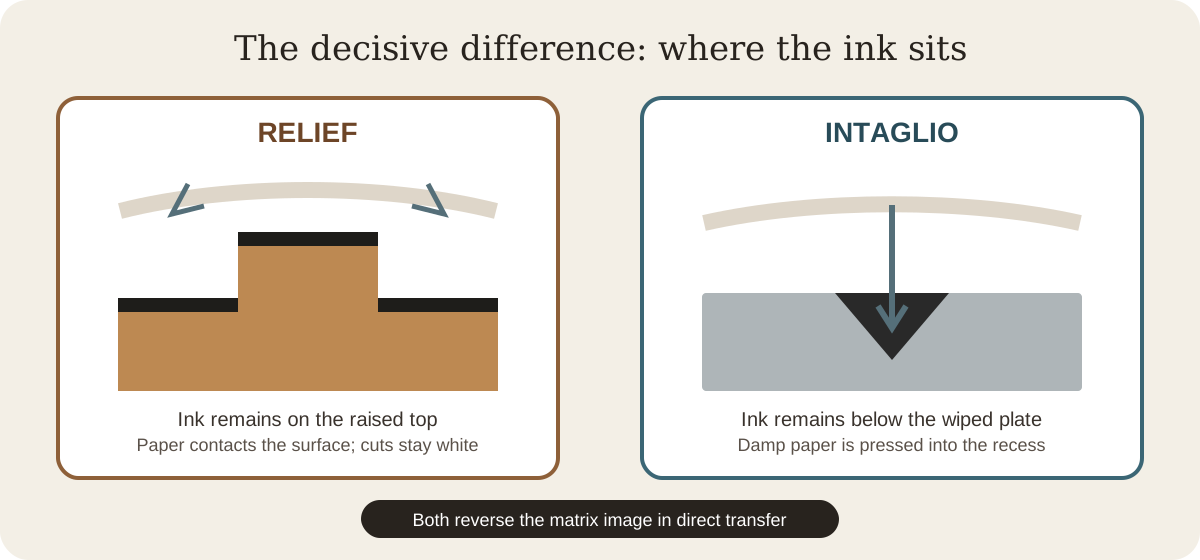
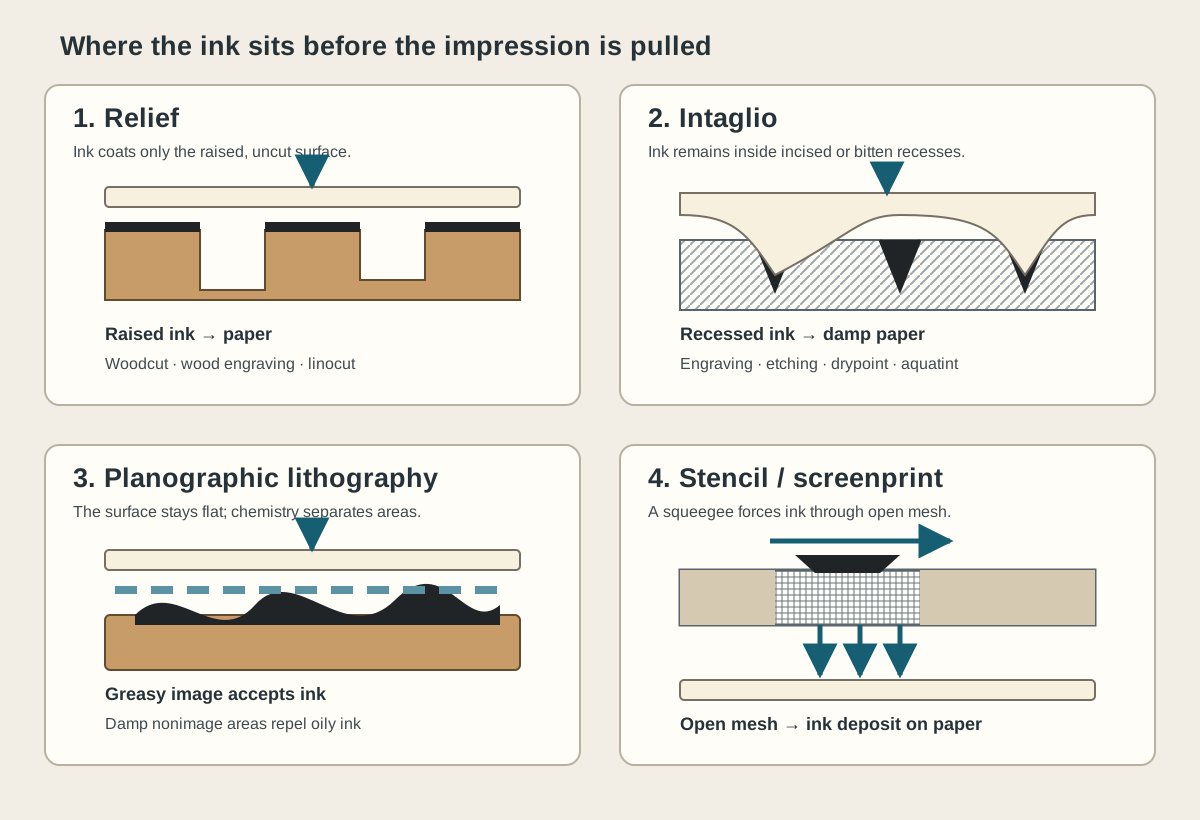
Printmaking creates an image on a prepared surface and transfers it to another surface, usually paper. That prepared surface is called a matrix. It may be a carved woodblock, an incised metal plate, a lithographic stone or plate, or a mesh screen carrying a stencil. What separates the main printmaking processes is not simply the tool an artist holds, but where the ink sits on the matrix and how pressure moves it to the sheet.[1][2]
Most printmaking methods allow more than one impression to be taken from the matrix. Each impression is an original print, not automatically a reproduction of a painting. Impressions can nevertheless differ: ink, wiping, paper, pressure, colour registration, changes to the matrix and wear all affect the result. Monotype is the important exception to the multiple-image rule because it is normally designed to produce one strong, materially unique impression.[1][3]
At a Glance
- Reliefink transfers from the raised or uncut matrix surface.
- Intaglioink transfers from incised or bitten recesses under pressure.
- Lithographyimage and blank areas share one plane but differ chemically.
- Screenprintinga stencil controls ink passing through open mesh.
- Variable routesmonotype and monoprint foreground singular or deliberately changing impressions.
Four Main Printmaking Families Compared
Museum classifications are not perfectly uniform. Some introductions name four representative processes—woodcut, etching, lithography and screenprint—while others group techniques by their physical printing principle. The most useful system for understanding how a print is made has four families: relief, intaglio, planographic and stencil. Monotype and hybrid methods sit across or beside those categories.[1][4][5]
| Family | Where the ink sits | How it transfers | Common techniques | Useful visual clues |
|---|---|---|---|---|
| Relief | On the raised, uncut surface | Paper meets the inked face by hand or press pressure | Woodcut, wood engraving, linocut | Bold shapes, cut-away whites, occasional block edge or grain, possible shallow emboss |
| Intaglio | Inside recessed lines or textures | Damp paper is pressed into the recesses under high pressure | Engraving, etching, drypoint, aquatint, mezzotint | Plate mark, pressed line, burr-softened edge, fine hatching or tonal grain |
| Planographic | On selected image areas of a flat prepared surface | Chemical separation keeps ink on the image while nonimage areas repel it | Lithography | Crayon grain, brush or wash-like marks, drawn fluency, separately registered colours |
| Stencil | Above the sheet and through open parts of a stencil or mesh | A brush or squeegee pushes ink through openings | Screenprint, pochoir | Flat ink film, crisp stencil edge, opaque colour layers, possible mesh texture or registration shift |
These clues are guides rather than guarantees. A trimmed intaglio print may have lost its plate mark. A finely cut wood engraving may not look coarse. Lithographic crayon can imitate charcoal, while photographic processes can imitate older marks. A reliable identification begins with an institutional catalogue record and then tests physical evidence under good light and magnification.
Relief printing: ink on the surface
Relief is the easiest family to understand as a cross-section. Imagine a block with valleys cut into it. A roller passes across the top and inks the remaining high surface without reaching the valleys. When paper touches the block, those inked high areas print; the cut-away areas remain the colour of the paper.[1][3]
Woodcut
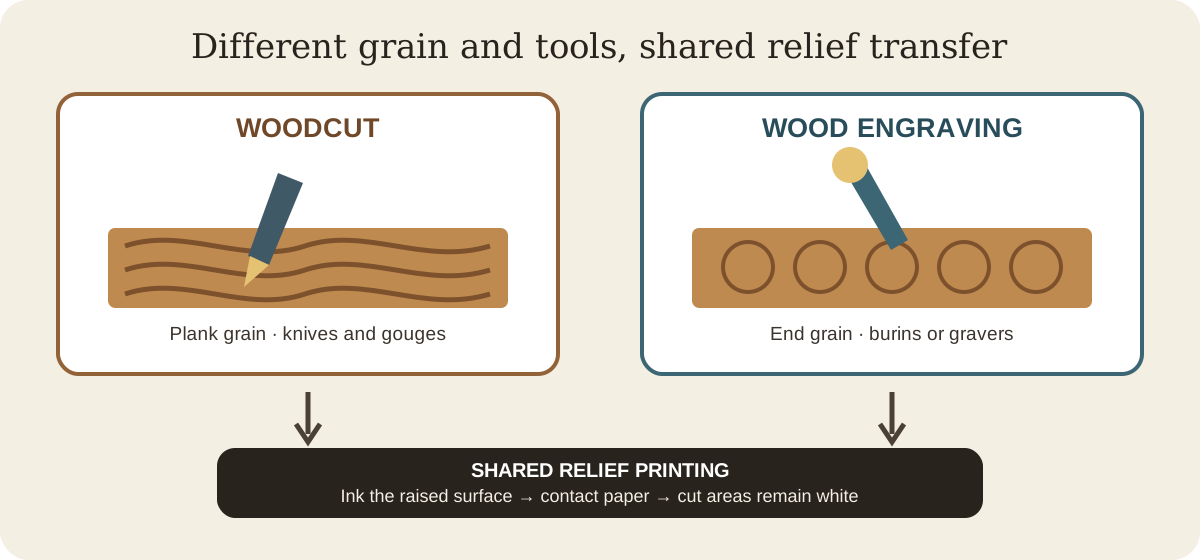
In a woodcut, the design is normally made on the plank side of a block, with the grain running across the working face. Knives and gouges remove nonprinting areas. The artist can leave broad black shapes, narrow raised lines or networks of marks. The technique encourages clarity because every cut changes the relationship between inked surface and paper, yet it is capable of extraordinary density and subtlety.
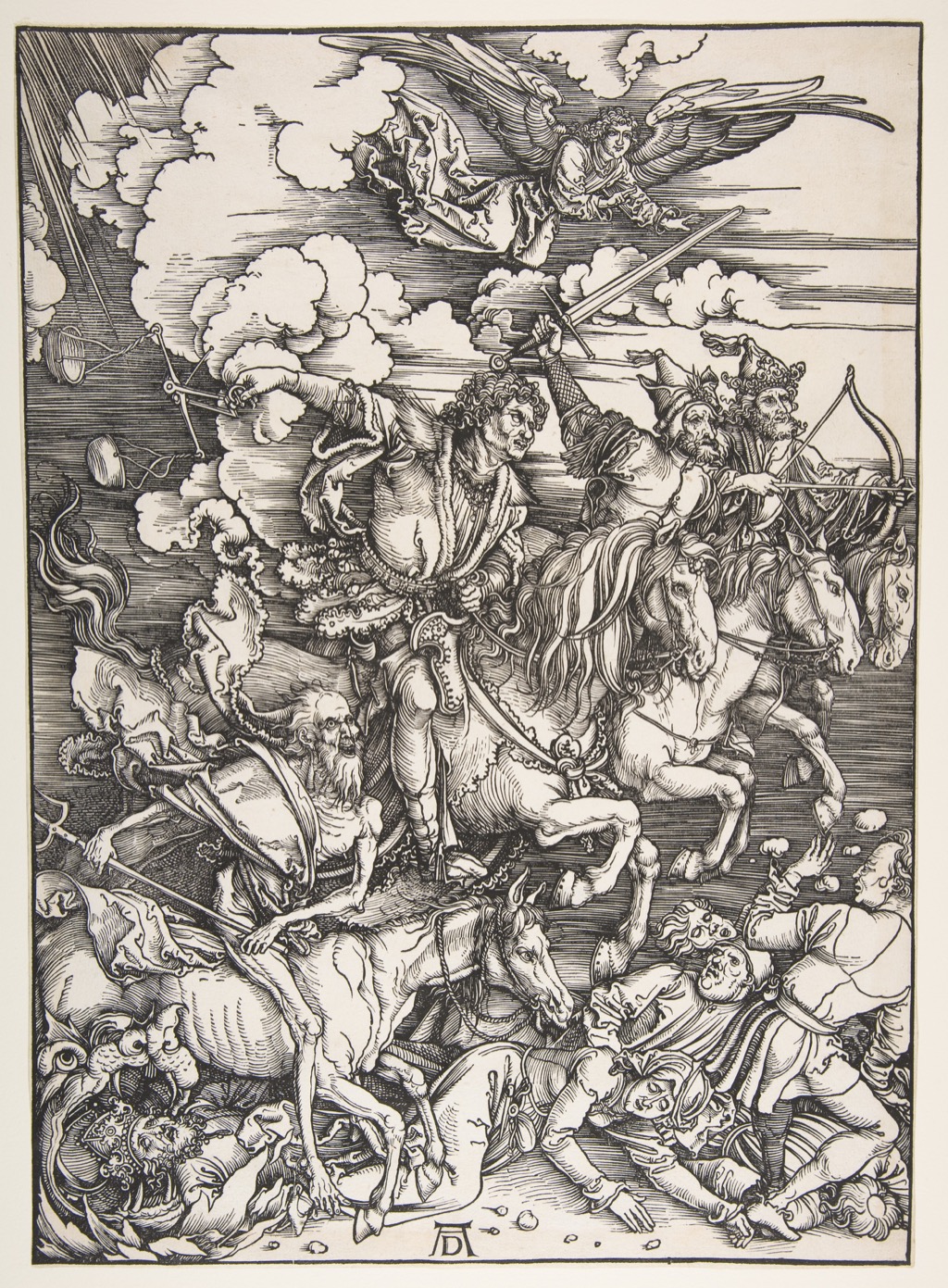
Albrecht Dürer's The Four Horsemen, from The Apocalypse of 1498 shows how sophisticated the medium had become in Europe by the end of the fifteenth century. Parallel raised lines establish middle tones, while changing intervals, curves and diagonals give bodies, clouds and rushing horses distinct weight. The Metropolitan Museum of Art identifies the sheet as a woodcut and makes its image available in the public domain.[7]
Woodblock printing has a much longer and geographically wider history than this European example suggests. MoMA traces woodcut in China to the ninth century, and colour woodblock traditions developed through the coordination of design, carving and printing.[6] In the Ukiyo-e tradition, Katsushika Hokusai's Under the Wave off Kanagawa, about 1830–32, uses multiple blocks and carefully registered colours to create outlines, patterned water, pale spray and layered blues. Relief printing is therefore not inherently monochrome, rough or simple.[8]
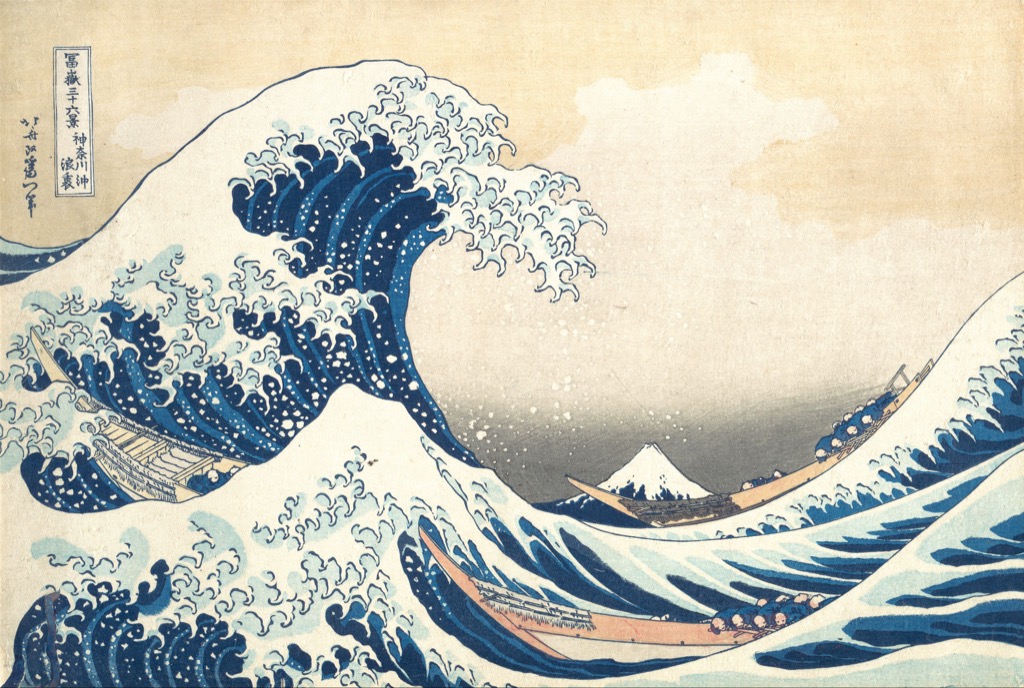
The six Metropolitan Museum images reproduced here are attached to object records marked Public Domain and supplied through the museum's Open Access programme.[13]
Wood engraving and linocut
Wood engraving is also a relief method, despite its name. It is commonly cut with gravers into the dense end grain of a block rather than the plank face used for most woodcuts. The hard surface supports closely worked white lines and fine tonal changes, which made the process especially effective for nineteenth-century illustration.[1]
Linocut substitutes linoleum for wood. The material has no wood grain and is relatively easy to cut, encouraging broad shapes and flowing incisions. Those tendencies are recognisable, but neither a bold design nor a smooth cut proves that a print is a linocut. Artists can work against a material's expected character.
Intaglio printing: ink below the surface
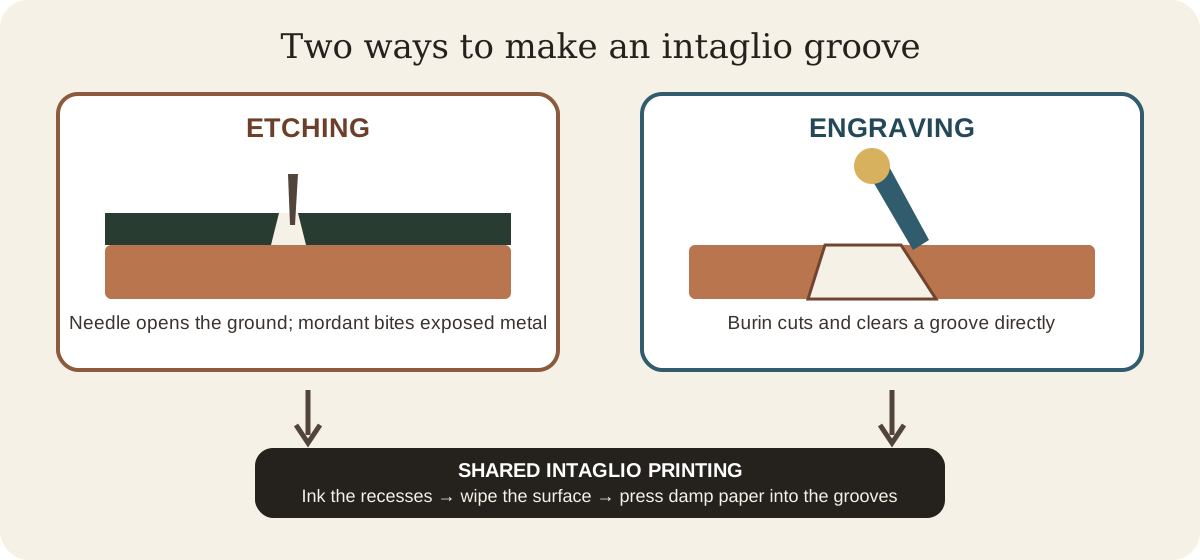
Intaglio reverses the logic of relief. Lines, dots or textured areas are sunk into a plate, usually metal. Ink is spread across the plate and worked into those recesses. The surface is then wiped, leaving ink in the incised or bitten marks. Under the strong pressure of an intaglio press, dampened paper is pushed into the recesses and lifts out the ink.[1][3]
The edge of the plate often leaves an indentation called a plate mark. It is one of the most familiar clues to an intaglio print, but it should not be treated as proof on its own. A sheet can be trimmed inside the mark; plate edges can be disguised; and other presswork may leave an impression.
Engraving
In engraving, a burin cuts directly into the plate. The V-shaped tool can make a line swell or narrow as its angle and pressure change. Cross-hatching builds tone from disciplined systems of intersecting lines. Because the metal is physically displaced and removed by the tool, the engraved line often has a controlled, tapering character.[1]
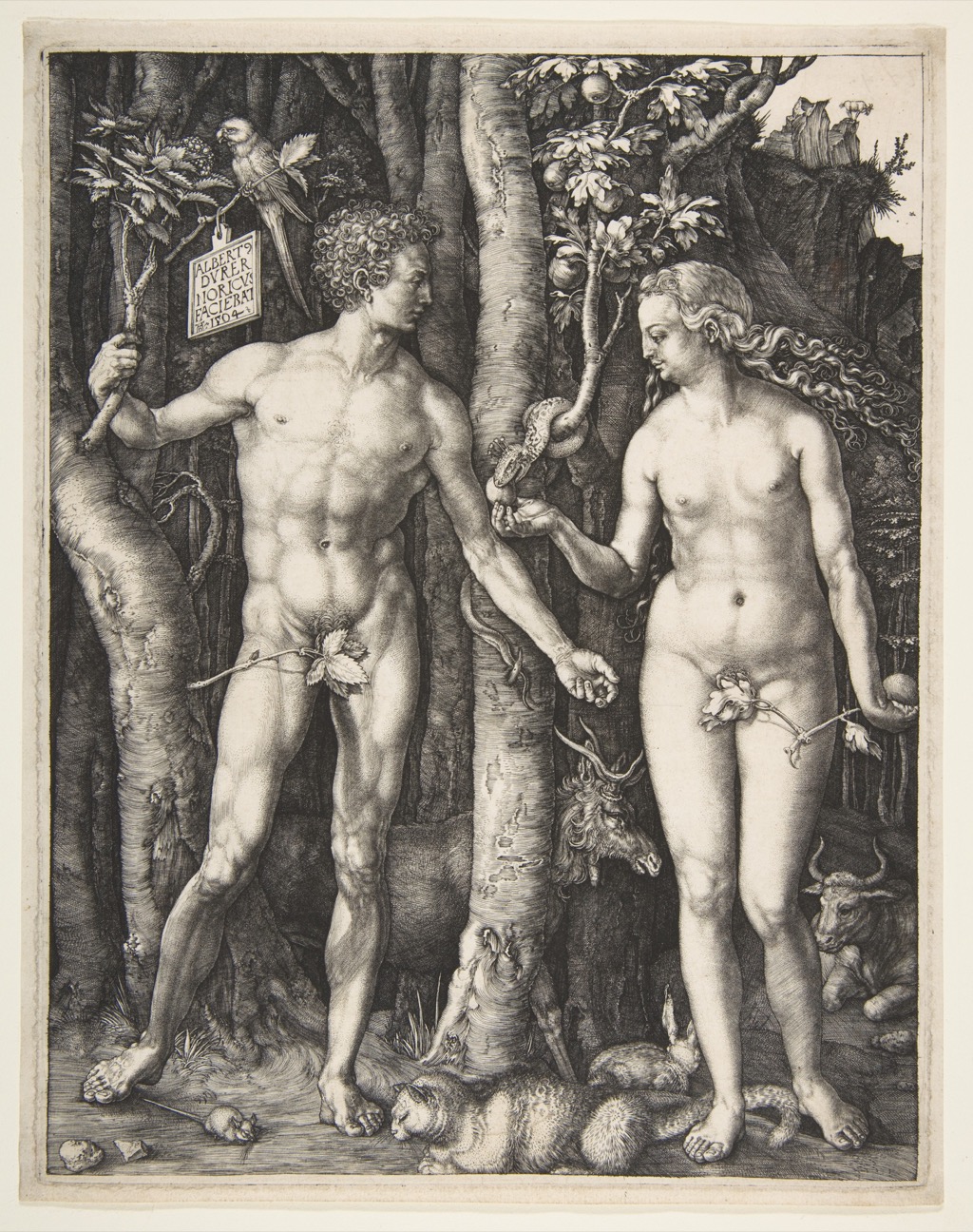
Dürer's Adam and Eve of 1504 is a masterclass in this language. Fine networks of engraved marks distinguish human skin, animal fur, bark, leaves and shadow while keeping the forms legible. The Met catalogues the work as an engraving, object 19.73.1, and marks the image Public Domain.[9]
Etching, drypoint, aquatint and mezzotint
Etching replaces much direct cutting with a mordant. A metal plate is covered by an acid-resistant ground. The artist draws through it with a needle, exposing metal. Acid or another mordant bites the exposed lines, which later hold ink. The needle can move with some of the freedom of a pen because it is opening a ground rather than ploughing a deep groove through metal.[3]
Drypoint is direct, but it scratches rather than cleanly engraving a groove. The point raises a ridge of metal called a burr. Burr holds additional ink and can give the printed line a soft, velvety edge. It wears down as impressions pass through the press, so early and later impressions may differ materially.
Aquatint is usually associated with fields of tone rather than only drawn lines. A porous acid-resistant ground lets the mordant bite a fine texture around protected particles. Mezzotint begins with a plate roughened so thoroughly that it would print dark, then smooths or scrapes selected areas to produce lighter tones.[3]
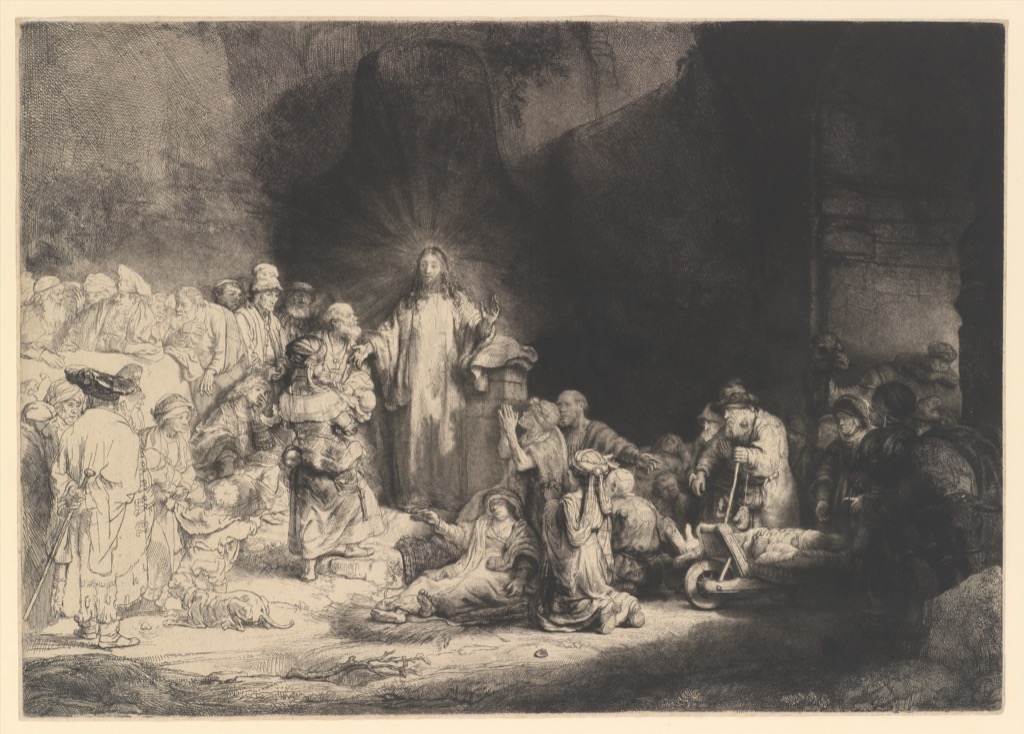
Artists regularly combine intaglio methods. Rembrandt's The Hundred Guilder Print of 1648 is catalogued as etching, engraving and drypoint, second state of two. Its lightly articulated passages, deep shadows and varied edges do not belong to a single tool. State means a version of the image after the plate has been changed; it is different from a mere variation caused by paper or inking.[10]
Lithography: drawing and printing from a flat surface
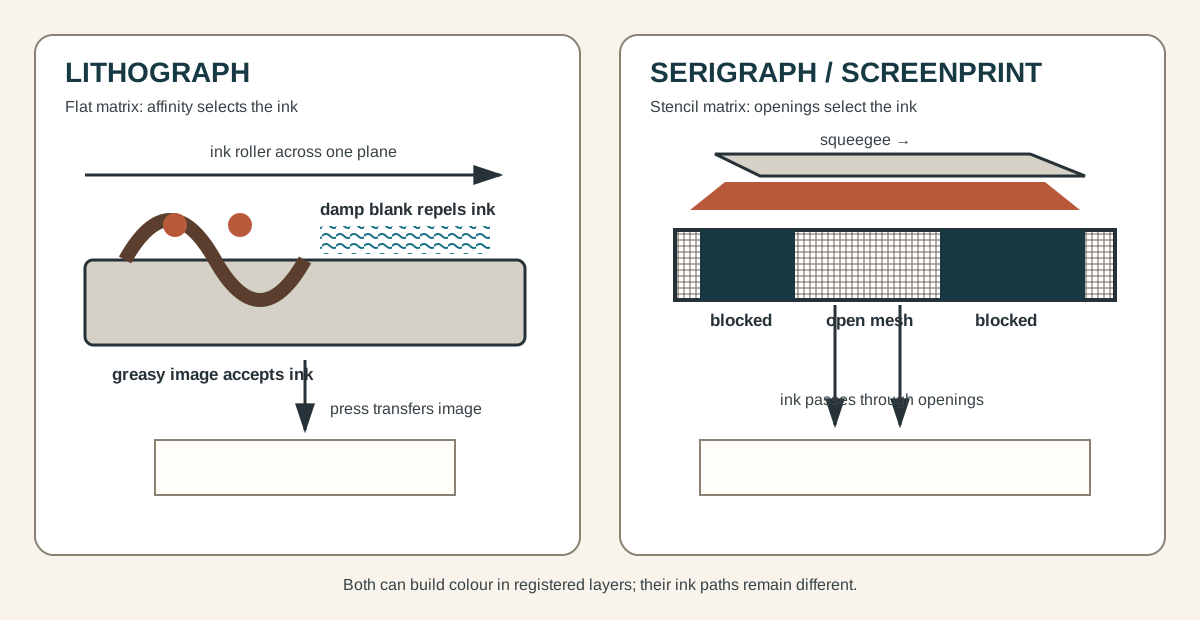
Lithography is planographic: the printing areas are neither raised like relief nor recessed like intaglio. The artist draws with greasy crayon, ink or wash on a prepared limestone surface or metal plate. Chemical processing establishes image areas that accept oily printing ink and damp nonimage areas that repel it. The surface stays physically flat in the basic process, but its affinity for ink differs from area to area.[1][2][3]
This principle gave artists an unusually direct relationship between drawing and print. Crayon grain, brushed tusche, scraped highlights and spatter can retain the energy of work made on the stone. Colour lithography usually requires a separate stone or plate for each colour, so the printer must register successive impressions accurately.
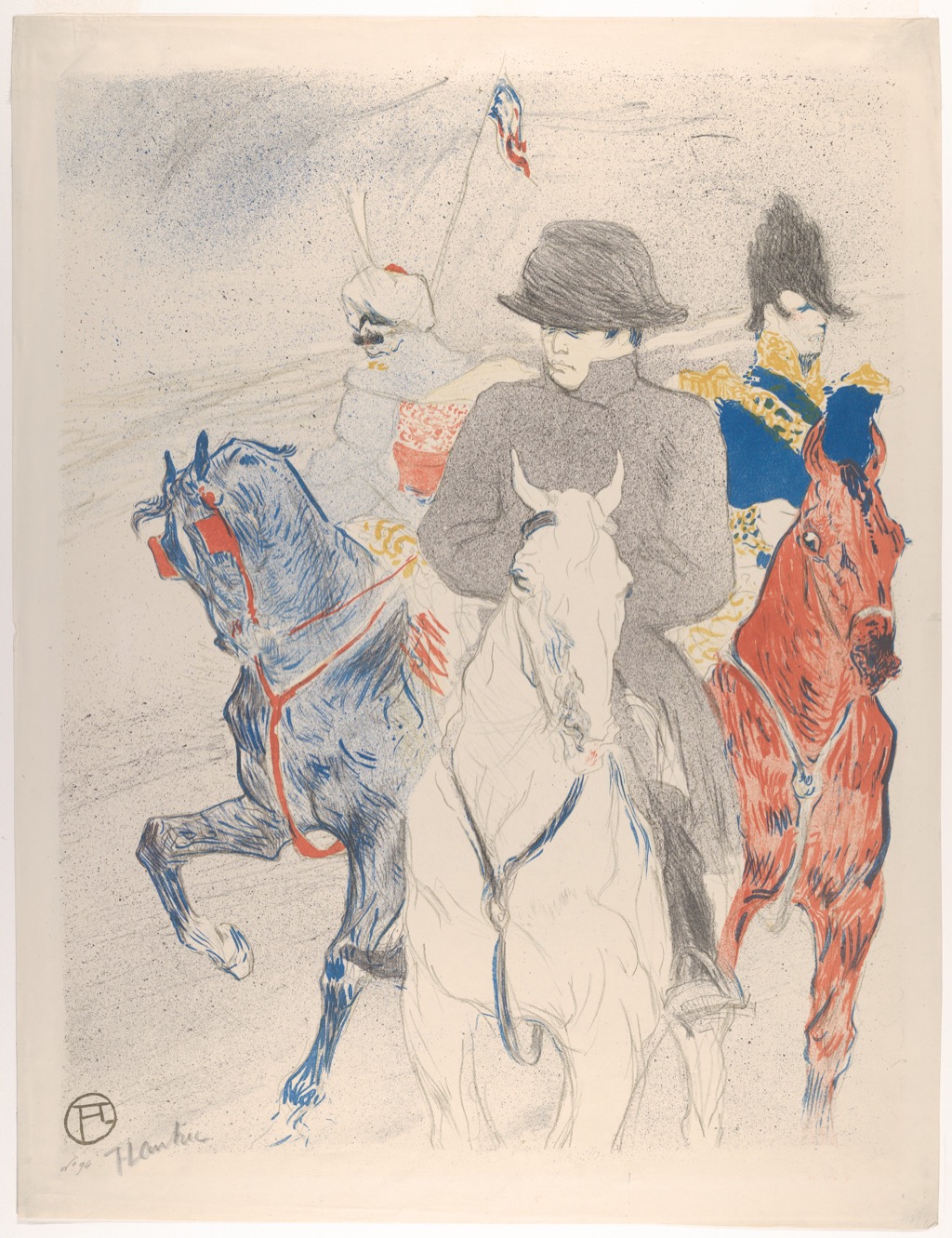
Henri de Toulouse-Lautrec's Napoleon of 1895 combines crayon, brush and spatter in a lithograph printed in six colours. The Met records Edward Ancourt as printer and calls the impression the only state. Those details matter: a fine-art print may be the result of close collaboration among artist, printer and publisher, and its identity includes more than the artist's name alone.[11]
Lithography was invented by Aloys Senefelder around 1798 and first developed as an economical printing method. Its commercial history does not make artistic lithographs reproductions by definition. A lithograph can be an original composition made for the stone or plate, a transfer of another design, or a reproductive image. The object record, not the process name by itself, resolves that distinction.[6]
Screenprinting: ink through a stencil
Screenprinting places a stencil on a mesh stretched across a frame. Some mesh openings remain permeable while others are blocked. A squeegee draws ink across the screen and forces it through the open areas onto the paper beneath. Separate screens or stencils commonly carry separate colours.[1][2][3]
The terms screenprint, silkscreen and serigraph often refer to the same family. Silkscreen reflects the historical use of silk mesh, although synthetic mesh is now common. Serigraph became useful in fine-art contexts but does not describe a different physical principle. The deposits can be opaque and sharply bounded, making the method well suited to large flat shapes, but artists can also produce gradients, texture and photographic detail.
Some summaries place screenprinting alongside planographic techniques because the image and nonimage regions occupy one plane. Treating it as stencil printing makes its mechanism clearer: ink travels through openings rather than adhering selectively to a damp flat stone. Classification labels vary; the physical ink path does not.
Monotype, monoprint and the unique impression
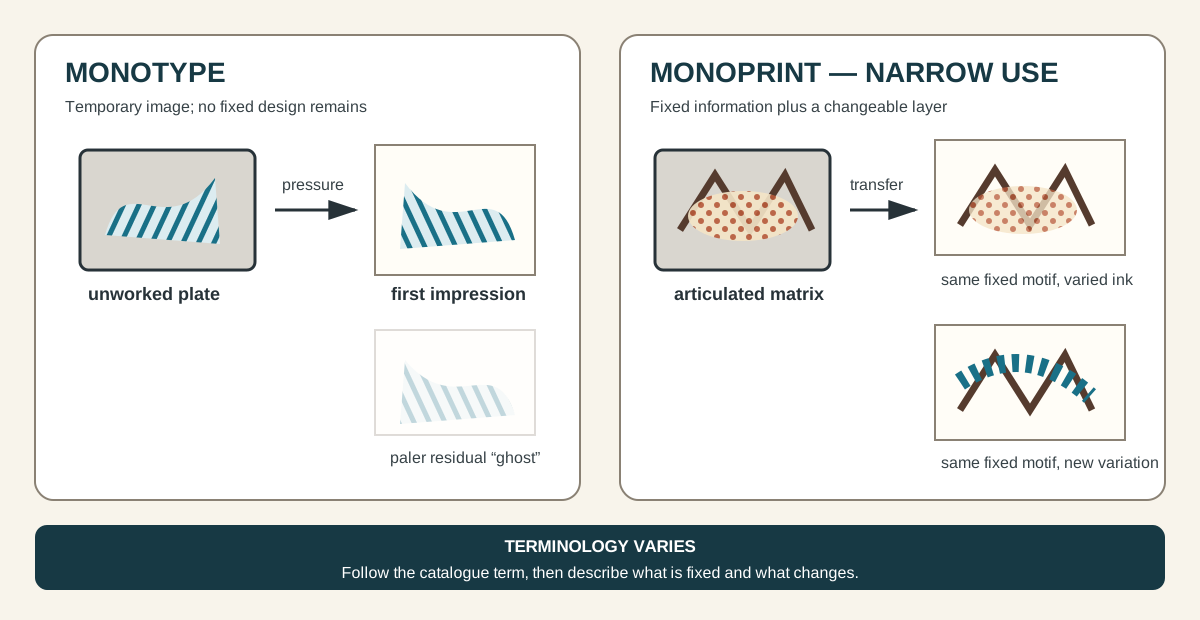
In a monotype, the artist commonly paints, rolls or wipes ink on a smooth unincised plate and transfers that temporary image to paper. Most of the ink leaves the plate in one pull, so a second ghost impression is usually paler and materially different. The matrix does not hold a fully repeatable design in the manner of a carved block or etched plate.[12]
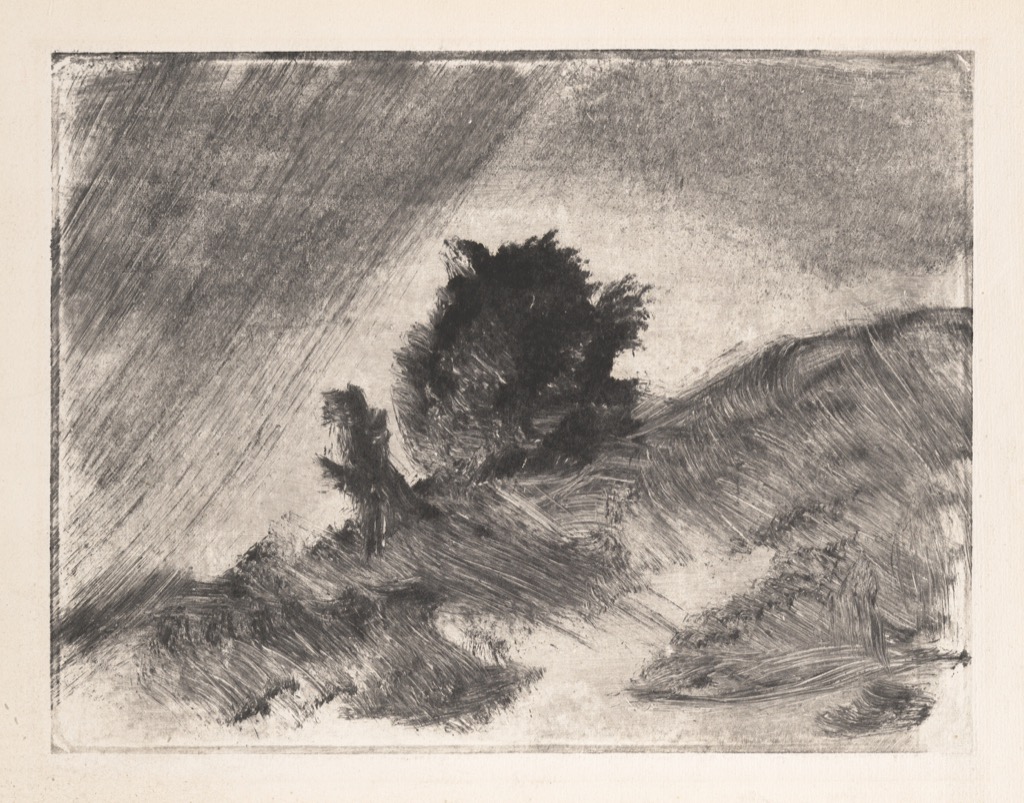
Edgar Degas's Landscape, about 1877–79, demonstrates how wiping, dragging and manipulating ink can create atmosphere on an unincised surface. The Met identifies it simply as a monotype. Its soft weather and streaked terrain come from the movement of ink before transfer, not from a permanently cut network of lines.[12]
Monoprint is less consistently defined. Some museums and workshops use it broadly for a unique printed impression. Others distinguish a monoprint as a unique variation taken from a matrix that also contains repeatable elements, reserving monotype for an image made on an unworked plate. The safest approach is to report the term used by the holding institution and explain how the matrix was made when that evidence is available.
How to identify a printmaking process
Start with documentation. Museum and collection records may name several processes, identify a state, distinguish artist from printer and give a catalogue number. Visual inspection is most useful when it tests that evidence rather than replacing it.
- Look in raking light. A plate mark, shallow relief emboss or thick surface deposit may become clearer when light crosses the sheet.
- Use magnification. Engraved taper, etched line, drypoint burr, lithographic crayon grain and screen mesh can be difficult to see unaided.
- Ask where the ink appears to sit. Relief ink tends to rest on the contacted surface; intaglio ink can appear pressed into the paper; screen ink may form an even surface film.
- Follow the whites as well as the darks. In relief, cut-away spaces often define the image. In wood engraving, the tool commonly draws with white cuts through an inked field.
- Inspect colour registration. Small shifts between colours may reveal separate blocks, stones, plates or screens, but they do not identify which of those matrices was used.
- Expect combinations. One sheet can mix etching with drypoint, or lithography with screenprint. Later hand colouring can add another layer that was not printed.
Paper, pressure, condition and trimming can hide expected evidence. A confident attribution should rest on several compatible clues or on a reliable catalogue entry.
Original print, reproduction, impression, edition and state
An original print is an artwork realised through printmaking, whether the artist cuts the matrix personally or works with a specialist printer. Collaboration does not diminish originality when the artist conceives and directs the work through the chosen process.
An impression is one printed sheet taken from a matrix. An edition is a group of impressions issued together, often with a stated size, although historical editions were not always numbered. A state records a physical change to the matrix. Two impressions in one state can still vary because of wiping, ink, paper or pressure.
A reproductive print translates an existing artwork into another medium. It can be historically important and technically accomplished, but its relation to the source work should be stated. A modern photographic or inkjet reproduction of a painting is not made original merely by being called a print. The decisive question is how the image was conceived, transferred and documented.
A short history of printmaking
Print history is not a single European sequence. Woodblock printing developed in East Asia and served religious, literary and pictorial purposes long before European paper prints became widespread. In Europe, woodcut and metal engraving expanded during the fifteenth century alongside paper, workshops, publishers and new networks of circulation.[1][6]
By 1500, artists such as Dürer used printmaking to create independent works of striking ambition. Prints could travel where an altarpiece or wall painting could not, carrying designs, styles and reputations across cities and borders. The matrix also encouraged series: related images could form narratives, devotional cycles or bodies of technical experiment.
Japanese colour woodblock production brought designer, carver, printer and publisher into a sophisticated collaborative system. European artists encountering Japanese prints in the nineteenth century learned from their cropping, contour, flat colour and unusual spatial intervals, even when they misunderstood the works' original contexts.
Lithography widened the vocabulary of printed drawing after 1798. Etching revivals, illustrated publishing and the modern poster gave artists new relationships with specialist workshops and mass audiences. Monotype offered a deliberately singular use of transfer. In the twentieth century, artists associated with Die Brücke returned to woodcut's cut edge and stark contrast, while artists adopted screenprinting from commercial practice for layered colour, repetition and mass-media imagery.[5][6]
No technique simply replaced the one before it. Artists continue to combine old and new matrices because each process structures a mark differently; Gauguin's prints and woodcuts are one useful bridge between nineteenth-century experiment, Japanese influence and modern relief revival. The history of printmaking is therefore a history of choices: what can be repeated, what changes from impression to impression, how labour is shared and how an image enters the world.
Watch Three Printmaking Families Transfer Ink
Choose relief, intaglio or lithography to compare where ink sits on the matrix and how it reaches paper.
Pressure + Ink: Introduction to Relief Printmaking
Begin with ink carried on a raised surface and transferred to paper.
Watch on YouTubeFrequently Asked Questions
The clearest four-family model is relief, intaglio, planographic and stencil printing. Woodcut is relief; engraving and etching are intaglio; lithography is planographic; screenprinting is stencil. Some introductions instead name woodcut, etching, lithography and screenprint as representative processes.
No. A fine-art print can be an original work conceived for its matrix and printing process. Print also describes reproductions and photographic outputs in everyday language, so the object record and method must clarify which meaning applies.
Direct contact transfers the matrix image to the sheet in reverse, much like a stamp. Artists and printers plan lettering and orientation accordingly. Multi-stage transfer methods can reverse an image more than once, so reversal is common rather than universal.
An edition is a group of impressions issued from a matrix. A state is a version created when the matrix is physically altered. Several impressions can belong to one state, and impressions within the same edition may still vary slightly.
Yes. Printmakers often combine methods. Rembrandt's Hundred Guilder Print, for example, uses etching, engraving and drypoint. Modern works may combine lithography, screenprint, collage or hand-applied additions.
Yes. Its identity depends on transfer from a prepared surface, not on producing a large edition. A monotype normally yields one strong impression and sometimes a weaker ghost.
Discussion
Which matrix-to-paper relationship feels easiest to recognise after comparing the page—and which example most usefully crosses or complicates a family boundary?
Reader Insights
Raised surface, recess, flat chemical image or open mesh is the clearest first distinction among the main families.
The plate, block, stone or screen stores possibilities; paper, ink, wiping, pressure and registration shape each printed result.
Mixed techniques, states and variable impressions often defeat a one-word label.
Join the Conversation
Share one precise observation or a useful museum example below.
References
- Victoria and Albert Museum, “What is print?” Updated 17 April 2024. View source
- National Gallery of Art, “Printmaking Basics.” View source
- Princeton University Art Museum, “Collection Publications: Printmaking.” 8 November 2019. View source
- Museum of Modern Art, “What Is a Print?” View source
- National Gallery of Art, “All About Prints.” View source
- Museum of Modern Art, “German Expressionism Techniques.” View source
- Metropolitan Museum of Art, Albrecht Dürer, The Four Horsemen, from The Apocalypse, 1498, woodcut, object 19.73.209. View source
- Metropolitan Museum of Art, Katsushika Hokusai, Under the Wave off Kanagawa, ca. 1830–32, woodblock print, object JP1847. View source
- Metropolitan Museum of Art, Albrecht Dürer, Adam and Eve, 1504, engraving, object 19.73.1. View source
- Metropolitan Museum of Art, Rembrandt, The Hundred Guilder Print, 1648, etching, engraving and drypoint, object 29.107.35. View source
- Metropolitan Museum of Art, Henri de Toulouse-Lautrec, Napoleon, 1895, colour lithograph, object 1984.1203.174. View source
- Metropolitan Museum of Art, Edgar Degas, Landscape, ca. 1877–79, monotype, object 2024.387. View source
- Metropolitan Museum of Art, “Open Access.” View source