by Tom Gurney
Tom Gurney BSc (Hons) is an art history expert with over 20 years experience
Email: tomgurney1@gmail.com / Phone: +44 7429 011000
How Art Opens, Compresses and Organises Distance
Space in art is the element concerned with areas and distances in, around and between forms, and with actual or represented depth and spatial relationships. A sculpture or room occupies physical space. A painting, print or screen can make a flat surface feel deep, shallow or deliberately flat.[1][2][3]
Institutions use overlapping terms rather than one universal taxonomy. Real or actual space usually means physical three-dimensional space. Pictorial, represented or implied space describes spatial relationships presented on a flat support. Illusionistic space is especially useful when that support appears to open convincingly beyond its surface. These terms are related, but they are not perfectly interchangeable in every museum or classroom.[1][2][3]
Depth is not a measure of artistic quality. A carefully constructed architectural recession is not inherently better than a gold ground, a shallow arrangement or a screen that keeps its surface visible. The useful question is not how close a work comes to one perspective system, but what kind of spatial experience its visible relationships create.[2]
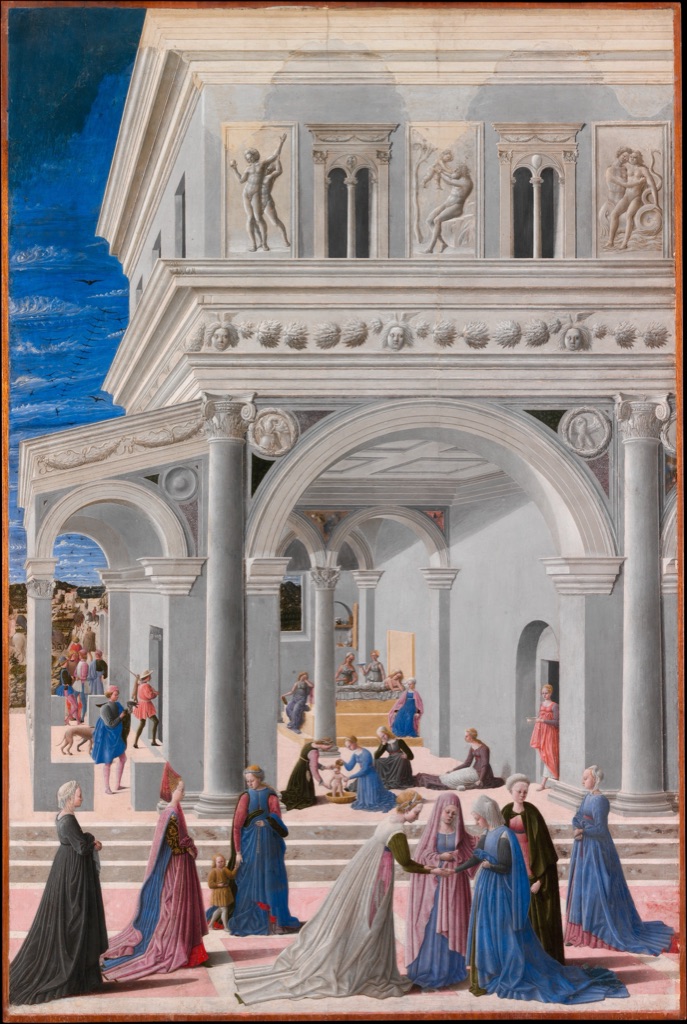
Fra Carnevale · The Birth of the Virgin · 1467 · The Metropolitan Museum of Art · Public Domain. Repeated edges, overlap and relative scale create a deep architectural interval; a close reading appears below. Source details.
At a Glance
- Actual spacephysical space that can be occupied or entered.
- Represented spacedepth and distance presented on a flat surface.
- Depth cuesoverlap, scale, convergence, contrast and detail.
- Spatial rangedeep, shallow, compressed or deliberately flat.
- Useful contrastform is volume; space is the interval around and between it.
Contents
Actual space and represented depth
Actual space can be occupied, enclosed or entered. A carved object has a physical volume and stands in the space around it; a room contains the viewer's possible position. Represented space works differently. Paint, ink or another material remains on a surface, while overlap, relative scale, converging edges or atmospheric change make some forms appear nearer and others farther away.[1][2][4]
Form is actual or represented volume; space concerns the areas, distances and depth relationships around, within and between those volumes.
Deep space suggests a substantial interval between near and far, while shallow space keeps forms closer to the picture plane. A flatter organisation withholds or subordinates many depth cues but may remain highly structured.[2]
Foreground, middle ground and background can help describe a work with clear near, middle and far zones, but not every artwork supplies all three. These are names for relationships we can see, not compartments that every composition must contain.[5]
Four questions for recognising space
When you meet an unfamiliar artwork, begin with four questions:
- What overlaps, and what appears in front of or behind what? Follow the places where one form interrupts the edge of another.
- What changes in relative scale, and are near, middle and far zones legible? Compare figures, objects or repeated architectural features rather than assuming that every small form is distant.
- Do repeated edges converge, or do colour, value, contrast and detail change with distance? Look for several cues working together rather than treating one as a formula.
- Does the work feel deep, shallow or flat—and, in Rousseau's case, cautiously compressed? What visible evidence creates that impression? Describe the relationship before giving it a label.
Use these questions flexibly when the visible evidence supports them. Linear perspective can make parallel edges appear to meet as they recede, but recognising that effect does not require reconstructing a vanishing point. Atmospheric distance may appear through paler or cooler colour, lower contrast and less detail. Those changes belong here only when they clarify spatial distance.[2][4][5]
Deep space through structure
Fra Carnevale: architecture opening into distance
Fra Carnevale's The Birth of the Virgin, 1467, is a tempera-and-oil painting on wood in the Metropolitan Museum of Art (accession 35.121).[6] The tall interior recedes through repeated arches, floor divisions and diminishing figures. Beyond the architecture at the left, a small opening extends the view into landscape.
No single cue carries the entire effect. Overlap places the gathered figures in front of the building; repeated edges establish direction; differences in scale separate the nearest people from those farther away. The structure feels deep because these relationships reinforce one another across the full panel.
Piranesi: depth that will not settle
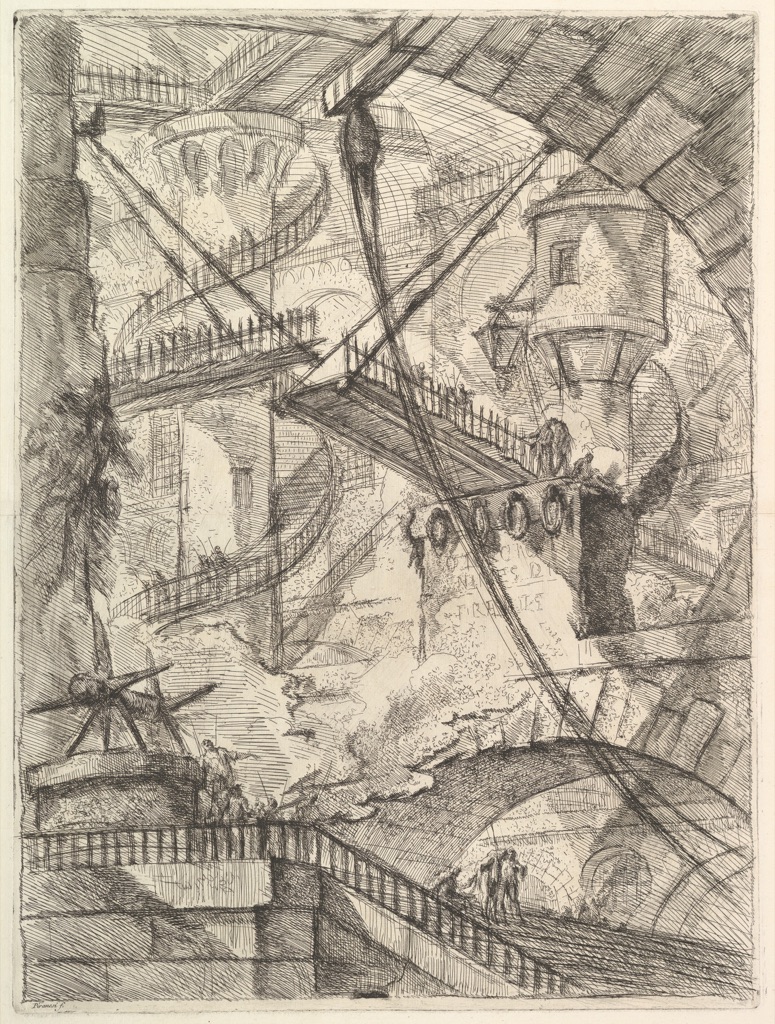
Giovanni Battista Piranesi's The Drawbridge, from Carceri d'invenzione (Imaginary Prisons), ca. 1749–50, is an etching and engraving in the Metropolitan Museum of Art (accession 37.45.3(23)).[11] Tiny figures, vast arches, stairs, bridges and suspended structures suggest an immense interior.
Yet the routes through that interior are difficult to reconcile. One platform seems to lead towards another, only for the connection to become uncertain. Scale and recession still create depth, but depth does not have to produce a stable or easily navigable world. Spatial ambiguity can be as deliberate as spatial clarity.
Shallow space and the picture surface
Rousseau: overlap without distant recession
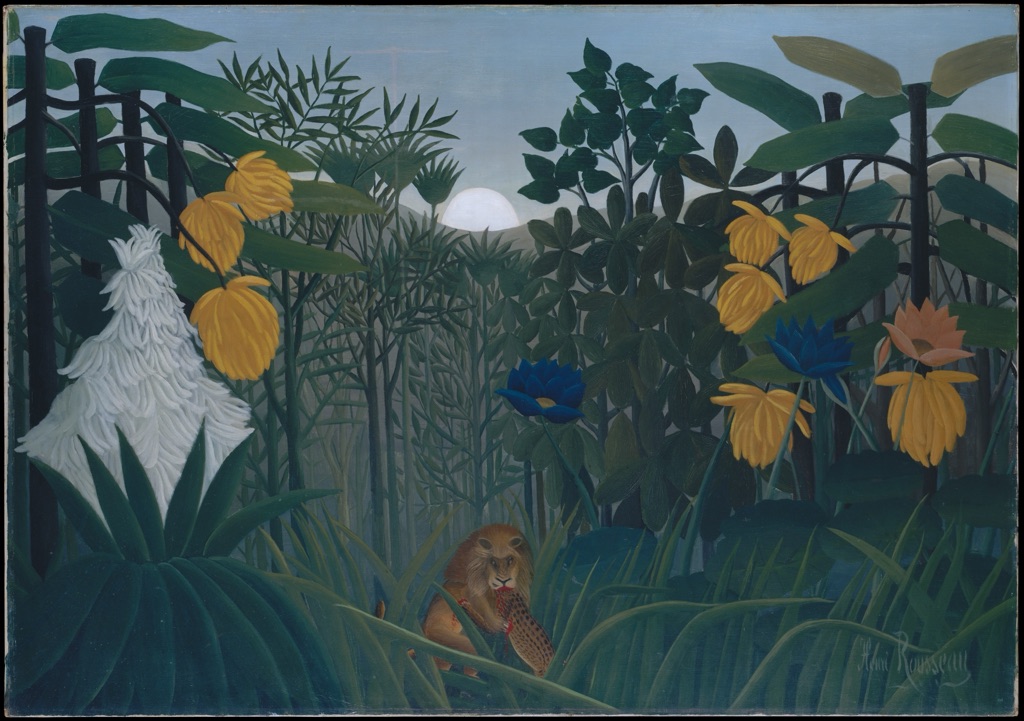
Henri Rousseau's The Repast of the Lion, ca. 1907, is an oil-on-canvas painting in the Metropolitan Museum of Art (accession 51.112.5).[8] Large leaves overlap in dense layers around a small lion. Their edges distinguish front from behind, but the crowded foliage leaves little uninterrupted distance through which the eye can travel.
The picture is not spatially weak because it stays shallow. Crowded leaves, dark openings and a narrow strip of pale sky produce a close, enclosing environment. Overlap can therefore establish order without opening a long recession.
Harnett: a small illusion close to the surface
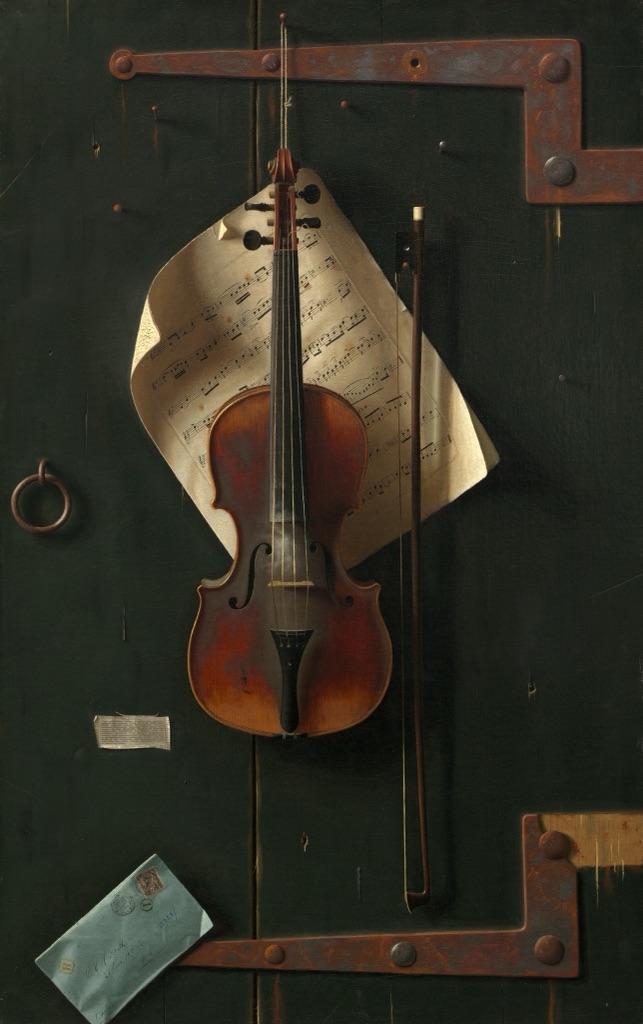
William Michael Harnett's The Old Violin, 1886, belongs to the National Gallery of Art, Washington (accession 1993.15.1), and is painted in oil on canvas.[10] A violin, bow, sheet music and envelopes appear to rest against a worn wooden door within painted metal strips.
The represented objects seem to project slightly, yet the whole effect remains close to the picture plane. Shadows, overlapping papers and curled edges build a narrow interval rather than a distant world. The work makes an illusionistic claim while reminding us that convincing space can be extremely shallow.
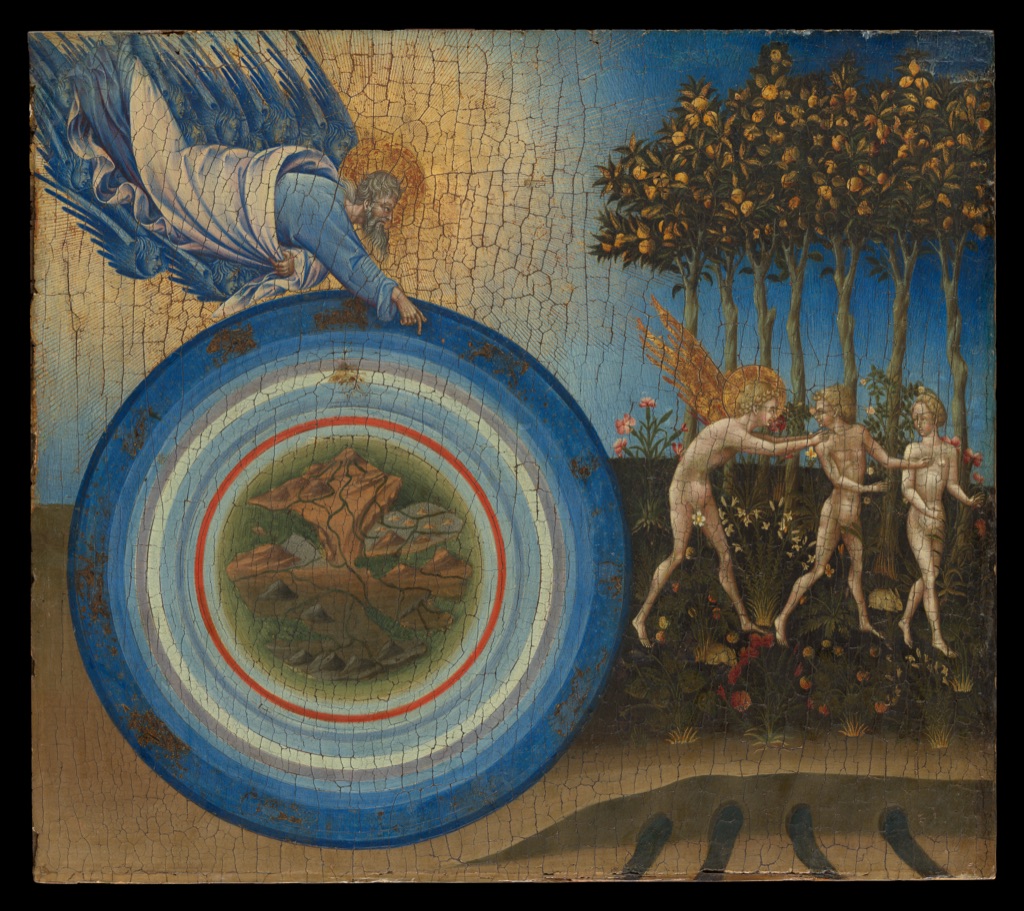
Giovanni di Paolo: several spaces on one panel
Giovanni di Paolo's The Creation of the World and the Expulsion from Paradise, 1445, is a tempera-and-gold painting on wood in the Metropolitan Museum of Art (accession 1975.1.31).[7] A circular cosmos, a gold field and the garden of Paradise share the panel without submitting to one continuous viewpoint.
The garden includes overlap and enclosed areas, while the patterned cosmic rings organise another kind of interval. Their coexistence makes the panel spatially rich without requiring a single naturalistic recession. Flatness here is not an absence of organisation; it is part of how separate realms are made visible together.
Distance through atmosphere and interval
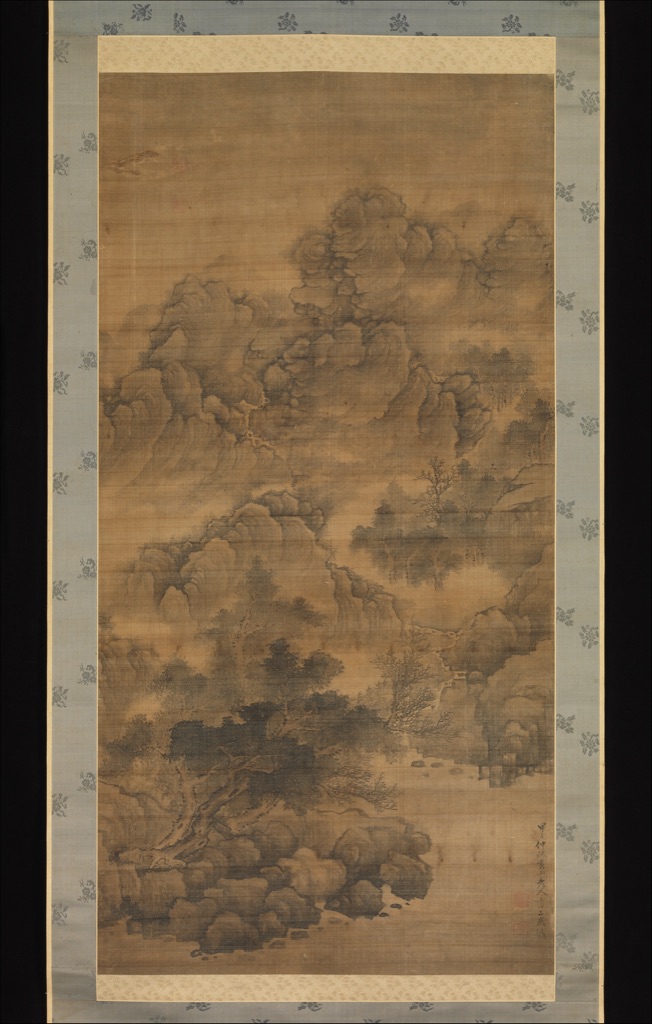
Fa Ruozhen: mountains separated by mist
Fa Ruozhen's Cloudy mountains, 1684, is a hanging scroll in ink and colour on silk in the Metropolitan Museum of Art (accession 2010.54).[12] Darker rocks and trees gather near the lower part of the tall image. Paler mountain forms rise beyond them through bands of mist and open silk.
Changes in value, contrast and detail help separate nearer from farther layers. The open intervals are not merely blank leftovers: they allow the mountain groups to remain distinct and make distance palpable without using a Western linear-perspective construction.
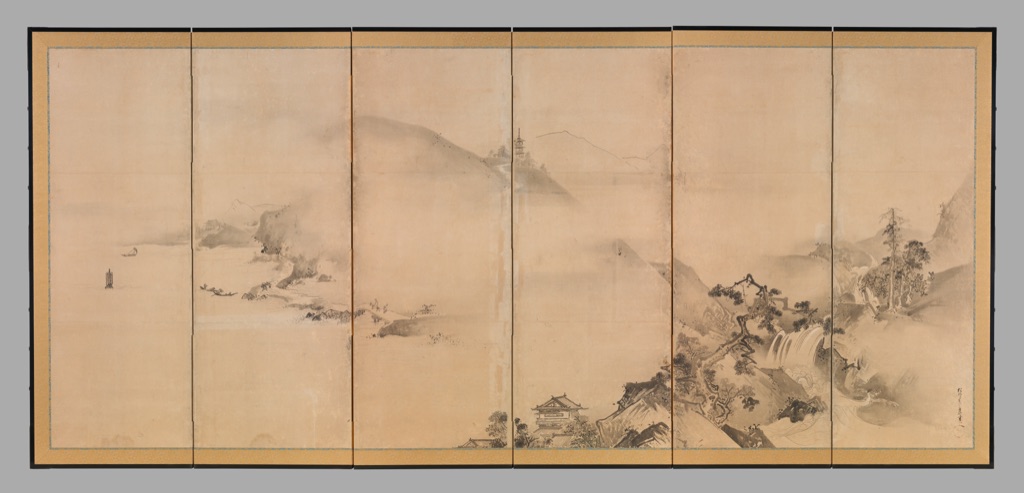
Kanō Tan'yū: depth across a pair of screens
Kanō Tan'yū's Landscapes of the Four Seasons, made in the 1630s, is a pair of six-panel screens in the Metropolitan Museum of Art (accessions 2015.300.77.1 and .2).[13] Shorelines, buildings, boats, trees and mountains extend across a very wide surface, interrupted by mist and broad pale intervals.
Some forms appear to recede, yet the folds and breadth of the paired screens remain visually important. Depth and flatness are not enemies here. The landscape can open into distance while the rhythm of clusters and intervals keeps the viewer aware of the object spread across the room.
Actual and represented space together
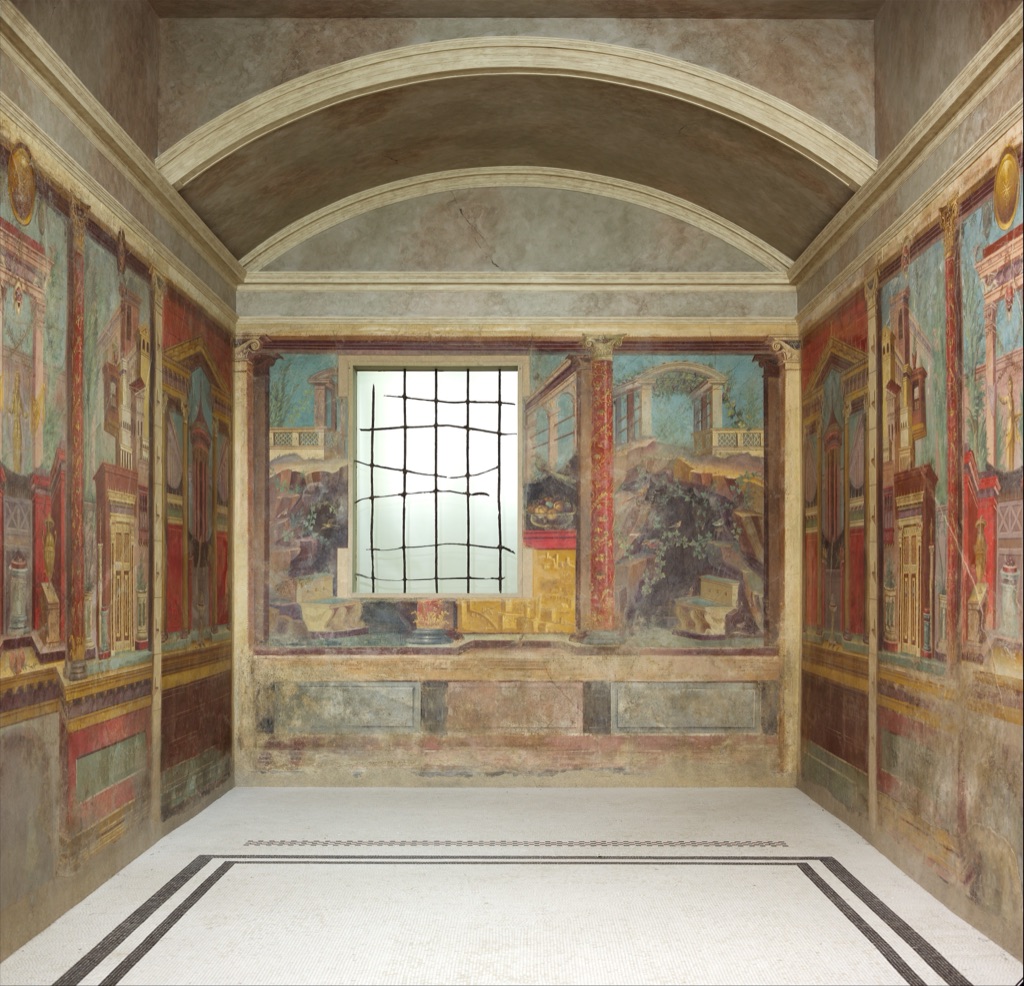
Boscoreale: a room opening beyond its walls
The Roman Cubiculum (bedroom) from the Villa of P. Fannius Synistor at Boscoreale, ca. 50–40 BCE, is a frescoed room in the Metropolitan Museum of Art (accession 03.14.13a–g); its painters are not identified in the collection record.[9] The reconstructed bedroom has a real floor, ceiling, corners and walls. Across those walls, painted columns, balconies and landscape openings appear to extend beyond the enclosure.
The complete room makes the distinction unusually direct. Actual space is the physical chamber within which a person could stand. Represented space begins where the painted architecture seems to continue through the wall. The two experiences meet at the fresco surface without becoming identical.
Space and its neighbours
Space becomes clearer when nearby concepts keep their own jobs. Form concerns actual or represented volume, while space concerns areas and distances around, within and between forms. Line can provide converging edges, and value or colour can support atmospheric distance, but each remains an element in its own right. Texture concerns actual or implied surface quality rather than depth.
Composition considers how all the parts become a realised whole; spatial intervals and depth are among the relationships that a composition may organise. Positive and Negative Space focuses more narrowly on the figure-ground relationship between occupied and unoccupied areas.
The Elements of Art introduces space within the wider family of visual elements. Form, value, composition and texture sharpen different relationships; space keeps attention on areas, distances and actual or represented depth.
Look for space yourself
Choose an artwork and begin at one edge. Find the first overlap, then compare the scale of two related forms. Notice whether the image offers clear near, middle and far zones or keeps most forms close to the surface. Look for converging edges and for changes in colour, value, contrast or detail that make distance more or less convincing.
Then ask what kind of spatial experience the work creates. Does it open gradually, stop abruptly, remain shallow, shift between several systems or keep its flat support visible? Tie the answer to something specific: an arch, a gap, a pale mountain, a cropped form or a painted opening.
The aim is not to find the most realistic depth. It is to explain how areas and distances make the work feel the way it does. Once those relationships become visible, space stops being an empty backdrop and becomes an active part of looking.
Watch: Space from Surface to Depth
Choose a focused form lesson, an overview of the elements, or a museum-led landscape analysis.
Introducing Formal Analysis: Landscape
Follow a museum-led analysis of how a landscape organises foreground, distance and atmosphere.
Watch on YouTubeFrequently Asked Questions
Space concerns areas and distances in, around and between forms, plus actual or represented depth.
Actual space can be physically occupied; represented space uses relationships on a surface to suggest depth and distance.
Overlap, relative scale, converging edges, atmospheric change, contrast and detail can work together to suggest depth.
Shallow space keeps represented forms close to the picture plane while still organizing overlaps and small intervals.
No. Artists may deliberately keep a support visible or organize several spatial systems without naturalistic recession.
Discussion
Which overlap, interval or atmospheric change most strongly affects the depth you perceive?
Reader Insights
Identify exactly which edge interrupts another and what appears nearer.
Check scale, convergence, contrast and detail rather than relying on one formula.
Describe shallow or surface-conscious organisation without treating it as failed realism.
Join the Conversation
Share one precise spatial observation or a useful museum example below.
References
- J. Paul Getty Museum, “Understanding Formal Analysis — Elements of Art”
- Khan Academy and Smarthistory, “Space”
- Honolulu Museum of Art, “Elements of Art | Space Glossary”
- The Metropolitan Museum of Art, The Art of Renaissance Europe: A Resource for Educators
- J. Paul Getty Museum, “From Foreground to Background”
- The Metropolitan Museum of Art, Fra Carnevale, The Birth of the Virgin, 1467
- The Metropolitan Museum of Art, Giovanni di Paolo, The Creation of the World and the Expulsion from Paradise, 1445
- The Metropolitan Museum of Art, Henri Rousseau, The Repast of the Lion, ca. 1907
- The Metropolitan Museum of Art, Roman, Cubiculum from the Villa of P. Fannius Synistor at Boscoreale, ca. 50–40 BCE
- National Gallery of Art, William Michael Harnett, The Old Violin, 1886
- The Metropolitan Museum of Art, Giovanni Battista Piranesi, The Drawbridge, ca. 1749–50
- The Metropolitan Museum of Art, Fa Ruozhen, Cloudy mountains, 1684
- The Metropolitan Museum of Art, Kanō Tan'yū, Landscapes of the Four Seasons, 1630s
- Quarto, Susie Hodge, Elements of Art. Publisher record.
- Phaidon, E. H. Gombrich, The Story of Art. Publisher record.