by Tom Gurney
Tom Gurney BSc (Hons) is an art history expert with over 20 years experience
Page created on September 3, 2026 / Page updated on September 13, 2026
Email: tomgurney1@gmail.com / Phone: +44 7429 011000
How Wood, Joinery and Ground Shape the Painted Object
A panel painting is a painting made on a rigid panel, most often wood. “Panel” names the support, not the binder: egg tempera, oil, wax and mixed techniques can all be applied to wood. That distinction explains why two panels may look very different while sharing problems of grain, joins, ground and environmental movement.[1][2]
Wood supported a vast proportion of European painting from the thirteenth to the early sixteenth century. It could be shaped into a small devotional image, joined into a monumental altarpiece, hinged as wings or integrated with a frame. Canvas later became dominant for many large portable paintings because it was lighter and easier to transport, but wooden panels never disappeared.
At a Glance
- Core categorypanel names a rigid support—usually wood—not a particular paint binder.
- Material systemspecies, grain, joins, sizing, ground, frame and paint work together.
- Historical usessmall devotional images, portraits, hinged wings and monumental altarpieces.
- Wood remains activehumidity changes can produce warp, split joins and stress across ground and paint.
- Read the objectedges, hinges, saw cuts, frames and reverse structures can reveal alteration and original function.
Contents
From tree to painting support
Panel makers selected available, workable timber and prepared it according to regional workshop habits. Poplar was especially common in central Italy; oak dominated much Northern European production. Linden, beech, fir, pine, walnut and fruitwoods also occur.[1][3] A medium line naming the species—“oil on oak” or “oil on linden”—therefore supplies material and geographic evidence.
Boards had to be seasoned to reduce later distortion. Large supports joined several planks, often with glue and reinforcing elements. The grain direction, thickness and cut affected movement. Frames might be carved from the same board, attached around it or built as part of a complex altarpiece. Hinges allowed diptychs and triptychs to open and close, changing which images were visible.[4]
Before painting, workshops normally sealed the wood with animal glue and applied a smooth white ground, often gesso in Italy or chalk-based preparation farther north. Fabric could bridge joins and vulnerable areas. Drawing, incising and gilding followed before or alongside paint. The luminous ground reflected light through thin colour and kept pigment from sinking directly into timber.
This preparation was specialised work. A panel could pass through the hands of timber merchants, joiners, carvers, gilders, painters and frame makers, while workshop assistants repeated the many coats and polishing stages. In Italian practice, gold areas could receive a reddish clay layer called bole before the leaf was laid and burnished. Stamped or incised ornament then made haloes and borders catch light differently from the painted passages.[14] The apparently simple phrase “tempera on wood” can therefore conceal a composite object made from timber, glue, textile, mineral ground, metal leaf, pigment and varnish.
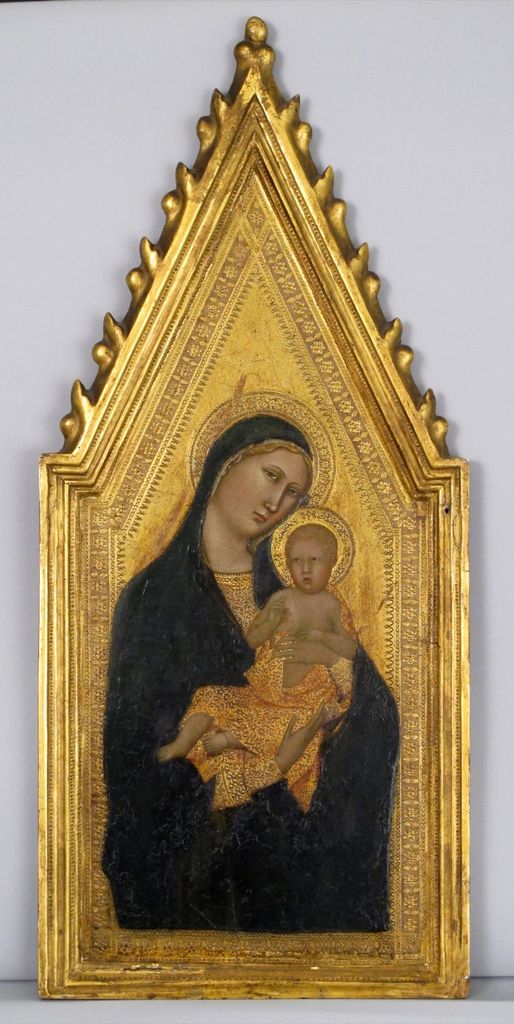
Original frames were structural as well as decorative. Early Italian examples might have mouldings engaged with the panel; larger altarpieces joined multiple boards to framing elements that helped hold the ensemble together. Later independent frames changed how painted panels could be made and remounted.[15] This history matters when an old panel now appears in a modern rectangle: trimming or reframing may have removed cusps, pinnacles or adjoining scenes that once controlled its meaning.
Eight panel paintings to look at
Madonna and Child
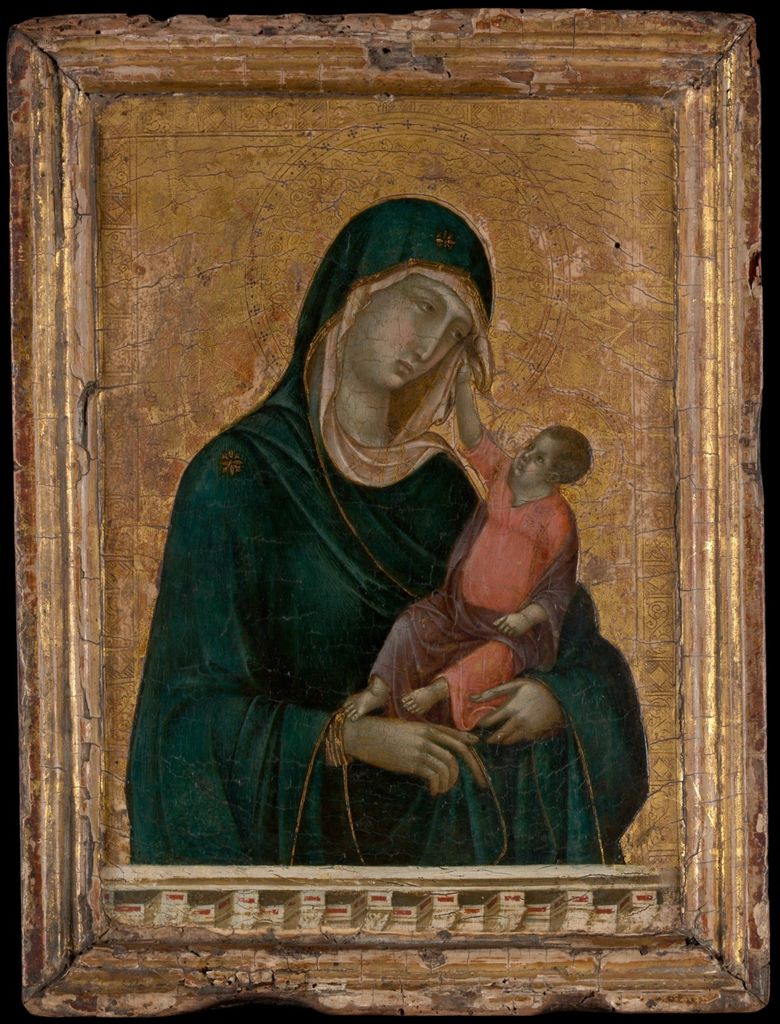
Duccio's Madonna and Child, about 1290–1300, is tempera and gold on wood.[5] Its engaged frame, pointed top and intimate scale belong to private devotion. Mary meets the viewer while the Child reaches toward her veil, combining solemn presentation with tactile affection.
The support provides a firm base for burnished and tooled gold. Along the parapet, illusionistic stone seems to occupy space in front of the figures, while the gold field resists ordinary depth. A small panel can therefore stage several kinds of surface at once.
Annunciation Triptych (Merode Altarpiece)
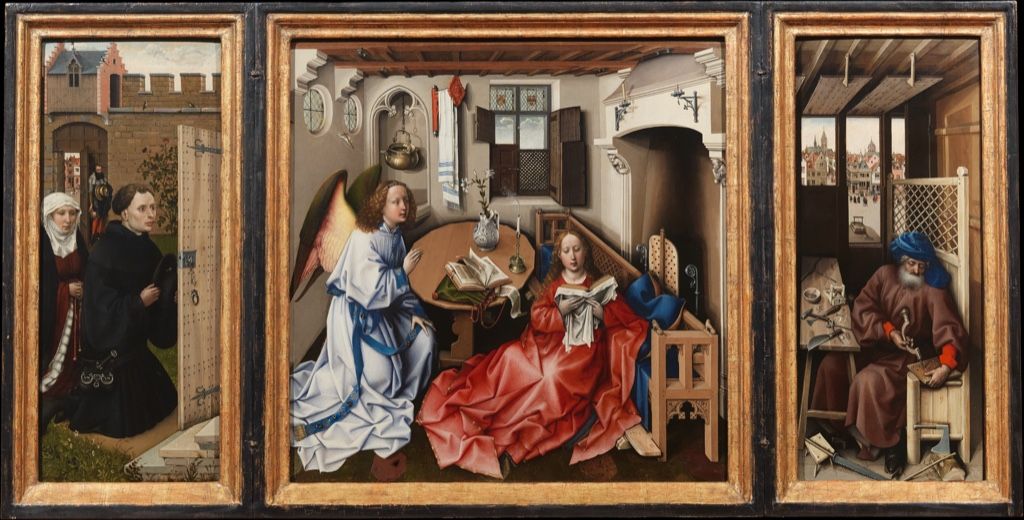
Robert Campin's workshop painted the Merode Altarpiece about 1427–32 in oil on oak.[6] The central Annunciation is flanked by donor figures and Joseph at work. Hinged wings make the object both image and furnishing: it can be opened, closed and placed in a domestic devotional setting.
Oak panels support extraordinarily fine oil detail, from reflected light on metal to tools, textiles and the tiny city beyond the window. The triptych format also controls reading. Physical joints divide sacred event, patrons and workshop while hinges unite them.
Salvator Mundi
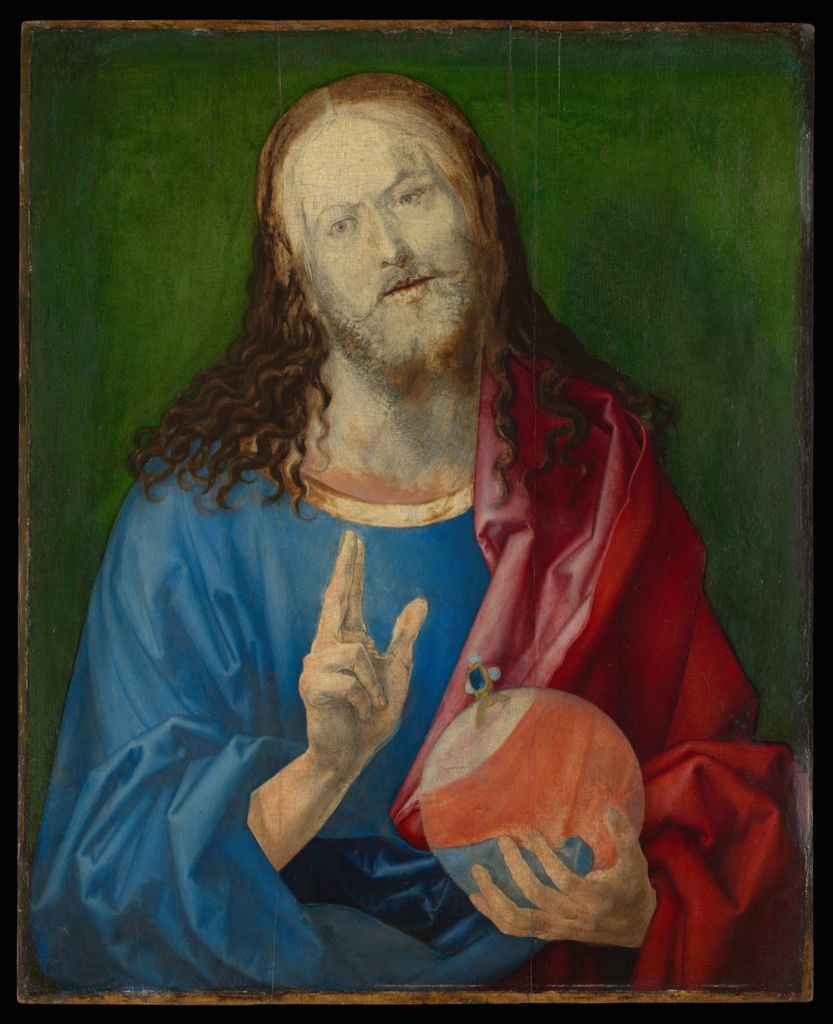
Albrecht Dürer's unfinished Salvator Mundi, about 1505, is oil on linden.[7] Finished passages in the face and patterned drapery meet areas where underdrawing and preparation remain exposed. That incompleteness makes the panel unusually informative.
Viewers can follow stages rather than see only a polished surface. The stable, smooth linden support carries drawn contours, tonal preparation and meticulous oil layers. Panel painting was a sequence of crafts, not paint placed directly on bare wood.
Madonna and Child Enthroned with Saints
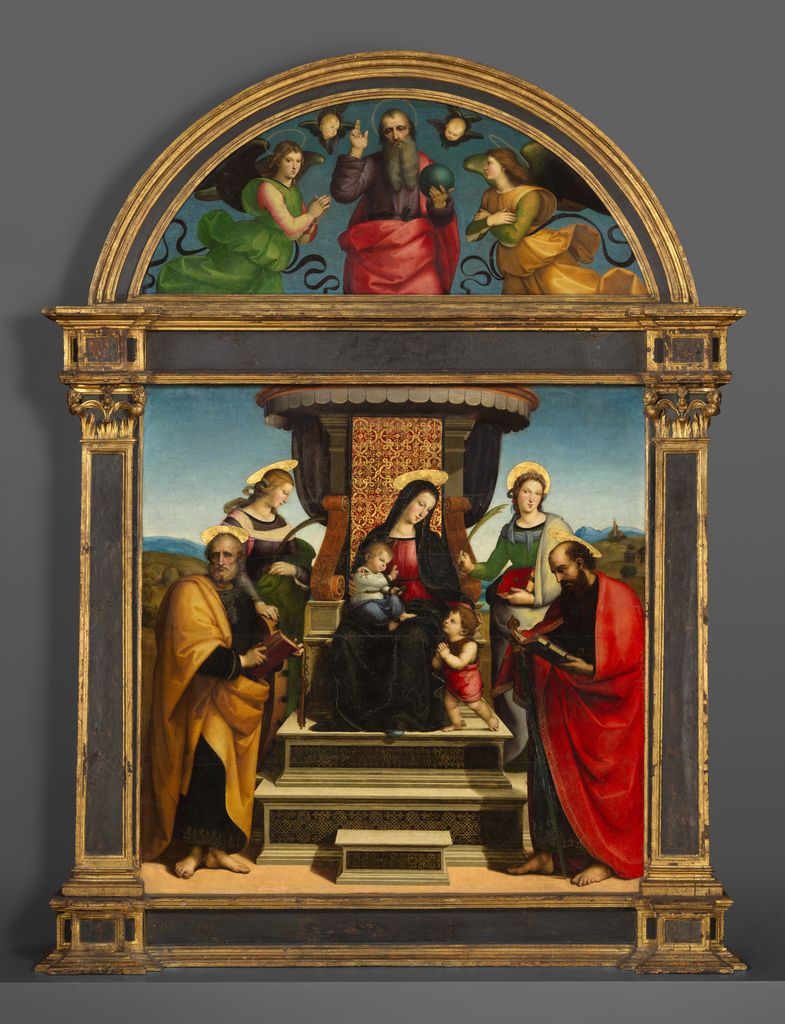
Raphael's altarpiece of about 1504 combines oil and gold on wood.[8] The enthroned Virgin and Child occupy a carefully ordered architectural space with saints and music-making angels. Separate components once formed a larger ensemble with a frame and additional scenes.
Its history reminds us that museum panels are often fragments of structures. Sawing, dispersal and reframing can alter scale relationships even when the painted face survives. Reconstructing an altarpiece requires attending to edges, joins and original placement.
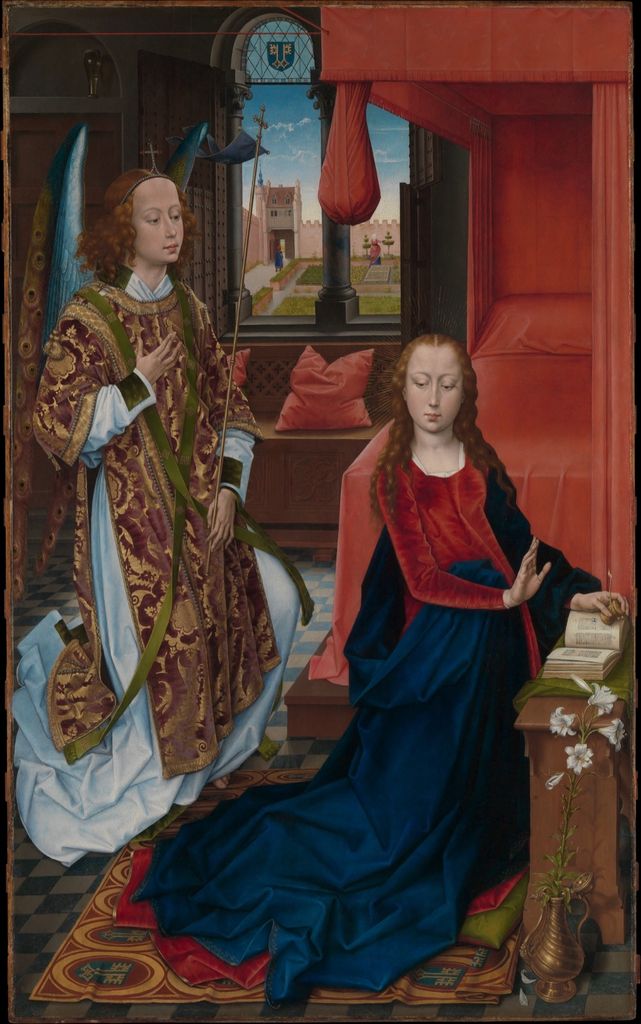
The Annunciation by Hans Memling
Hans Memling's Annunciation, about 1465–70, uses oil on wood to transform a domestic interior with sacred light.[9] Fabrics, vessels and architecture are described through thin, controlled layers. The angel's approach and Mary's movement are held within a shallow room.
Northern oak-panel practice suited oil's capacity for saturated glazes and minute highlights. Yet the support itself is not visually neutral: its rigid plane helps preserve precise geometry and a smooth ground beneath the illusion.
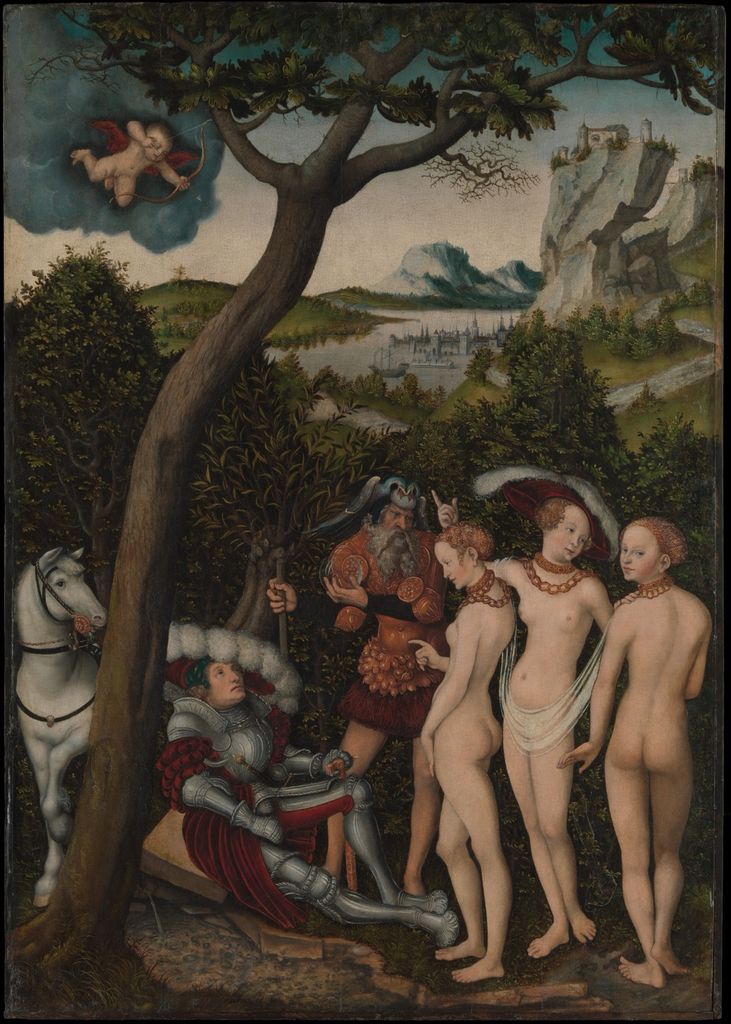
The Judgment of Paris
Lucas Cranach the Elder painted The Judgment of Paris about 1528 in oil on beech.[10] Three goddesses stand before Paris in a dense landscape while Mercury presents the choice. Slender bodies, jewellery and foliage combine linear clarity with translucent oil colour.
Beech is less frequently named than oak or poplar, which makes the specific record valuable. Wood species can connect an object to local availability and workshop practice, though it should not be used alone to assign an artist or region.
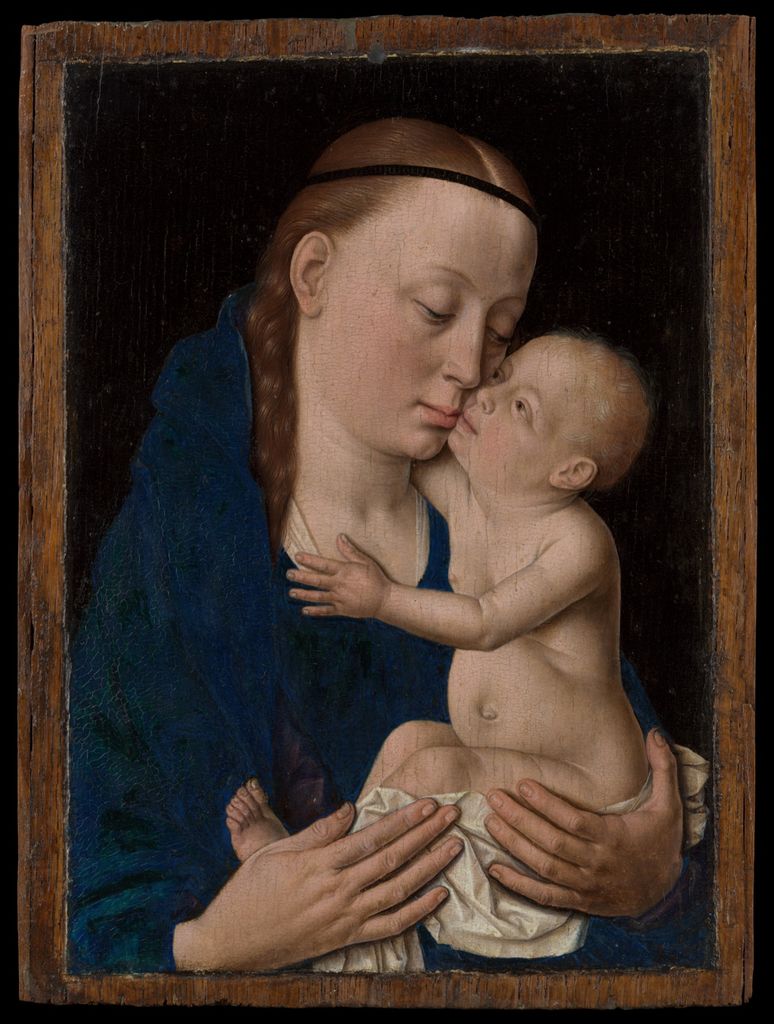
Virgin and Child
Dieric Bouts's Virgin and Child, about 1455–60, is oil on wood.[11] Mother and child appear behind a stone ledge before a cloth of honour. Tiny changes in flesh, pearl, hair and fabric build a concentrated devotional presence.
The panel's portability differs from a fixed fresco, but it still had a designed setting and scale. Its smooth preparation supports oil layers that make surfaces distinct without sacrificing the firmness of contour.
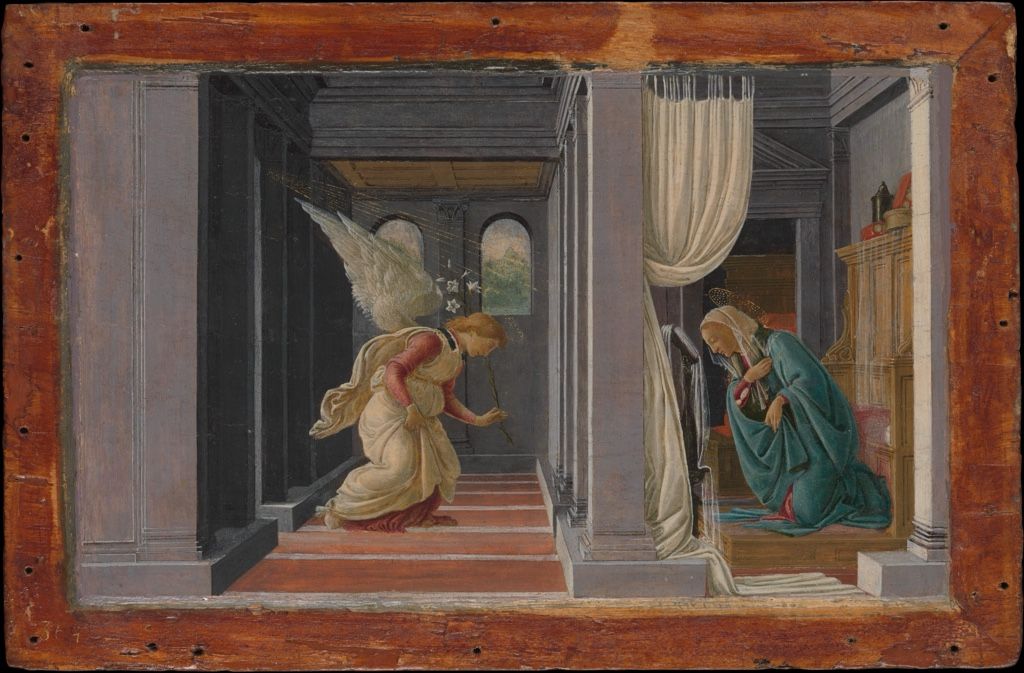
The Annunciation by Botticelli
Botticelli's Annunciation, about 1490, is tempera and gold on wood.[12] Gabriel kneels in a spare interior while Mary turns sharply, her gesture carrying the scene's emotional tension. Perspective lines lead through a doorway toward a distant landscape.
Here panel does not imply oil. Tempera's clear layers and contours work with a prepared wooden ground, while gold heightens divine light. Comparing this work with Memling's oil Annunciation separates support from binder and reveals different solutions to a shared subject.
Altarpieces, portraits and portable images
Wood's rigidity made it suitable for structures that were painted, gilded, carved and hinged. Medieval and Renaissance altarpieces could combine a central image, side wings, pinnacles, predella scenes and sculpture. Opening or closing them responded to liturgical calendars and protected inner faces. When museums separate those elements, catalogue reconstruction becomes essential.
Smaller panels served private devotion and portraiture. Their hard surface supported exact drawing and precious finish, while frames made them durable social objects. Artists also painted domestic furnishings such as birth trays, chests and shutters. “Panel painting” therefore crosses modern categories of fine art and decorated object.
Canvas gained ground in sixteenth-century Europe, especially where large works needed to be rolled or shipped. It responds differently to pressure and humidity, and its weave may remain visible. Copper panels offered another rigid support with an exceptionally smooth surface.[1] None of these supports dictates one style; they create different working and conservation conditions.
Format also carries evidence of use. A portrait-sized rectangle may have hung in a residence, while a pointed crest can preserve the outline of an architectural frame. Painted reverses indicate that wings or shutters were meant to be seen in more than one state. Cut edges, planed backs and isolated fragments may instead record later collecting. Questions about panel shape are therefore historical questions: who handled the object, where it stood, when it opened, and what surrounding parts once completed its visual argument. Even a plainly recorded “wood” support can yield information through tool marks and construction.
What technical examination can reveal
Conservators do not need to prise a panel apart to study it. X-radiography can show joins, dowels, nails and denser paint passages; infrared examination may clarify carbon-based underdrawing beneath the colour. Microscopy and tiny samples can identify layer sequences. On suitable oak boards, dendrochronology compares patterns of annual rings with established regional chronologies. It can indicate the earliest plausible period in which the tree was felled, but it does not by itself give the painting's date, and the National Gallery cautions that the method is not dependable for erratically growing poplar.[14]
Technical evidence works best in combination. Wood species may suggest a regional habit; tool marks may indicate manufacture; an underdrawing may reveal a workshop design; labels and seals on the reverse may document later ownership. None is a definitive signature. Together, however, they can test whether separated panels once belonged to one structure or whether a supposed date is materially possible.
Wood movement and conservation
Wood takes up and releases moisture as relative humidity changes. It moves more across the grain than along it, so a panel may cup, split or open along joins. Paint and ground are less flexible than the support beneath them; repeated movement can produce lifting and loss. Insects, old nails and weakened glue add further risks.[3]
Historic restorers sometimes thinned panels or added rigid cradles intended to force them flat. Such systems could restrain natural movement and cause new damage. Current structural conservation tends to respect an existing curvature and use flexible, minimally invasive supports where intervention is necessary. Stable display conditions and protective backboards can slow rapid environmental change.[3][13]
The reverse may reveal tool marks, labels, joins, crossbars and evidence of alteration. It is not merely the invisible back of the art. Conservators read both faces to understand construction and decide whether a crack needs treatment or is a stable part of the object's history.
Respecting movement is the governing principle. A perfectly flat panel is not always a healthy one: forcing aged boards into plane can transfer stress to joins, ground and paint. The goal is usually stability and safe movement, not restoration of an imagined factory-new geometry. This is why backing systems, frames and gallery climate form part of the conservation treatment even when visitors never see them.
Artists associated with panel painting
Albrecht Dürer, Raphael and Sandro Botticelli appear among the eight examples above, but their binders and regional practices differ. Jan van Eyck is indispensable to the history of Northern oil painting on oak, particularly for the way hinged polyptychs could coordinate public ceremony, donor identity and close naturalistic detail. Duccio represents an earlier Italian relationship among tempera, gold and a shaped devotional support.
These associations should be read materially, not as a list of “panel specialists.” Artists often worked across supports, and later collectors transferred some paintings from wood to canvas or altered their formats. The catalogue medium line for the individual object remains more reliable than a general assumption about an artist.
Panel compared with tempera, oil and fresco
Panel is a support category; tempera and oil are binder categories. A single wooden altarpiece can include egg tempera, drying oil, metal leaf and resinous coatings. Fresco, by contrast, is tied to plaster and architecture. The Art Mediums hub keeps those levels separate.
When looking at a panel, begin with format. Is it one board or several? Can you see hinges, an engaged frame or a shaped top? Read the medium line for wood species and binder. Then inspect how ground, gilding and paint exploit the firm plane. Finally, remember that movement continues: a centuries-old panel is still wood, responding slowly to its environment.
Watch: Wooden Supports and Panel-Painting Conservation
Use three conservation-led films to compare wooden support structure, repair decisions and treatment limits.
Conservation of Panel Painting Wooden Supports
See why wood movement, construction and previous interventions matter to panel paintings.
Watch on YouTubeFrequently Asked Questions
Panel painting is painting made on a rigid panel, most often wood; the term identifies support rather than binder.
Yes. Wood panels can carry egg tempera, oil, wax, metal leaf and mixed layer systems.
Prepared wood offered a firm, smooth surface suitable for detail, gilding, portable devotion, portraits and complex hinged altarpieces.
Wood responds to humidity and construction stress, so boards, joins, ground and paint can move at different rates.
Read the complete medium label, inspect format and edges, and consider wood species, joins, frame, original function and later alteration.
Discussion
Which panel on this page reveals its original object function most clearly through hinges, shape, framing or surviving edges?
Reader Insights
Panel identifies what carries the paint, not whether the image is oil or tempera.
Reverse, edge, join and frame can preserve decisive evidence.
Conservation aims for stability, not forcing old wood into an imagined perfect plane.
Join the Conversation
Share one precise observation or a useful museum example below.
References
- National Gallery, London, “Panel painting.” https://www.nationalgallery.org.uk/paintings/glossary/panel-painting
- National Gallery, London, “Supports.” https://www.nationalgallery.org.uk/paintings/glossary/supports
- Getty Conservation Institute, The Structural Conservation of Panel Paintings. https://www.getty.edu/conservation/publications_resources/pdf_publications/panelpaintings.html
- National Gallery, London, “Side panels and wings.” https://www.nationalgallery.org.uk/paintings/glossary/side-panels-and-wings
- Metropolitan Museum of Art, “Madonna and Child.” https://www.metmuseum.org/art/collection/search/438754
- Metropolitan Museum of Art, “Annunciation Triptych (Merode Altarpiece).” https://www.metmuseum.org/art/collection/search/470304
- Metropolitan Museum of Art, “Salvator Mundi.” https://www.metmuseum.org/art/collection/search/436243
- Metropolitan Museum of Art, “Madonna and Child Enthroned with Saints.” https://www.metmuseum.org/art/collection/search/437372
- Metropolitan Museum of Art, “The Annunciation.” https://www.metmuseum.org/art/collection/search/437490
- Metropolitan Museum of Art, “The Judgment of Paris.” https://www.metmuseum.org/art/collection/search/436037
- Metropolitan Museum of Art, “Virgin and Child.” https://www.metmuseum.org/art/collection/search/435762
- Metropolitan Museum of Art, “The Annunciation.” https://www.metmuseum.org/art/collection/search/459016
- Getty, “Panel Paintings Initiative.” https://www.getty.edu/projects/panel-paintings-initiative/
- National Gallery, London, “Dendrochronology.” https://www.nationalgallery.org.uk/paintings/glossary/dendrochronology
- Metropolitan Museum of Art, “Italian Renaissance Frames.” https://www.metmuseum.org/essays/italian-renaissance-frames