by Tom Gurney
Tom Gurney BSc (Hons) is an art history expert with over 20 years experience
Email: tomgurney1@gmail.com / Phone: +44 7429 011000
Explore art through ideas, materials and ways of looking
Art becomes easier to explore when you have more than one way into it. You might begin with something visible—a sharp line, a patch of colour, a rough surface—or with the way a picture holds together. You might instead follow a subject such as trees, horses or sunsets, discover the artists linked to a movement, or look for ideas that lead back to your own drawing.
This Topics section brings those paths into one place. Its foundations explain the visual building blocks of art, the principles that organise them and the role of composition in bringing a work together. Alongside them, a selection of established guides lets you browse artists, paintings and drawings by subject or approach. Museum collections use similarly varied routes into art, grouping material by themes as well as movements, techniques and media.[1][2]
There is no single route that suits every viewer. Start with the question that brought you here, then move between concepts and examples as your eye catches new details.
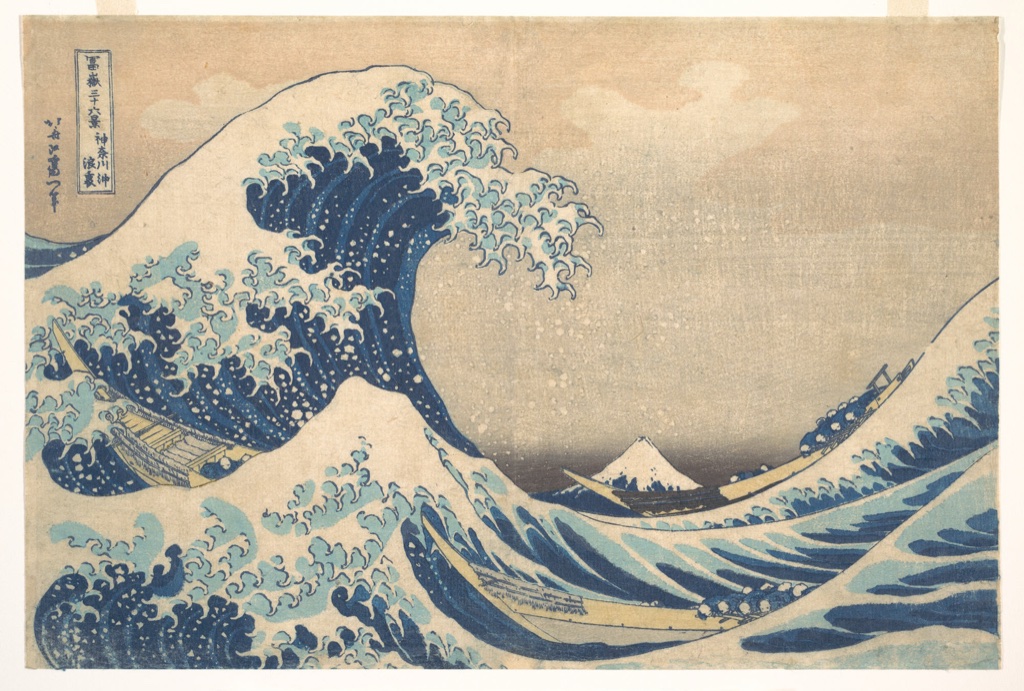
Katsushika Hokusai · Under the Wave off Kanagawa · ca. 1830–32 · The Metropolitan Museum of Art · Public Domain. Its lines, repeated shapes, contrasts and spatial scale demonstrate how several art topics can meet in one work. Source details.
At a Glance
- Begin withelements for words describing what you see.
- Then askhow principles organise those visual parts.
- Whole imagecomposition explains arrangement and visual hierarchy.
- How it was madefollow media, materials and techniques.
- How to interpretuse formal analysis and iconography.
Contents
Start with the foundations
Elements of Art
The elements of art are the visual resources from which an artwork is made and understood. Line can carry the eye across a page; shape can enclose an area; colour and value can separate light from dark; texture can be physical or suggested; form and space can give a flat image a sense of volume and depth. Museum teaching resources encourage viewers to identify such elements and compare the different ways artists use them.[3]
Begin here when you want a vocabulary for what you can actually see.
The 7 Elements of ArtPrinciples of Art
The principles of art describe ways those visual elements can be organised. Repetition may establish pattern or rhythm. Contrast can make a difference vivid, while emphasis draws attention to a particular area. Balance, proportion, movement, unity and variety concern the relationships among parts of the work. The Getty summarises the distinction neatly: principles describe ways artists use the elements of art.[4]
Begin here when you want to understand why your attention moves, settles or returns.
The Principles of ArtComposition in Art
Composition is the arrangement you encounter as a whole: where forms sit, how spaces open or close, what appears dominant and how one passage leads into another. Elements name much of what is present; principles help describe the relationships among those parts; composition lets you consider the overall result. Formal analysis brings these kinds of observation together when examining the structure of a work.[5]
Begin here when you want to see how an entire artwork has been put together.
Composition in ArtArt Media
Follow the materials and supports that shape how artworks are made and how their surfaces look, from wax and wet plaster to oil, watercolor and gouache.
Art MediumsArt Materials
Understand supports, surface preparation, paint components and tools through a technical, non-commercial reference system.
Art Materials GuidePrintmaking Techniques
See how relief, intaglio, lithography, screenprinting and monotype move ink from a matrix to paper, with process diagrams and exact print examples.
Printmaking GuideArt and Painting Techniques
Recognise historical painting techniques through exact artworks, from sfumato and glazing to impasto, dry brush and scumbling.
Painting Techniques GuidePainting Genres
Understand subject-based painting genres through clear boundaries, historical development and exact famous examples.
Painting Genres GuidePerspective in Art
Understand how artists organise depth and viewpoint through linear, aerial, foreshortened and deliberately alternative spatial systems.
Perspective in Art GuideIconography and Symbols in Art
Read subjects, attributes and symbols through exact artworks while keeping meanings tied to culture, period and evidence.
Iconography GuideArt Comparisons
Choose among focused comparisons of movements, styles and painting media, with clear links to established subject guides.
Art Comparisons GuideTypes of Sculpture
Classify sculpture by space, process, format, representation and the viewer’s relationship to exact works.
Sculpture GuideArt Criticism
Learn how to criticise art through close looking, visual evidence, context, interpretation and a supported judgement, with a complete Manet example.
Art Criticism GuideFormal Analysis of Art
Learn formal analysis through a clear visual-evidence method, thesis and paragraph structure, plus a complete worked example using Rembrandt's Night Watch.
Formal Analysis of Art GuideBrowse the art fundamentals
These guides are grouped so that you can move from a broad foundation to one specific visual question. The names below form the complete Topics directory.
Elements of Art
Principles of Art
Bringing the parts together
Four artworks, many ways of looking
The same artwork can reveal several concepts at once. These four works show why the Topics directory is a network rather than a set of sealed definitions.
Hokusai: line, pattern, movement and space
In Katsushika Hokusai's Under the Wave off Kanagawa (Kanagawa oki nami ura), also known as The Great Wave, from the series Thirty-six Views of Mount Fuji (Fugaku sanjūrokkei), ca. 1830–32, the wave rises through a sequence of strong curves before breaking into repeated, claw-like tips. Boats press along the lower diagonals while Mount Fuji appears small and still on the horizon. Line creates movement, repeated shapes create pattern, and dramatic differences of scale make the space feel both deep and precarious. The woodblock print is held by The Metropolitan Museum of Art.[6]
Katsushika Hokusai · Under the Wave off Kanagawa · ca. 1830–32 · The Metropolitan Museum of Art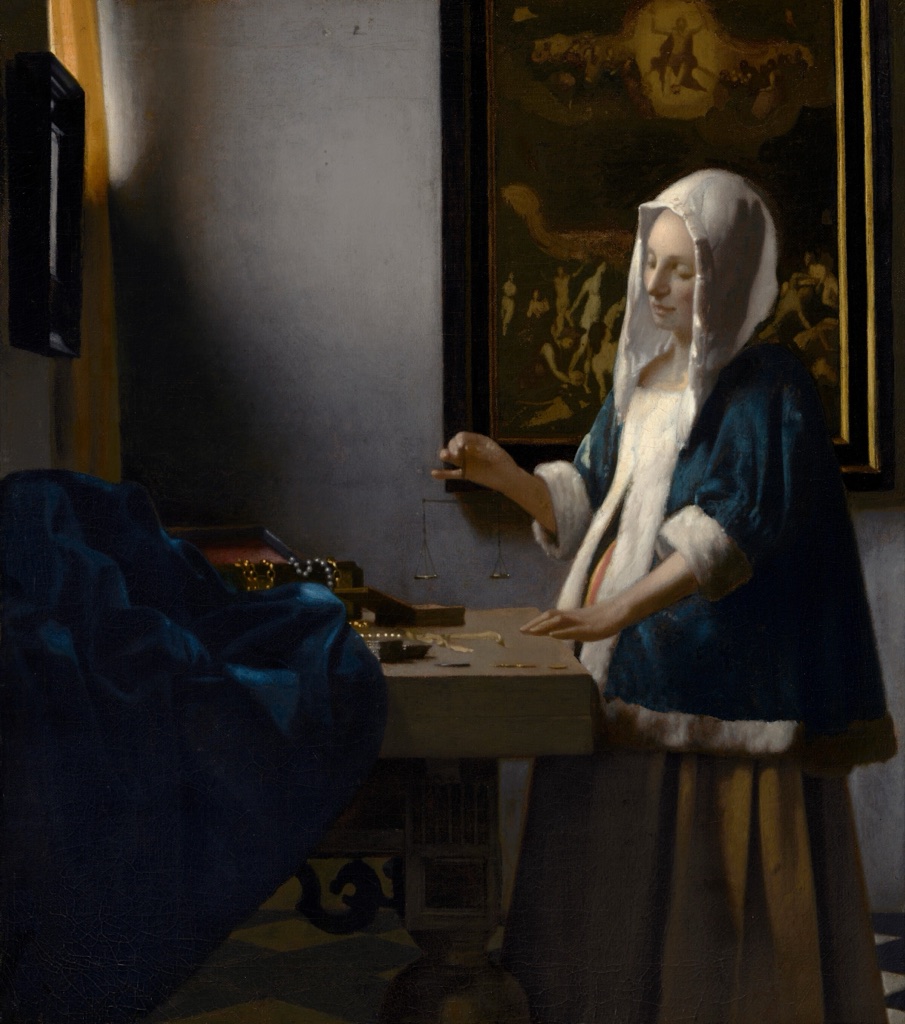
Vermeer: balance, emphasis, value and space
Johannes Vermeer's Woman Holding a Balance, c. 1664, is quiet but carefully weighted. The standing woman occupies the brighter right half of the room, while the window, curtain and table build a darker structure on the left. Her small balance hangs against a relatively bare section of wall, making it easier to notice. Light picks out her face, hands and fur trim before fading into shadow around them. The arrangement gives visual balance a richer meaning than simple mirror symmetry. The painting belongs to the National Gallery of Art, Washington.[7]
Johannes Vermeer · Woman Holding a Balance · c. 1664 · National Gallery of Art, Washington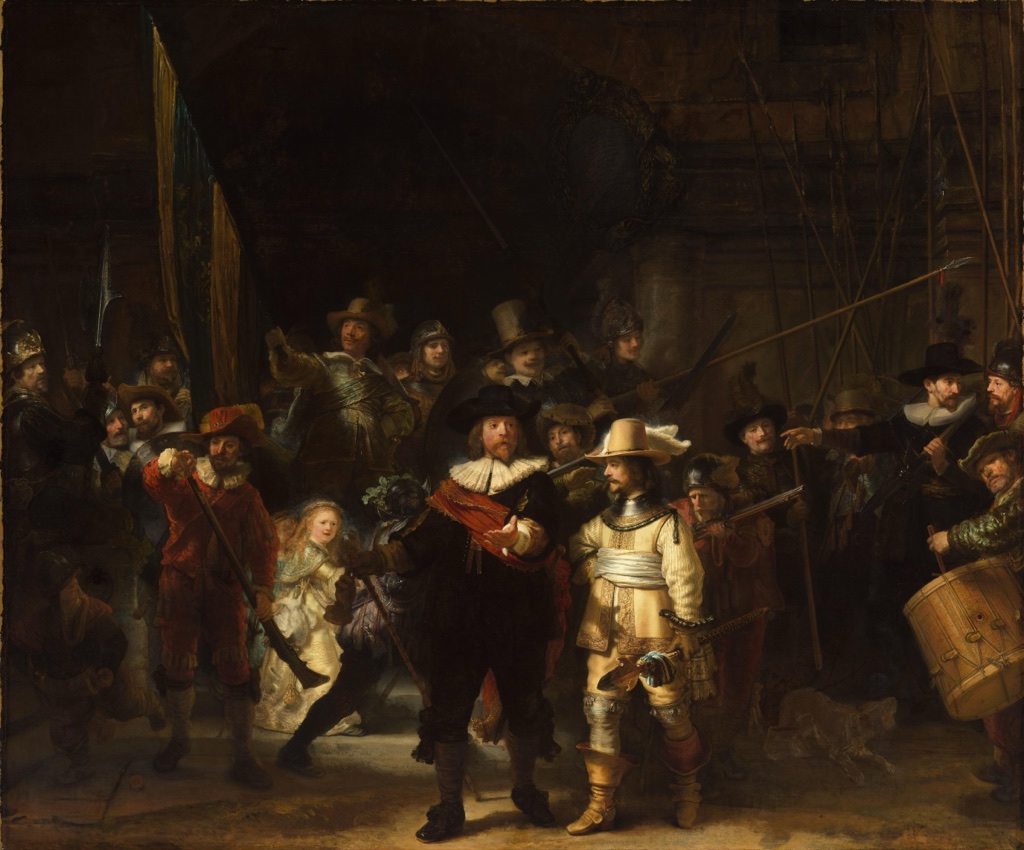
Rembrandt: composition, movement, contrast and emphasis
Rembrandt van Rijn's The Night Watch Militia Company of District II under the Command of Captain Frans Banninck Cocq, 1642, turns a large group portrait into an event. Diagonal weapons, overlapping bodies and uneven intervals keep the company from settling into a static row. Strong light selects the captain, lieutenant and young girl from the surrounding darkness, establishing emphasis within a crowded field. The eye moves out from these bright figures and back through faces, banners, lances and the drum at the edge. The painting is in the Rijksmuseum.[8]
Rembrandt van Rijn · The Night Watch · 1642 · Rijksmuseum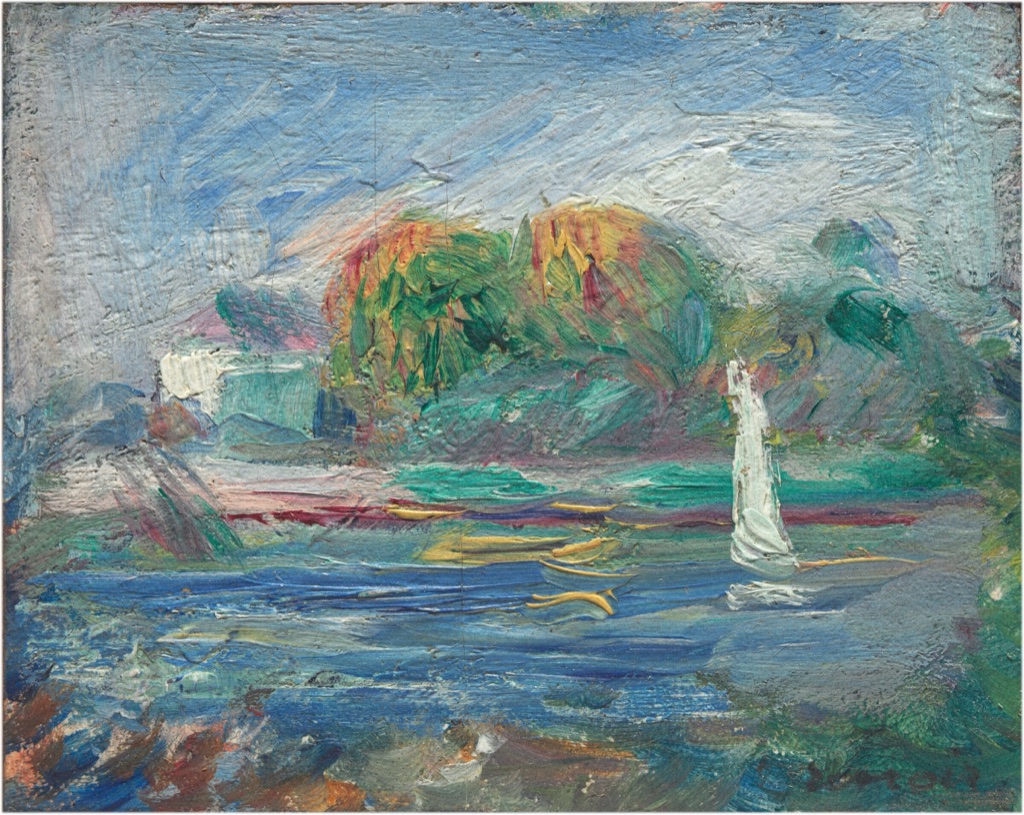
Renoir: colour, texture, form and rhythm
In Auguste Renoir's The Blue River, c. 1890/1900, blue water, green vegetation and a pale sky are built from loose, layered strokes. The paint varies from dragged passages to thicker ridges, so texture remains visible even in reproduction. Repeated horizontal touches carry the eye across the river, while clustered greens and warm accents give weight to the bank. Colour and brushwork do not merely fill outlined objects; together they suggest the landscape's forms and visual rhythm. The painting is held by the National Gallery of Art, Washington.[9]
Auguste Renoir · The Blue River · c. 1890/1900 · National Gallery of Art, WashingtonPopular Art Topics
Foundational concepts are only one way to browse art history. The guides below follow established subjects, artists and practical interests. They keep their existing homes within the Artists, Paintings and Drawings sections.
Artists and movements
- Art Movements and Schools — compare the major movements and the artists associated with them.
- Line Artists — meet artists whose work makes especially expressive or inventive use of line.
- Art Quotes by Artists — browse artists' words about art, work and creative life.
- Sunset Artists — see how painters across periods have approached changing light and sky.
Subjects in painting
- Horse Paintings — follow a subject that moves through portraiture, battle painting, sport and landscape.
- Tree Paintings — explore trees as natural forms, symbols and structures within the landscape.
Drawing and making
- Cool Drawings — browse a wide visual collection of drawing subjects and styles.
- Drawing Ideas — find subjects to sketch when you want a practical starting point.
- Line Drawings — look at finished examples built around outline and linear detail.
- How to Draw — begin with tools, observation, shape, perspective, light and shade.
Watch: Three Ways into Art
Choose a formal analysis of landscape, a close look at still life, or a broad introduction to the National Gallery of Art.
Introducing Formal Analysis: Landscape
Use line, colour, space, composition and context to look closely at a landscape.
Watch on YouTubeChoose a path
If you want words for what you see, begin with The 7 Elements of Art. If you are asking how those parts interact, choose The Principles of Art. If your attention is on the placement and effect of the whole image, start with Composition in Art.
For a route led by people, periods or ideas, open one of the artist guides. For a familiar subject seen across different works, try the painting guides. If you want to look and make at the same time, the drawing section offers the most practical entry.
Whichever path you choose, return to the artworks themselves. A concept becomes useful when it helps you notice something precise: a line that changes direction, a light area that holds attention, a repeated shape, an unexpected gap or a colour that alters the balance of everything around it.
Frequently Asked Questions
The section covers elements and principles of art, composition, colour, materials, media, painting techniques, genres, iconography, sculpture, perspective, printmaking, comparison and formal analysis.
Elements name visible resources such as line, shape, colour, value, texture, form and space. Principles describe relationships among those resources, including balance, contrast, emphasis, rhythm, unity and variety.
Begin with the elements of art for a vocabulary of what you can see, then use the principles and composition guides to understand how those parts interact across a whole artwork.
A medium is the material or material system used to make an artwork, such as oil, fresco or charcoal. A technique is a way of handling materials, such as glazing, impasto or stippling.
No. Each guide works independently, and the directory and related links let readers move between a visual question, material, technique, subject or method of analysis.
Discussion
Which route into art helps you notice the most: visual elements, composition, materials, subject or historical context?
Reader Insights
Begin with one observable line, shape, colour, value or texture before interpreting it.
Ask how repetition, contrast, balance or emphasis turns separate details into an arrangement.
Use reliable collection records to distinguish visual inference from material or historical fact.
Join the Conversation
Share the guide, artwork or observation that opened a useful path for you.
References
- The Museum of Modern Art, “Art terms”
- Art UK, “Discover Artworks”
- National Gallery of Art, “The Elements of Art”
- J. Paul Getty Museum, “Understanding Formal Analysis: Principles of Design”
- J. Paul Getty Museum, “Understanding Formal Analysis”
- The Metropolitan Museum of Art, Katsushika Hokusai, Under the Wave off Kanagawa, ca. 1830–32
- National Gallery of Art, Johannes Vermeer, Woman Holding a Balance, c. 1664
- Rijksmuseum, Rembrandt van Rijn, The Night Watch, 1642
- National Gallery of Art, Auguste Renoir, The Blue River, c. 1890/1900
- Phaidon, E. H. Gombrich, The Story of Art. Publisher record.
- Phaidon Editors, The Art Book. Publisher record.
- Getty Museum, “Introducing Formal Analysis: Landscape.” Watch on YouTube.
- Getty Museum, “Introducing Formal Analysis: Still Life.” Watch on YouTube.
- National Gallery of Art, “The National Gallery of Art brings works of art to you.” Watch on YouTube.