by Tom Gurney
Tom Gurney BSc (Hons) is an art history expert with over 20 years experience
Page created on September 3, 2026 / Page updated on September 13, 2026
Email: tomgurney1@gmail.com / Phone: +44 7429 011000
How Fast-Drying Colour, Fine Strokes and Gold Build a Luminous Surface
Tempera painting uses coloured pigment held in a water-miscible binder. In present-day museum and studio language, “tempera” most often means egg tempera: pigment mixed with egg yolk and usually diluted with water. Historically, however, the term is wider. Whole egg, egg white, animal glue, gums and emulsions containing oil can all appear in tempera traditions, so an object label or technical analysis matters more than a rule learned from one recipe.[1][2]
Egg yolk forms a quick-drying, durable film. That behaviour shapes the look of many medieval and early Renaissance paintings: colour is commonly built with thin applications and many small strokes instead of being blended wet for a long time. Tempera can produce brilliant colour, sharp contours, minute patterns and softly modelled flesh, but none of those effects happens by itself. Painters designed their supports, grounds, drawings, gilding and brushwork as a connected system.[3]
At a Glance
- Core mediumpigment is mixed with a water-miscible binder; egg yolk is the best-known historical form.
- Working methodrapid setting favours thin layers, hatched modelling and carefully planned edges.
- Support systemprepared wood, gesso, drawing, gilding and paint often function as one material sequence.
- Historical cautiontempera names a broad binder family, and individual works may combine egg, oil, glue, gum or resin.
- Close lookingcompare tiny strokes, incised gold, contour, surface sheen and the relationship between painted and gilded passages.
Contents
What tempera is made from
Pigment supplies colour and the binder holds its particles together. Egg yolk is both watery and fatty, making it a natural emulsion. Mixed with ground pigment and a little water, it can be brushed in a fluid film that sets rapidly as water leaves and the binder changes. The mixture is normally prepared in small amounts because it does not remain conveniently open on the palette like slow-drying oil paint.[2]
The word “tempera” should not be treated as a chemical guarantee. Getty's vocabulary describes a family of emulsions, and technical examination has found mixtures of egg, oil and resin in historical paintings.[2] Egg white, or glair, also had uses in manuscript illumination and gilding. Modern commercial products sold as tempera may have quite different binders, particularly school paints. “Egg tempera” is therefore the precise phrase when egg yolk is known or intended.
Support, ground and working method
Many celebrated Italian tempera paintings were made on seasoned wooden panels. Workshops joined and braced boards, covered them with fabric where needed, then applied repeated layers of animal glue and a white mineral ground. In Italy this was commonly gypsum-based gesso. The polished ground offered a bright, smooth surface for drawing, gilding and very fine paint handling.[4]
Gold leaf could be laid over a reddish clay bole, burnished and tooled before or alongside painting. The design was transferred or drawn on the ground; incised boundaries helped organise haloes, architecture and patterned fields. Tempera colour was then built in controlled stages. Because fresh strokes set quickly and are difficult to merge into one continuous wet passage, painters modelled forms with overlapping hatch-like touches, translucent layers and carefully placed highlights.[3][4]
Rapid setting is not simply a limitation. It keeps one mark from endlessly disturbing another and can make intricate edges unusually stable. A viewer standing back sees a coherent face or robe; close inspection reveals a woven construction of strokes. The method rewards planning, but the eight works below show that it can support tenderness, drama, spatial experiment and crowded narrative rather than one fixed “medieval” style.
Eight tempera paintings to look at
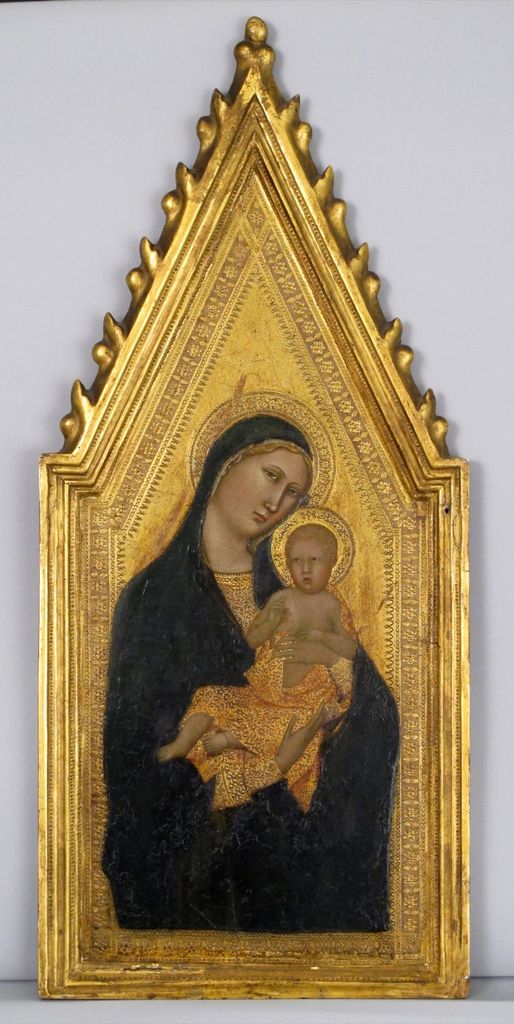
Madonna and Child
Lippo Memmi's Madonna and Child, made about 1340, joins tempera on wood to a gold ground.[5] The narrow panel was designed for devotion. Mary's dark mantle forms a strong enclosing shape, while the Child turns and reaches within it. Incised and punched decoration animates the gold without confusing it with painted space.
Look closely at the transitions in the faces. Small light strokes build volume over underlying colour, while sharper lines define eyes, brows and fingers. Tempera's disciplined layering allows flesh to remain delicate beside the hard optical brilliance of metal leaf.
Saint Andrew
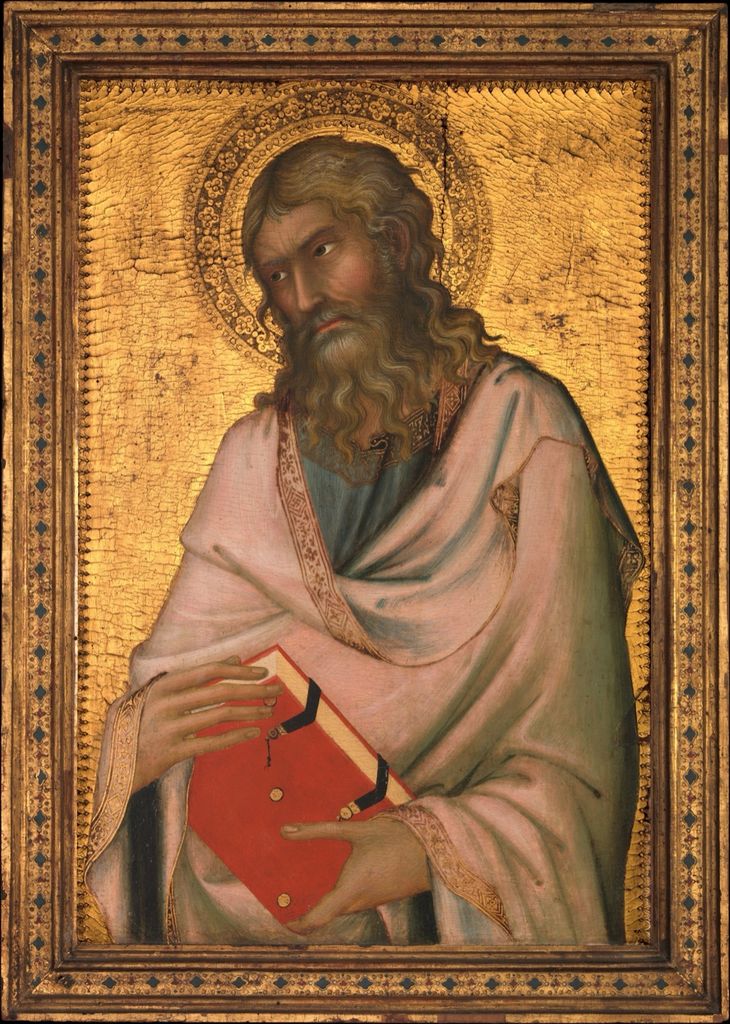
Simone Martini's Saint Andrew, about 1326, was once part of a larger altarpiece.[6] The saint's book and distinctive cross identify him, but the painting's force comes equally from line. Hair, beard, fingers and drapery are articulated with economical changes of direction.
The gold ground is not an empty background. Its reflective field separates the figure from ordinary time and space, while punched ornament gives the halo a material presence. Painted modelling and worked metal leaf perform different tasks within one panel system.
The Creation of the World and the Expulsion from Paradise
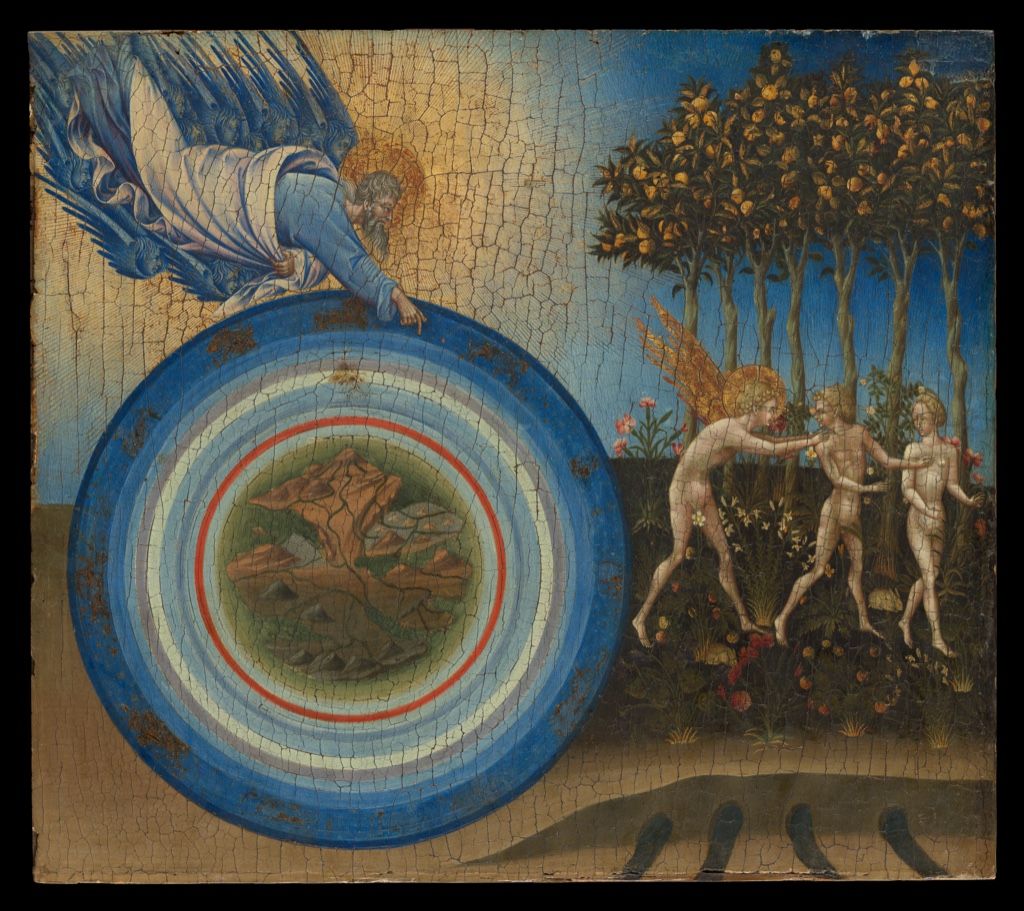
Giovanni di Paolo's 1445 panel compresses cosmic creation and human expulsion into a startling image.[7] A radiant circular universe occupies the left side; at right, an angel drives Adam and Eve from a flowering paradise. Tempera and gold create distinct visual registers for diagram, landscape and story.
Fine patterning makes the cosmos read as an ordered structure, while sharp contours carry the figures' urgent movement. The work shows why tempera should not be equated with stillness. Precisely bounded colour can produce an exceptionally dynamic contrast.
Portrait of a Woman with a Man at a Casement
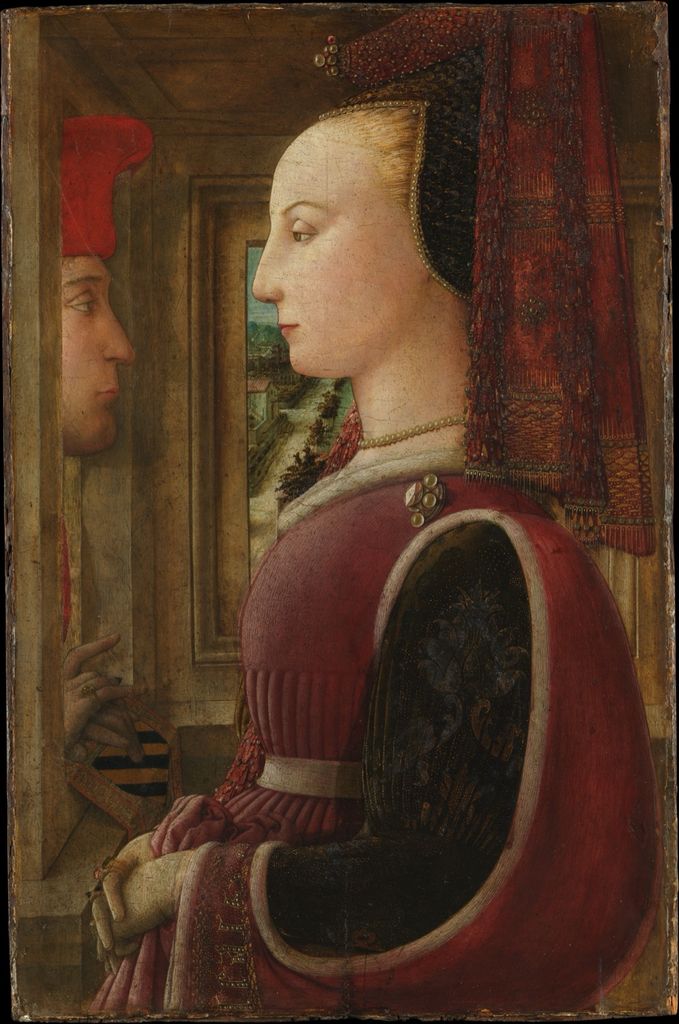
Fra Filippo Lippi's portrait, about 1440, is among the earliest surviving Italian independent double portraits.[8] A woman appears in profile before a domestic interior while a man looks through a window-like opening. Architecture, costume and heraldic details turn the compact panel into a statement about marriage, lineage and status.
The woman's profile is held by an exact contour, yet her flesh is not flat. Closely spaced light strokes and tonal layers round the forehead, cheek and neck. The crisp descriptive power of tempera serves fabric, jewellery and architecture without preventing quiet psychological tension.
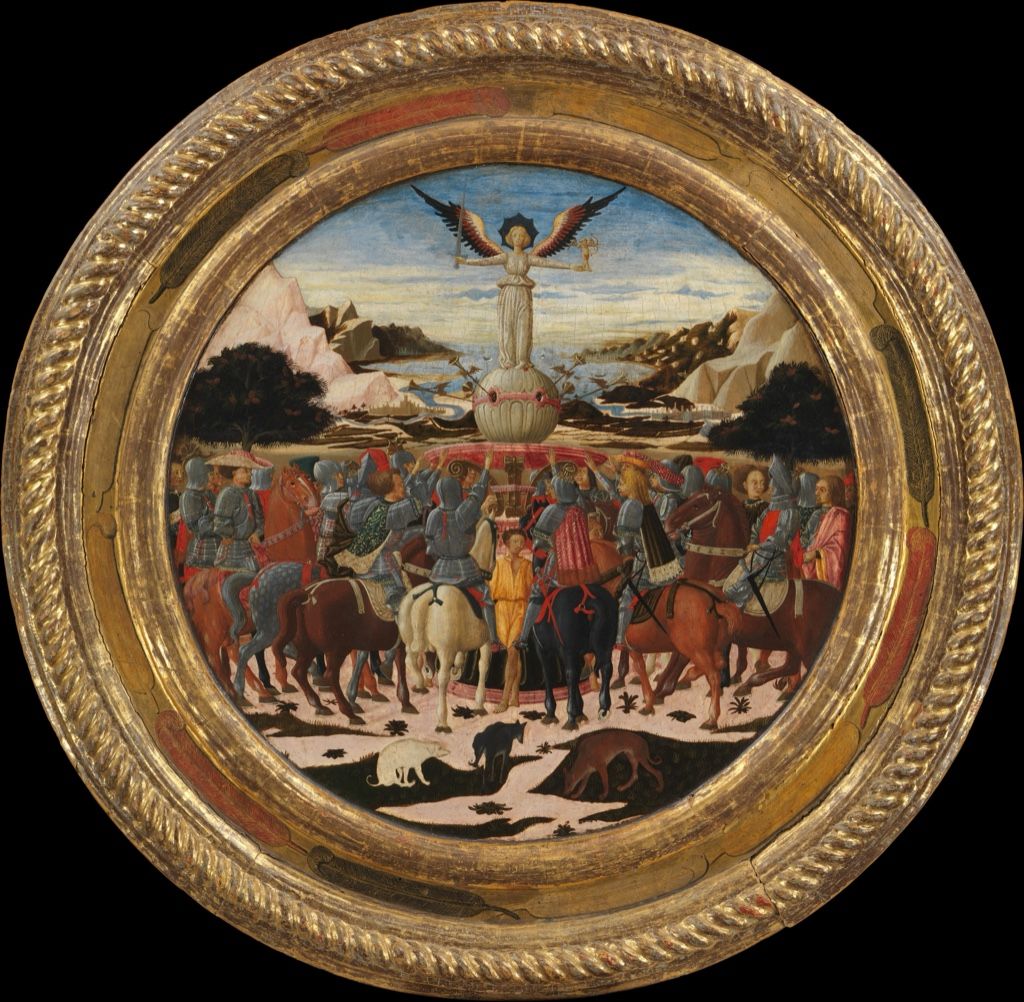
The Triumph of Fame
The Triumph of Fame, painted about 1449 by Giovanni di ser Giovanni Guidi, called Scheggia, is a decorated birth tray.[9] Such trays celebrated childbirth and could become commemorative display objects. On the front, Fame rises above a dense procession; family emblems occupy the reverse.
Tempera, silver and gold make the circular support gleam, but its imagery is also highly organised. Repeated horses, figures and lances move around the centre in measured bands. The paint's quick-setting precision supports both miniature incident and a legible ceremonial pattern.
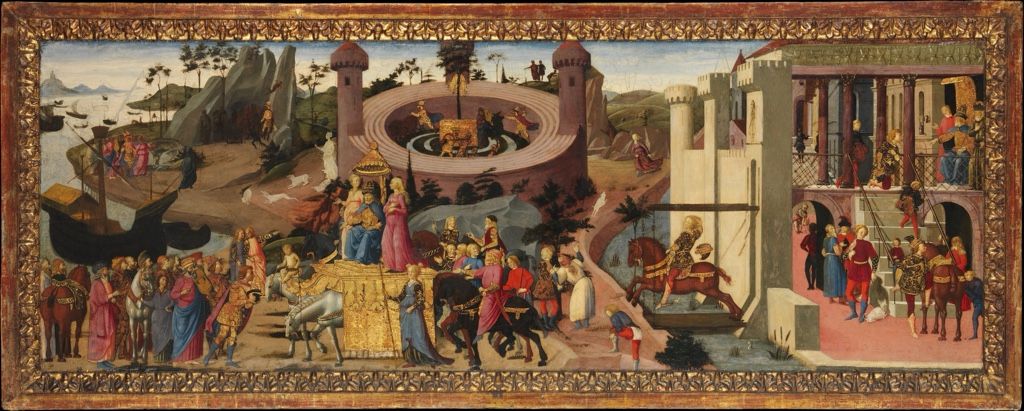
Scenes from the Story of the Argonauts
Biagio d'Antonio's long late-fifteenth-century panel presents multiple episodes from the Argonaut story in one continuous landscape.[10] Figures recur as time advances across architecture, shore and sea. The viewer reads the painting by tracing actions rather than by locating one instantaneous event.
Tempera helps keep small ships, crowds, buildings and gestures distinct. Gilt ornaments heighten selected details. Instead of treating precision as merely decorative, notice how it makes narrative navigation possible: clear forms allow several places and moments to coexist.
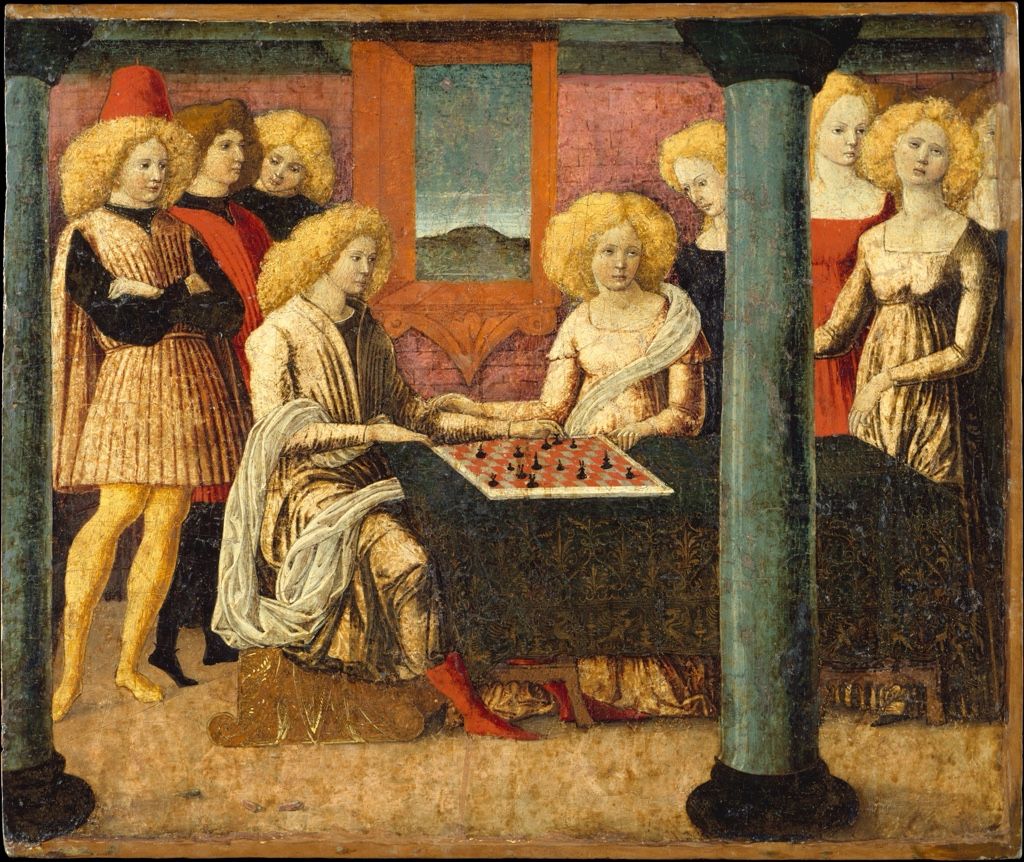
The Chess Players
Liberale da Verona's The Chess Players, about 1475, shows three fashionably dressed figures gathered at a chessboard.[11] The subject has been associated with courtly love as well as play. Hands, glances and the geometry of the board create a compact exchange whose outcome remains open.
The surface demonstrates tempera's aptitude for textiles and accessories. Fine lines specify fur, hair and patterned clothing, while measured tonal strokes model the faces. Material exactness becomes part of the social story, distinguishing dress and gesture within a small panel.
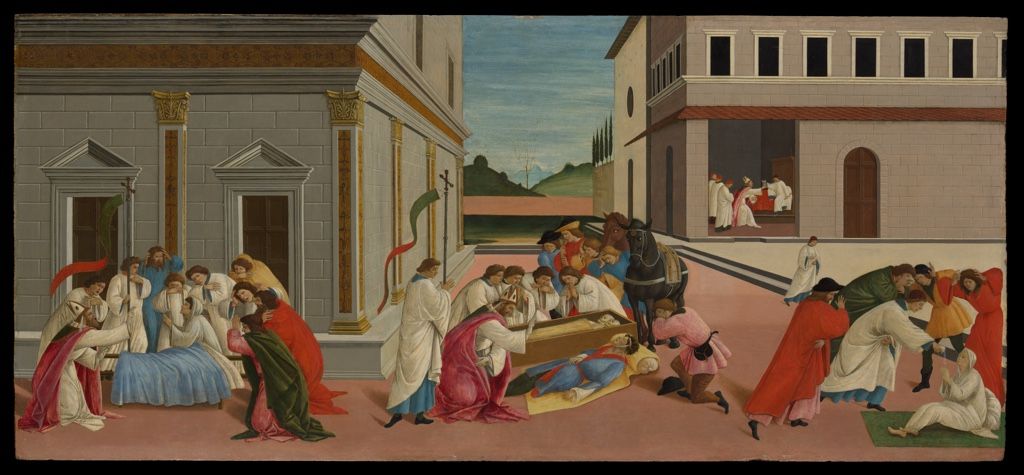
Three Miracles of Saint Zenobius
Botticelli's Three Miracles of Saint Zenobius, painted about 1500, unfolds separate episodes across a unified Florentine street.[12] Repeated appearances of the saint carry the narrative from left to right. Architecture stabilises the sequence while urgent groups, diagonals and areas of open pavement vary its pace.
By this date oil painting was well established, yet Botticelli used tempera to coordinate many figures and vivid local colours. The panel warns against describing 1500 as a clean boundary after which tempera vanished. Artists chose and combined media according to workshop practice and desired effect.
Tempera, oil and the Renaissance transition
Oil painting did not suddenly “invent realism” and replace an incapable older paint. Drying oils had long histories, and fifteenth-century painters understood practical and optical differences between binders. Oil generally stays workable longer, supports wet blending and deep translucent glazes, and can produce a saturated, enamel-like depth. Egg tempera dries rapidly to a relatively light film and encourages thin, discrete strokes.[13]
Those contrasts opened choices rather than enforcing camps. Italian painters combined tempera and oil, modified egg media, or used different binders in different passages. Northern oil techniques influenced southern workshops, while established panel preparation and design practices persisted. A museum label reading “tempera and oil” records this productive overlap.
Tempera also survived beyond the Renaissance and was deliberately revived. Nineteenth- and twentieth-century artists valued its matte clarity and association with early painting. Modern practitioners include painters as different as Andrew Wyeth and Jacob Lawrence, although individual works and commercial paints require exact technical evidence. A modern surface called tempera may contain manufactured additives rather than a simple yolk-and-pigment mixture.[14]
Tempera compared with fresco and gouache
Fresco is defined by plaster: in buon fresco, pigment carried in water is applied to fresh lime plaster and becomes part of the wall surface as it sets. Tempera uses a separate binder and can be painted on a dry, prepared panel. The two can coexist in wall painting, where tempera-like secco additions sit over dried plaster, but they remain materially distinct.
Gouache is also water-miscible and usually matte, but it is commonly a gum-bound, opaque watercolour rather than an egg emulsion. Both media can favour decisive layers and can be re-described loosely in older records, so appearance alone is inadequate. The Art Mediums hub keeps binder, support and technique separate and makes the comparison explicit.
How to look at a tempera painting
Start with the museum's medium line, then move from whole design to small marks. Is the support wood, paper or wall? Does a white ground brighten the colour? Where does gold leaf replace painted illusion? In flesh and drapery, look for parallel or crossing strokes that build a gradual transition without prolonged wet blending. At edges, notice how a firm contour can organise complex pattern.
Do not assume every matte painting is tempera or every smooth panel uses egg. Varnish, later restoration, mixed binders and ageing can alter appearance. Scientific analysis may identify proteins, lipids or layered combinations that the eye cannot separate. The responsible description is object-specific: tempera is a broad historical family, egg tempera is its best-known branch, and technique is visible most clearly when material evidence and close looking agree.
Watch: Egg Tempera, Colour Making and Underpainting
Choose National Gallery comparisons and demonstrations or a museum introduction to egg-tempera underpainting.
How Is Egg Tempera Paint Made?
See pigment and egg binder prepared as a usable tempera paint.
Watch on YouTubeFrequently Asked Questions
Tempera uses pigment in a water-miscible binder; in museum and studio usage, egg tempera commonly means pigment bound with egg yolk.
Its rapid setting encourages thin applications, small strokes and planned layering rather than prolonged wet blending.
No. Historical tempera can include whole egg, egg white, glue, gums and emulsions containing oil, so object-specific evidence matters.
Many historical Italian works use carefully prepared wood panels with glue and gesso, although tempera can occur on other supports.
No. Oil offered different handling and optical possibilities, but tempera continued, was combined with other binders and was later deliberately revived.
Discussion
Which work on this page makes the contrast between minute painted strokes and worked gold most visible?
Reader Insights
Tempera is a binder family, not one universal recipe.
Small strokes and a white ground can build luminosity without wet blending.
Incision, punching and metal leaf contribute effects the binder alone cannot explain.
Join the Conversation
Share one precise observation or a useful museum example below.
References
- National Gallery, London, “Tempera.” https://www.nationalgallery.org.uk/paintings/glossary/tempera
- Getty Research Institute, Art & Architecture Thesaurus, “tempera.” https://www.getty.edu/vow/AATFullDisplay?subjectid=300015062
- Metropolitan Museum of Art, “The Metropolitan Museum of Art Bulletin, v. 25, no. 4.” https://resources.metmuseum.org/resources/metpublications/pdf/The_Metropolitan_Museum_of_Art_Bulletin_v_25_no_4_December_1966.pdf
- Metropolitan Museum of Art, Medieval Art: A Resource for Educators. https://resources.metmuseum.org/resources/metpublications/pdf/Medieval_Art_A_Resource_for_Educators.pdf
- Metropolitan Museum of Art, “Madonna and Child.” https://www.metmuseum.org/art/collection/search/459134
- Metropolitan Museum of Art, “Saint Andrew.” https://www.metmuseum.org/art/collection/search/437675
- Metropolitan Museum of Art, “The Creation of the World and the Expulsion from Paradise.” https://www.metmuseum.org/art/collection/search/458971
- Metropolitan Museum of Art, “Portrait of a Woman with a Man at a Casement.” https://www.metmuseum.org/art/collection/search/436896
- Metropolitan Museum of Art, “The Triumph of Fame.” https://www.metmuseum.org/art/collection/search/436516
- Metropolitan Museum of Art, “Scenes from the Story of the Argonauts.” https://www.metmuseum.org/art/collection/search/435665
- Metropolitan Museum of Art, “The Chess Players.” https://www.metmuseum.org/art/collection/search/436884
- Metropolitan Museum of Art, “Three Miracles of Saint Zenobius.” https://www.metmuseum.org/art/collection/search/435729
- Metropolitan Museum of Art, “Painting in Oil in the Low Countries and Its Spread to Southern Europe.” https://www.metmuseum.org/essays/painting-in-oil-in-the-low-countries-and-its-spread-to-southern-europe
- Getty Conservation Institute, “The Salk Institute and Jacob Lawrence's Migration Series.” https://www.getty.edu/conservation/publications_resources/newsletters/17_3/feature.html