by Tom Gurney
Tom Gurney BSc (Hons) is an art history expert with over 20 years experience
Email: tomgurney1@gmail.com / Phone: +44 7429 011000
How Surfaces Become Visible, Material and Imagined
Texture in art is the actual tactile surface quality of an artwork or object and the visual or implied sensation of surface represented in an image. A carved stone can really be smooth, chipped or ridged. A painting can make leather, glass or clouds look as if they would feel different, although the picture itself remains paint on a support.[1][2][3]
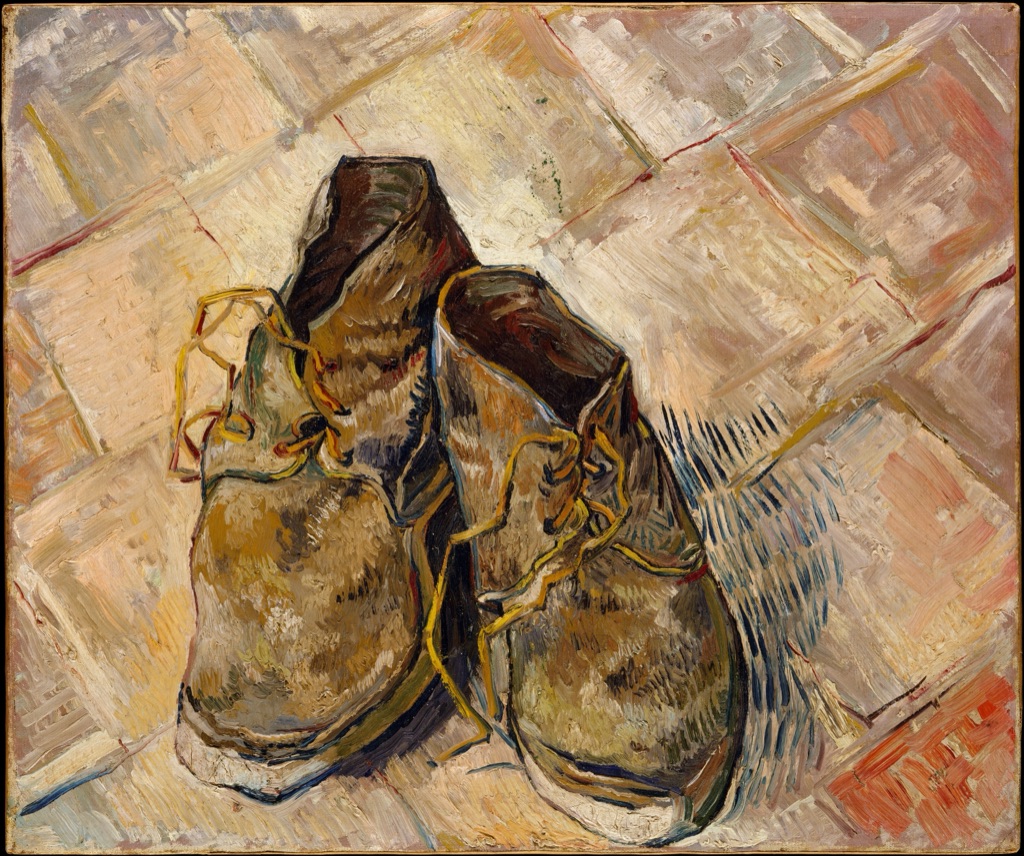
Vincent van Gogh · Shoes · 1888 · The Metropolitan Museum of Art · Public Domain. Visible paint remains distinct from the dry, creased leather it suggests; a close reading appears below. Source details.
At a Glance
- Actual texturea physical surface quality that materially exists.
- Implied texturea surface sensation represented for the eye.
- Visual cuesmarks, edges, highlights, colour, value and modelling.
- Research ruleuse collection records for materials and images for visible evidence.
- Useful contrastform concerns volume; texture concerns surface.
Contents
Institutions use several overlapping terms. Actual, tactile and physical texture generally describe a surface that materially exists. Visual, implied and simulated texture generally describe a surface sensation conveyed to the eye. These are useful vocabulary families, not two universal types with perfectly interchangeable names.[1][2][5]
Texture is therefore relational. We understand it by comparing one surface with another, or by comparing what an artwork is physically made from with what it appears to represent. Marks, modelling, edges, highlights, colour and value changes may contribute to that impression, but none is a guaranteed formula.[1][3]
Looking at texture through a reproduction requires care. A collection record can establish materials such as oil paint, marble, steel or lacquer. Close looking can describe visible marks, reflections and worn areas. It cannot prove exactly how high a ridge of paint is or how an object would feel in the hand.
Actual surface and implied sensation
A painting demonstrates both sides of the idea. Its canvas, panel and layers of paint have an actual surface. Within that surface, the artist may represent worn leather, polished metal, soft cloth or distant rock. Those represented materials do not acquire their real-world feel; the sensation is implied through visible relationships.[1][3][5]
Vincent van Gogh's Shoes makes the distinction especially clear. The crossing strokes are visibly paint, while dark creases, uneven edges and muted changes of colour make the footwear look dry, bent and worn. Actual paint handling and represented leather coexist without becoming the same texture.
Actual texture is not restricted to roughness, and implied texture is not restricted to realistic painting. A polished surface, a shallow incision and a glossy coating are actual qualities too. Likewise, a restrained arrangement of edges and highlights can imply several materials without conspicuous brushwork.
Scale also matters. A broad museum image may reveal the distribution of different surfaces, while a closer authorised view may clarify a mark or join. Neither replaces the object record, and magnification does not turn every visible variation into a deliberate technique. The strongest account combines known material facts with modest descriptions of what can actually be seen.
Six questions for recognising texture
When you look at a work or an authorised image of it, ask:
- What is it physically made from? Begin with the museum record: paint and canvas, marble, steel, lacquer, textile or another material.
- What actual surface can be recorded or seen? Notice raised, recessed, polished, worn, carved or layered areas without guessing how they feel.
- What material or surface sensation is represented? Look for skin, cloth, wood, glass, metal, stone, water, foliage or atmosphere.
- Which visible cues build that sensation? Follow marks, modelling, edges, colour and value changes, highlights or shadows.
- Where does light catch, reflect or sink? Reflection may suggest polish; broken light may clarify an uneven surface.
- Would a three-dimensional surface change with viewpoint or illumination? On an object, turn to authorised alternate views rather than treating one photograph as the whole surface.[1][3][4]
Use the questions selectively; an artwork may answer only some of them. In a museum, look closely while following the collection's rules; never touch an original unless the institution explicitly provides a handling object for that purpose.
Paint surfaces and represented materials
Van Gogh: paint and worn leather
Vincent van Gogh, Shoes, 1888, is an oil-on-canvas painting in the Metropolitan Museum of Art (accession 1992.374).[6] The two shoes sit against a pale floor crossed by visible strokes. Their bent openings, dark seams and irregular outlines suggest leather altered by wear.
The picture does not ask us to confuse paint with leather. Its lesson is the relationship between them: actual painted marks remain legible while building an implied surface that seems creased, dulled and uneven.
Rembrandt: quiet changes in handling
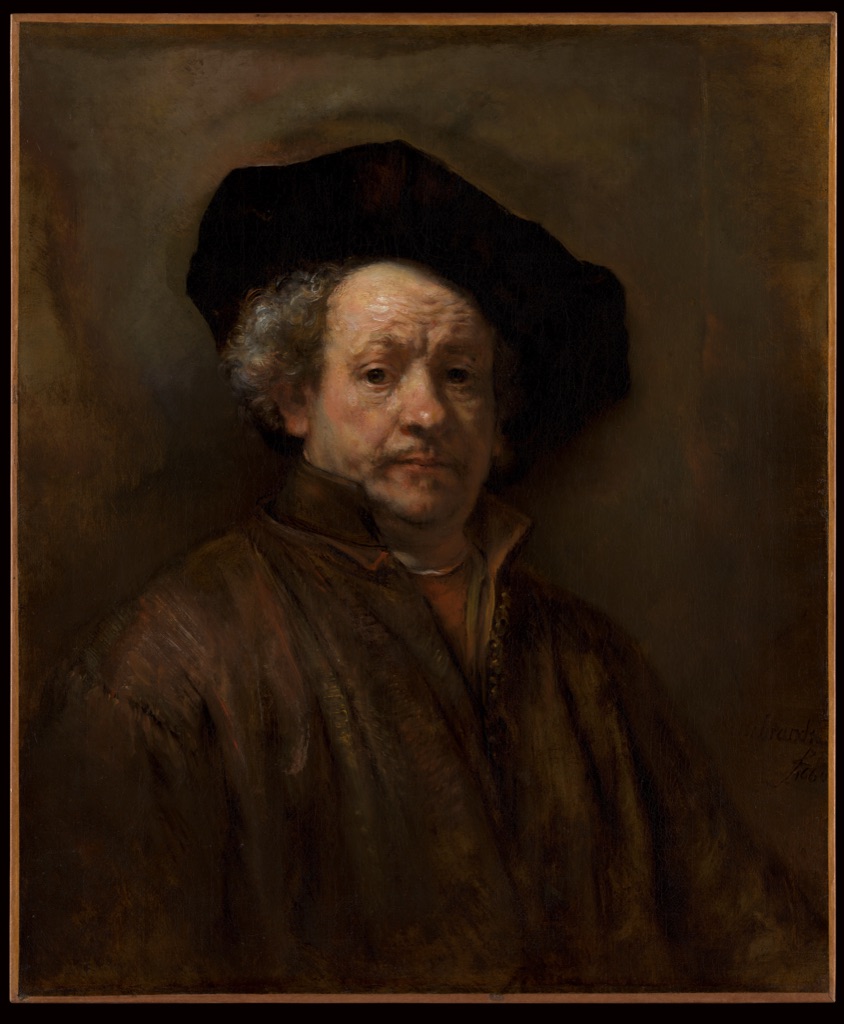
Rembrandt, Self-Portrait, 1660, is an oil-on-canvas painting in the Metropolitan Museum of Art (accession 14.40.618).[7] Lighter, more broken touches are visible around the face and shirt, while the cap, coat and background settle into darker, quieter areas.
Those local changes help skin, hair, fabric and surrounding darkness appear unlike one another. Texture need not announce itself through uniformly thick paint: small differences in edge, modelling and mark can separate represented surfaces while keeping the portrait coherent.
Heda: several surfaces in one still life
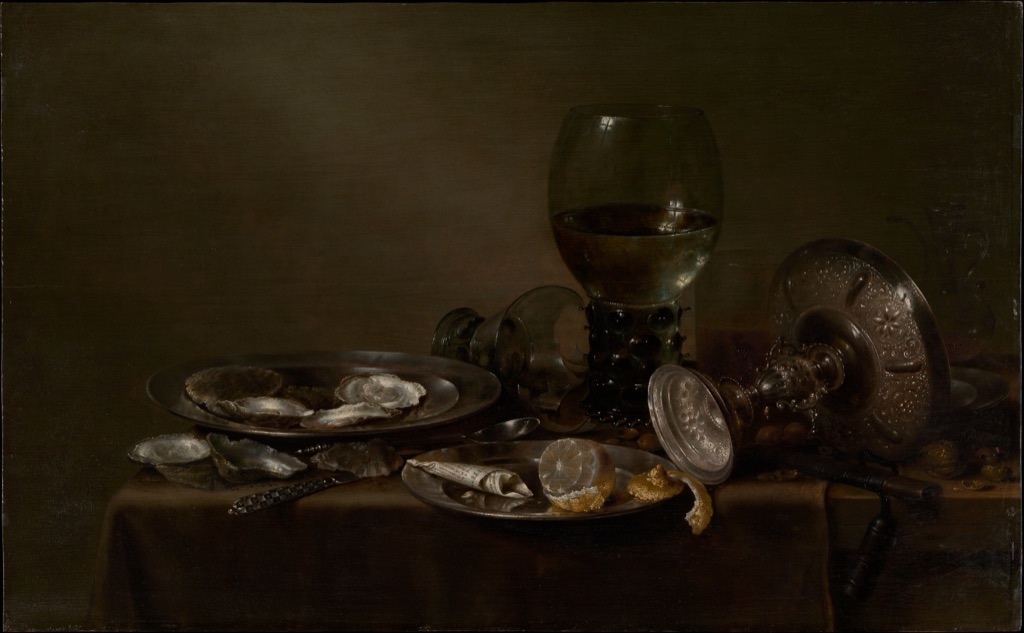
Willem Claesz Heda's Still Life with Oysters, a Silver Tazza, and Glassware, 1635, is oil on wood in the Metropolitan Museum of Art (accession 2005.331.4).[8] Across the full painting, oysters, glass vessels, silver dishes, lemon peel and cloth present a concentrated comparison of implied surfaces.
Sharp glints make metal and glass appear reflective; softer transitions give the cloth less brittle edges; broken shells and curling peel look uneven beside the vessels. These observations concern represented qualities. The collection record, not the reproduction alone, establishes that the physical support is wood.
Vermeer: texture without spectacle
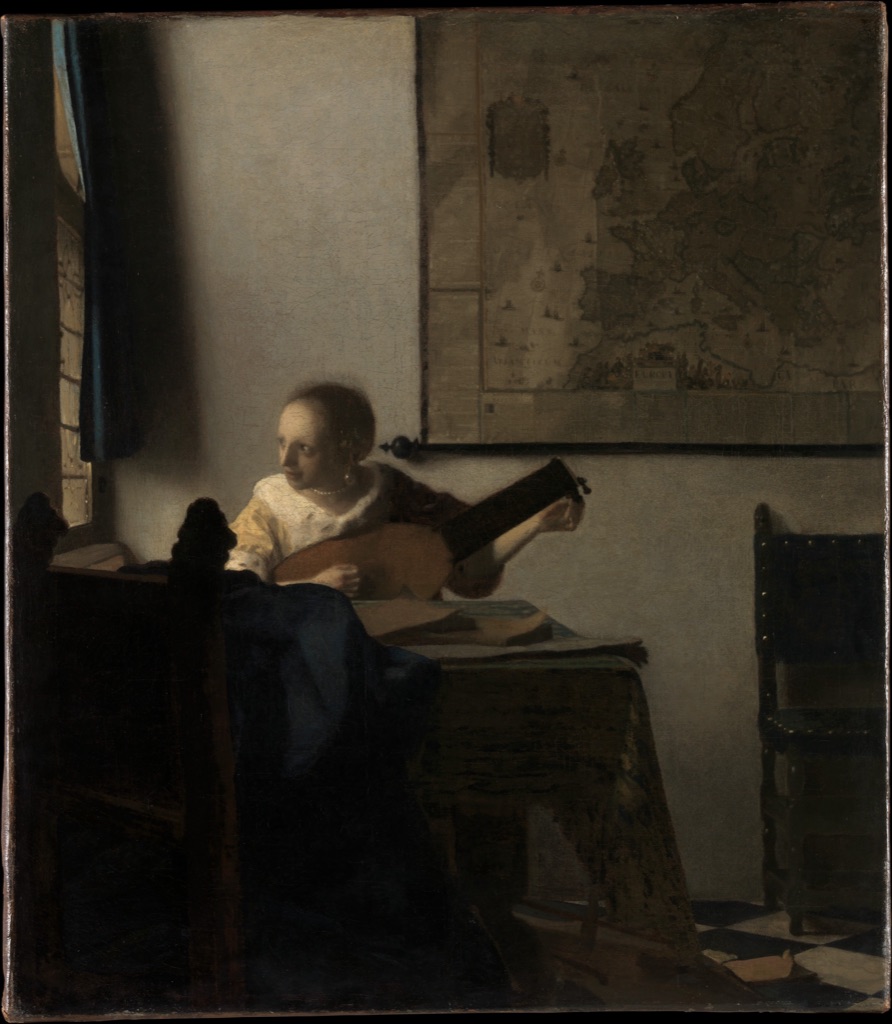
Johannes Vermeer, Young Woman with a Lute, ca. 1662–63, is an oil-on-canvas painting in the Metropolitan Museum of Art (accession 25.110.24).[10] A wall map, table covering, chair, tiled floor, skin and clothing occupy a quiet interior. Their surfaces remain distinguishable even though no single passage dominates through heavy impasto.
Edges sharpen or soften, light spreads differently, and colour shifts from one material to another. The work shows that implied texture can depend on restrained relationships rather than a display of obvious roughness.
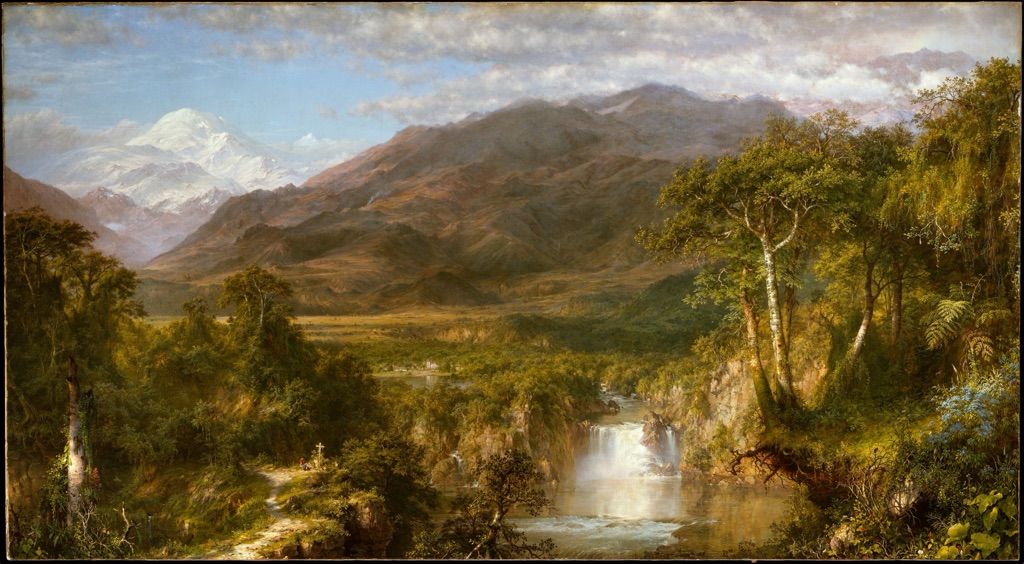
Church: surface across a landscape
Frederic Edwin Church, Heart of the Andes, 1859, is an oil-on-canvas painting in the Metropolitan Museum of Art (accession 09.95).[11] Dense trees, exposed rock, falling water, river and clouds extend across a wide landscape.
At full-work scale, texture is distributed rather than isolated in one specimen. Changes of mark, edge, light and colour let foliage appear dense, distant mountains hard and atmospheric, and water reflective or foaming. Space and composition help organise the view; texture concerns the surface sensations represented within it.
Actual surfaces on objects
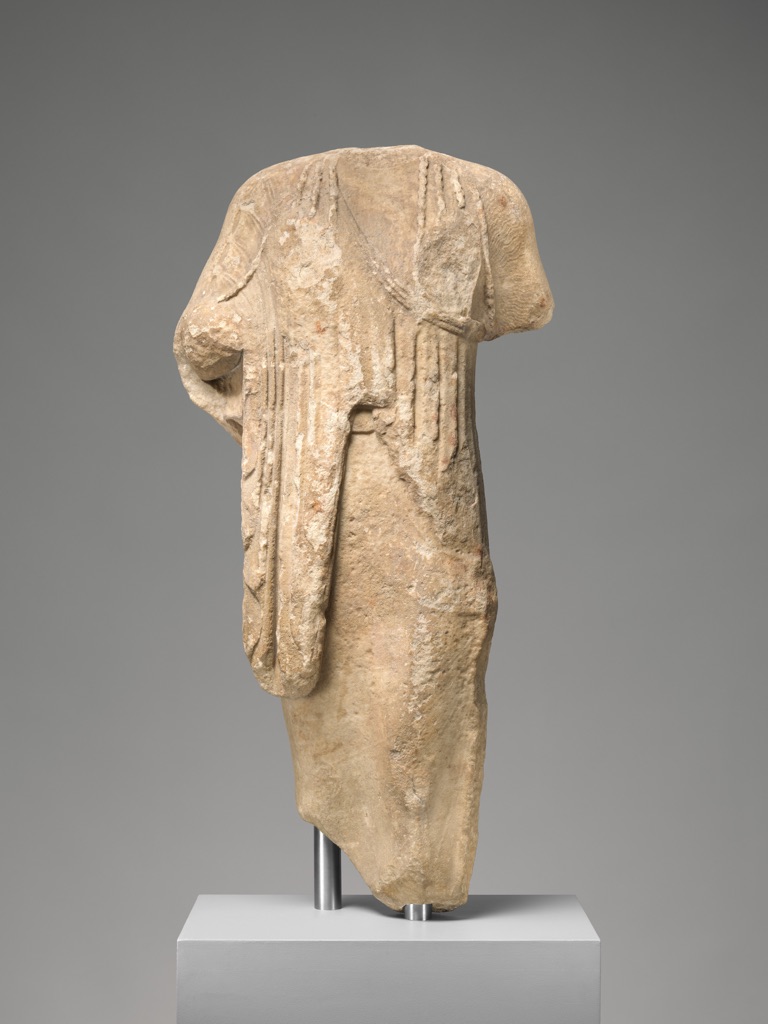
Greek kore: carved, worn and broken stone
The Marble statue of a kore (maiden), made in the late sixth century BCE, is a Greek Archaic sculpture carved from island marble and held by the Metropolitan Museum of Art (accession 07.306).[9] The surviving object is headless. Carved drapery produces long ridges and recesses, while broken and worn areas interrupt the smoother figure.
These are actual features of a three-dimensional surface, visible differently as light and viewpoint change. Form concerns the sculpture's volume; texture concerns the condition and treatment of the marble across that volume. A full-object view keeps both relationships legible without inventing a reconstruction.
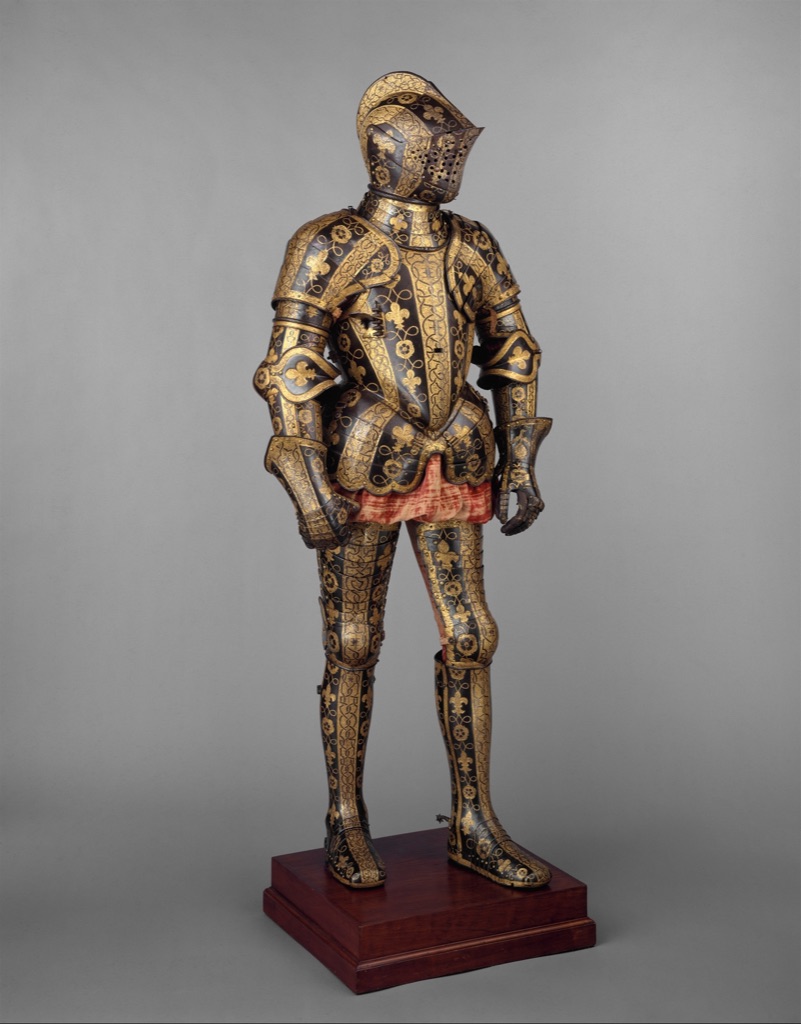
Halder workshop: polish, articulation and mixed materials
The Armor Garniture of George Clifford (1558–1605), Third Earl of Cumberland, made under the direction of the British armorer Jacob Halder in 1586, is in the Metropolitan Museum of Art (accession 32.130.6a–y).[12] Its recorded materials include steel, gold, leather and textile.
Polished dark plates, gold decoration, perforations, articulated joins and red textile create real differences across the object. Light changes sharply on the steel and more softly on the fabric. The lesson is not a catalogue of metalworking techniques, but how actual materials and their treatment make one object visually varied at the surface.
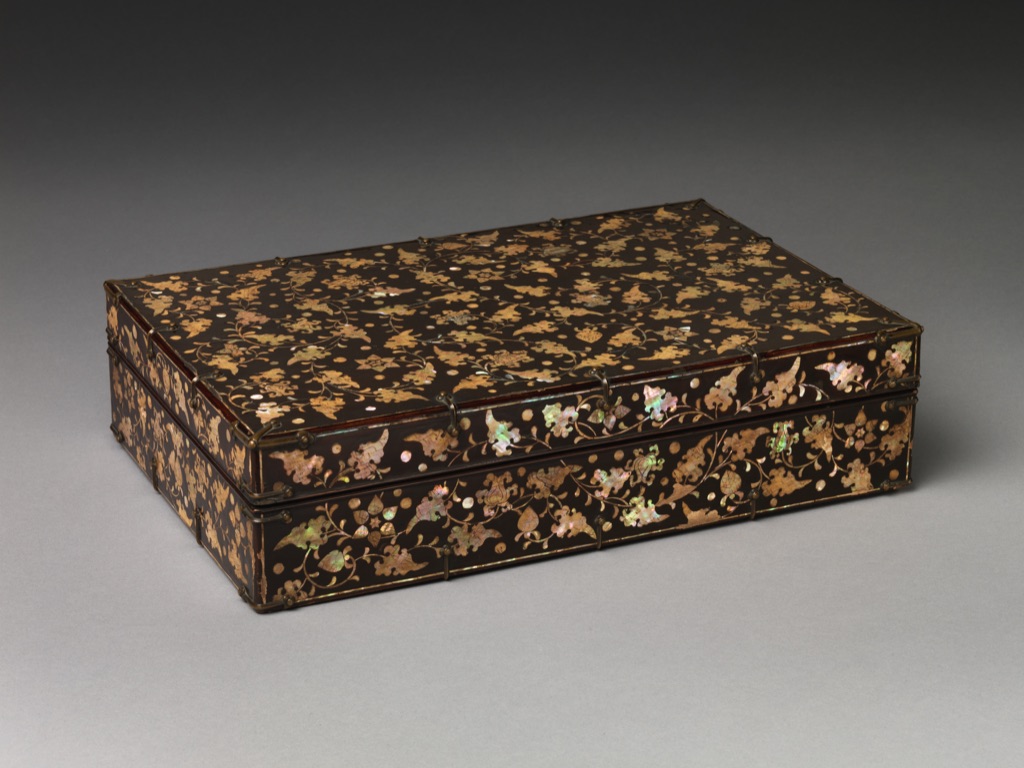
Korean stationery box: surface and recurrence
The Korean Stationery box decorated with peony scrolls, made in the Joseon period during the fifteenth or sixteenth century, combines lacquer, mother-of-pearl and brass and is in the Metropolitan Museum of Art (accession 2015.500.3.1a, b).[13] Its dark glossy surface reflects light, while pale inlay and metal fittings create material changes across the lid and sides.
The peony scrolls recur in an organised arrangement, which belongs to pattern. Their recurrence does not replace the texture question: lacquer, inlay and brass remain actual surfaces with different visual responses to light. One object can support both observations while the concepts retain separate jobs.
Texture and its neighbours
Texture becomes clearer when nearby ideas stay distinct. Form concerns actual or represented three-dimensional volume; texture concerns surface quality across that volume. Pattern concerns organised recurrence, even when the repeated motif appears on a physically textured object.[4]
Value describes lightness and darkness, and colour concerns hue and colour relationships. Both may help suggest a surface without becoming texture themselves. Line may create hatching, seams or edges, while a sustained line analysis follows their paths and qualities. Space concerns depth and occupied or unoccupied relations. Composition concerns the whole-work arrangement rather than the feel or appearance of a surface.
The Elements of Art places texture among the visual elements. Form, pattern, value, colour, line and space offer useful comparisons, while texture keeps attention on actual or implied surface quality.
Look for texture yourself
Choose one artwork and begin with its collection record. Name what it is physically made from, then separate that fact from the surfaces you can see represented. Find one mark, edge, highlight or change of colour and value that helps a surface appear rough, smooth, soft, hard, reflective, worn or layered.
Next, compare two areas. Are they actually different materials, different treatments of one material, or different implied surfaces made from the same paint? Keep your language tied to what the image and record support. Look closely, use authorised views when available, and never touch a collection object unless the museum specifically invites handling.
Try the same questions with an object and a painting. The object may make actual carving, joins or polish easiest to notice; the painting may make the gap between physical paint and represented materials especially clear. The comparison should sharpen your description, not rank one medium as more textural than another.
Watch: Surface, Material and Close Looking
Choose a focused lesson on form and surface, an overview of the elements, or a museum-led demonstration of formal analysis.
Elements of Art: Form
See how light, value and visible marks help a surface describe volume.
Watch on YouTubeFrequently Asked Questions
Texture is the actual surface quality of an artwork or the implied sensation of a represented surface.
Actual texture materially exists on an object; implied texture is a surface sensation represented for the eye.
Artists can combine marks, modelling, edges, highlights, colour and value changes to distinguish represented surfaces.
No. Smooth, glossy, polished, soft and reflective qualities are textures as much as rough or ridged ones.
No. A reproduction supports careful visual description, while collection records establish materials; it cannot prove tactile sensation.
Discussion
Which visible cue most strongly changes the surface you imagine in one of these works?
Reader Insights
Use the object record for materials and the image for what can be seen.
Describe how marks, edges, light or value make neighbouring materials differ.
Texture concerns surface; form concerns volume and pattern concerns recurrence.
Join the Conversation
Share one precise surface observation or a useful museum example below.
References
- J. Paul Getty Museum, “Understanding Formal Analysis — Elements of Art.” https://www.getty.edu/education/teachers/building_lessons/formal_analysis.html
- Smithsonian National Portrait Gallery, “Art Vocabulary — Elements of Art.” https://npg.si.edu/sites/default/files/NPG_KeyTerms_0.pdf
- National Gallery of Art, “The Elements of Art: Texture.” https://www.nga.gov/educational-resources/elements-art/elements-art-texture
- J. Paul Getty Museum, “Vocabulary for Describing an Artwork.” https://www.getty.edu/education/k-12-learning/describe-listen-draw/vocabulary-for-describing-an-artwork/
- Brigham Young University–Idaho Department of Art, “Design Elements: Texture.” https://courses.byui.edu/art110_new/art110/week09/texture.html
- The Metropolitan Museum of Art, “Shoes.” https://www.metmuseum.org/art/collection/search/436533
- The Metropolitan Museum of Art, “Self-Portrait.” https://www.metmuseum.org/art/collection/search/437397
- The Metropolitan Museum of Art, “Still Life with Oysters, a Silver Tazza, and Glassware.” https://www.metmuseum.org/art/collection/search/438376
- The Metropolitan Museum of Art, “Marble statue of a kore (maiden).” https://www.metmuseum.org/art/collection/search/248008
- The Metropolitan Museum of Art, “Young Woman with a Lute.” https://www.metmuseum.org/art/collection/search/437880
- The Metropolitan Museum of Art, “Heart of the Andes.” https://www.metmuseum.org/art/collection/search/10481
- The Metropolitan Museum of Art, “Armor Garniture of George Clifford (1558–1605), Third Earl of Cumberland.” https://www.metmuseum.org/art/collection/search/23939
- The Metropolitan Museum of Art, “Stationery box decorated with peony scrolls.” https://www.metmuseum.org/art/collection/search/40524