by Tom Gurney
Tom Gurney BSc (Hons) is an art history expert with over 20 years experience
Page created on September 3, 2026 / Page updated on September 13, 2026
Email: tomgurney1@gmail.com / Phone: +44 7429 011000
How Pigment, Wet Plaster and Architecture Become One Painted Surface
Fresco painting joins colour to plaster and therefore to architecture. In buon fresco—“true” or fresh fresco—pigments ground in water are brushed onto a newly laid coat of wet lime plaster. As the plaster sets through carbonation, colour becomes bound within its surface. Fresco a secco uses paint on dry plaster, with egg, glue, gum or another binder holding the pigment. Historical walls often combine both methods, but secco passages are generally more vulnerable to flaking.[1][2]
This distinction matters because “fresco” is often used casually for any mural. A wall painting may instead be made in oil, tempera, acrylic, casein or another system. True fresco is identified not by scale or subject but by the relationship among water, pigment and wet lime plaster.
At a Glance
- Buon frescowaterborne pigment is applied to fresh lime plaster and becomes bound as the wall carbonates.
- Fresco seccopaint is applied to dry plaster with an added binder; it behaves and ages differently.
- Working daya giornata is the area of fresh finish plaster prepared for one session.
- Architecture matterswall shape, light, viewing distance and building use organise the image.
- Conservationmoisture, salts, detachment, overpaint and past restorations can alter both surface and interpretation.
Contents
Wall, plaster and working day
The masonry wall is first stabilised and dampened. A relatively coarse plaster layer, the arriccio, evens the surface. The main design may be drawn there in reddish earth as a sinopia, or transferred from a full-size cartoon. A cartoon could be incised with a stylus or pricked along its outlines so charcoal dust passed through the holes—a transfer method called pouncing or spolvero.[13] Over it comes the finer intonaco that will receive colour.[1][2]
Only as much intonaco as can be painted before it sets is laid at one time. That day's section is a giornata. Boundaries can follow contours so joins become less conspicuous, yet close inspection often reveals how a monumental composition was divided into daily tasks. Planning, plastering and painting are inseparable: the artist must judge both pictorial sequence and the chemistry of a changing surface.
Pigments need to tolerate lime's alkalinity. Colours brushed in water may look different as the plaster dries, and elaborate corrections are harder than in a portable panel. Details or colours unsuitable for wet plaster can be added a secco afterward. The resulting surface is usually matte and integrated with the wall rather than a separate glossy paint skin.
The process therefore runs in two clocks. The cartoon and colour plan can be prepared over weeks, but the exposed intonaco sets a daily deadline. Large passages are established first, while edges and modelling must be completed before the surface stops accepting pigment. A painter cannot simply reopen yesterday's wet layer: the next patch must meet it cleanly. Visible seams are not necessarily mistakes. They are evidence of decisions about which head, limb, fold or architectural band could form one practicable unit.
Fresco was also rarely a solitary performance. On a large site, assistants mixed lime, ground stable pigments, prepared cartoons, laid plaster and sometimes painted secondary passages. Scaffolding divided a high wall or vault into reachable zones, and the sequence could be shaped by access as much as narrative order. Attribution consequently needs care: the directing artist may be responsible for the design and crucial figures while a workshop translated much of the programme into plaster.
Eight frescoes to look at
Wall painting from Room H at Boscoreale
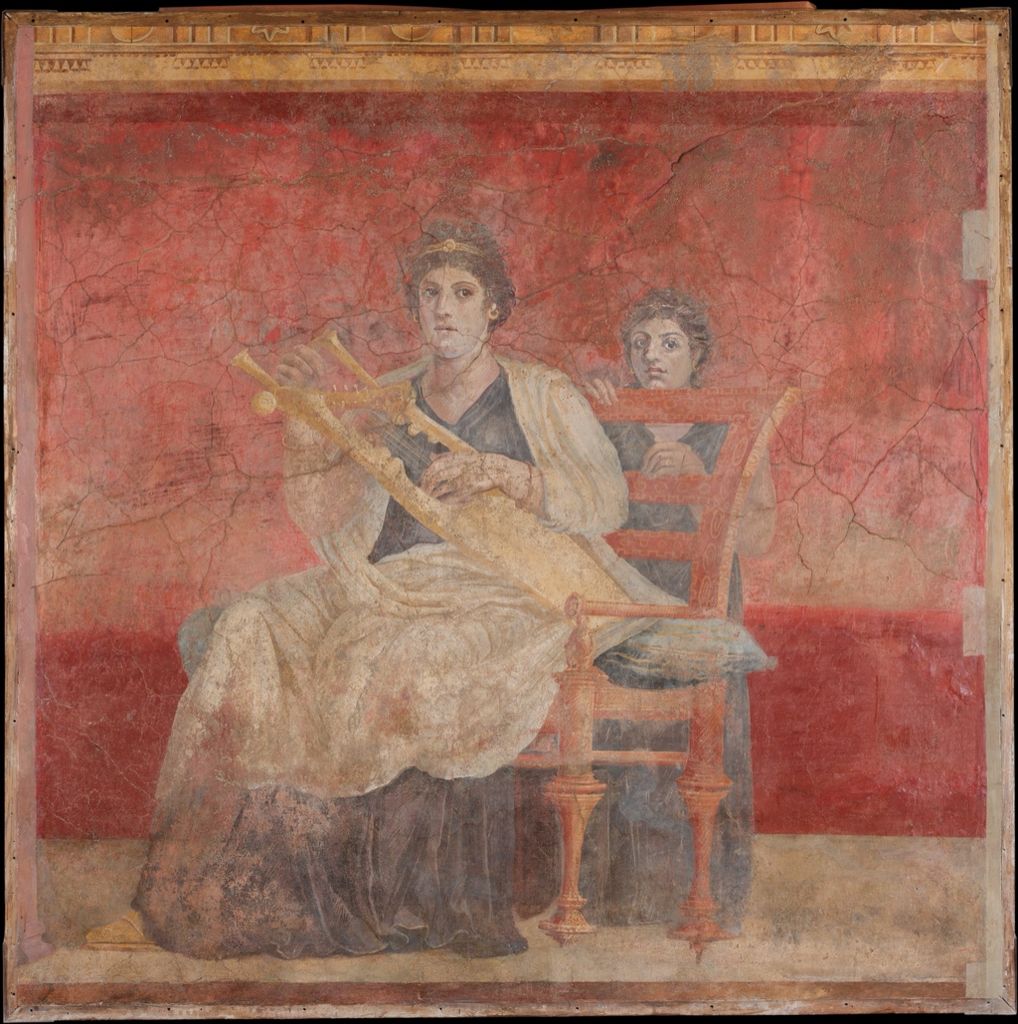
Painted about 50–40 BCE in the Villa of P. Fannius Synistor near Pompeii, this Roman wall reconstructs fantastic architecture across a real room.[3] Columns, ledges, doors and distant structures turn flat plaster into an imagined stage. Saturated red zones organise the illusion while fine architectural lines invite the eye beyond the wall.
Roman preparation could involve several plaster layers, with marble powder in finishing coats. Subtle giornata edges and later secco additions complicate any simple reconstruction of process.[4] The fragment now displayed in a museum was once one part of a total decorative environment.
The Virgin and Child in Majesty and the Adoration of the Magi
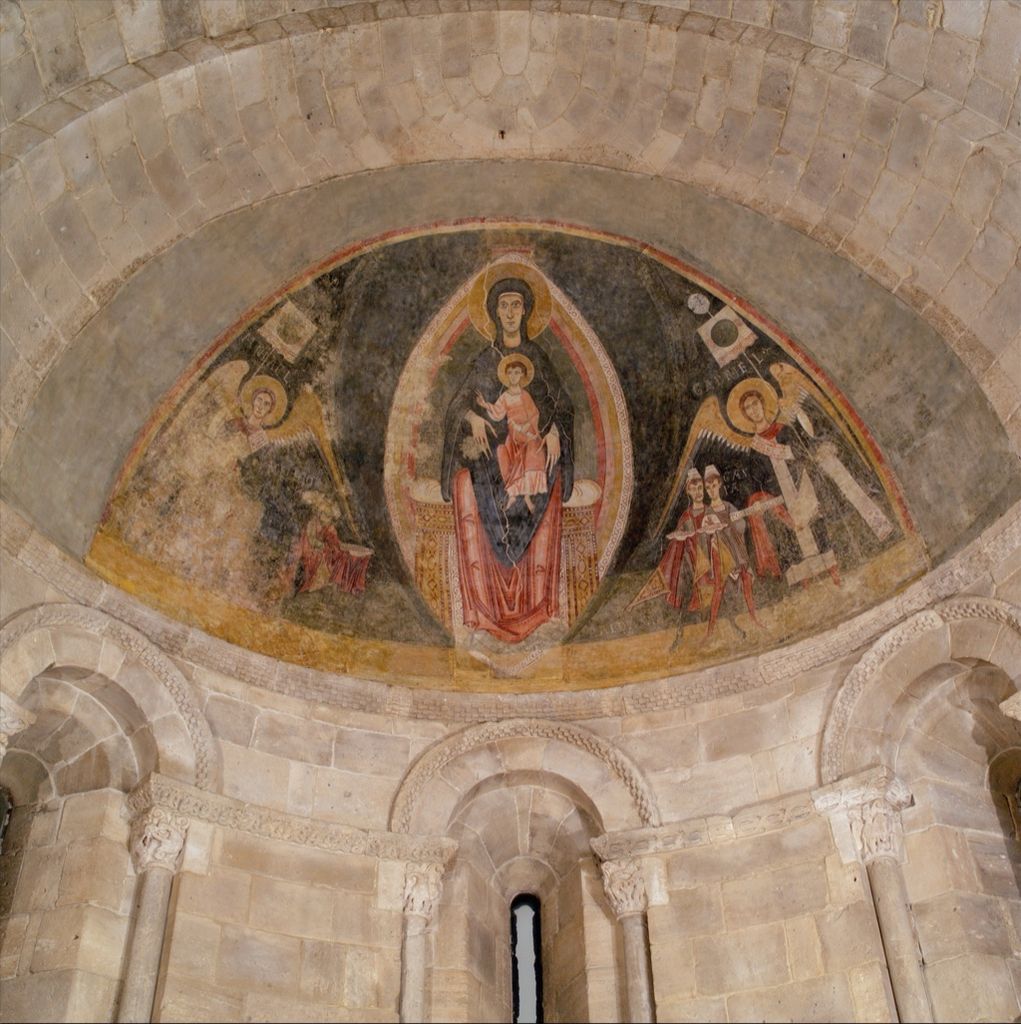
The Master of Pedret's apse painting, about 1100, places the Virgin and Child within a mandorla above the Magi.[5] Its curved original setting structured the hierarchy: sacred authority occupied the architectural centre and worshippers encountered the image within a church, not as a rectangular canvas.
Firm outlines and broad colour fields remain legible at distance. The transferred fragment preserves much of the design, but museum display changes its scale relationship, lighting and ritual setting. A fresco's support is part of its meaning even when conservation has separated it from the wall.
The Healing of the Blind Man and the Raising of Lazarus
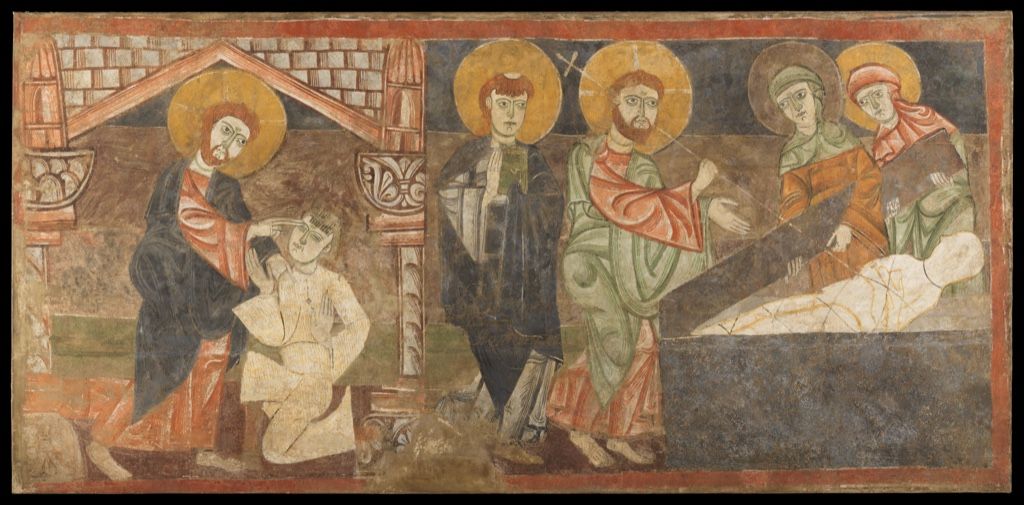
This first-half twelfth-century Catalan fresco places two New Testament miracles in a continuous band.[6] Gesture and repeated figures move the narrative forward. The simplified architecture and emphatic outlines suit viewing across a church interior.
Areas lost or abraded make the wall's history visible. Fresco is durable when its building remains dry and stable, but movement, salts, damp and later alteration can disrupt the plaster layers that carry the image.
Camel
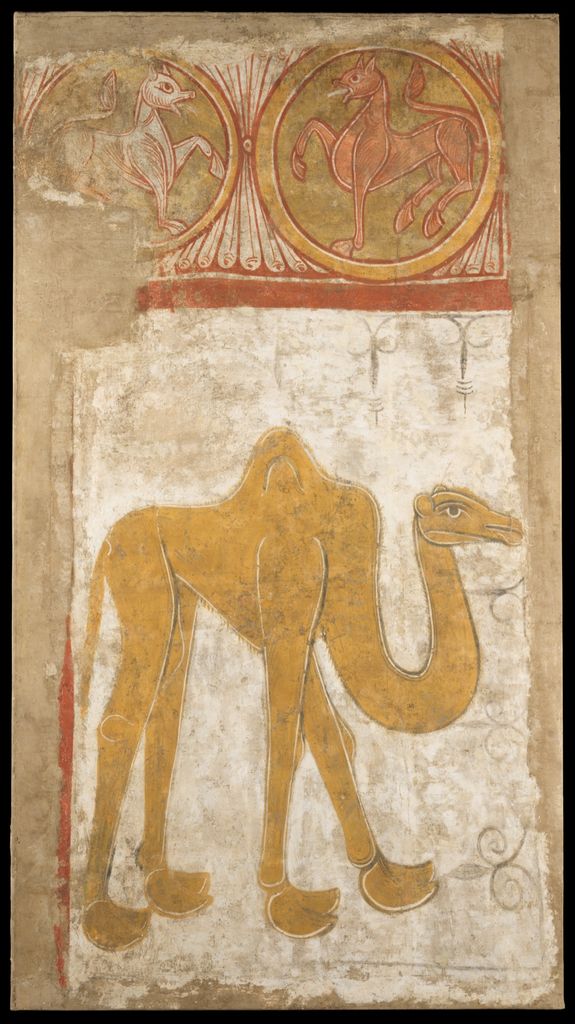
The Camel, from the same twelfth-century ensemble, belongs to an unusual painted bestiary.[7] Its long neck and patterned body turn the animal into a clear sign against a simple ground. Modelling is secondary to contour, rhythm and recognition.
Transferred to canvas, the work illustrates both preservation and displacement. Detachment can save a threatened surface, yet it removes physical evidence about wall sequence and architectural context. Modern conservation therefore treats transfer as a major intervention, not routine framing.
Lion
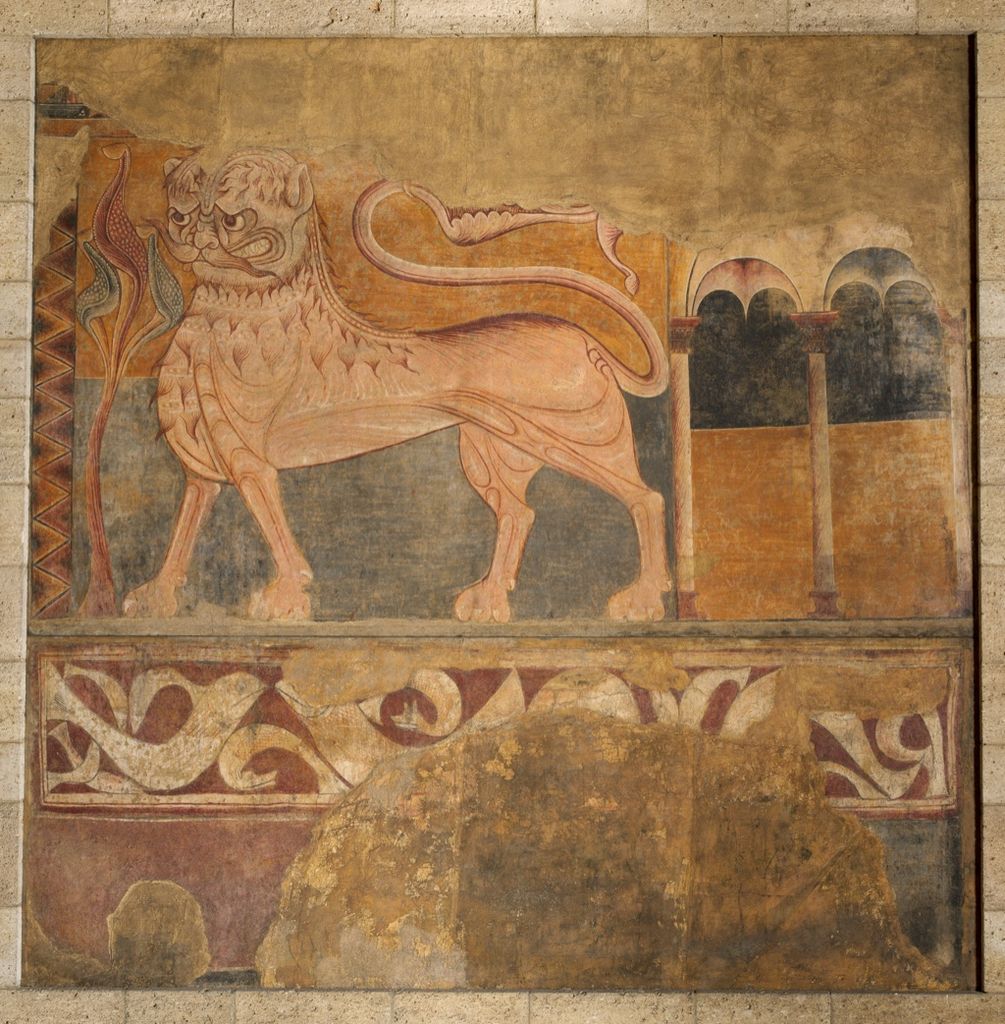
Made after 1200, this frescoed lion once occupied the chapter house of San Pedro de Arlanza in Spain.[8] The animal strides within a bold border, its patterned body and raised tail filling the available field. It combines heraldic clarity with the imaginative energy of medieval bestiaries.
The block-like colour and decisive line suit lime plaster. Surface wear has not erased the design's authority; instead, cracks and losses remind us that the painted image and the building material have aged together.
Dragon
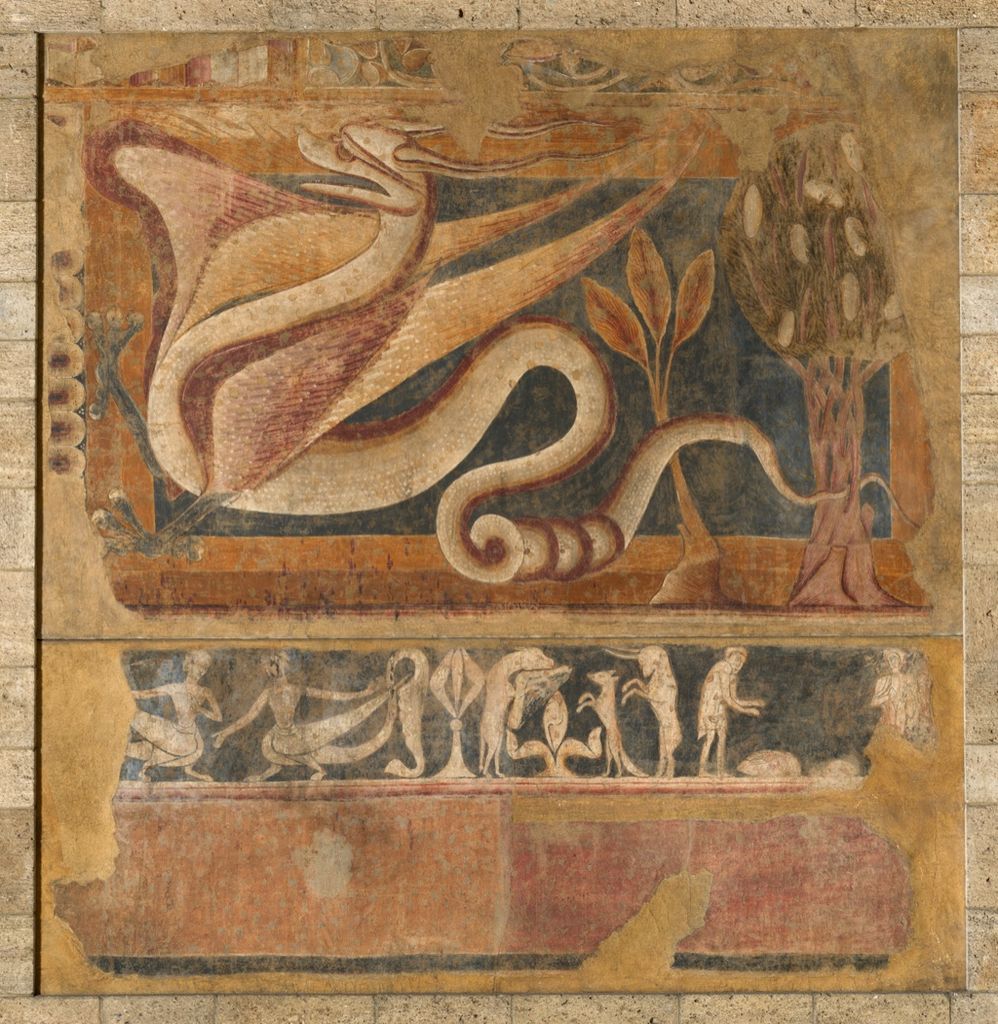
The companion Dragon coils through its framed field with wings, claws and a looping tail.[9] Its silhouette uses the wall almost like a woven or carved pattern. The creature's energy depends on how every curve presses against the border.
Placed beside the lion, it demonstrates programme rather than isolated invention. Medieval interiors coordinated beasts, sacred stories, ornament and architecture. Fresco could bind all of them into a continuous environment.
Saint Christopher and the Infant Christ
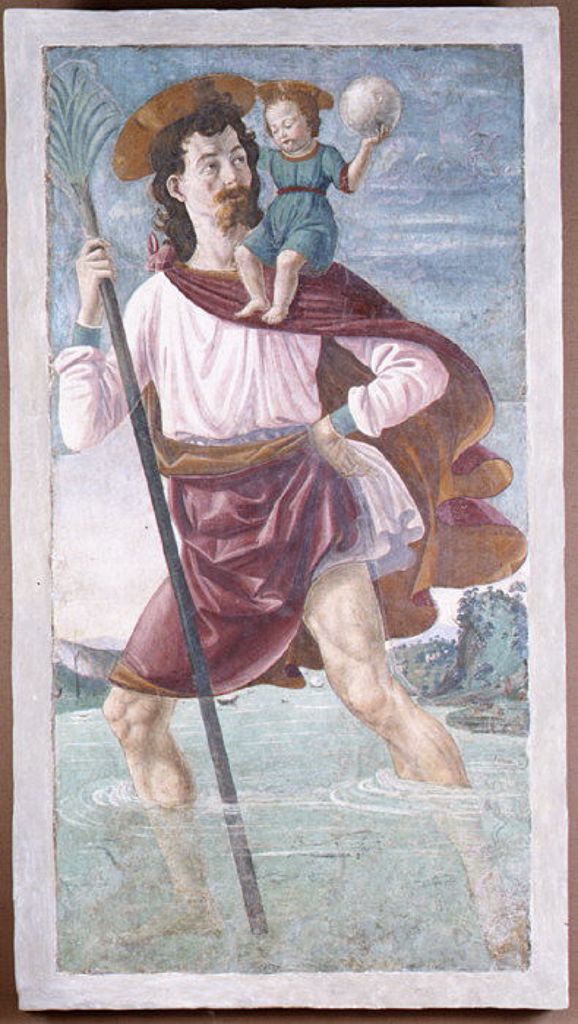
Domenico Ghirlandaio's monumental Saint Christopher and the Infant Christ brings a Renaissance figure to near architectural scale.[10] Christopher strides through water with the Child on his shoulder. Drapery, bodily structure and landscape modelling extend beyond the flatter pattern of the Romanesque fragments.
The image's size addressed a viewer moving through a building. Fresco let workshops cover large surfaces economically, but scale intensified logistical demands: cartoons, assistants, scaffold levels and successive giornate had to align.
Allegorical Figure Representing Geometry
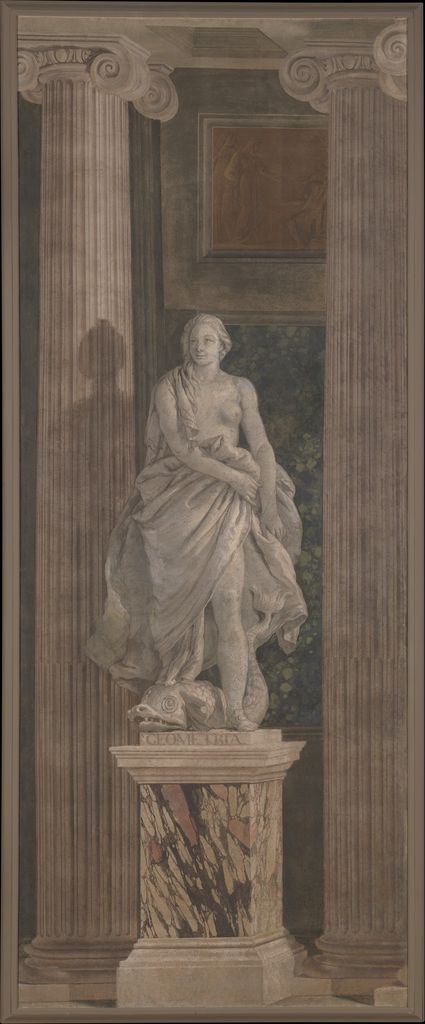
Tiepolo painted this airborne figure in 1760 for the Villa Pisani at Strà.[11] Geometry carries her attributes while drapery and clouds open an illusionistic space overhead. The fresco was later transferred to canvas.
The work shows the medium's Baroque and Rococo afterlife. Light colour and foreshortening dissolve the ceiling plane, converting architecture into sky. Its museum status again asks viewers to imagine an original position above eye level and within a larger decorative scheme.
From antiquity to Renaissance ceilings
Ancient Mediterranean painters used wet- and dry-plaster systems in houses, burial chambers and public buildings. The Boscoreale room shows how Roman decoration could simulate precious materials and impossible architecture. Fresco continued in medieval churches, where large narrative cycles organised sacred space.
The relation to architecture changed what a painted cycle could do. Images could frame doorways, distinguish chapels, guide processions or align sacred figures with an altar. A programme unfolded as the visitor crossed the space, so sequence depended on movement and sightlines as well as story. Commissioning also involved patrons, builders, plasterers and painters whose work had to be coordinated on site. These conditions distinguish fresco from a portable picture that can be moved after completion without changing its fundamental format.
In fourteenth-century Italy, Giotto's Arena Chapel and Ambrogio Lorenzetti's Siena murals made the working day serve ambitious storytelling. Renaissance masters refined cartoons, perspective and collaborative workshop organisation. Michelangelo's Sistine Chapel ceiling, painted 1508–12, remains the most famous example: its immense programme was broken into workable plaster sections while figures were designed for a curved surface high above viewers.
Later artists such as Tiepolo used fresco to make ceilings appear open to limitless space. In the twentieth century, Mexican muralists including Diego Rivera renewed public interest in the method. The historical thread is not stylistically continuous; what persists is the negotiation between image, fresh plaster, labour and site.
Artists associated with fresco
Giotto is central to accounts of Italian fresco because the Arena Chapel coordinates human action, spatial clarity and an entire architectural interior. Michelangelo treated the Sistine vault and altar wall as immense fields for bodies designed to be read from far below. Domenico Ghirlandaio, represented by the Saint Christopher on this page, shows how a Renaissance workshop could translate monumental drawing into an architectural surface. In a very different civic context, Diego Rivera used mural programmes to address public history, labour and political identity.
These names should not collapse fresco into an exclusively Italian or European story. Wet- and dry-plaster painting systems developed across regions and periods, while the exact materials differ with local building traditions. “Fresco” is most useful when a catalogue or technical study identifies the plaster-and-pigment process, rather than when it is used loosely for every old wall painting.
Fresco, tempera and mural painting
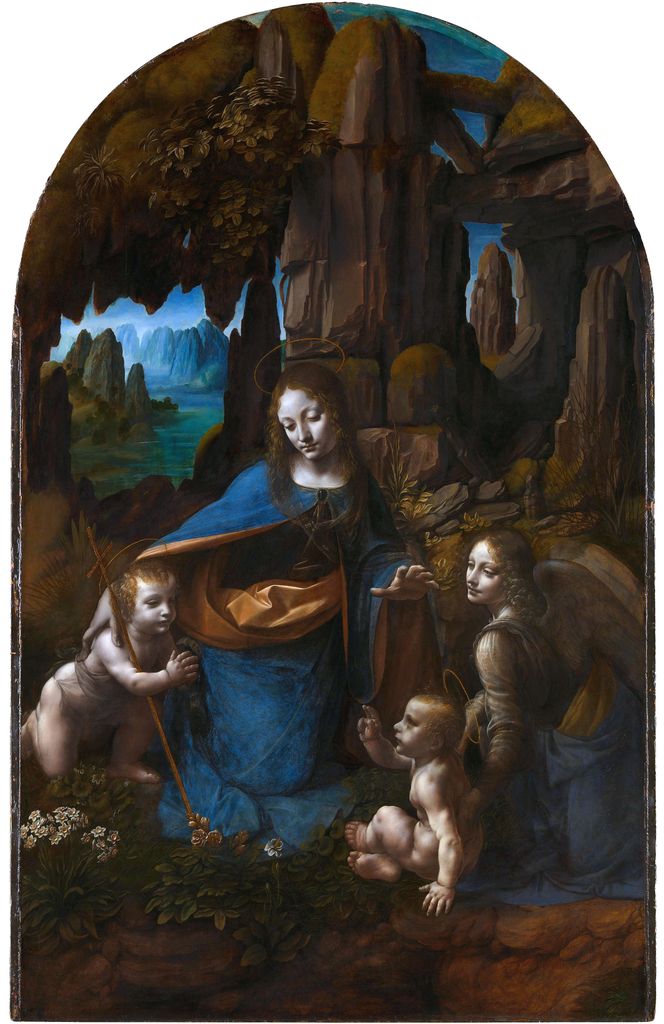
Tempera has a separate binder, most famously egg yolk, and is often associated with prepared wooden panels. It can also appear as secco work on a wall. Oil paint dries by oxidation and allows prolonged blending, but experimental oil-and-tempera murals can fail when their layered films do not bond well to damp masonry. Leonardo da Vinci's Last Supper is a celebrated wall painting, not a successful buon fresco, because he worked experimentally on dry preparation.[1]
“Mural” names a painting's architectural location, not its binder. A contemporary acrylic mural and an ancient buon fresco may share scale while differing completely in chemistry. The Art Mediums hub separates support, binder and technique so those relationships stay clear.
Conservation and responsible looking
Moisture is fresco's persistent danger. Water moving through masonry can dissolve and redeposit salts, stain surfaces, weaken plaster and encourage biological growth. Changes in humidity can cause salts to dissolve and crystallise repeatedly; pressure from crystallisation disrupts painted plaster at and below the surface.[14] Structural movement creates cracks or detachment. Secco details may disappear before the true-fresco passages beneath them, changing colour balance and making a work appear simpler than it once was.[2]
Cleaning is equally sensitive because soot, dust, old coatings and original surface effects can overlap. Conservation starts with diagnosis: a loose paint film, a hollow plaster layer and salt activity are different problems, even when all appear as a pale or flaking patch. Getty's wall-painting work at Mogao stresses environmental control and compatible, minimal intervention rather than treating every void or stain.[14] Detachment and transfer, once widely used to rescue threatened paintings, can preserve the coloured surface but sacrifice information held by the wall and room.
The vivid colours revealed by major Sistine Chapel campaigns prompted valuable debate about what belonged to Michelangelo and what reflected later history. In 2026 the Vatican described extraordinary maintenance of the Last Judgment as removal of accumulated whitish deposits, alongside ongoing inspection and environmental management—not the repainting of Michelangelo's design.[12]
When looking, find the wall before the image: note curvature, scale, windows and viewing height. Then seek giornata boundaries, incised transfers, broad wet-plaster colour and more fragile dry additions. If a label says “transferred to canvas,” imagine both the rescued paint and the lost room. Fresco is best understood as painting that has shared the life of a building.
Watch: Fresco Materials, Transfer and Plaster Chemistry
Choose a museum demonstration of buon fresco, a Getty transfer-process study, or a chemistry-led explanation of plaster painting.
Alchemy of Art: Fresco
See pigment applied to wet plaster in a concise museum demonstration of buon fresco.
Watch on YouTubeFrequently Asked Questions
Fresco is wall painting in which pigments are applied to plaster; in buon fresco they are brushed onto fresh lime plaster and become bound as it carbonates.
Buon fresco is painted into fresh plaster, while fresco secco is applied to dry plaster with an added binder.
A giornata is the section of finish plaster prepared for the amount an artist expects to paint in one working day.
No. Mural describes location and scale; wall paintings can use fresco, secco, tempera, oil, acrylic and other systems.
The image is tied to an architectural wall and can be affected by moisture, salts, structural movement, detachment, overpaint and environmental change.
Discussion
Which fresco on this page depends most strongly on its architectural position and the viewer’s movement through the building?
Reader Insights
Shape, height, light and route determine how the image was encountered.
Giornate and joins can reveal planning and sequence.
A wall painting is not automatically buon fresco.
Join the Conversation
Share one precise observation or a useful museum example below.
References
- National Gallery, London, “Fresco.” https://www.nationalgallery.org.uk/paintings/glossary/fresco
- Metropolitan Museum of Art, “Italian Painting of the Later Middle Ages.” https://www.metmuseum.org/essays/italian-painting-of-the-later-middle-ages
- Metropolitan Museum of Art, “Wall painting from Room H of the Villa of P. Fannius Synistor at Boscoreale.” https://www.metmuseum.org/art/collection/search/247009
- Metropolitan Museum of Art, Pompeian Frescoes in the Metropolitan Museum of Art. https://resources.metmuseum.org/resources/metpublications/pdf/Pompeian_Frescoes_in_the_Metropolitan_Museum_of_Art_The_Metropolitan_Museum_of_Art_Bulletin_v_45_no_3_Winter_1987_1988.pdf
- Metropolitan Museum of Art, “The Virgin and Child in Majesty and the Adoration of the Magi.” https://www.metmuseum.org/art/collection/search/472381
- Metropolitan Museum of Art, “The Healing of the Blind Man and the Raising of Lazarus.” https://www.metmuseum.org/art/collection/search/471846
- Metropolitan Museum of Art, “Camel.” https://www.metmuseum.org/art/collection/search/471906
- Metropolitan Museum of Art, “Lion.” https://www.metmuseum.org/art/collection/search/471061
- Metropolitan Museum of Art, “Dragon.” https://www.metmuseum.org/art/collection/search/471062
- Metropolitan Museum of Art, “Saint Christopher and the Infant Christ.” https://www.metmuseum.org/art/collection/search/436492
- Metropolitan Museum of Art, “Allegorical Figure Representing Geometry.” https://www.metmuseum.org/art/collection/search/437797
- Vatican Press Office, “Extraordinary maintenance of Michelangelo’s Universal Judgement.” https://press.vatican.va/content/salastampa/en/info/2026/02/02/260202a.html
- Metropolitan Museum of Art, “Putti Playing with Hoops (Cartoon for a Fresco in Parma Cathedral).” https://www.metmuseum.org/art/collection/search/420449
- Getty Conservation Institute, “Scientific Investigation: Wall Paintings Conservation at Mogao Grottoes.” https://www.getty.edu/projects/wall-paintings-conservation-mogao-grottoes/scientific-investigation/