by Tom Gurney
Tom Gurney BSc (Hons) is an art history expert with over 20 years experience
Page created on September 2, 2026 / Page updated on September 13, 2026
Email: tomgurney1@gmail.com / Phone: +44 7429 011000
How Distinct Parts Become a Connected Whole
Unity in art is the coherence or belonging that lets distinguishable parts be seen as one connected whole. It does not reside in a colour, line or object by itself. It appears in the relationships among them: a shape answered elsewhere, figures gathered into a group, a band carried across a divide, or different passages held within a shared visual character.[1][2]
Coherence is the clearest everyday word for this effect. Harmony is sometimes used for compatible or mutually supportive relationships, but institutions do not all organise the vocabulary in the same way.[3][4][5] Similarity is narrower still. Related colours or shapes can help a work feel unified, yet likeness is only one possible connection; the parts do not have to match.
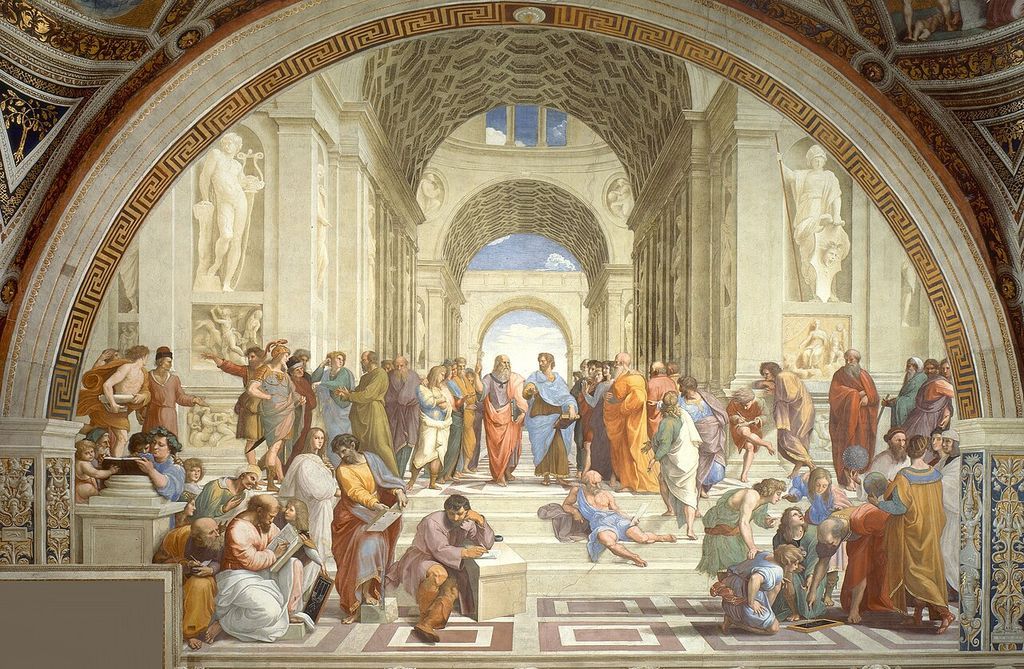
Raphael, The School of Athens, 1509–11. Distinct figures and discussions remain legible while the architecture, converging lines and central grouping connect them as a whole. Image: Wikimedia Commons, public domain.
At a Glance
- Core idearelationships that allow distinguishable parts to belong together.
- Look forcontinuity, grouping, alignment, recurrence and shared visual conditions.
- Not samenessunity can preserve strong differences among parts.
- Not a quality scorea work may be intentionally fragmented or unresolved.
- Close neighbourvariety asks what remains visibly different.
Contents
Unity is therefore not a guarantee of prettiness, symmetry or calm. It does not require a limited palette or the removal of variety. A work may be crowded, sharply divided or full of unexpected forms and still hold together. The useful question is not “Is everything the same?” but “Why do these differences still belong?”
How to recognise unity
There is no universal numbered list of unity types. Instead, begin with four questions that can be tested against what you see.[1][2]
- What relates? Look for colours, shapes, lines, textures, scales or kinds of handling that answer one another. The relationship may be close without being identical.
- What groups? Proximity, overlap or enclosure can make separate figures and objects read as a unit. Notice whether smaller groups also belong to a larger field.
- What continues? An edge, band, line, form or related treatment may carry across an interval, join two zones or bridge a physical division.
- Do the differences still belong? Identify the strongest change, then ask what keeps it connected to the rest of the work. Variety can remain visible inside a coherent whole.
Repetition may help establish these connections, but recurrence alone is not the full meaning of unity. Unity asks a broader question about belonging among the parts. In the same way, a related palette can connect a scene without proving unity by itself. The colours still have to participate in a larger set of relationships.
Unity without sameness
The easiest examples of unity may use obvious resemblance: repeated blue shapes, a row of similar figures or one material carried across a surface. More complex works let differences remain active. One figure may be isolated from a crowd, one colour may break a quiet range, or one zone may feel denser than another. If other relationships connect those changes, the whole need not fall apart.
This is where unity meets variety. Unity concerns coherence; variety concerns sustained diversity. They can work together rather than cancel each other.[1][2] The flowers in a tapestry need not repeat exactly, and figures in a public square need not share a pose. Their differences can keep looking lively while enclosure, spacing, colour or handling gives them common ground.
Unity also differs from symmetry. Mirrored sides can support a strong sense of order, but an unequal arrangement may be just as coherent. Belonging is not the same as blending in: a dark figure may remain sharply distinct from a light field while shape, placement and surrounding echoes connect it to the larger work.
Unity across eight artworks
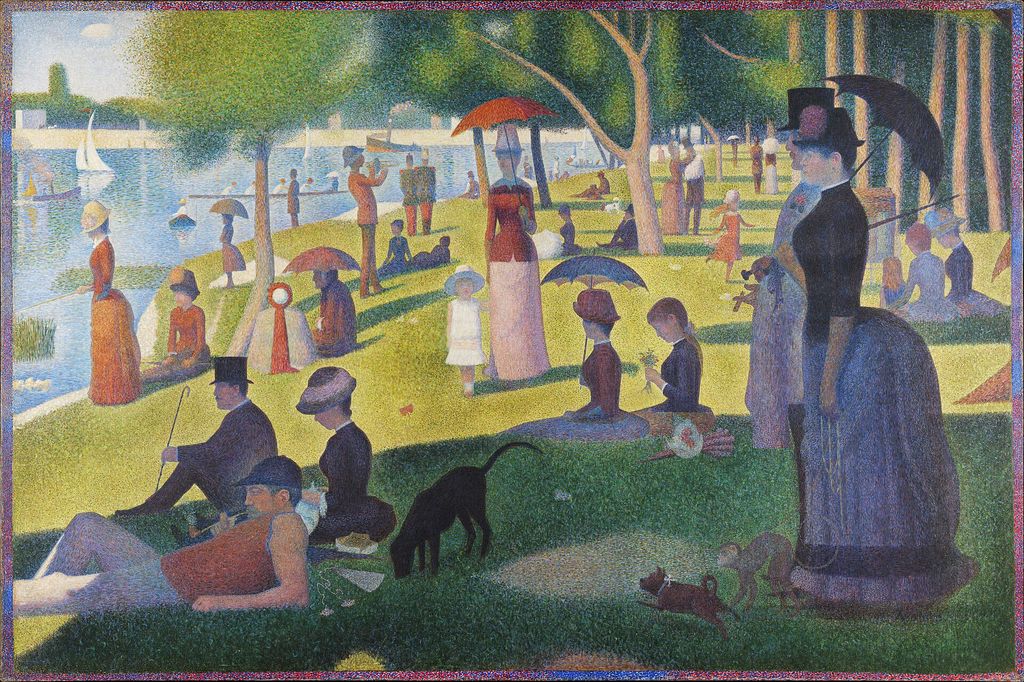
Seurat: many figures, one park
Georges Seurat's A Sunday on La Grande Jatte—1884, 1884–86, is in the Art Institute of Chicago, accession 1926.224.[6] Standing figures, seated groups, animals, boats and trees spread across an unusually broad field. They do not merge into one crowd; intervals of grass and water keep them visibly separate.
Coherence comes through relationships distributed across the entire park. Upright bodies answer tree trunks, curved parasols recur at different sizes, and the finely handled colour gives people, shade and sunlight a shared visual fabric. The riverbank carries the groups through one continuous setting. Seurat shows how numerous distinct parts can remain legible while belonging to a larger order.
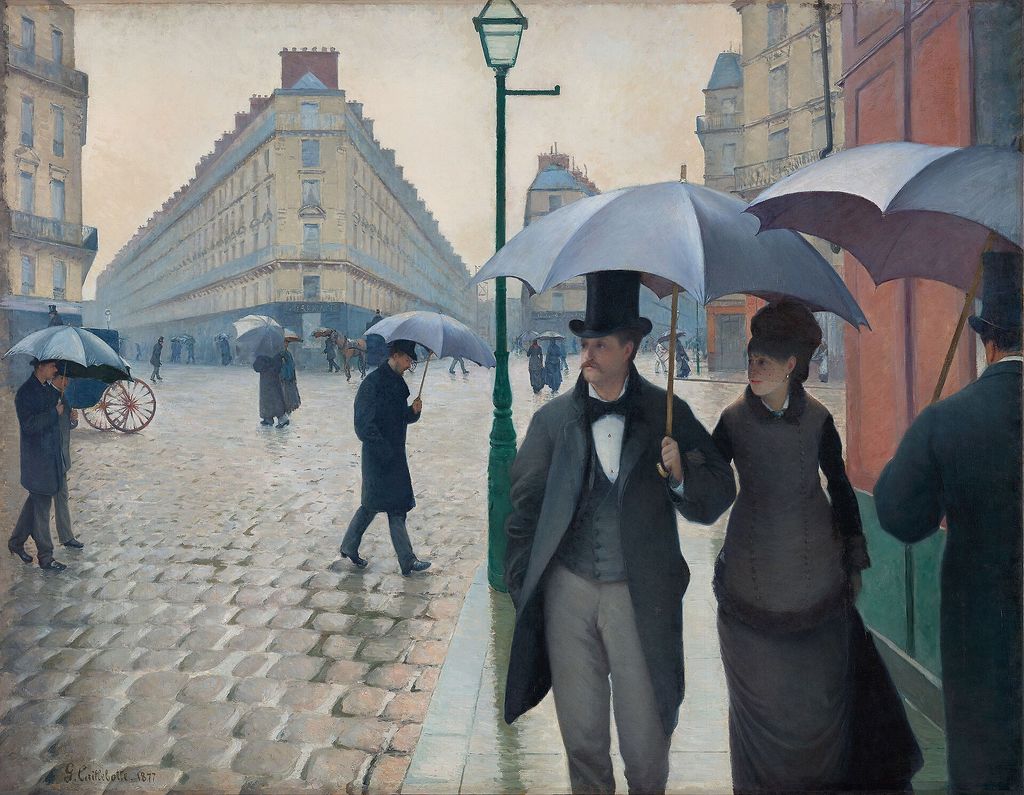
Caillebotte: umbrellas across the street
Gustave Caillebotte's Paris Street; Rainy Day, 1877, belongs to the Art Institute of Chicago, accession 1964.336.[7] A large couple approaches at right while smaller figures cross the wet paving and disappear between pale buildings.
Repeated umbrellas connect people who never form one compact group. The street's angled edges and building fronts continue through the open spaces, while blue-grey light settles over pavement, clothes and sky. Unlike Seurat's densely populated field, Caillebotte's unity depends on connections stretched across emptiness. Geometry and atmosphere let dispersed encounters read as one rainy urban scene.
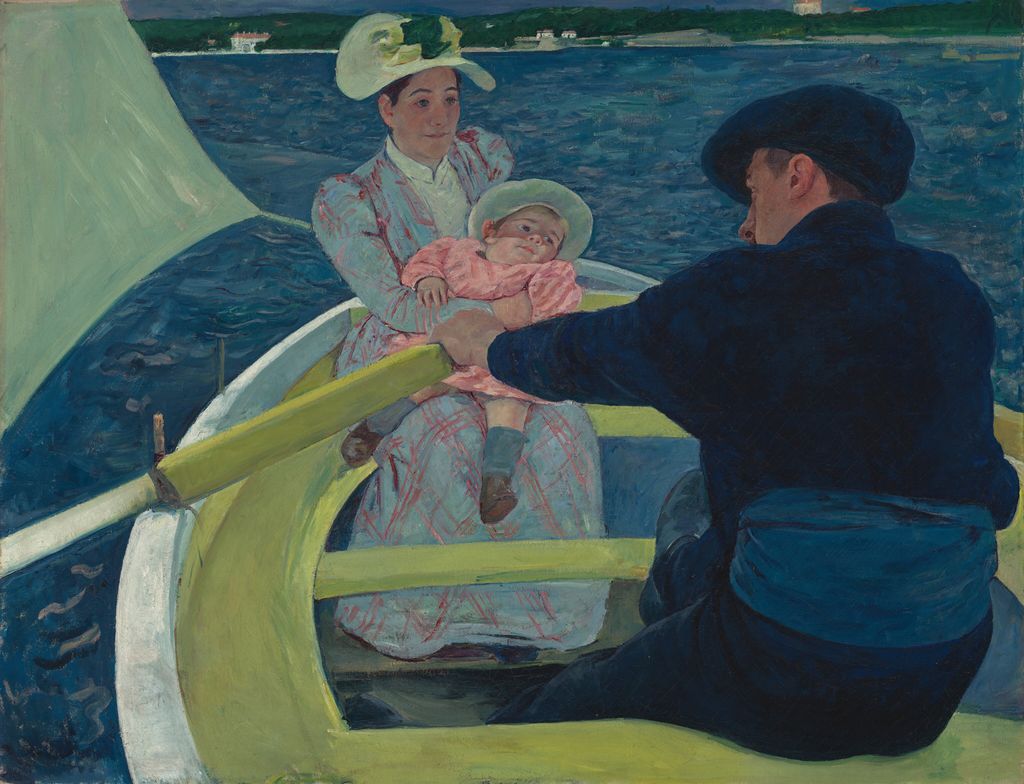
Cassatt: a compact group inside the boat
Mary Cassatt's The Boating Party, 1893/1894, is held by the National Gallery of Art, Washington, accession 1963.10.94.[8] A woman and child face a dark-clothed boatman inside a yellow boat, with blue water and a high horizon enclosing the scene.
The figures are different in scale, colour and orientation, yet overlap and interlocking shapes bind them into a compact unit. The boat's curving edge gathers the group, and the oar reaches across the surrounding blue. This is not a lesson about which figure dominates. It is about how three distinct bodies and a few large colour areas fit together without mirror symmetry.
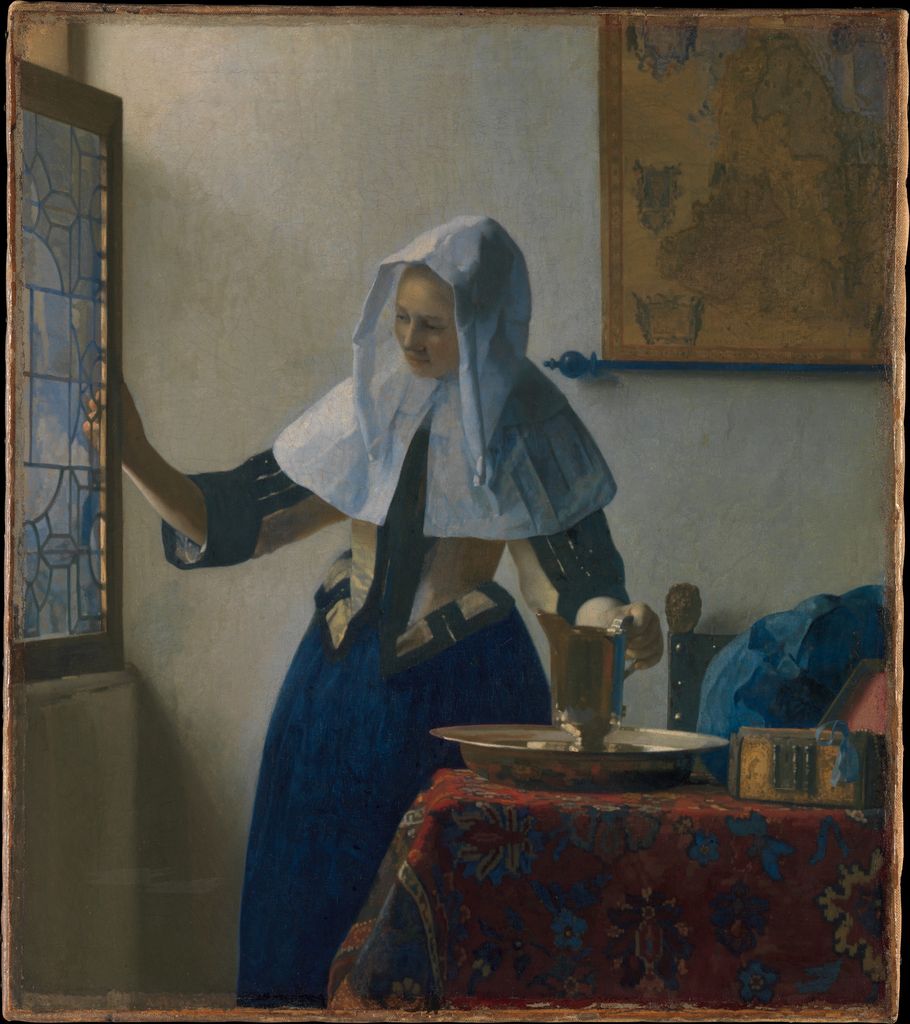
Vermeer: relationships in a quiet room
Johannes Vermeer's Young Woman with a Water Pitcher, ca. 1662, belongs to The Metropolitan Museum of Art, accession 89.15.21.[9] A woman stands between an open window and a table, with a wall map, basin and patterned cloth occupying the room around her.
Rectangular forms recur in the window, map, table edge and picture field. Pale light passes across the woman's linen, the wall and the metal vessel, while cooler blues and warmer reds remain related without becoming uniform. Proximity matters too: hand, pitcher, basin and window form a close network of actions and objects. Nothing has to be repeated mechanically for the interior to feel connected.
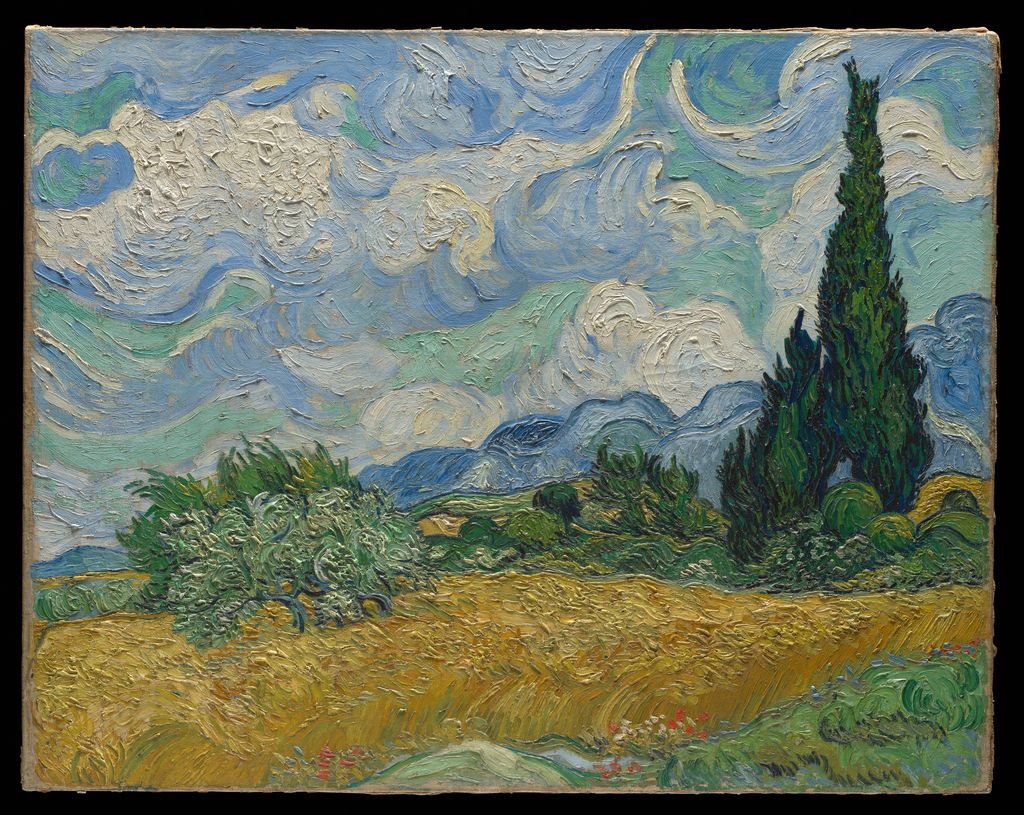
Van Gogh: one handling across changing zones
Vincent van Gogh's Wheat Field with Cypresses, 1889, is in The Metropolitan Museum of Art, accession 1993.132.[10] Yellow-green wheat, dark cypresses, blue hills and pale clouds divide the landscape into strongly different zones.
They belong together because related marks and colour families pass from one zone to another. Curving strokes appear in vegetation, distant land and cloud, while greens and blues recur with changing intensity. The marks do not make field, tree and sky alike; they give unlike things a common visual treatment. Pace and interval belong to Rhythm; directed eye path belongs to Movement. Here the useful observation is the shared handling that keeps the zones connected.
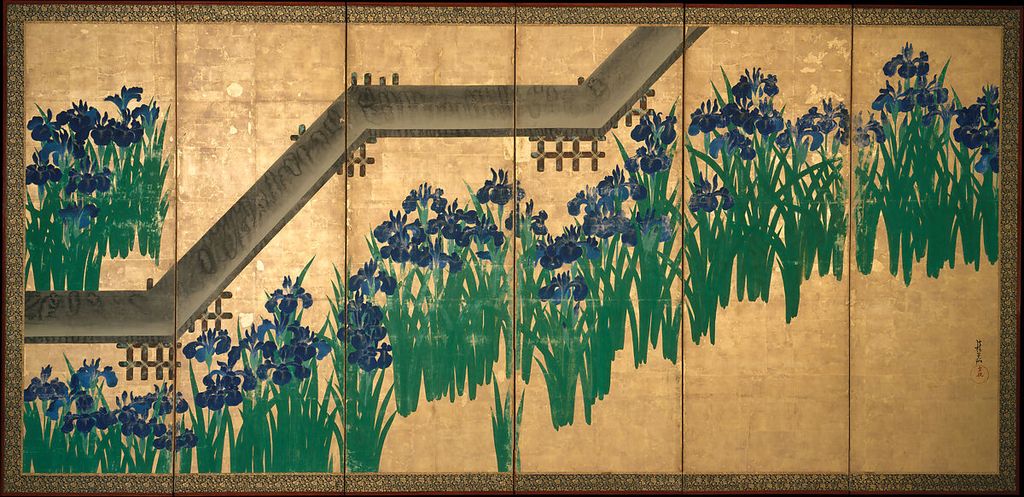
Kōrin: connection across two screens
Ogata Kōrin's Irises at Yatsuhashi (Eight Bridges), after 1709, is a pair of folding screens in The Metropolitan Museum of Art, objects 53.7.1 and 53.7.2.[11] Clusters of blue irises rise against gold while an angular bridge moves from one screen to the other.
The physical gap between the screens does not end the relationship. Iris leaves and bridge segments continue across it, and the gold ground gives both halves the same expansive field. The clusters change in density and position, so the pair does not depend on exact repetition. The floral recurrence remains visible; unity explains why the separate screens and intervals still read as a connected work.
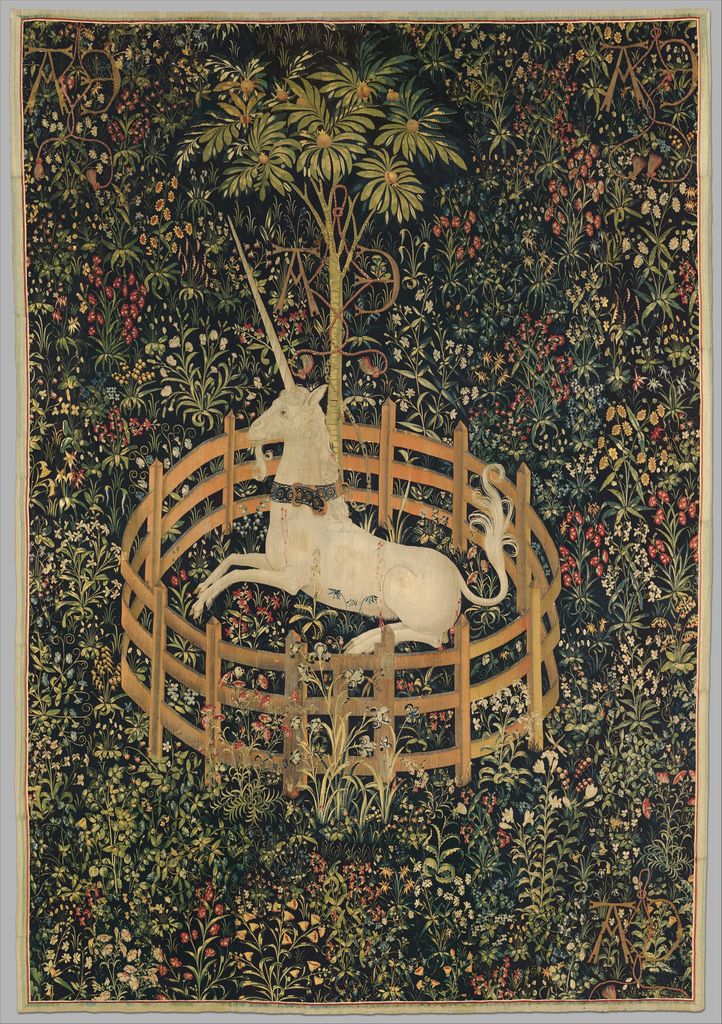
The Unicorn tapestry: variety inside an enclosure
The Unicorn Rests in a Garden (from the Unicorn Tapestries) was designed in France and woven in the South Netherlands between 1495 and 1505. The tapestry is in The Metropolitan Museum of Art, accession 37.80.6.[12] A white unicorn rests beneath a tree inside a low circular fence, surrounded by a dense field of flowering plants.
The flowers differ in shape, colour and scale, yet the enclosure, central tree and continuous dark ground let them belong to one field. Small details accumulate without becoming an unrelated catalogue. The unicorn provides a clear centre, but coherence reaches beyond it: foliage repeats in changing forms, the fence gathers the lower area, and the woven surface holds the varied materials together. Unity here accommodates abundance rather than suppressing it.
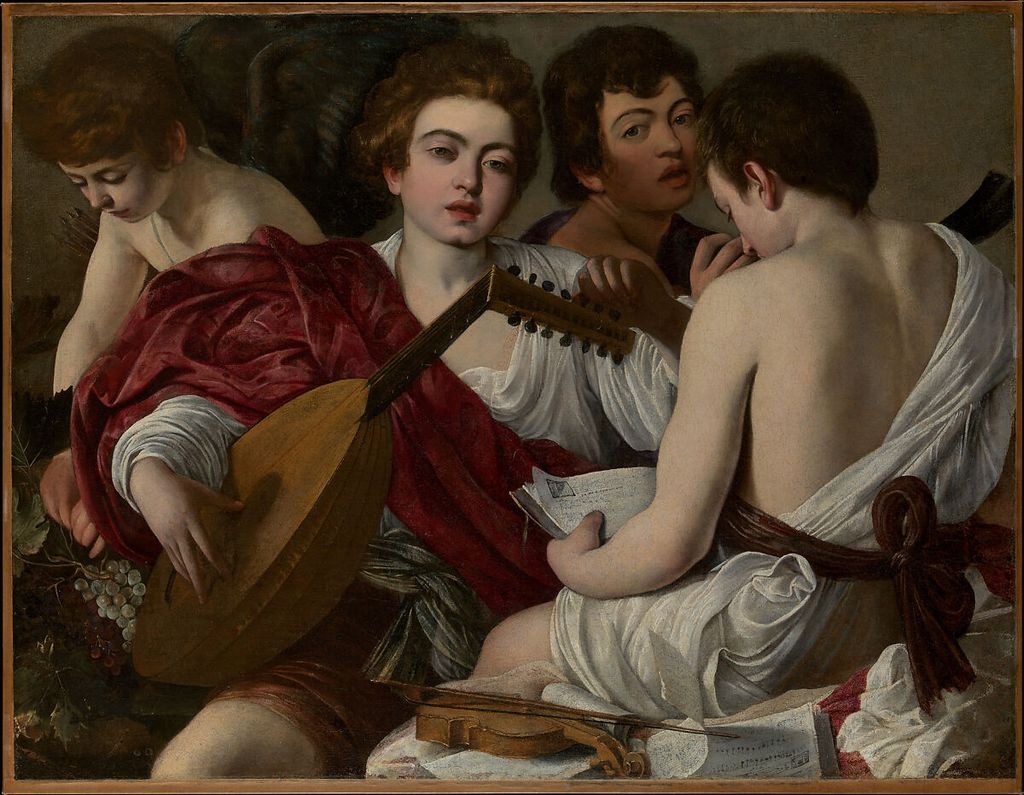
Caravaggio: four figures in close company
Caravaggio's The Musicians, 1597, belongs to The Metropolitan Museum of Art, accession 52.81.[13] Four half-length youths occupy a shallow dark space with instruments and sheet music.
Their bodies overlap, faces sit close together and hands meet the shared objects between them. Warm flesh, reds, whites and dark passages recur across the group, but the figures retain different poses and expressions. Instruments and music connect the gathering without requiring symmetry. Caravaggio makes proximity and overlap do much of the unifying work: the company feels compact while each person remains distinguishable.
Unity and neighbouring principles
Unity asks whether parts cohere; balance asks how visual weight is distributed. Emphasis establishes relative priority. Unity does not require low contrast; Contrast in Art describes perceptible difference rather than belonging.[3][4][5]
Pattern in Art concerns organised recurrence; repetition can connect separate areas, but a unified work need not contain an obvious recurring motif. Composition is broader: it concerns the complete arrangement in which all these relationships meet.
Related looking
The Principles of Art places unity beside other organising relationships. Variety, balance, rhythm, movement and composition offer further comparisons, while unity keeps the central question on how distinguishable parts belong together.
Focused subjects that remain distinct are Variety in Art; Balance in Art; Rhythm in Art; Movement in Art; Composition in Art. The two working comparison pages above extend different questions without completing this answer.
Look for unity yourself
Choose an unfamiliar artwork and ask what relates. Name a visible connection precisely: two distant blues, several rounded forms, a repeated edge or one kind of handling across different objects. Then ask what groups. Do overlap, proximity or enclosure make some parts read together?
Next, look for continuation. Follow any band, line, colour family or repeated treatment that crosses an interval. Finally, find the strongest difference in the work. Does it still belong? Point to the relationship that connects it rather than deciding from mood alone.
If the answer is yes, the work need not be tidy or uniform. Unity becomes useful when it helps explain how clearly different parts can remain themselves and still make one whole.
Watch: Unity through Formal Analysis
Choose a museum-led whole-work analysis, a close reading, or a foundations overview for considering unity.
Introducing Formal Analysis: Landscape
Follow how recurring shapes, colours and intervals contribute to a larger visual organisation.
Watch on YouTubeFrequently Asked Questions
Unity describes the relationships that allow distinguishable parts to read as a connected whole.
No. Differences in figure, colour, scale, texture or shape can remain visible within a unified work.
Usage varies, but unity is most useful here as a structural question about belonging, while harmony often suggests compatible or pleasing relationships.
Yes. Fragmentation, rupture or unresolved relationships can be intentional and meaningful.
Name several distinct parts, then trace the visible relationships—such as alignment, grouping, continuity or recurrence—that connect them.
Discussion
Which example on this page keeps its parts most visibly different while still making them belong together?
Reader Insights
Begin with at least three distinguishable forms or passages.
Look for alignment, grouping, continuity or a shared field.
Unity is clearest when it does not collapse everything into sameness.
Join the Conversation
Share one precise observation or a useful museum example below.
References
- Neuberger Museum of Art / Purchase College SUNY, “Activity — Principles of Art: Unity and Variety”
- BBC Bitesize, “What is unity?”
- J. Paul Getty Museum, “Understanding Formal Analysis — Principles of Design”
- Museum of Modern Art, “A Vocabulary for Discussing Art — Principles of Design”
- Massachusetts College of Art and Design, “Principles and Elements”
- Art Institute of Chicago, Georges Seurat, A Sunday on La Grande Jatte—1884, 1884–86
- Art Institute of Chicago, Gustave Caillebotte, Paris Street; Rainy Day, 1877
- National Gallery of Art, Mary Cassatt, The Boating Party, 1893/1894
- The Metropolitan Museum of Art, Johannes Vermeer, Young Woman with a Water Pitcher, ca. 1662
- The Metropolitan Museum of Art, Vincent van Gogh, Wheat Field with Cypresses, 1889
- The Metropolitan Museum of Art, Ogata Kōrin, Irises at Yatsuhashi (Eight Bridges), after 1709
- The Metropolitan Museum of Art, The Unicorn Rests in a Garden (from the Unicorn Tapestries), 1495–1505
- The Metropolitan Museum of Art, Caravaggio, The Musicians, 1597