by Tom Gurney
Tom Gurney BSc (Hons) is an art history expert with over 20 years experience
Page created on September 3, 2026 / Page updated on September 13, 2026
Email: tomgurney1@gmail.com / Phone: +44 7429 011000
How Heated Wax Carries Pigment, Builds Surface and Preserves Ancient Faces
Encaustic painting uses coloured pigment held in wax, usually beeswax. The word is associated with “burning in,” yet surviving ancient paintings and written descriptions do not point to one fixed recipe or one compulsory use of heat. Wax could be prepared and handled in different ways, and researchers distinguish between evidence for molten application, wax emulsions, brushes and harder tools.[1][2]
What makes encaustic immediately recognisable is not simply age or subject. Wax can carry translucent colour, glossy passages, thick ridges, incised marks and rapid brushwork within the same small panel. It cools into a substantial paint layer that can preserve the pressure of a tool. The medium's most famous survivors are portraits made in Roman Egypt, often fitted over the face of a wrapped mummy, but encaustic also has a longer ancient, late-antique and modern history.
At a Glance
- Core mediumpigment is combined with a wax-based binder and worked with controlled heat.
- Surface characterwax can remain thin and smooth, take incised detail, hold relief or receive gilding.
- Support mattersmany surviving ancient portraits were painted on wooden panels associated with mummy coverings.
- Not every wax objectanalysis of binder, support and technique is needed before assigning encaustic.
- Safetymodern heating, pigments and solvents require ventilation, temperature control and manufacturer guidance.
Contents
Materials, support and basic process
Pigment gives encaustic its colour; wax binds that pigment into a workable paint. A painter may warm the wax mixture, the support or the tools, then apply and fuse layers as needed. Modern practice often uses a heated palette and controlled reheating, but it is misleading to project every modern studio method onto antiquity. The Met notes evidence for hot and cold wax, underpainting, soft and hard tools and mixtures that may include resin, glue, egg, gum or oil.[1]
Rigid supports are practical because a thick wax layer can become vulnerable when repeatedly flexed. Many Roman Egyptian portraits use thin wood panels, including limewood. The panel might be prepared with glue, distemper or dark wax before the face and clothing were established. In some passages a thinner mixture could cover a background; thicker paint and tool work could model flesh, hair and jewellery.[2]
Heat remains central to many contemporary definitions because it melts and fuses the wax. Yet the safest historical claim is narrower: encaustic identifies a wax-based painting method whose exact preparation and application must be judged object by object. Conservation analysis is especially important when a label inherited from appearance alone may conceal mixed binders.[3]
Eight encaustic works to look at
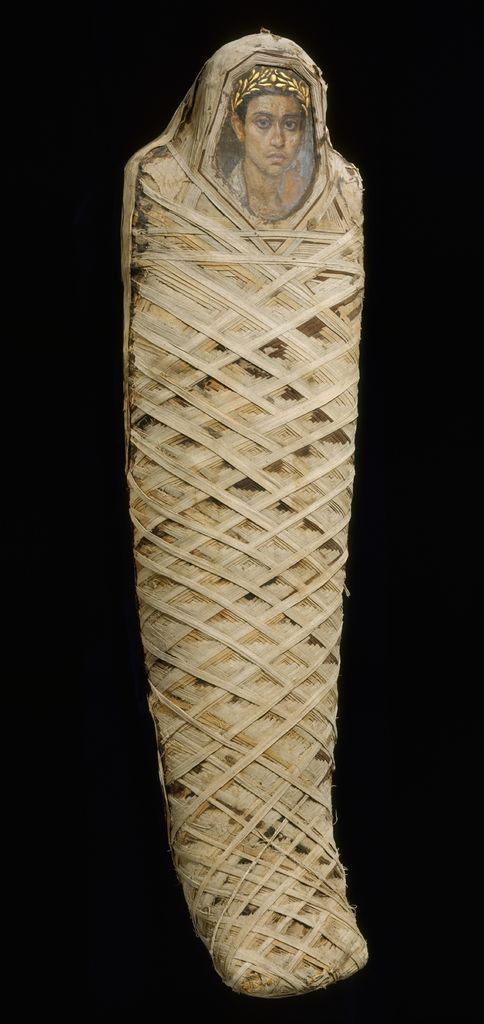
Mummy with an Inserted Panel Portrait of a Youth
This mummy from Roman Egypt, dated 80–100 CE, preserves the portrait in its funerary setting rather than presenting the painted panel alone.[4] The narrow limewood portrait is inserted over the wrapped face. Seeing panel, linen and body together makes clear that the image was part of a ritual object: it was not originally conceived as a detached gallery portrait.
The youthful face is modelled with warm and cool shifts while the hair, brows and lashes use more decisive dark marks. Wax allowed the painter to move between softened transitions and strokes that remain visible. The surrounding wrappings show why the panel's tapered form and unfinished lower edge could be functional.
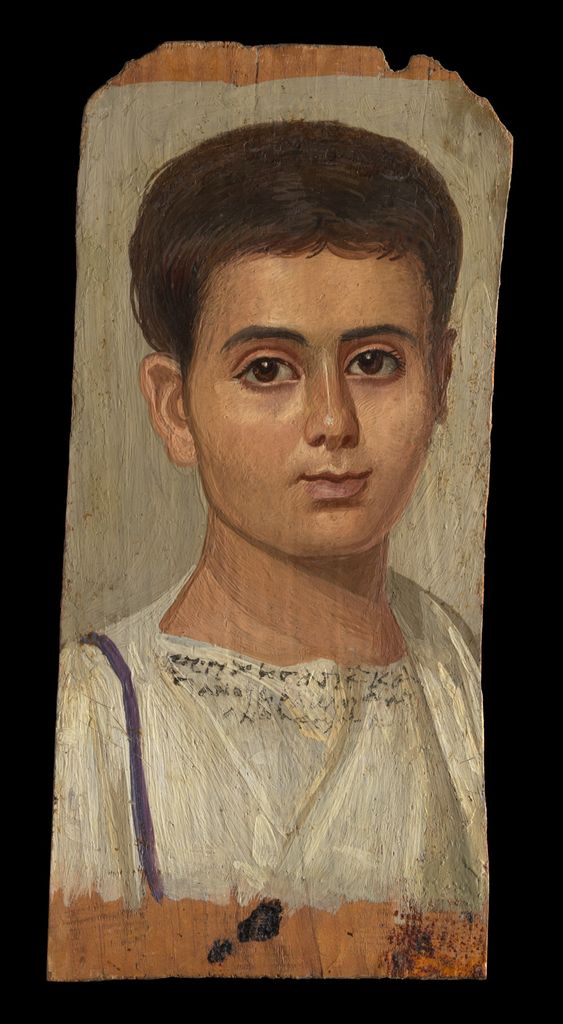
Portrait of the Boy Eutyches
The Portrait of the Boy Eutyches, dated 100–150 CE, is one of the rare mummy portraits to preserve an identifying inscription.[5] The boy turns slightly while his large eyes address the viewer. Smooth passages across the cheeks coexist with quick touches in the hair and clothing.
The portrait's fame can tempt us to read it as a modern personality study. Its directness is real, but it belonged to Roman Egyptian funerary culture. Encaustic helped create a compelling likeness within that setting; it did not detach the sitter from the social and religious world of the mummy.
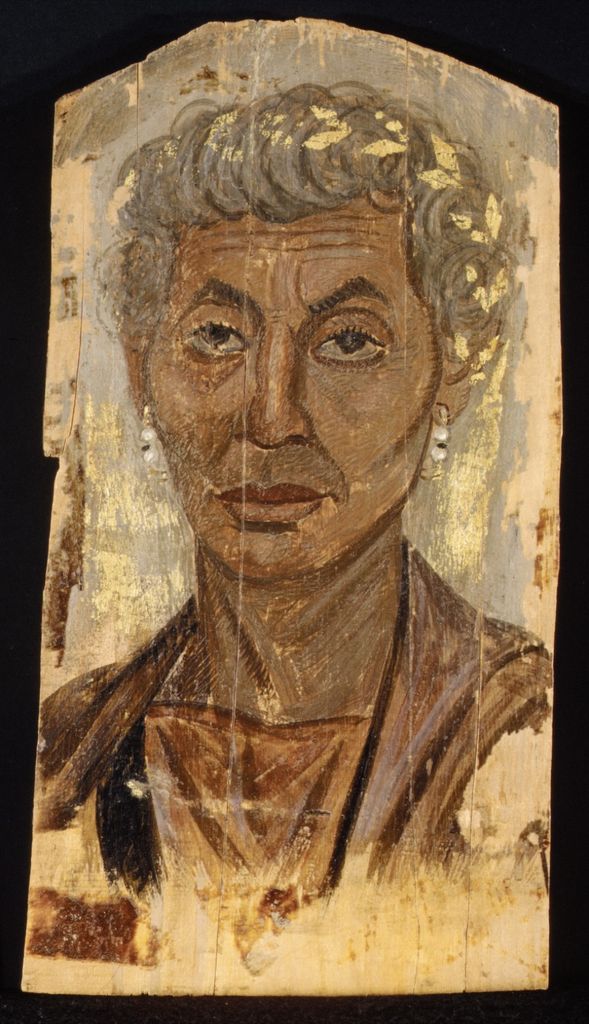
Portrait of an elderly lady with a gold wreath
Made around 100–125 CE, this portrait combines encaustic on limewood with the visual prestige of a gilded wreath.[6] Age is described through the long face, shadowed eyes and fine changes around mouth and cheeks. The wax surface carries both broad modelling and smaller descriptive marks.
Gold introduces a second material system. It catches light differently from pigmented wax and was associated with the transformed status of the deceased. The contrast between metallic wreath and painted flesh is therefore material, visual and funerary at once.
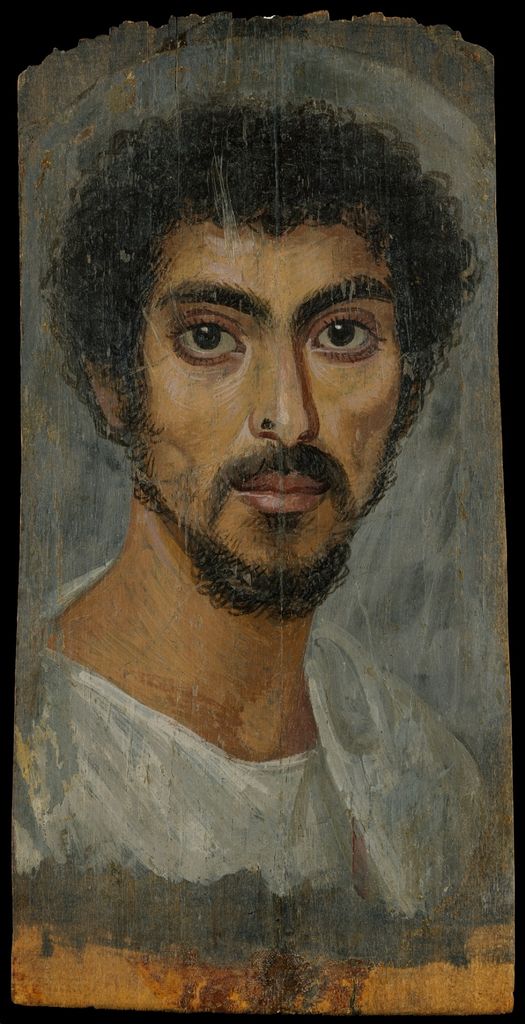
Portrait of a man with a mole on his nose
This portrait, dated 130–150 CE, shows how a small identifying feature can operate within a highly conventional panel shape.[7] The mole sits within carefully graded flesh, while the beard and hair are constructed from darker strokes. The sitter's turn and alert eyes create asymmetry without breaking the frontal encounter.
Wax does not make the surface uniformly thick. Some zones are thin and fluid; others catch tool pressure or build volume. Close looking should compare those local changes instead of describing the entire portrait as simply “smooth” or “impastoed.”
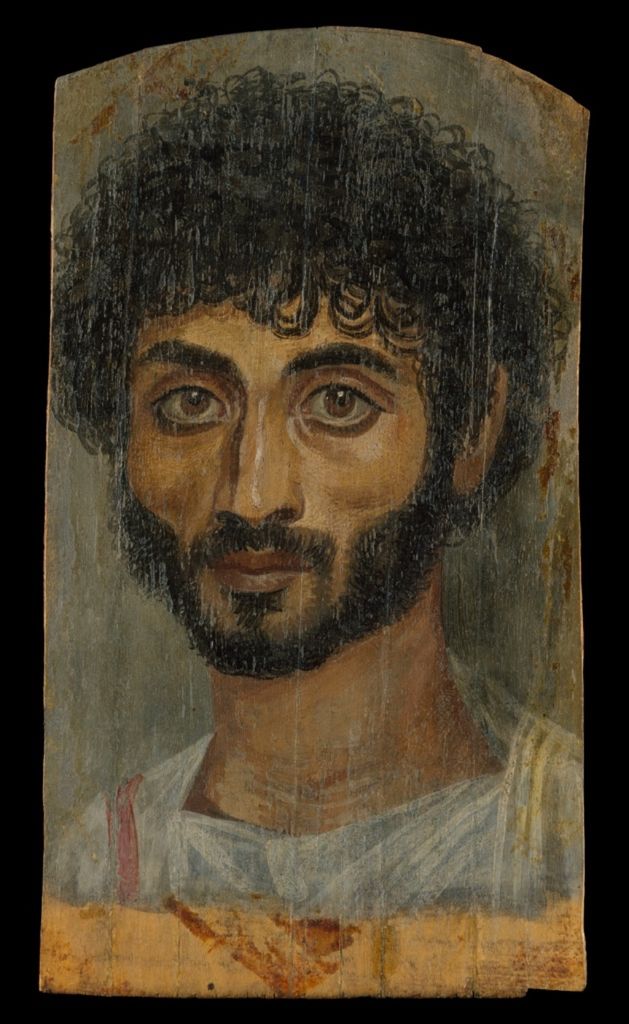
Portrait of a thin-faced man
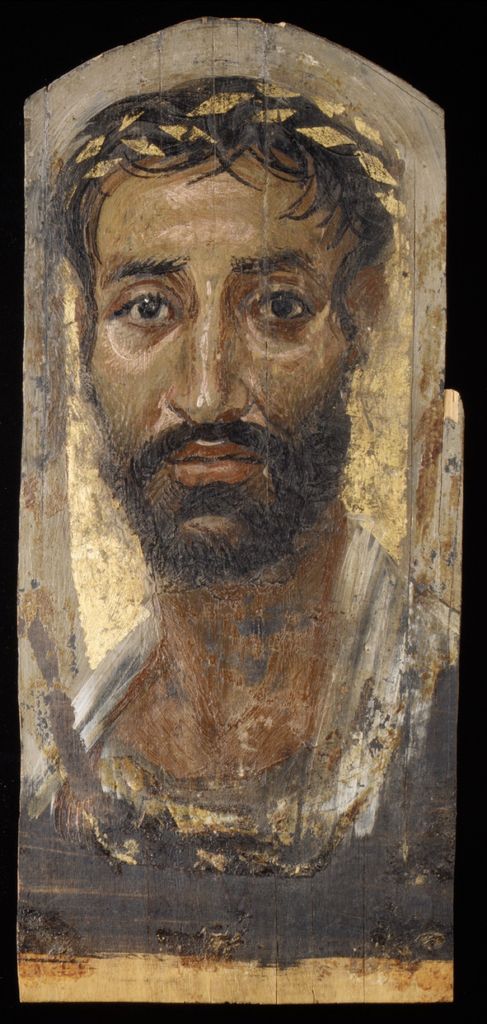
The Portrait of a thin-faced man, dated 140–170 CE, uses encaustic on limewood with gold leaf.[8] Free brushwork builds the hair and beard while light and shadow sharpen the narrow face. The wreath and background gilding were added after the panel entered the mummy wrapping, evidence that making continued beyond the painted portrait itself.
This sequence matters. The visible object joins workshop painting, funerary assembly and later material additions. Medium history includes those stages rather than isolating the wax layer from the completed mummy.
Portrait of a young woman in red
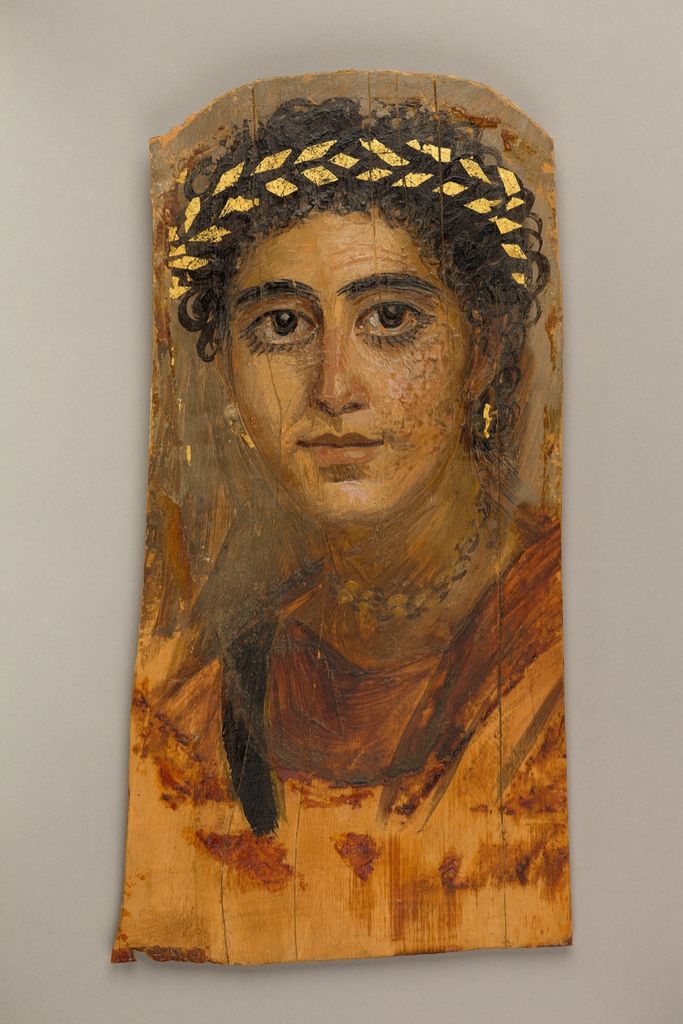
Made around 90–120 CE, the Portrait of a young woman in red uses wax paint and gold leaf on limewood.[9] Saturated red clothing supports a face modelled with flowing strokes and small highlights. Loose curls extend beyond the head, and gilding once heightened the background and jewellery.
The paint can look unexpectedly spontaneous because separate strokes remain legible. That resemblance to later oil painting is useful only as a visual comparison. Encaustic has its own binder, setting behaviour and historical context.
Portrait of a young woman with a gilded wreath
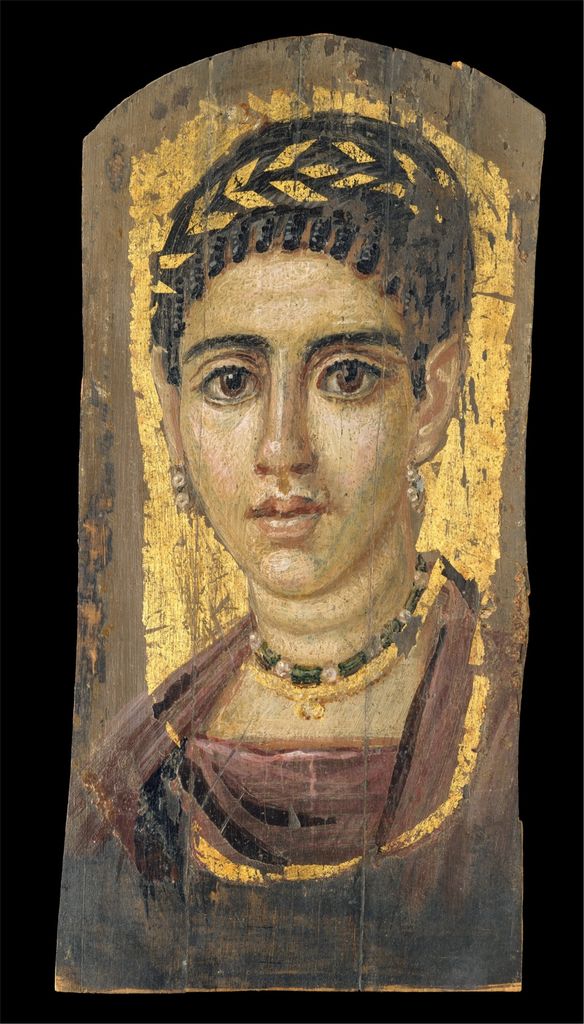
This panel, dated 120–140 CE, presents a young woman with jewellery and a gilded wreath.[10] Fine dark lines describe eyes and brows, broader strokes shape flesh, and gold supplies hard flashes beside the softer wax colour. The materials distinguish adornment without turning the face into a flat pattern.
The portrait also cautions against treating every mummy image as a direct record of appearance at the moment of death. Dress, jewellery, hairstyle and idealisation participated in public identity, status and remembrance.
Panel with Winged Figures
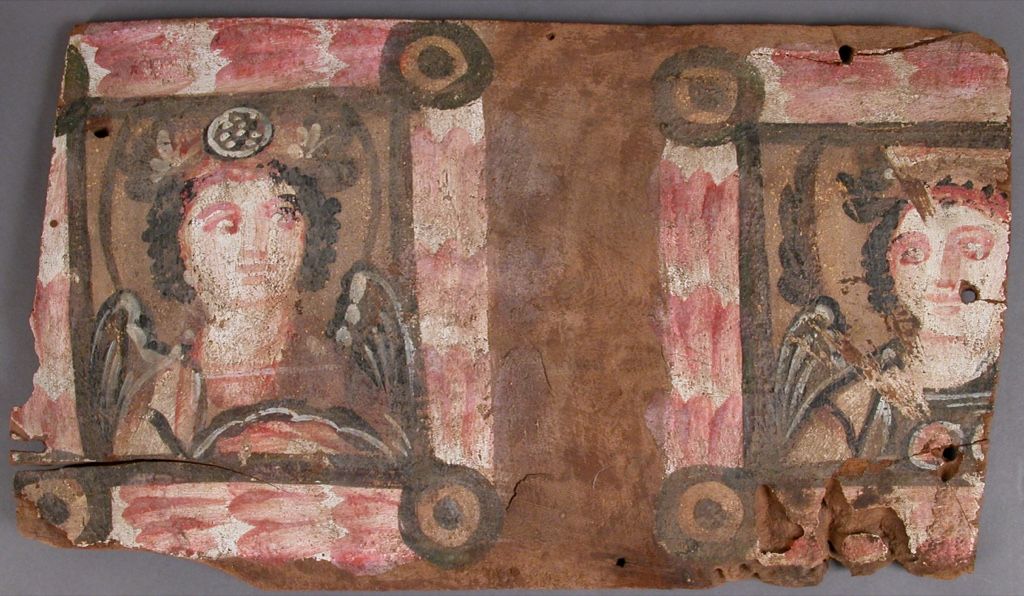
The fifth-century Panel with Winged Figures extends encaustic beyond the Roman Egyptian portrait group.[11] Two winged figures occupy a wooden panel with a frontal, emblematic clarity. The work belongs to a late-antique world in which wax painting could serve religious and decorative imagery as well as funerary portraiture.
Its survival helps bridge ancient panel practice and later icon traditions, but the historical line is not simple or continuous. Few ancient paintings survive, and labels such as “encaustic” encompass material variations that technical study continues to refine.
From antiquity to revival
Ancient Greek and Roman writers described wax painting, but the loss of most large-scale ancient painting left later artists and scholars to reconstruct the process. In eighteenth-century France, the Comte de Caylus and others promoted experiments intended to recover the ancient secret; a Rijksmuseum publication record preserves this revival context.[12]
Modern encaustic expanded again in the twentieth century. Artists valued wax for embedding, collage, scraping, translucency and relief as well as painted colour. Jasper Johns's flags and targets are widely known examples, but copyright and image rights require care; this page keeps its visible gallery to public-domain objects while acknowledging the modern history in text.
Contemporary studio practice can place wax on panels, combine it with paper or fabric, incise it, polish it or build substantial relief. These possibilities explain why encaustic appears in both painting and mixed-media labels. They do not make every wax-containing object an encaustic painting: the wax must play a binding or painted structural role.
Encaustic compared with tempera, oil and fresco
Encaustic and tempera can both appear on wooden panels, but wax and water-miscible binders set and reflect light differently. The Met's mummy-portrait exhibition describes many tempera portraits as matte and calligraphic beside glossier wax portraits, while also recognising mixed practices.[1] Oil paint uses a drying oil and remains workable through a different chemical process. Fresco binds colour into or onto plaster and is tied to an architectural support.
Those distinctions are material rather than stylistic guarantees. Encaustic can be smooth or heavily marked; tempera can be delicate or bold; oil can be glazed or thick; fresco can be highly finished or visibly divided by working days. The Art Mediums hub keeps binder, support and technique separate so comparisons remain precise.
How to recognise encaustic responsibly
Look for a substantial wax-like paint film, areas where strokes or tools remain embedded, and collection evidence naming wax or encaustic. Then check the support and date. Appearance alone is not proof: varnish, oil, resin and later treatment can also create gloss or thickness. A museum's current technical record is more reliable than a caption that merely calls every mummy portrait encaustic.
The strongest conclusion is often specific rather than universal: this passage seems brushed; that ridge preserves a tool; this gold was added during funerary assembly; this object contains mixed binders. Encaustic becomes richer when wax is treated as historical evidence, not a mysterious lost formula.
Watch: Encaustic Paint, Mummy Portraits and Wax Technique
Compare a practical wax-paint introduction with museum reconstructions rooted in Roman-period mummy portraits.
How to Paint in Encaustic
See wax-based paint heated, handled and fused in a contemporary studio demonstration.
Watch on YouTubeFrequently Asked Questions
Encaustic painting uses pigment in a wax-based binder, typically manipulated through controlled heating.
They preserve a substantial group of ancient painted likenesses whose materials, supports and funerary settings illuminate Roman-period Egypt.
No. Wax paint can be thin, matte, smooth, incised, layered, gilded or raised depending on formulation, handling and condition.
Encaustic uses wax as a principal binder, while tempera uses an aqueous emulsion such as egg; their drying, handling and surfaces differ.
Combine object records, technical analysis, support and surface evidence rather than relying on a wax-like appearance alone.
Discussion
Which encaustic work on this page uses wax most visibly as a material surface rather than only as a carrier of colour?
Reader Insights
Portrait panel, mummy covering and later independent artwork have different functions.
Incision, relief, translucency and gilding can reveal varied handling.
A glossy or aged surface alone does not establish the binder.
Join the Conversation
Share one precise observation or a useful museum example below.
References
- Metropolitan Museum of Art, “Ancient Faces: Mummy Portraits from Roman Egypt.” https://www.metmuseum.org/exhibitions/listings/2000/mummy-portraits
- Metropolitan Museum of Art, “Portrait of a thin-faced, bearded man.” https://www.metmuseum.org/art/collection/search/547856
- Getty, Mummy Portraits of Roman Egypt. https://www.getty.edu/publications/mummyportraits/downloads/SvobodaCartwright_MummyPortraits.pdf
- Metropolitan Museum of Art, “Mummy with an Inserted Panel Portrait of a Youth.” https://www.metmuseum.org/art/collection/search/547697
- Metropolitan Museum of Art, “Portrait of the Boy Eutyches.” https://www.metmuseum.org/art/collection/search/547951
- Metropolitan Museum of Art, “Portrait of an elderly lady with a gold wreath.” https://www.metmuseum.org/art/collection/search/547859
- Metropolitan Museum of Art, “Portrait of a man with a mole on his nose.” https://www.metmuseum.org/art/collection/search/547857
- Metropolitan Museum of Art, “Portrait of a thin-faced man.” https://www.metmuseum.org/art/collection/search/547858
- Metropolitan Museum of Art, “Portrait of a young woman in red.” https://www.metmuseum.org/art/collection/search/547860
- Metropolitan Museum of Art, “Portrait of a young woman with a gilded wreath.” https://www.metmuseum.org/art/collection/search/547861
- Metropolitan Museum of Art, “Panel with Winged Figures.” https://www.metmuseum.org/art/collection/search/453639
- Rijksmuseum, “Encaustic or Count Caylus's method of painting in the manner of the ancients.” https://www.rijksmuseum.nl/en/collection/publication/Encaustic-or-Count-Cayluss-method-of-painting-in-the-manner-of-the-ancients-to-which-is-added-a-sure-and-easy-method-for-fixing-of-crayons--7e120139668bd8eff4ce4fda33de67f8