by Tom Gurney
Tom Gurney BSc (Hons) is an art history expert with over 20 years experience
Email: tomgurney1@gmail.com / Phone: +44 7429 011000
Seven Visual Questions That Open Up Any Artwork
The seven elements of art used in this guide are line, shape, form, space, colour, value and texture. They are the visual building blocks you can look for in an artwork: the path of a mark, the edge of an area, the sense of volume, the gaps around objects, the colours you see, the movement from light to dark and the character of a surface.[1][2]
Knowing these terms gives you a practical way to begin looking. You do not need to identify every element in every work. Start with the feature that catches your attention, describe it as precisely as you can, and then notice what it does beside the other features.
Teaching lists vary between museums and art courses. The Smithsonian National Portrait Gallery vocabulary treats these seven separately, while Getty groups value within colour and the National Gallery of Art uses a five-element teaching set.[1][2][3] Here, the seven-part model keeps closely related ideas distinct without suggesting that it is the only possible system.
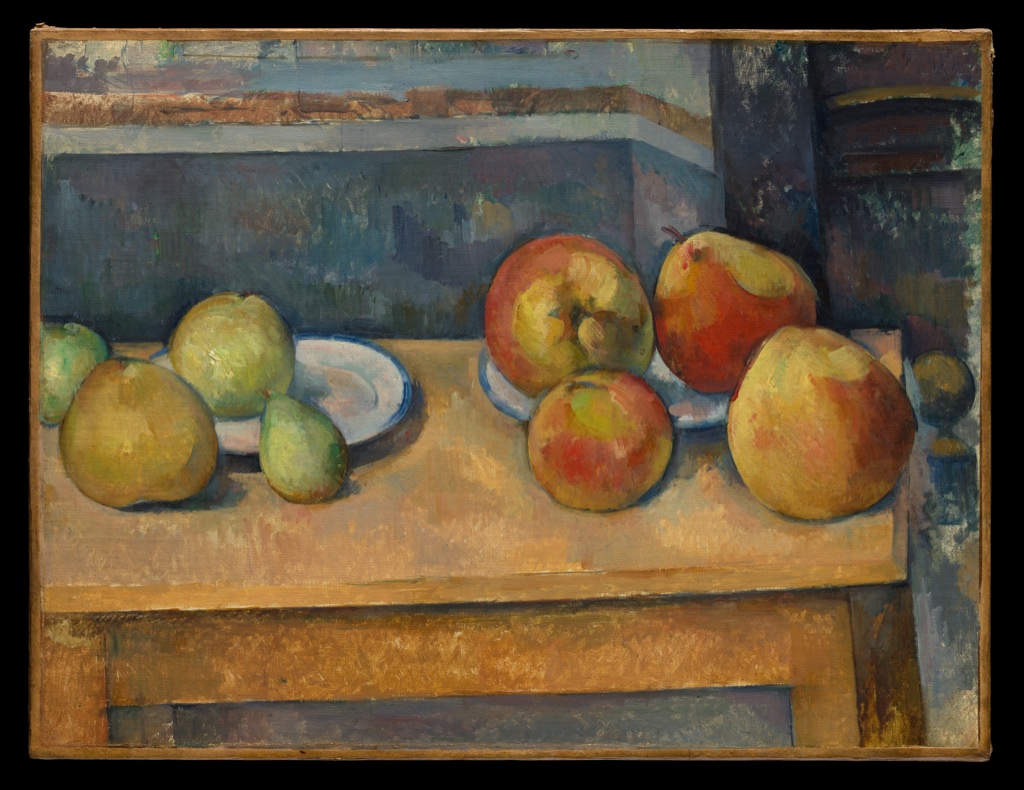
Paul Cézanne · Still Life with Apples and Pears · ca. 1891–92 · The Metropolitan Museum of Art · 61.101.3 · Public Domain. A single still life can be read through every element: enclosed shapes, implied form, intervals, colour, value, painted texture and directional edges. Source details.
At a Glance
- Linea mark or path with direction.
- Shapea flat area enclosed by an edge.
- Formactual or represented three-dimensional volume.
- Spaceareas in, around and between forms.
- Colour and valuehue relationships and relative lightness or darkness.
- Texturethe actual or implied character of a surface.
Contents
The seven elements at a glance
Line
A line is a mark or path with length and direction; it may be narrow or broad, straight or curved, steady or broken. In Albrecht Dürer's The Rhinoceros, firm outlines and dense hatching make the animal's body feel both solid and intricately patterned.[1][2]
Shape
A shape is a flat area enclosed by an edge or line, so it has height and width but no actual depth. The plates, fruit and table edges in Paul Cézanne's Still Life with Apples and Pears can first be read as overlapping shapes before they begin to suggest solid objects.[1][2]
Form
Form has height, width and depth: the Statue of Gudea occupies real three-dimensional space, while Cézanne suggests rounded fruit on a flat canvas. Looking for form means asking where volume is physically present and where light, colour or contour makes us imagine it.[1][2]
Space
Space includes the areas in, around and between forms, as well as the impression of depth within a flat image; Cézanne's tilted tabletop and the open area around Gudea offer two very different spatial experiences. Positive space is occupied by the main subject, while negative space is the area that surrounds it.[1][2]
Colour
Colour begins with the hues we perceive through reflected light, then becomes richer as those hues vary in intensity and in their relationship to light and dark. In Claude Monet's Rouen Cathedral, West Façade, Sunlight, blues, creams, pinks and golds make the stone façade seem to shift in changing illumination.[2]
Value
Value means relative lightness and darkness, not price or artistic worth. Dürer's black lines, pale paper and closely worked areas create a wide range of values that separates the rhinoceros from the page and gives its patterned hide weight.[1][2]
Texture
Texture may be actual—the physical quality of a surface—or implied, when marks make a surface look rough, smooth, hard or soft. The diorite of the Gudea sculpture has a real polished surface, while Dürer's cut lines simulate bristles, scales, folds and armour-like plates.[1][2]
How the elements work together
The elements are easiest to define one at a time, but artworks rarely keep them apart. A change in line can alter a shape. A shift in value can make a shape appear three-dimensional. Colour can pull an area forward, while the space around it can make the same area seem isolated or crowded. Texture may come from the material itself or from a pattern of marks that also affects value.
This overlap is what makes the vocabulary useful. Instead of hunting for a single correct label, you can follow a chain of observation: a dark contour encloses a shape; lighter passages give it form; repeated marks suggest texture; the empty field around it changes its visual weight. Each term gives you a different question to ask of the same work.
Four artworks, seven ways of seeing
Cézanne: shape becoming form
Paul Cézanne's Still Life with Apples and Pears, ca. 1891–92, is held by The Metropolitan Museum of Art, accession 61.101.3.[5] Rounded fruit sits among white plates, folded cloth and sharply angled furniture. The circles and ovals are easy to recognise as shapes, yet patches of green, yellow, red and shadow make them swell into implied form. The table does not settle into one simple viewpoint: its edges tilt, objects overlap and intervals open between them, so space feels constructed piece by piece rather than measured from a single fixed position.
Paul Cézanne · Still Life with Apples and Pears · ca. 1891–92 · The Metropolitan Museum of Art · 61.101.3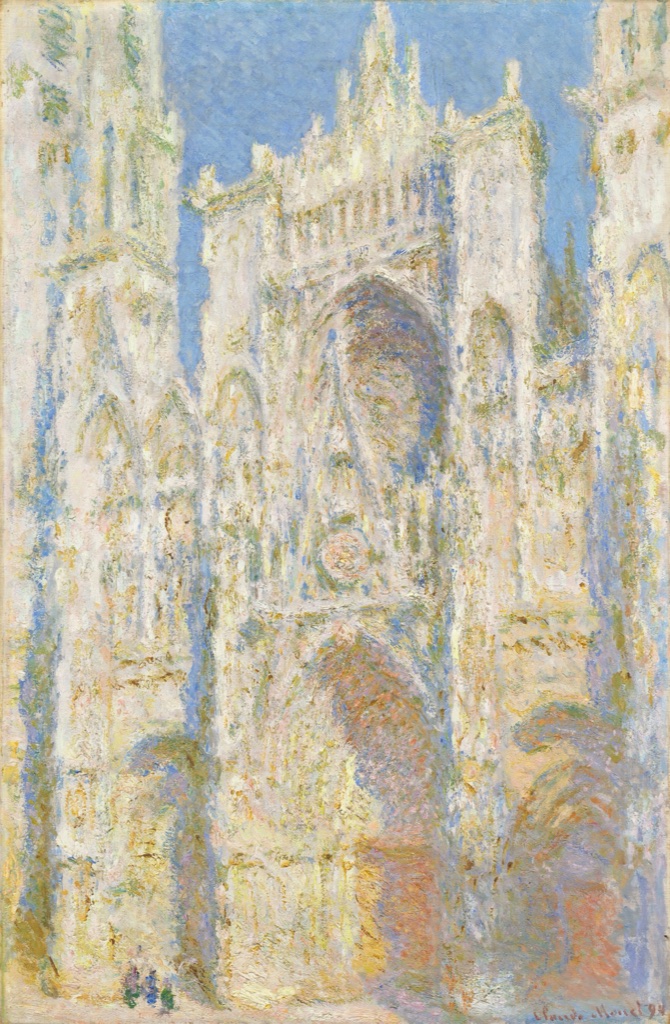
Monet: colour changing value and texture
Claude Monet's Rouen Cathedral, West Façade, Sunlight, 1894, belongs to the National Gallery of Art, Washington, accession 1963.10.179.[6] From a distance, the cathedral reads as a pale vertical mass against blue sky. Closer looking reveals broken strokes of cream, pink, gold and blue. Darker touches gather in doorways and carved recesses; lighter passages spread across projecting stone. Colour and value make the façade advance and recede, while the visible brushwork gives solid architecture an almost shimmering texture.
Claude Monet · Rouen Cathedral, West Façade, Sunlight · 1894 · National Gallery of Art, Washington · 1963.10.179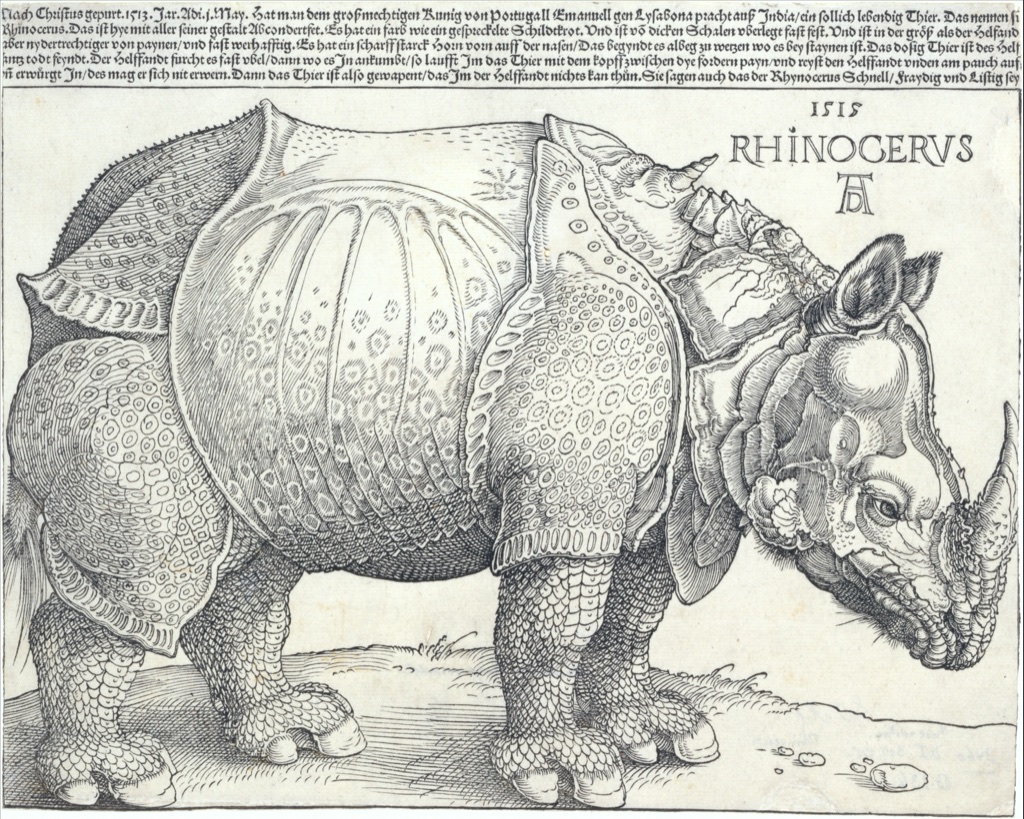
Dürer: line inventing a surface
Albrecht Dürer's The Rhinoceros, 1515, is a woodcut in The Metropolitan Museum of Art, accession 19.73.159.[7] A strong outer contour fixes the animal's broad shape, then smaller lines divide its hide into plates, folds, scales and patches of hair. Close hatching creates darker values beneath the body and around the legs, while pale gaps keep neighbouring patterns distinct. The surface looks rough and varied even though the print itself is ink on paper: an especially clear example of line creating implied texture.
Albrecht Dürer · The Rhinoceros · 1515 · The Metropolitan Museum of Art · 19.73.159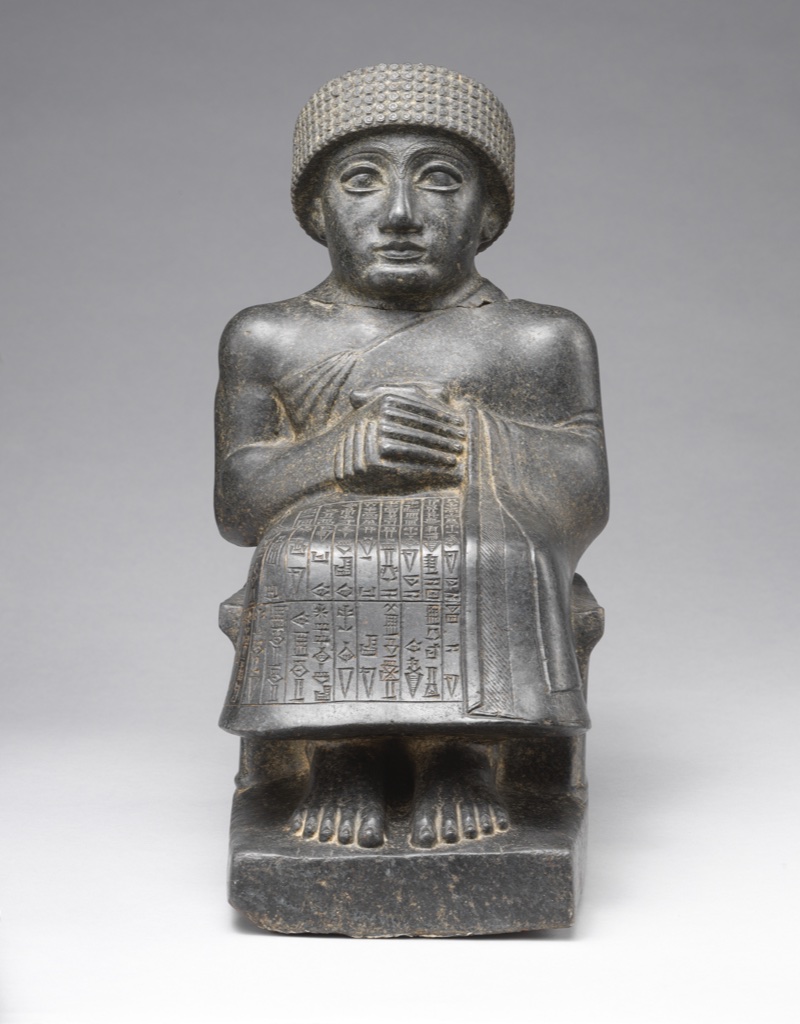
Gudea: form occupying space
The Statue of Gudea, named “Gudea, the man who built the temple, may his life be long”, ca. 2090 BCE, is a Neo-Sumerian work whose creator is not identified in The Metropolitan Museum of Art's collection record; its accession number is 59.2.[8] The dark diorite figure has weight and volume on every side, even when seen in a frontal photograph. Folded hands project from the robe, the patterned cap circles the head and incised cuneiform travels across the garment. Those changes in surface catch light differently, while the silhouette makes the unoccupied space around the seated body part of how its form is perceived.
Creator not identified in the collection record · Statue of Gudea, named “Gudea, the man who built the temple, may his life be long” · ca. 2090 BCE · The Metropolitan Museum of Art · 59.2Elements, principles and composition
Elements name the visual components you can observe. Principles describe ways artists organise and relate those components, while composition is the arrangement you encounter across the work as a whole.[2][4] A repeated line, for example, is an element; the rhythm created by its repetition concerns a principle; its placement among all the other parts contributes to the composition.
Keeping those levels distinct helps close looking stay clear. Begin by describing what is present, then consider the relationships that guide attention, and finally step back to see how the complete arrangement holds together.
Explore each element
The complete Elements of Art directory separates the broad vocabulary into eight focused subjects. Positive and Negative Space appears separately because it is a specific relationship within the wider element of space.
Watch: The Elements from Overview to Detail
Choose a complete introduction, a close study of line quality, or a lesson focused on shape.
Elements of Art: Introduction
Meet the visual vocabulary and see how its parts support practical looking and making.
Watch on YouTubeKeep looking
When you meet an unfamiliar artwork, begin with a slow scan from edge to edge. Notice the strongest line and the largest shape. Ask whether the forms have real depth or whether volume is being suggested on a flat surface. Look at what occupies the image and what has been left open around it.
Then narrow your attention. Where are the lightest and darkest values? Which colours seem to come forward or fall back? Does the surface have a physical texture, or do the artist's marks make you imagine one? Finally, bring the observations together and ask how changing any one of these features would alter the whole work.
The elements are most useful when they return you to something visible and specific. For more routes into artists, paintings, drawings and foundational ideas, continue through Art Topics.
Frequently Asked Questions
The seven elements used in this guide are line, shape, form, space, colour, value and texture.
Teaching systems group related ideas differently. Some treat value within colour or use a smaller introductory set, while the seven-part model keeps closely related visual questions separate.
Shape describes a flat enclosed area with height and width. Form has actual or represented depth as well as height and width.
Value means relative lightness and darkness. It operates within colour but can also be studied independently, including in monochrome work.
Start with one visible feature, describe it precisely, then follow how it interacts with other elements and contributes to principles such as contrast, balance or emphasis.
Discussion
Which element do you notice first in an artwork, and what does it help you see next?
Reader Insights
Name a visible line, shape, colour, value, texture, form or interval before deciding what it means.
Notice how one element changes another: value creates form, line encloses shape or space alters visual weight.
Use the same element to ask a consistent question of very different media and periods.
Join the Conversation
Share one precise visual observation from a work you know.
References
- Smithsonian National Portrait Gallery, “Art Vocabulary — Elements of Art”
- J. Paul Getty Museum, “Understanding Formal Analysis — Elements of Art”
- National Gallery of Art, “The Elements of Art”
- J. Paul Getty Museum, “Understanding Formal Analysis”
- The Metropolitan Museum of Art, Paul Cézanne, Still Life with Apples and Pears, ca. 1891–92
- National Gallery of Art, Claude Monet, Rouen Cathedral, West Façade, Sunlight, 1894
- The Metropolitan Museum of Art, Albrecht Dürer, The Rhinoceros, 1515
- The Metropolitan Museum of Art, Statue of Gudea, ca. 2090 BCE
- Quarto, Susie Hodge, Elements of Art. Publisher record.
- Phaidon, E. H. Gombrich, The Story of Art. Publisher record.
- Children's Museum of the Arts, “Elements of Art: Introduction.” Watch on YouTube.
- Children's Museum of the Arts, “Elements of Art: Line Quality.” Watch on YouTube.
- KQED Art School, “Elements of Art: Shape.” Watch on YouTube.