by Tom Gurney
Tom Gurney BSc (Hons) is an art history expert with over 20 years experience
Email: tomgurney1@gmail.com / Phone: +44 7429 011000
How Flat Shapes Become Convincing Volume
Form in art is actual or represented three-dimensional volume: something understood as having height, width and depth. A sculpture has form because it physically occupies space. A painter or printmaker can represent form on a flat surface so convincingly that an object appears rounded, faceted, heavy or hollow.[1][2][3]
This makes form different from shape. A shape has height and width; a form adds depth. A circle is a shape, while a sphere is a form. A square is a shape, while a cube is a form. In an artwork, the distinction is not always tidy: a flat outline may be the first clue to a volume that light, overlap or changing planes gradually make visible.[1][2]
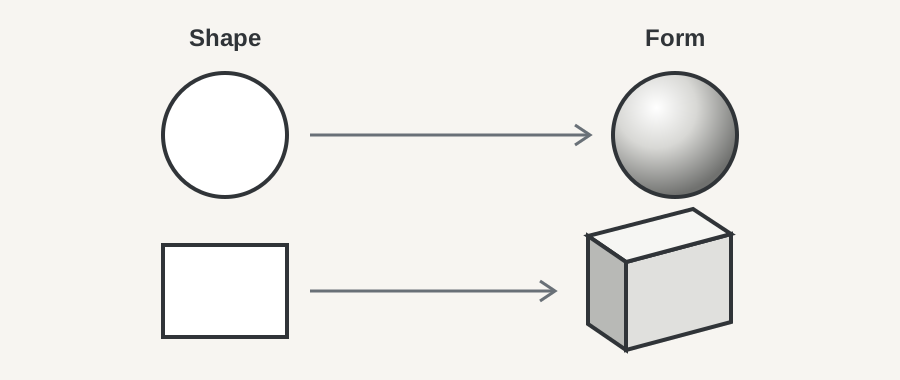
Artists and museums do not use one universal numbered list of form types. It is more useful to ask how volume is present. Is it actual or represented? Does it appear regular and geometric, irregular and organic, or some combination? In sculpture, does it read as relatively dense and closed, or does surrounding space enter and participate in it? These are different ways of describing form, not one fixed taxonomy.[1][2][4]
Here, form does not mean an art form such as painting, sculpture or printmaking, and it does not mean a genre. It names the visual element of volume. That narrow meaning gives us something concrete to test: even before we know what a depicted object is, we can notice whether it feels flat, rounded, hollow, block-like or built from several turning planes.
At a Glance
- Core ideavolume with height, width and depth.
- Actual forma physical object that occupies space.
- Represented formvolume suggested on a flat surface.
- Main cluescontour, value, overlap, planes and foreshortening.
- Useful contrastshape is two-dimensional; form adds depth.
Contents
Shape and form
A silhouette can be read as a flat shape even when it belongs to a solid object. Walk around a sculpture and that silhouette changes: a shoulder overlaps a torso, a cheek turns away, and a projecting feature comes into view. Those changing relationships reveal actual form. Sculpture is therefore an especially direct place to encounter volume, although a solid object may still present a strong flat outline from one position.[1][2]
In a painting or print, nothing projects beyond the physical surface in the same way. The artist instead represents—or implies—form. Light and dark can make a rounded surface appear to turn; angled planes can suggest a block; contour and overlap can separate front from side. The resulting volume is perceptual rather than physically present in the depicted object.[2][5]
Geometric and organic or biomorphic are helpful descriptive words. A sphere, cube or cone has regular, named geometry. A head, fruit or folded body is usually more irregular and organic. Many artworks combine both qualities, so these terms should open up looking rather than force every form into a single category.[1][2]
Six questions for recognising form
When form is not immediately obvious, begin with the work in front of you and ask:
- Is the volume actual or represented? Does the object physically occupy space, or does a flat image make depth appear?
- What happens at the contour? Notice where the silhouette turns, swells, narrows or breaks.
- Where do light and dark reveal planes? Look for gradual rounding as well as abrupt changes of angle.
- How are front, side and depth made legible? Overlap, foreshortening and adjoining planes can all help.
- What qualities does the volume have? It may be regular and geometric, irregular and organic, or a mixture.
- In sculpture, how does space participate? Does the object read as dense and closed, or do openings let space pass through it?[1][2][4][5]
Use the questions selectively: a single work may answer only two or three of them clearly. Their purpose is to move from naming an object—head, cup, card—to describing why it reads as a volume.
It can help to separate evidence from conclusion. “The face is a form” is a conclusion. “The cheek shifts from light to shadow, the nose projects beyond the far cheek, and the jaw changes the silhouette” identifies the evidence. That kind of description also works when the volume is unfamiliar or partially abstracted.
Actual form: mass, planes and silhouette
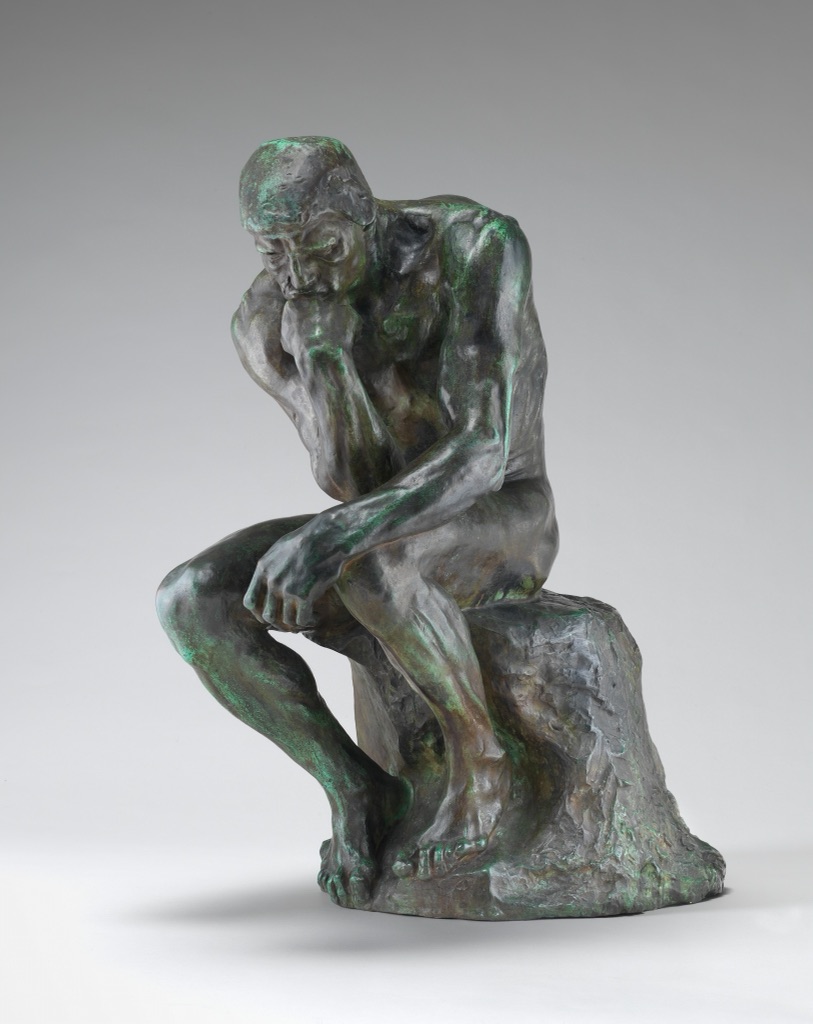
Rodin: a body gathered into mass
Auguste Rodin, The Thinker (Le Penseur), model 1880, cast 1901, is in the National Gallery of Art, Washington (accession 1942.5.12).[6] The bronze figure bends forward, but the pose is not a flat curve. A projecting elbow, folded legs and the turn between chest and back gather the body into a compact, twisting mass. Follow the outer edge from head to shoulder to knee: each change in silhouette hints at another side of the actual form.
The figure is recognisably organic, but its volume is not soft or vague. Knees, forearms and back press together in a structure that feels compressed and weight-bearing. The work shows why geometric and organic are qualities rather than mutually exclusive boxes.
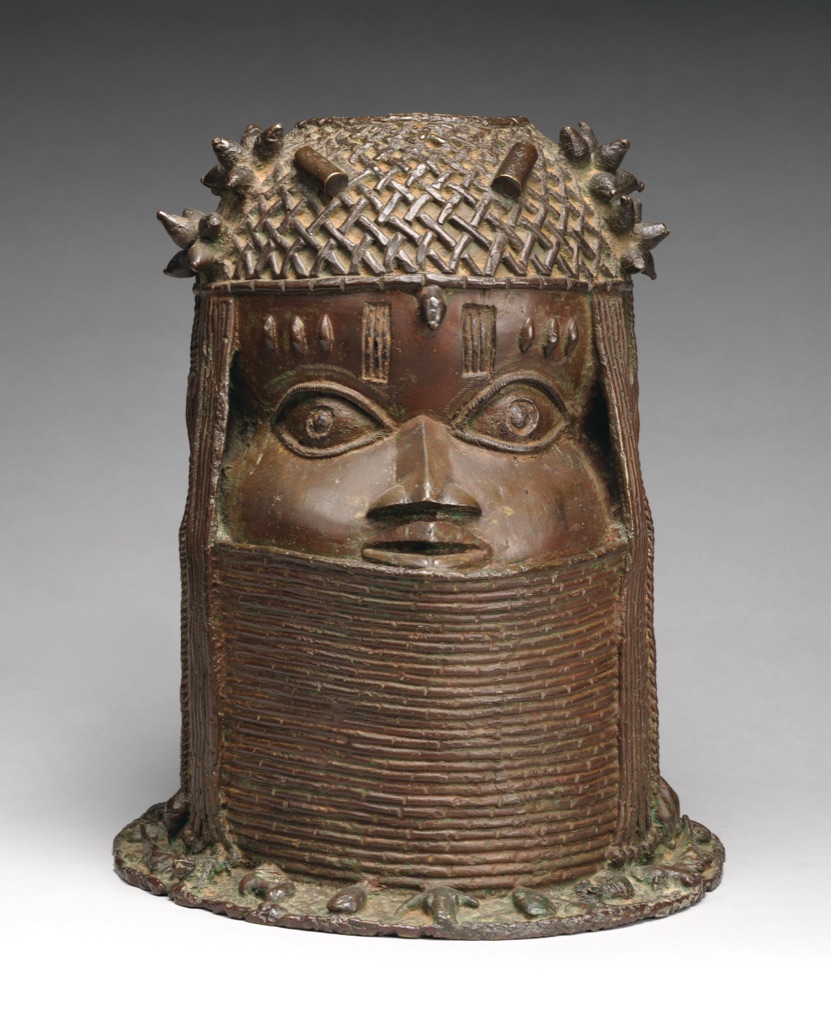
Benin: volume built outward
Ùhúnmwèlaò (head of an ọ́bà) was made in the 19th century by Ìgùn Ẹ́rọ̀nwwọ̀n brass-casting guild artists of the Edo peoples, Court of Benin, Nigeria. It is in the Metropolitan Museum of Art (accession 1977.187.37).[7] Its cylindrical neck establishes a firm central mass. Eyes, lips and the high patterned crown project from and build upon that volume. Regular bands and organic facial forms belong to one object without becoming the same kind of form.
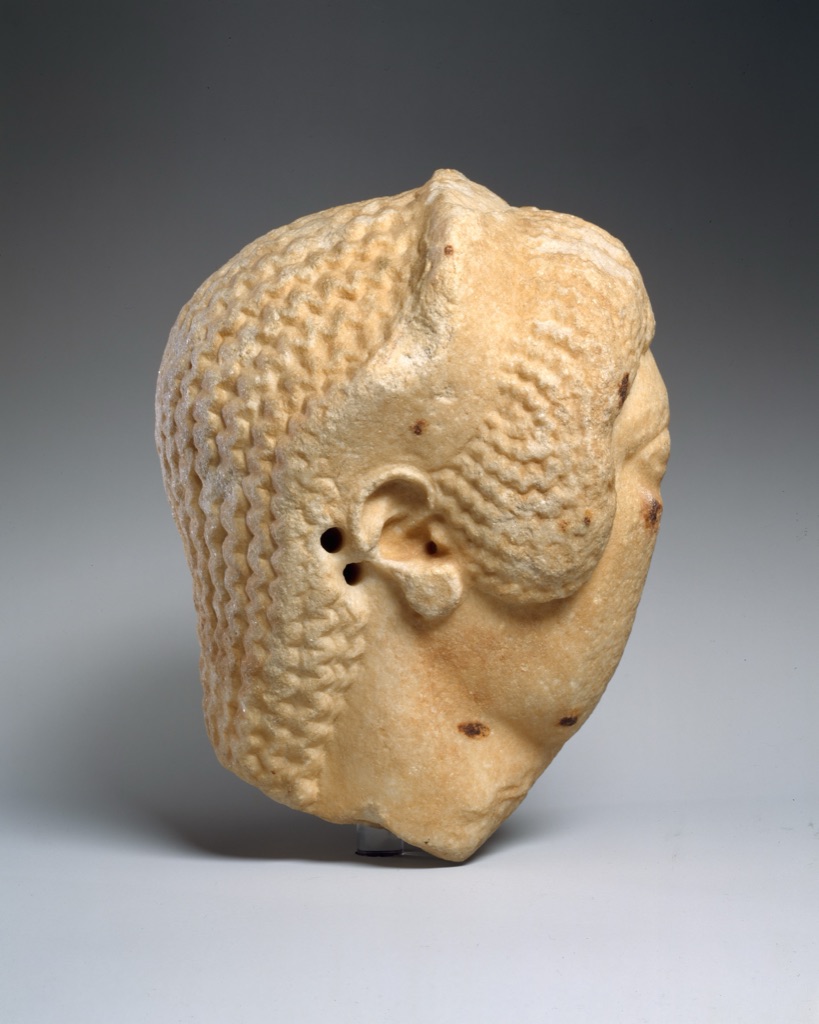
Greek marble: a turn held in stone
The creator of the Greek Marble head of a woman, probably Cycladic or northern Ionian and made in the late 6th century BCE, is not identified. The work is in the Metropolitan Museum of Art (accession 1991.11.7).[8] The head turns slightly, so its two sides do not present equal shapes. Broad cheek, brow and nose planes catch light differently, while the surviving silhouette makes the compact carved volume readable even from a single museum view.
Because this is a surviving fragment, the lesson stays with what can be seen. The broken lower edge does not erase the head's volume; it makes the transition from carved exterior to interrupted object especially apparent.
Two sculptures allow a cautious open-and-closed comparison. Rodin's bent limbs create small intervals through which space participates, while the Benin head reads as a relatively concentrated, closed mass. This vocabulary is useful for sculpture, but it is not a universal division for every kind of form.[4]
Represented form: volume on a flat surface
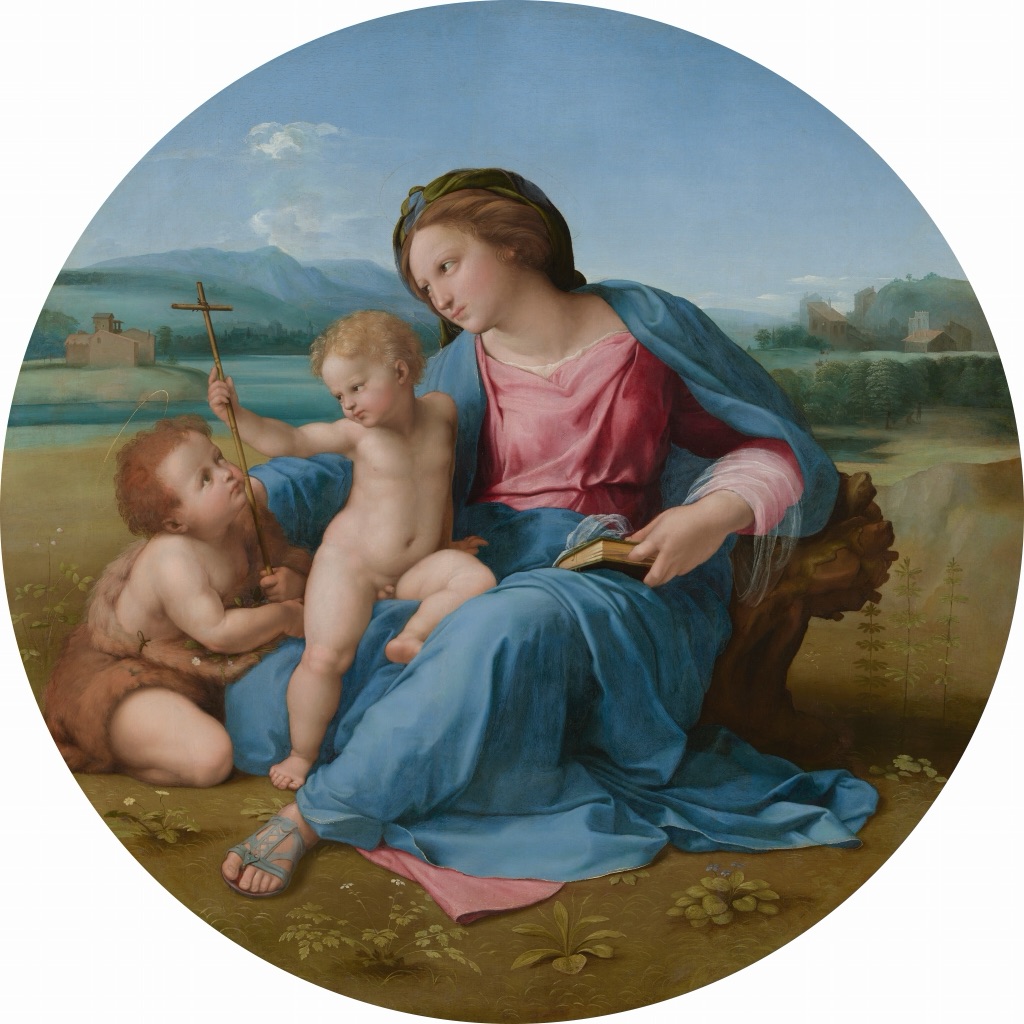
Raphael: rounded figures in a circle
Raphael, The Alba Madonna, c. 1510, is in the National Gallery of Art, Washington (accession 1937.1.24).[9] The painting's support is a flat circle, yet the figures do not read as flat shapes. Soft shifts from light to shadow make arms and faces appear rounded, while overlapping bodies clarify which forms sit in front. The circular boundary contains the group without determining the volumes inside it.
Look especially at a bent arm or knee. Its outline supplies a shape, but the gradual transition across the flesh persuades us that the surface continues around a volume we cannot literally touch.
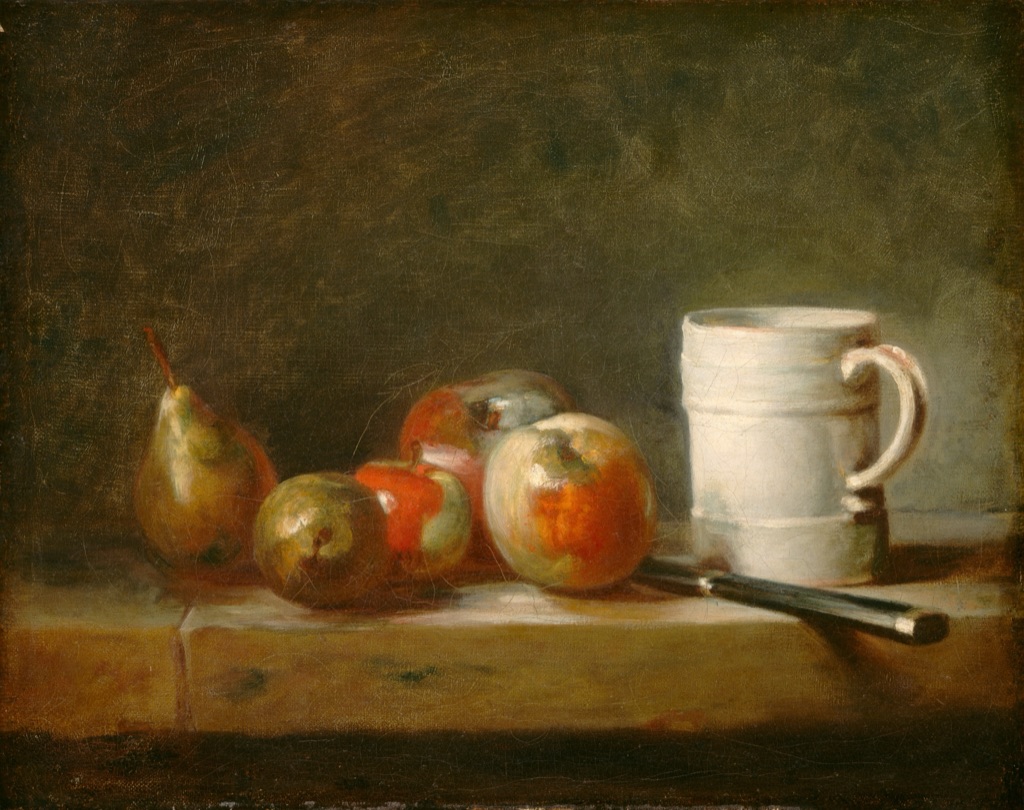
Chardin: light turning over ordinary things
Jean Siméon Chardin, Still Life with a White Mug, c. 1764, is in the National Gallery of Art, Washington (accession 1972.9.6).[10] Highlights cross the mug and fruit, then give way to quieter shadow. Those visible changes help each object appear to turn away from us. Lightness and darkness contribute to the reading of form here, but form is the apparent volume—not the tone itself.
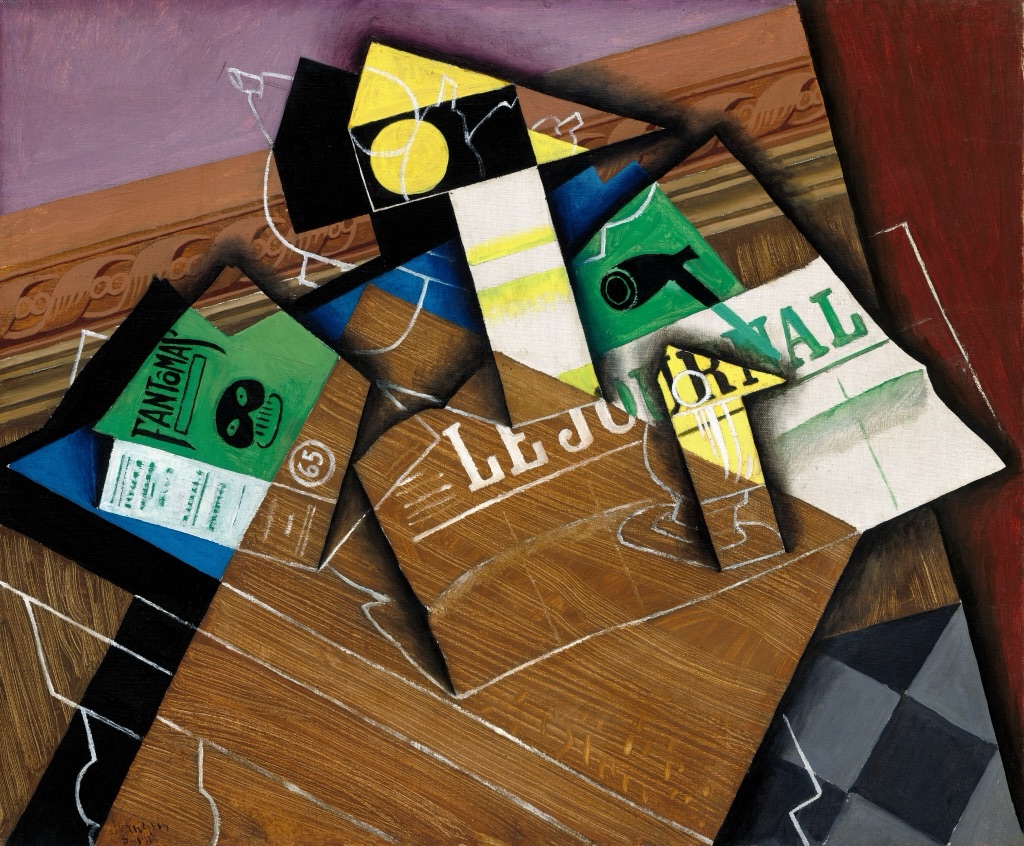
Gris: volume unsettled by facets
Juan Gris, Fantômas, 1915, is in the National Gallery of Art, Washington (accession 1976.59.1).[11] Angular planes, lettering and fragments of tabletop objects overlap across the canvas. Some planes seem to face us while others tilt away, so volume remains present even as the picture refuses a single, seamless viewpoint. Geometric qualities can describe these facets without reducing the whole painting to a stack of named solids.
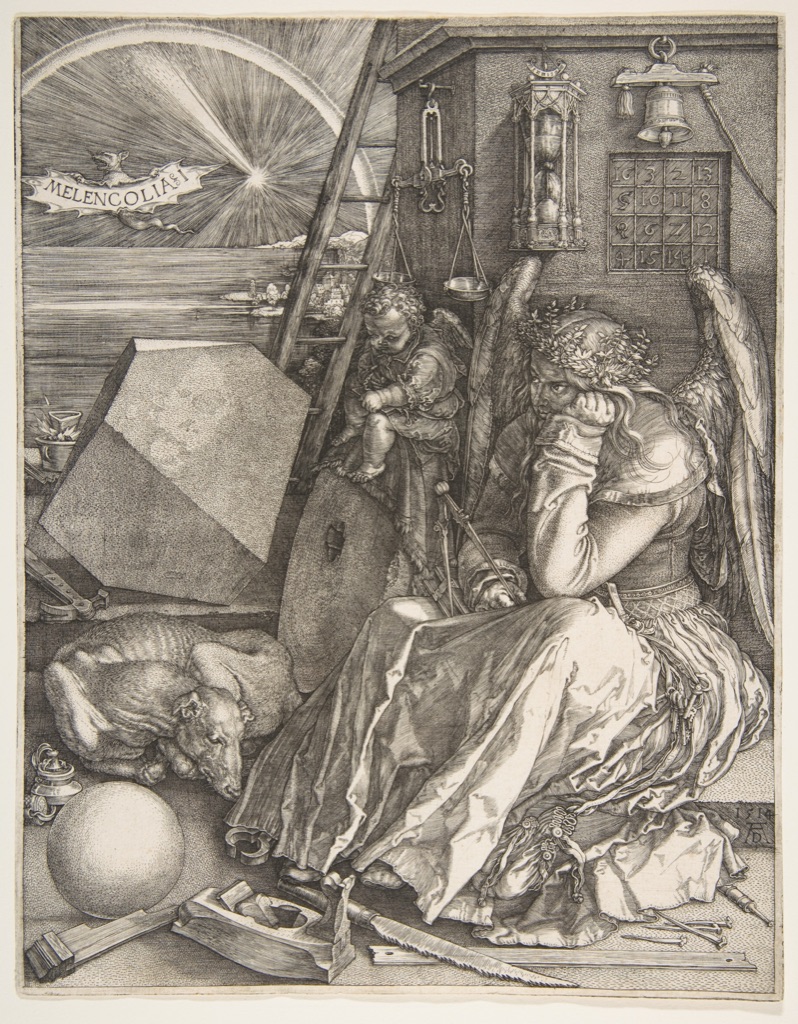
Dürer: a solid made from marks
Albrecht Dürer, Melencolia I, 1514, is in the Metropolitan Museum of Art (accession 19.73.85).[12] Beside the seated figure, a large polyhedron appears weighty although it is made only from ink on paper. Its contour gives a boundary; angled faces establish geometry; and restrained hatching separates one plane from another. Line helps the form read, but the print does not need a lesson in every kind of line to make that volume convincing.
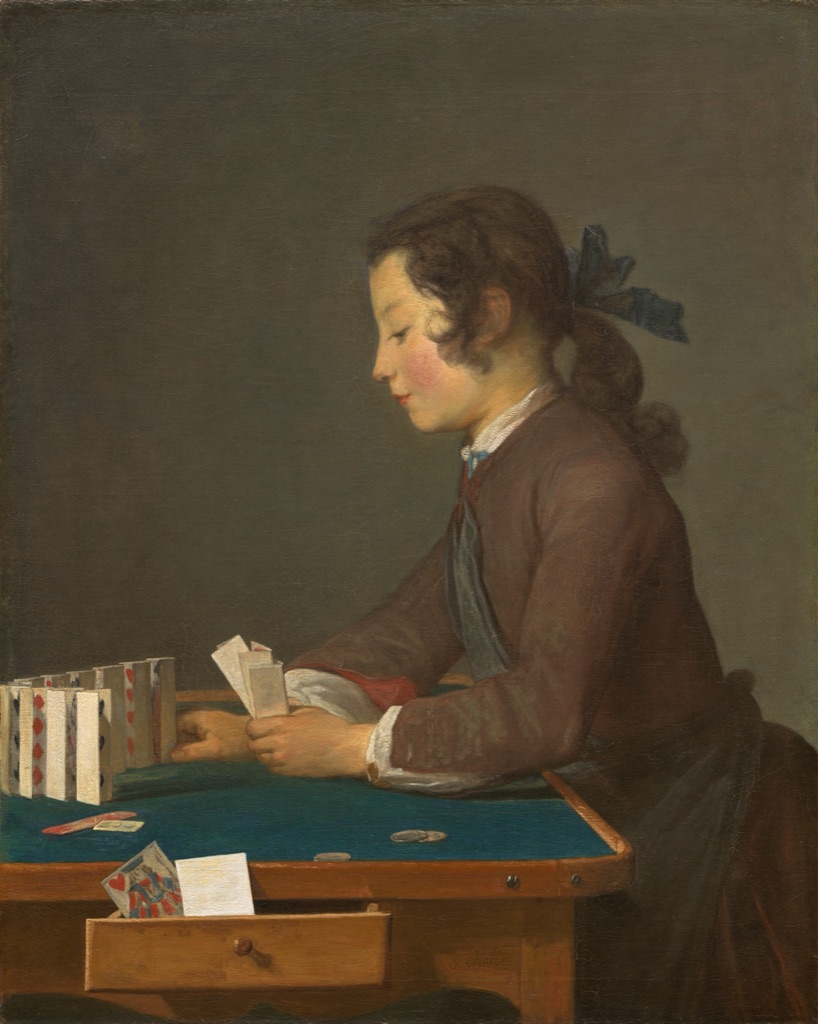
Chardin: planes becoming a structure
Chardin's The House of Cards, probably 1737, is in the National Gallery of Art, Washington (accession 1937.1.90).[13] The cards begin as thin planes. By leaning them together, the sitter turns them into small standing structures with fronts, sides and enclosed pockets of space. Nearby, softer modelling makes the face and hands feel organic and rounded. The painting brings constructed geometry and bodily form into one quiet scene.
This is a useful reminder that represented form is not always a rounded object. A volume can appear fragile, angular or assembled. What matters is that height, width and depth become legible together.
Form and its neighbours
Form becomes easier to recognise when its neighbouring elements remain distinct. Shape is a bounded two-dimensional area; form is actual or represented volume. Space is what lies around, between or within forms and also concerns how depth is organised. Value means lightness and darkness, which may reveal a turning plane without becoming form itself. Texture concerns surface quality rather than the volume beneath it.[2][3]
Line may define a contour or make a plane legible through hatching. Colour may separate or model parts of a volume, as Raphael's subtle changes do, but colour remains its own element. Composition describes the selection and arrangement of parts across the whole artwork; it is not another word for any one form.
The Elements of Art places form beside the other visual elements. Shape, space, value, texture and composition offer useful comparisons, while form keeps attention on actual or represented volume.
Look for form yourself
Choose one solid object in an artwork and pause before naming it. Trace its contour with your eyes. Find the point where a plane turns, an edge overlaps or light gives way to shadow. Then ask whether the volume is physically there or represented on a flat surface.
Finally, compare two forms. One might feel compact, rounded and organic; another might be angular or geometric, while a sculpture might be relatively open. Describe the visible evidence rather than searching for a perfect label. Form becomes vivid when “a figure” turns into a twisting mass, or “a cup” becomes a rounded volume assembled from edge, light and shadow.
Watch: Three Ways to Understand Form
Choose a concise introduction, a broadcast lesson on illusionistic volume, or a museum-led close look at form across a collection. [16] [17] [18]
Elements of Art: Form — Art in Context
Investigate how form functions through works in the museum's collection, moving between observation and visual vocabulary.
Watch on YouTubeFrequently Asked Questions
Form is actual or represented three-dimensional volume: something understood as having height, width and depth. [1]
A shape is two-dimensional, with height and width. A form has or convincingly represents depth as well. A circle and a sphere offer a simple comparison, but artworks often make the distinction more subtle.
Actual form physically occupies three-dimensional space, as a sculpture or constructed object does. Its silhouette and visible planes change as the viewer moves around it.
Artists use changes of value, contour, overlap, foreshortening and adjoining planes to make volume legible on a flat surface.
They are useful descriptive qualities rather than rigid categories. Many artworks combine regular geometry with irregular or biomorphic volume.
Discussion
Which artwork made you notice form rather than simply recognise the subject? Describe the contour, planes, overlap or changes of light that made its volume convincing.
Reader Insights
Explain whether the volume occupies space or appears on a flat surface.
Identify where an outer edge swells, turns, overlaps or breaks.
Notice where light or an angled edge makes one side turn away.
Join the Conversation
Share a close observation or a useful museum source below.
References
- National Gallery of Art, “The Elements of Art: Form.” View source
- J. Paul Getty Museum, “Understanding Formal Analysis.” View source
- Smithsonian National Portrait Gallery, “Art Vocabulary — Elements of Art.” View source
- Neuberger Museum of Art, Purchase College, SUNY, “Exploring Form.” View source
- J. Paul Getty Museum, “Still-Life Painting: Arranging Nature — Lesson 3.” View source
- National Gallery of Art, “The Thinker (Le Penseur).” View source
- The Metropolitan Museum of Art, “Ùhúnmwèlaò (head of an ọ́bà).” View source
- The Metropolitan Museum of Art, “Marble head of a woman.” View source
- National Gallery of Art, “The Alba Madonna.” View source
- National Gallery of Art, “Still Life with a White Mug.” View source
- National Gallery of Art, “Fantômas.” View source
- The Metropolitan Museum of Art, “Melencolia I.” View source
- National Gallery of Art, “The House of Cards.” View source
- The Quarto Group, Susie Hodge, Elements of Art: Ten Ways to Decode the Masterpieces. View publisher record
- Phaidon, Herbert George, The Elements of Sculpture: A Viewer's Guide. View publisher record
- Honolulu Museum of Art, “Elements of Art | FORM (Art in Context).” Watch on YouTube
- KQED Art School, “Elements of Art: Form.” Watch on YouTube
- Children's Museum of the Arts, “Elements of Art: Form.” Watch on YouTube