by Tom Gurney
Tom Gurney BSc (Hons) is an art history expert with over 20 years experience
Email: tomgurney1@gmail.com / Phone: +44 7429 011000
How Edges Turn a Field into Distinct Visual Areas
Shape in art is a bounded or visually distinguishable two-dimensional area. Two-dimensional means that we apprehend the area through height and width rather than actual depth. Calling a shape two-dimensional does not deny that a painting, textile, print or tile has a physical surface; it identifies the flat area we can distinguish within or across that surface.[1][2][3]
Bounded is the most useful controlling word because a shape does not always need one unbroken enclosing line. An outline can surround an area, but a change of colour or value, the meeting of adjacent passages, a cropped edge or a partial boundary can also make one area distinct from another. An edge is the perceived boundary where neighbouring areas change; it need not be a separately drawn line.[1][2]
Shape is relational. A red patch, a flower profile or a rectangular field becomes legible because it differs from what meets or surrounds it. That makes shape a practical tool for close looking: before asking what an area represents, we can ask where it is, what contains or distinguishes it, and how its visible qualities compare with nearby areas.
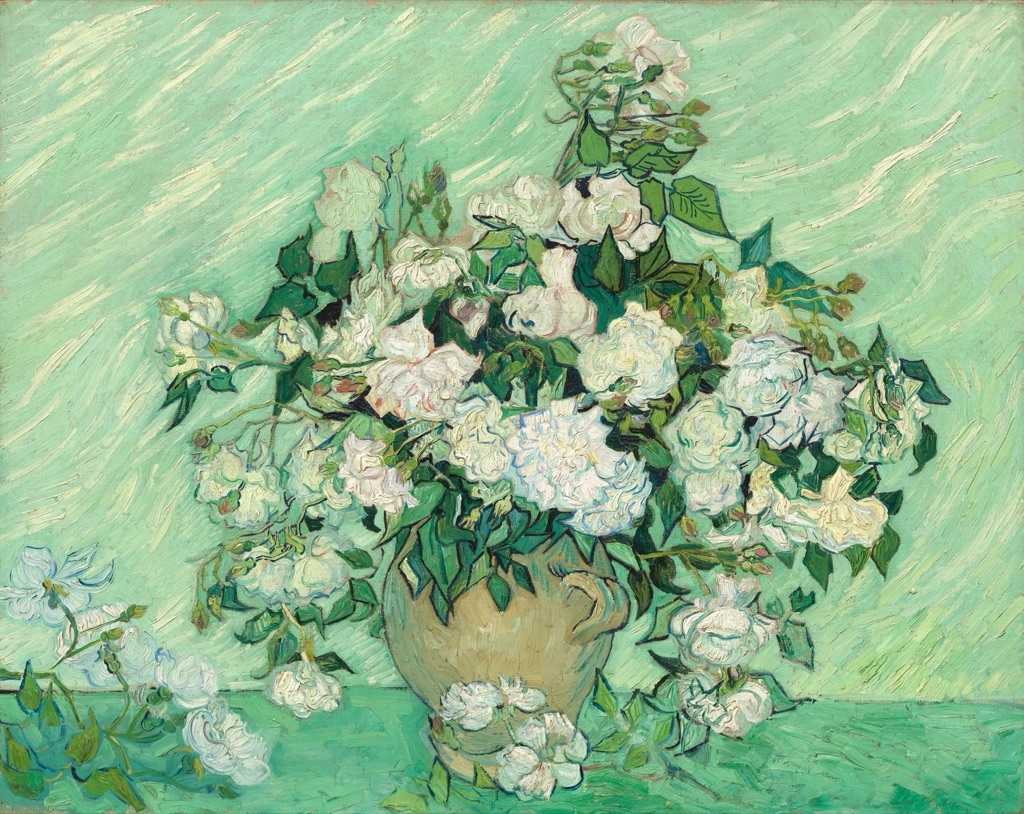
Vincent van Gogh · Roses · 1890 · National Gallery of Art, Washington · Public Domain. Overlapping, partly outlined areas remain legible without one rigid boundary; a detailed close reading appears below. Source details.
At a Glance
- Core ideaa bounded or distinguishable two-dimensional area.
- Boundaryline, colour, value, texture, overlap or adjacency.
- Geometricregular or mathematically nameable areas.
- Organicirregular, curving or biomorphic areas.
- Useful contrastform adds actual or represented depth.
Contents
How shapes become visible
An outline is a visible line that surrounds or helps articulate an area. A silhouette or profile describes the outer shape presented by a figure or object. These words overlap in ordinary use, but they do not name universal types. A solid object can present a strong profile while still possessing volume, and a painted area can have a clear edge without being enclosed by a literal outline.[2][3]
Museum and art-school resources often use geometric for regular or mathematically nameable shapes. Organic and biomorphic are overlapping descriptions for irregular, curving or life-associated areas, though institutions do not use the terms in exactly the same way. Words such as natural, irregular and free-form can be helpful when tied to visible evidence, but they do not form an exhaustive classification.[1][4][5][6]
A work may combine regular and irregular areas, or make an area legible without closing every side. Implied shape can cautiously describe a perceived area assembled from partial edges, nearby alignments or intervals. It is ordinary descriptive language rather than an official additional type.
None of these descriptions carries one fixed mood, gender, meaning or standard of quality. A triangle is not inherently aggressive, a curve is not universally gentle, and geometric regularity is not evidence that one work is more correct than another. The useful question is always what the visible area does in this particular work.
Four questions for recognising shape
Begin with four practical questions:
- 1
What two-dimensional area are you identifying?
- 2
What boundary, adjacency or contrast makes it legible?
- 3
What can you describe directly about it—regularity, curvature, irregularity, edge or relative size?
- 4
Is the area marked by a continuous boundary, a visible profile or a cautious implied relation, and which neighbouring concept remains secondary?
Begin with one area rather than trying to classify the entire artwork. Follow its boundary as far as it remains visible. Notice where it meets another area, disappears beneath an overlap, reaches the edge of the work or continues only by suggestion. This keeps the description anchored to what can actually be seen.
Boundaries without one hard outline
Van Gogh: overlapping areas in Roses
The National Gallery of Art, Washington, holds Vincent van Gogh's 1890 oil painting Roses, accession 1991.67.1.[7] Pale blossoms, green leaves, vase and background gather into overlapping areas across the complete canvas.
Some petals have short, noticeable outlines; elsewhere a pale or dark change is enough to separate one flower from the next. Leaf shapes narrow, bend and disappear beneath their neighbours. The boundaries remain irregular and sometimes incomplete, yet the areas stay distinguishable. Colour and value help them separate, but the central Shape lesson is how several bounded areas remain legible without one hard continuous contour.
Kandinsky: areas held by partial edges
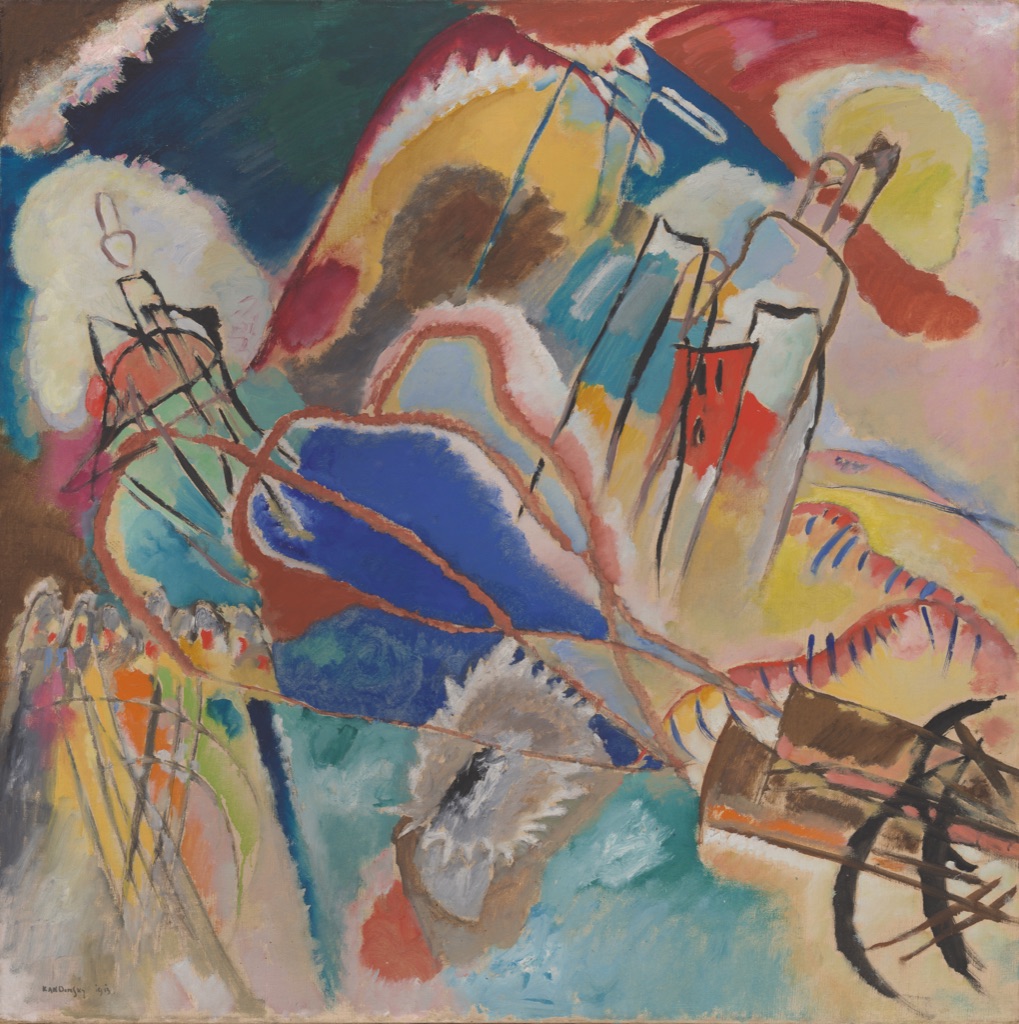
Vasily Kandinsky's Improvisation No. 30 (Cannons), 1913, is an oil painting in the Art Institute of Chicago, accession 1931.511.[12] Across the complete canvas, red, blue, yellow, green and black passages meet lines and paler ground.
Several irregular areas stop against a painted edge on one side but open or soften on another. Nearby colours and marks allow those passages to be apprehended as shapes even when their limits are partial. This is a useful place for cautious implied-shape language: the perceived area depends on visible fragments and adjacency, not on an invented invisible outline or a claim about one compulsory route through the painting.
Outer shapes and shapes within objects
A Japanese stencil: boundaries cut through paper
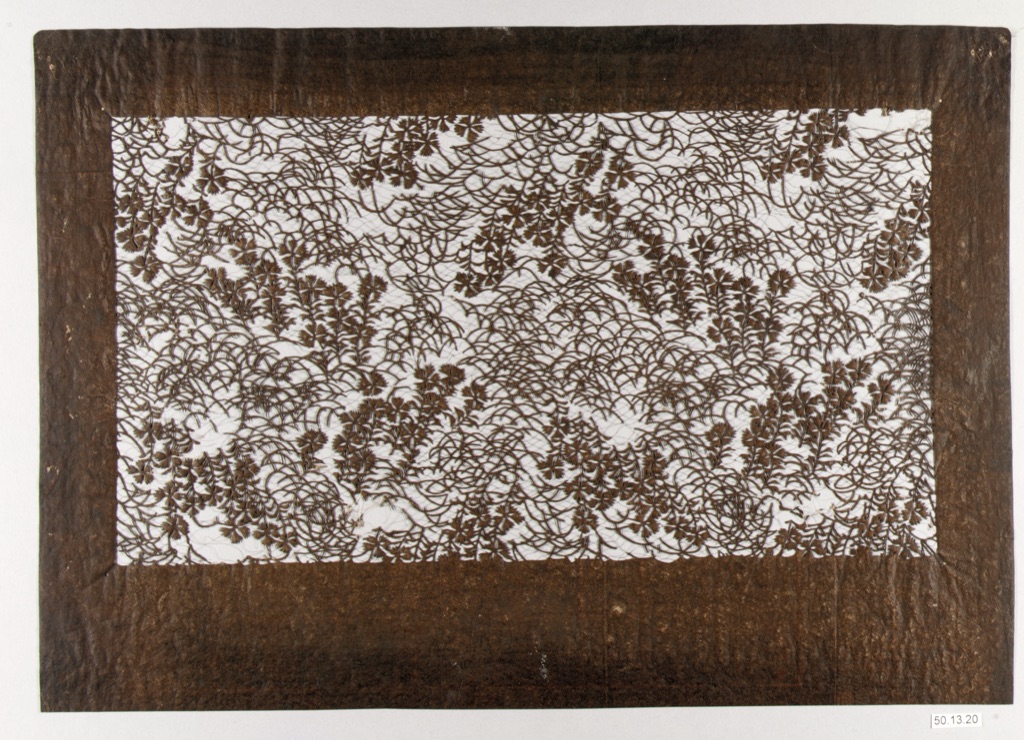
The nineteenth-century Japanese Stencil, made by an unrecorded maker and held by The Metropolitan Museum of Art, accession 50.13.20, is a complete paper object.[8] Its openings have angular, curved and branching edges, while the paper left between them forms another set of bounded areas.
Because the boundaries are physically cut, the distinction between opening and remaining material is unusually clear. Some shapes recur, but this is not a lesson in constructing the stencil or analysing its pattern. Occupied and surrounding areas can also be described as positive and negative, but that focused figure-ground relationship is a separate subject.
An Inca and Spanish tabard: outer profile and internal areas
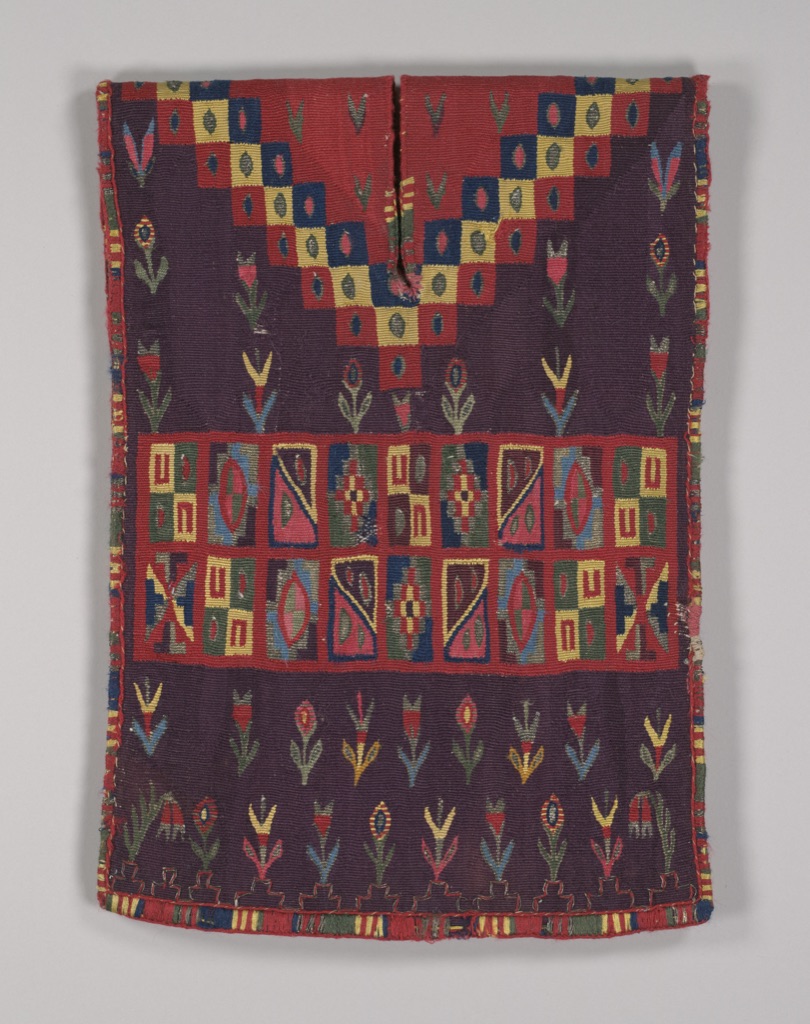
The Miniature tabard, made by an unrecorded Inca and Spanish maker between 1600 and 1700, belongs to The Metropolitan Museum of Art, accession 2007.470.[9] The complete textile has a broad rectangular garment profile filled with bands of smaller geometric motifs.
Two levels of shape can be compared at once. The outer edge distinguishes the tabard as one large area, while the woven interior divides into smaller rectangles, stepped forms and other regular motifs. Their relative sizes differ, but no ratio is needed to recognise them. The textile shows how one bounded shape can contain many others without reducing the object to a list of geometry terms.
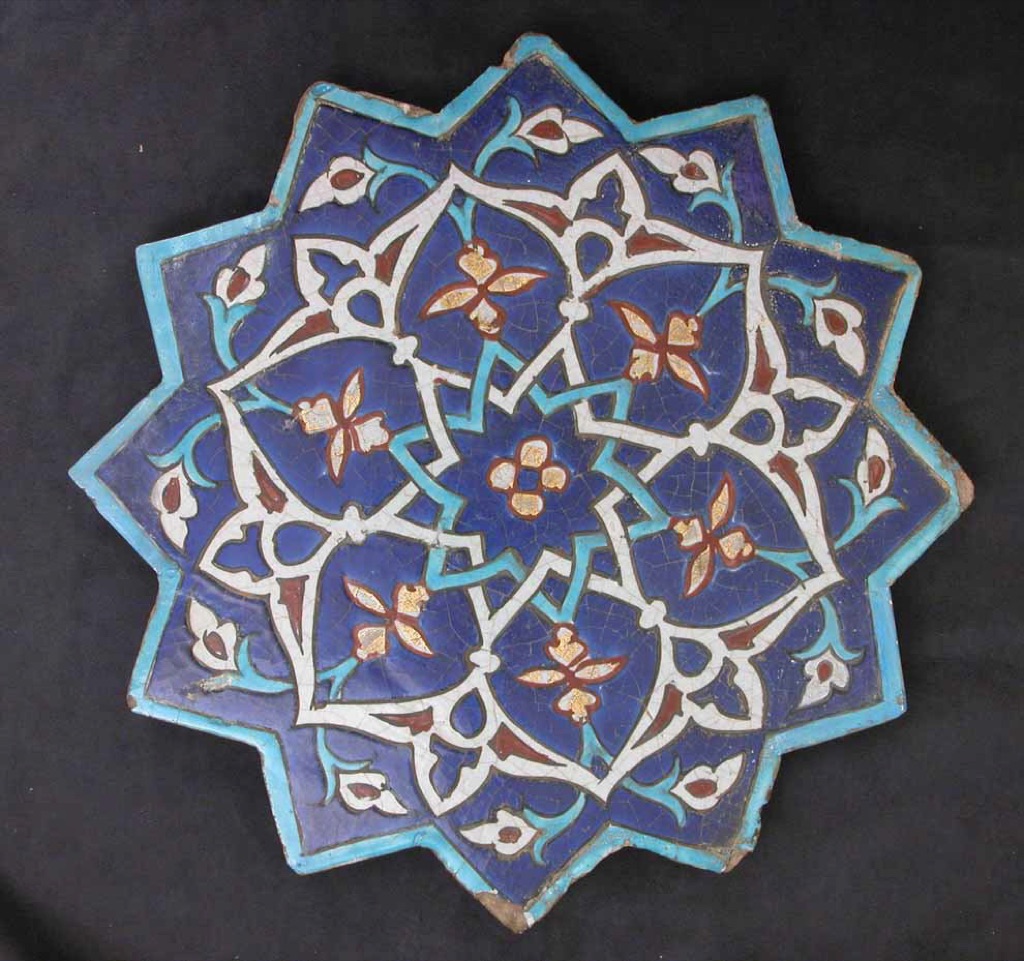
An Iranian tile: profile and painted interior
The Iranian Twelve-Pointed Star-Shaped Tile, dated 846 AH/1442–43 CE, is in The Metropolitan Museum of Art, accession 17.143.1.[10] Its complete stonepaste object presents a twelve-pointed outer profile around painted calligraphic and plant-like areas.
The star edge is regular enough to name, while the curving passages inside do not follow the same geometry. Comparing those two relationships makes the object particularly useful: its profile establishes one shape, and its painted interior establishes several more. The tile has actual thickness and material surface, but those properties remain secondary to the two-dimensional boundaries visible from the complete frontal view.
Profiles, cropping and representational areas
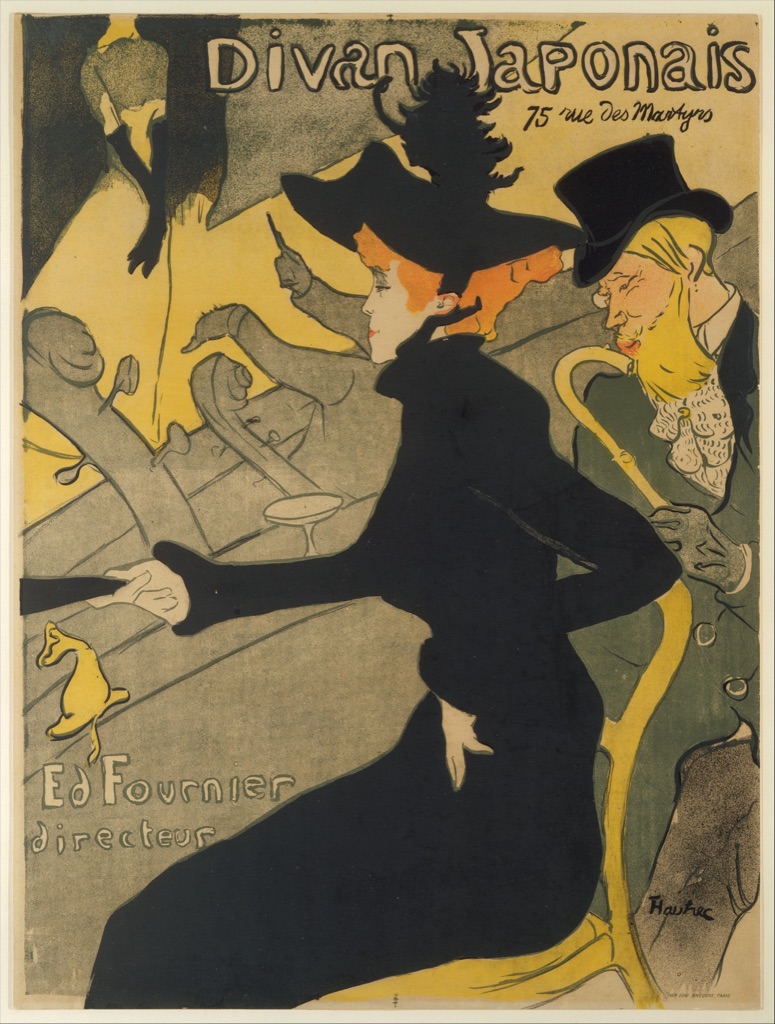
Toulouse-Lautrec: silhouettes meeting a sheet edge
Henri de Toulouse-Lautrec's Divan Japonais, 1892–93, is a four-colour lithograph in The Metropolitan Museum of Art, accession 58.621.17.[11] The complete sheet includes large black figure profiles beside flat yellow, red and grey passages.
The dark foreground figure is immediately legible through silhouette, even though the sheet edge crops the body. A second profile rises nearby, and the meeting of black, pale paper and coloured areas sharpens each boundary. Cropping does not erase these shapes; it makes the frame one of their visible limits. The point is not to retell the scene or rank its figures, but to notice how profile, adjacency and the edge of the sheet establish flat areas.
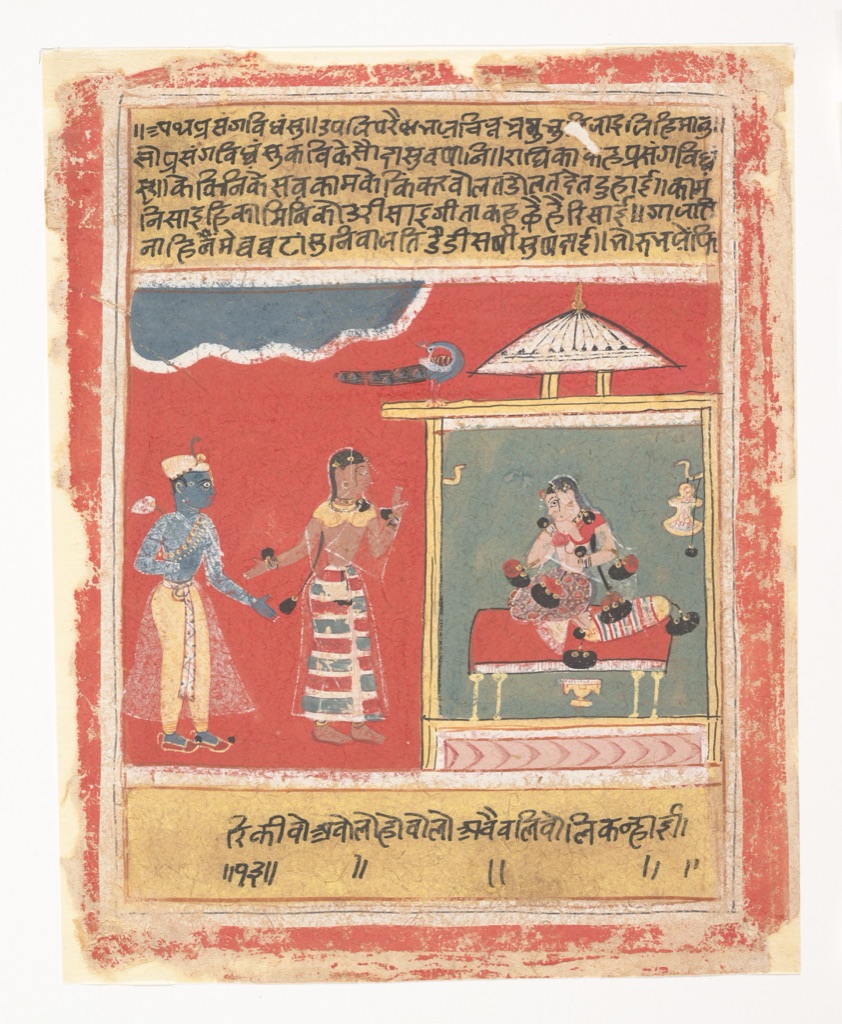
A Malwa folio: shape in a representational image
Radha's Friend Pleads with Her to Receive Krishna Page from a Dispersed Rasikapriya, made by an unrecorded Indian artist in Malwa in 1634, belongs to The Metropolitan Museum of Art, accession 35.34.[13] The complete folio presents its literary and religious subject through figures, architecture and broad red, blue, green and yellow areas.
Rectangular architectural fields meet the curved profiles of bodies, trees and landscape. The areas remain distinct through edge and colour change even where no heavy enclosing line is present. The figures are representational, yet they can still be examined as bounded two-dimensional areas. That formal observation does not replace the folio's Rasikapriya context or turn its colours into a separate theory lesson.
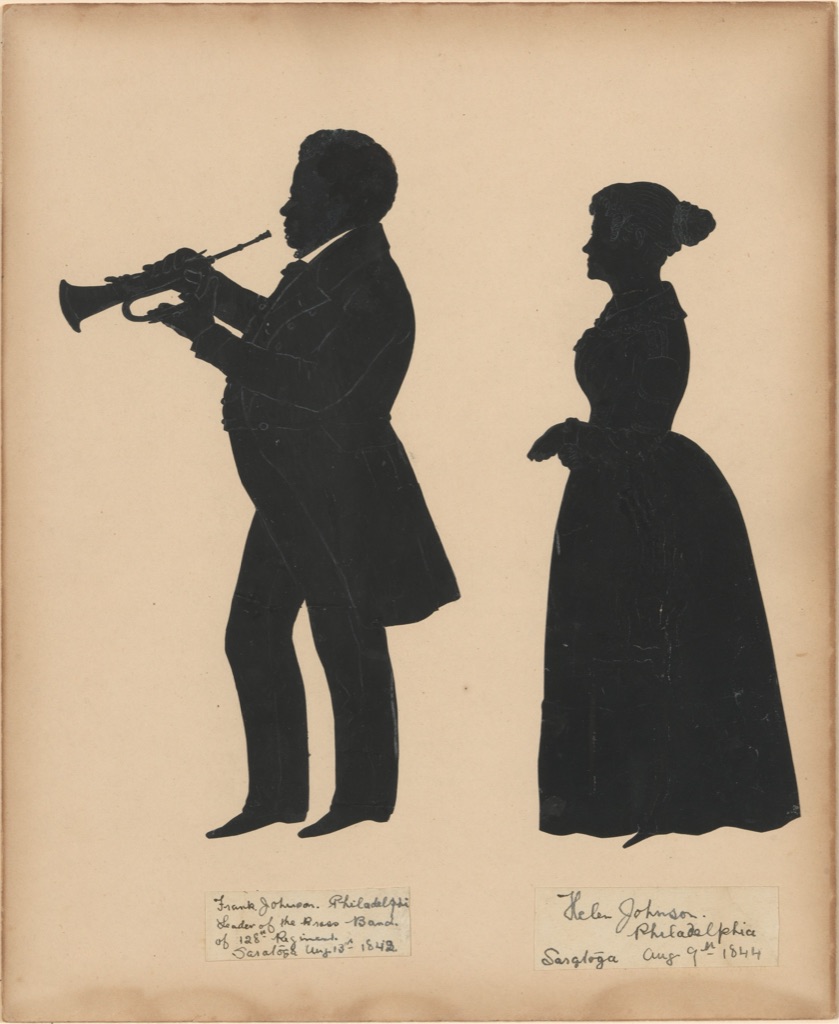
Edouart: continuous cut-paper profiles
Auguste Edouart's Frank Johnson Leader of the Brass Band of the 128th Regiment in Saratoga with his wife Helen, 1842–44, is a cut-paper silhouette pair in The Metropolitan Museum of Art, accession 1976.652.3–4.[14] The complete mounted pair shows Frank Johnson playing a keyed bugle beside Helen Johnson.
Here the dark paper gives each figure a continuous outer boundary against the light support. The profiles remain recognisable through the shapes of head, clothing, arms and instrument rather than through modelled volume or interior detail. Comparing the two silhouettes also reveals that a clear boundary need not produce identical shapes: each figure has a distinct pose and outline.
Shape and its neighbours
Shape concerns the bounded two-dimensional area itself. Line in Art concerns identifiable paths and extended marks, although a line may help define an outline. Form in Art concerns actual or represented volume rather than height and width alone. Space in Art asks about areas, distances and depth, including what lies around or between forms.
A colour change can establish a boundary, while Value in Art concerns relationships of lightness and darkness. Texture in Art concerns actual or implied surface quality. Pattern in Art begins when motifs are organised through recurrence rather than merely identified as shapes.
Shapes also contribute to larger relationships without becoming interchangeable with them. Composition in Art considers the realised organisation of the whole. Proportion in Art compares the sizes of parts with one another and with that whole, while Balance in Art concerns the distribution of visual weight.
The Elements of Art places shape alongside the other elements. Positive and Negative Space in Art examines the relation between occupied and surrounding areas, while colour can make a boundary visible. Shape keeps attention on the two-dimensional area that boundary defines.
Look for Shape Yourself
Choose one complete artwork or object and identify a single area before naming its subject. Follow the boundary. Is it a visible line, a profile, a meeting between colours or values, a cut edge, or a partial relation that remains open?
Describe the area's directly visible qualities. It might be regular, curved, angular, irregular, broad, narrow or cropped. Then compare it with one neighbouring area. Ask where they touch, where one overlaps another and whether either boundary disappears before returning.
Finally, keep the neighbouring concept in view without letting it replace shape. A line may mark the edge, value may separate two passages, or volume may be represented inside the area. Shape becomes clearer when “I see a flower, figure or tile” turns into a precise account of the two-dimensional areas that make that subject visible.
Watch: Shape from Boundary to Artwork
Choose a focused shape lesson, an overview of the elements, or a museum demonstration of formal analysis.
Elements of Art: Shape
Consider geometric, organic, positive and negative shapes across artworks.
Watch on YouTubeFrequently Asked Questions
Shape is a bounded or visually distinguishable two-dimensional area understood through height and width.
Shape is two-dimensional; form is actual or represented volume with depth as well as height and width.
Geometric describes regular or mathematically nameable areas, while organic describes irregular or biomorphic areas; many works combine both.
No. Changes of colour, value, texture, overlap or adjacency can make an area legible without a continuous drawn outline.
Yes. Areas around, between and within figures can have distinct boundaries and therefore visible shapes.
Discussion
Which boundary makes a shape especially clear without relying on a complete outline?
Reader Insights
Notice whether line, colour, value, texture or overlap makes an area legible.
Describe regularity, curvature, size and the point where neighbouring shapes meet.
Separate the flat area you see from any volume represented within it.
Join the Conversation
Share one close observation or a useful museum example below.
References
- National Gallery of Art, “The Elements of Art: Shape”
- J. Paul Getty Museum, “Understanding Formal Analysis — Elements of Art”
- Smithsonian National Portrait Gallery, Art Vocabulary — Elements of Art
- National Gallery of Art, “The Elements of Art”
- Honolulu Museum of Art, Elements of Art: Shape
- Massachusetts College of Art and Design, Principles and Elements
- National Gallery of Art, Vincent van Gogh, Roses, 1890
- The Metropolitan Museum of Art, Stencil, 19th century
- The Metropolitan Museum of Art, Miniature tabard, 1600–1700
- The Metropolitan Museum of Art, Twelve-Pointed Star-Shaped Tile, dated 846 AH/1442–43 CE
- The Metropolitan Museum of Art, Henri de Toulouse-Lautrec, Divan Japonais, 1892–93
- Art Institute of Chicago, Vasily Kandinsky, Improvisation No. 30 (Cannons), 1913
- The Metropolitan Museum of Art, Radha's Friend Pleads with Her to Receive Krishna Page from a Dispersed Rasikapriya, 1634
- The Metropolitan Museum of Art, Auguste Edouart, Frank Johnson Leader of the Brass Band of the 128th Regiment in Saratoga with his wife Helen, 1842–44
- Quarto, Susie Hodge, Elements of Art. Publisher record.
- Phaidon, E. H. Gombrich, The Story of Art. Publisher record.