by Tom Gurney
Tom Gurney BSc (Hons) is an art history expert with over 20 years experience
Page created on September 3, 2026 / Page updated on September 13, 2026
Email: tomgurney1@gmail.com / Phone: +44 7429 011000
How a Slow-Drying Binder Supports Transparent Depth, Direct Revision and Raised Surface
Oil painting uses pigment bound in a drying oil, commonly linseed, walnut or poppy oil. Unlike water that simply evaporates from watercolour, the oil reacts with oxygen and forms a cross-linked film. Its relatively slow setting gives painters time to blend, revise and work wet passages together; its optical depth supports transparent glazes as well as opaque colour and thick impasto.[1][2]
Those properties do not dictate a single “oil-painted look.” An oil surface can be mirror-smooth, thin and matte, darkly glazed, broadly brushed or raised into ridges. The eight examples below show how painters used the same broad medium family to construct stormy landscape, quiet interior, public history and modern colour.
At a Glance
- Core mediumpigment is dispersed in a drying oil, commonly linseed, walnut or poppy oil.
- Working rangeoil can support thin glaze, opaque body colour, wet-in-wet revision, scumble and raised impasto.
- Support systempanel or canvas, sizing and ground affect absorption, handling and ageing.
- History cautionoil painting predates Jan van Eyck; Northern European painters developed influential refinements rather than inventing the binder.
- Conservationvarnish, cracking, cleaning and colour change can alter the surface now visible.
Contents
- What is oil painting?
- Binder, pigment, support and ground
- Glaze, scumble, impasto and wet paint
- Eight oil paintings to look at
- A history older than Van Eyck
- Artists associated with oil painting
- Oil compared with tempera, watercolour and acrylic
- Ageing, conservation and close looking
- Watch Oil Painting in Practice
Binder, pigment, support and ground
Pigments are solid colour particles; oil is the binder that surrounds them and adheres them to a prepared support. Linseed oil generally dries strongly and was widely used. Walnut and poppy oils can yellow less but behave differently. Historical paints also include resins, waxes, driers and fillers, so technical analysis often finds more complex mixtures than a simple tube label suggests.[1][3]
Wooden panels offer a rigid, smooth plane. Woven canvas is lighter and can support large portable works, but it flexes and its texture may affect brushwork. Both are normally sized and covered with a ground to isolate the support, control absorbency and establish a working colour. Grounds may be pale, dark or mid-toned; exposed glimpses can participate in the final effect.
Oil's “drying” is gradual chemical change, not one instant. A surface may feel touch-dry while deeper layers remain mobile. Sensible layering avoids trapping a weak, slow layer beneath a rapidly stiff one. Temperature, light, pigment and film thickness all affect the pace. Historical practice varied, so conservation evidence—not a universal studio slogan—should guide claims about a particular painting.
The ratio of pigment to binder helps determine whether a paint is lean and stiff or more flowing and saturated, but pigment particles themselves differ in how much oil they need. Adding oil is therefore not a neutral way to make every colour fluid. Painters historically modified handling with solvents, resins, waxes or prepared mediums, and some complicated mixtures have aged poorly. A technical account of one painting should take precedence over a general recipe.
On absorbent grounds, oil can sink from an upper layer and leave colour looking matte; on a sealed or oil-rich preparation, strokes may retain more saturation and glide. Venetian painters working on canvas often used a coloured priming or imprimitura rather than treating a white ground as an invisible base.[13] Ground colour can speed the organisation of light and shadow, unify gaps between marks or remain deliberately visible in the finished work.
Glaze, scumble, impasto and wet paint
A glaze is a thin transparent or translucent layer that alters colour beneath it. Several glazes can create depth without hiding an underpainting. Scumbling draws a lighter, relatively opaque film across a darker or dry layer so broken colour catches on the surface. Impasto builds paint thickly enough to hold brush or knife marks.
Wet-in-wet handling mixes or places strokes while surrounding paint remains workable. Blending can soften transitions; direct marks can stay distinct. Painters combine these approaches: a face may be modelled in layered half-tones, fabric glazed, a highlight placed thickly and a background dragged thin. Technique should be described locally rather than assigning one word to a whole canvas.
Underpainting creates another layer of structure. A monochrome or limited-colour beginning can establish drawing, value and shadow before fuller colour is added. Other painters begin directly with coloured masses or leave areas of ground active between strokes. Brushes range from soft tools that minimise marks to bristles that drag and ridge paint; palette knives and rags can place or remove it. Because oil remains responsive, revision may leave pentimenti—earlier decisions that become visible as upper layers age and gain transparency.
What common oil-painting terms do—and do not—mean
“Indirect painting” usually describes a build-up in stages, often involving an underpainting and later glazes; “direct painting” describes colour brought closer to its final effect in fewer sessions. Neither guarantees a particular appearance. A direct passage can be carefully blended, while an indirect surface may retain forceful final marks. Alla prima—literally “at first attempt”—is associated with completing a passage while it remains wet, but even apparently spontaneous paintings may include dry revisions.
Likewise, impasto does not mean that the whole painting is thick, and glazing does not mean that every shadow is transparent. Painters distribute surface effects to create hierarchy. Raised light may project physically while a thin shadow lets the ground contribute depth. Scumble can cool or veil without the depth of a glaze. The useful question is not which single technique an artist “used,” but where each kind of handling appears and what it does there.
Eight oil paintings to look at
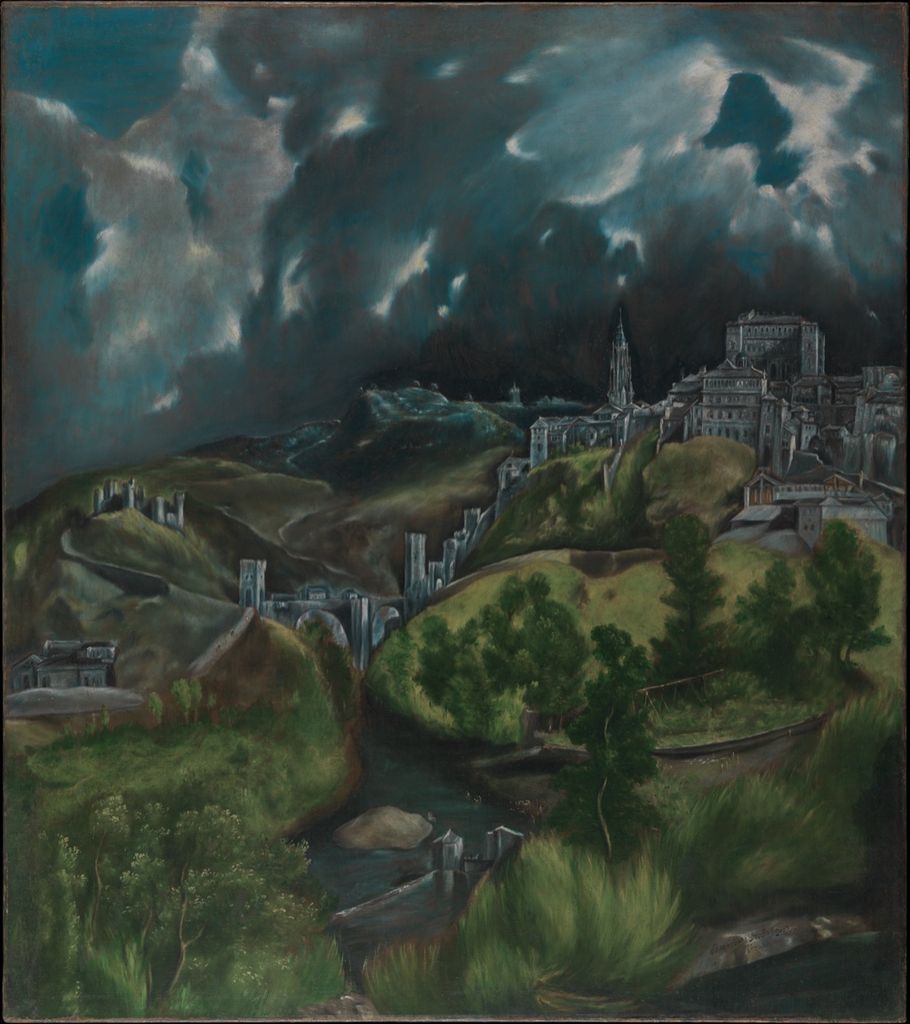
View of Toledo
El Greco's View of Toledo, about 1599–1600, turns a Spanish city into a charged pattern beneath a turbulent sky.[4] Buildings are rearranged for pictorial force, and green hills surge against blue-black weather. Thin dark passages coexist with sharper lights along cloud and architecture.
Oil lets transitions remain atmospheric while contours stretch expressively. The painting is not a neutral map; material movement makes landscape carry spiritual and emotional intensity.
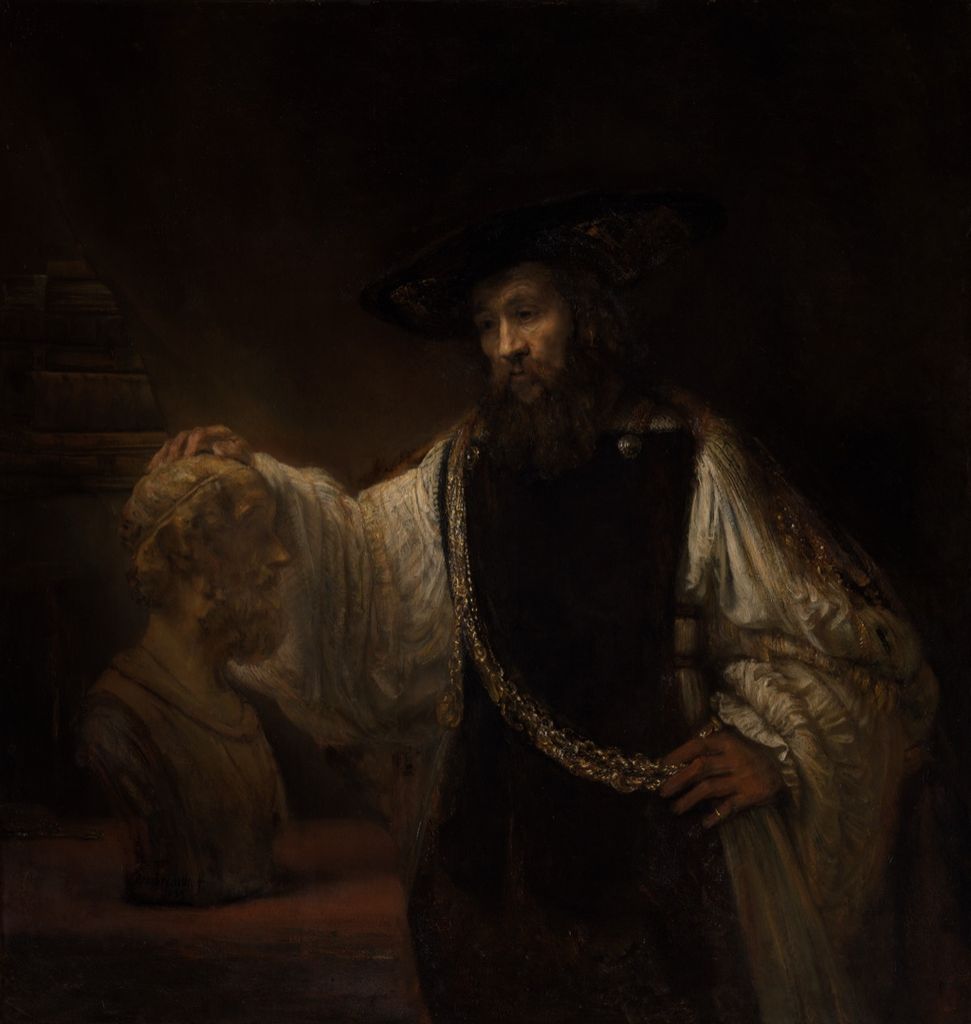
Aristotle with a Bust of Homer
Rembrandt painted Aristotle with a Bust of Homer in 1653.[5] Aristotle rests a hand on the poet's sculpted head while a gold chain crosses his dark clothing. Light emerges gradually from brown depths and catches metal, flesh, sleeve and stone with different degrees of finish.
Transparent shadow and thicker highlights create a hierarchy of attention. Some edges dissolve; others crystallise. Oil's range allows thought to be suggested through touch: hand, chain and bust connect worldly recognition with inherited wisdom.
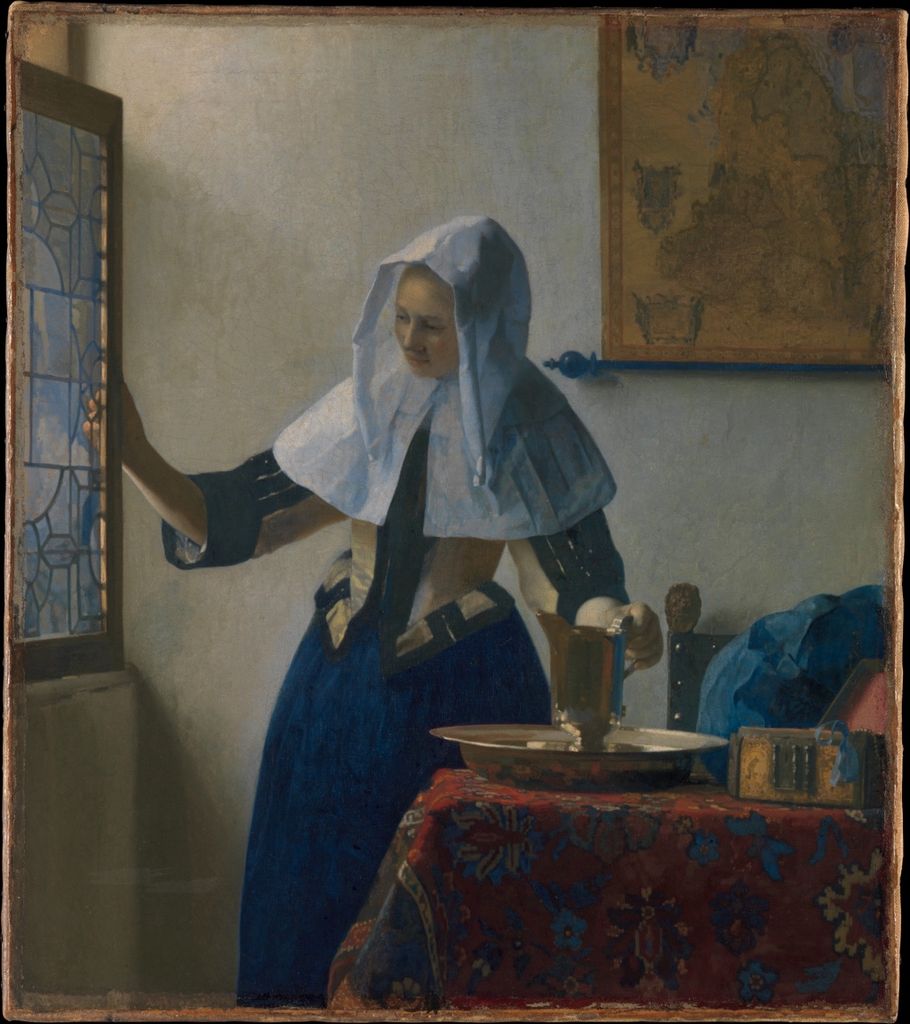
Young Woman with a Water Pitcher
Vermeer's Young Woman with a Water Pitcher, about 1662, stages a small action beside a window.[6] Pale wall, blue textile, brass basin and white head covering are joined by cool daylight. The woman's hand opens the window while her other steadies the pitcher.
Controlled layers and tiny accents distinguish reflective metal, fabric and skin without making every detail equally sharp. The calm surface is highly constructed. Oil's slow working and translucency serve measured light rather than conspicuous paint texture.
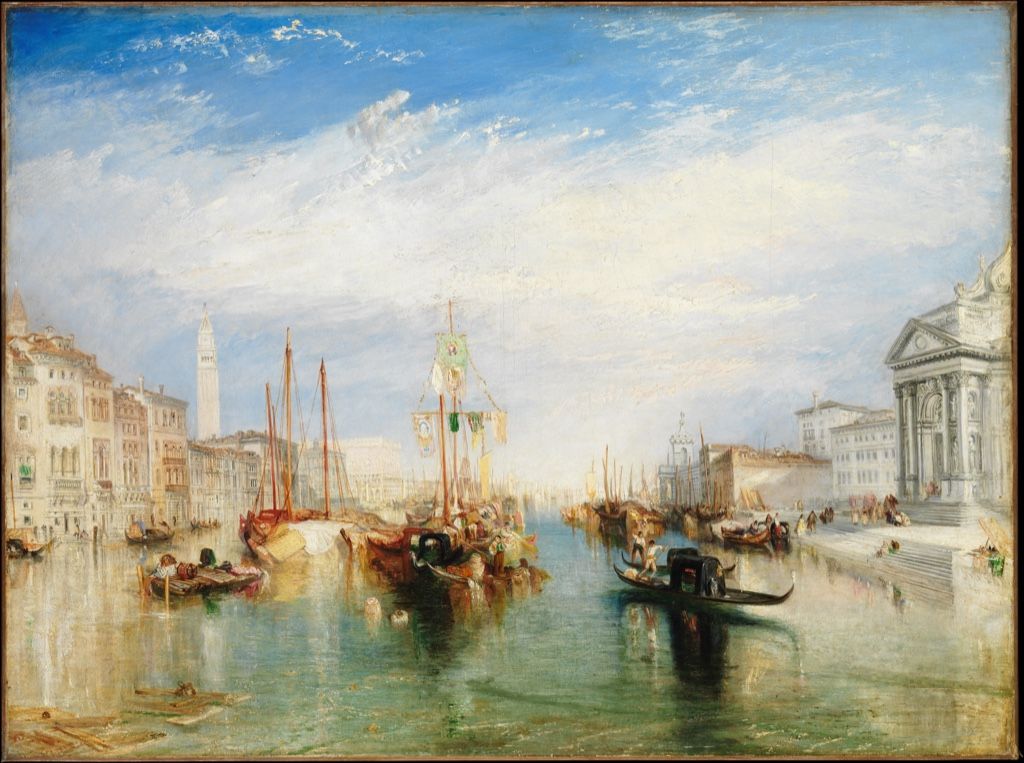
Venice, from the Porch of Madonna della Salute
Turner's Venetian view, about 1835, opens architecture into luminous air and water.[7] Boats and buildings remain identifiable, yet reflections and sky are carried by broad, light-filled passages. Warm and cool colour seem to circulate across the canvas.
Thin veils, opaque notes and softened edges make atmosphere the subject. Compared with Vermeer's contained room, the same binder supports an outward, dissolving vision.
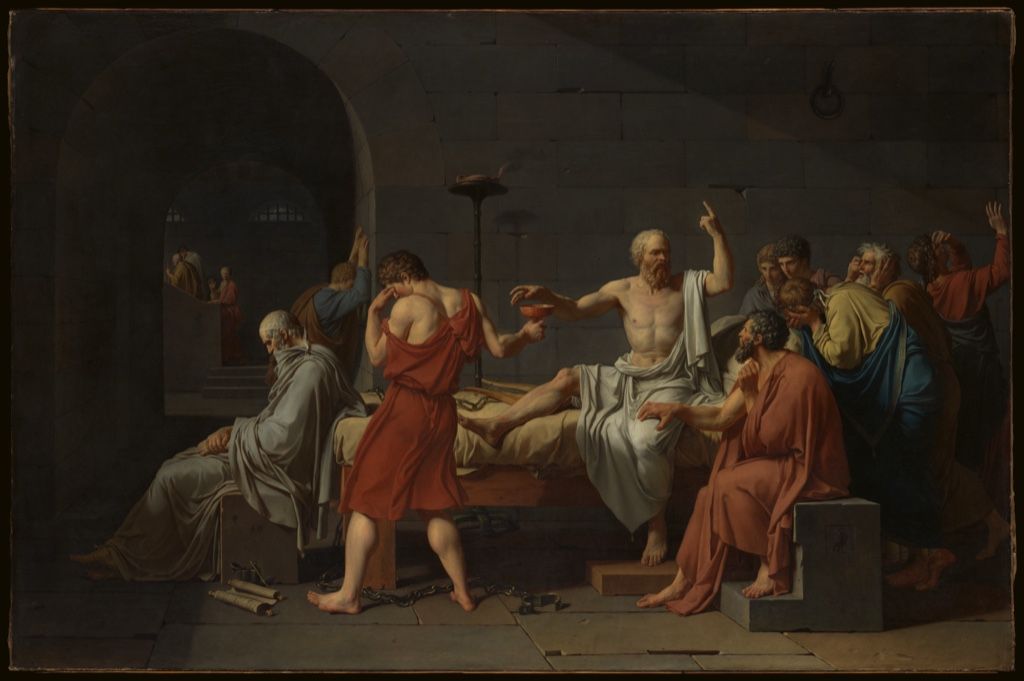
The Death of Socrates
Jacques Louis David's The Death of Socrates of 1787 presents the philosopher reaching for poison while continuing to teach.[8] Drawing, controlled modelling and carefully staged gesture make moral argument legible. Red, white and stone grey organise the crowded scene.
Oil layers are disciplined toward a polished finish. Brushwork does not demand attention for itself; it clarifies bodies, textiles and architecture. This restraint is a technical choice, not evidence that the medium lacks texture.
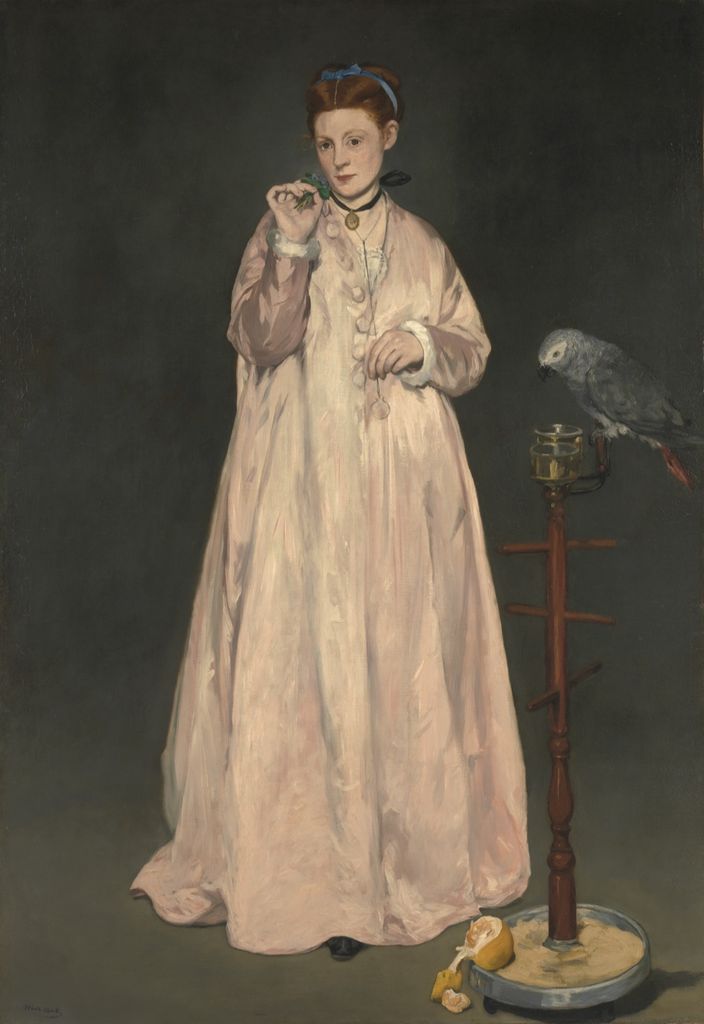
Young Lady in 1866
Manet's Young Lady in 1866 presents Victorine Meurent in a pale dressing gown with monocle, bouquet and parrot.[9] Broad, relatively flat passages and abrupt tonal changes challenged expectations of smoothly modelled salon painting.
The canvas shows how oil could foreground its own surface. Fabric is constructed by placed strokes rather than concealed labour, while still-life details create competing clues about identity and modernity.
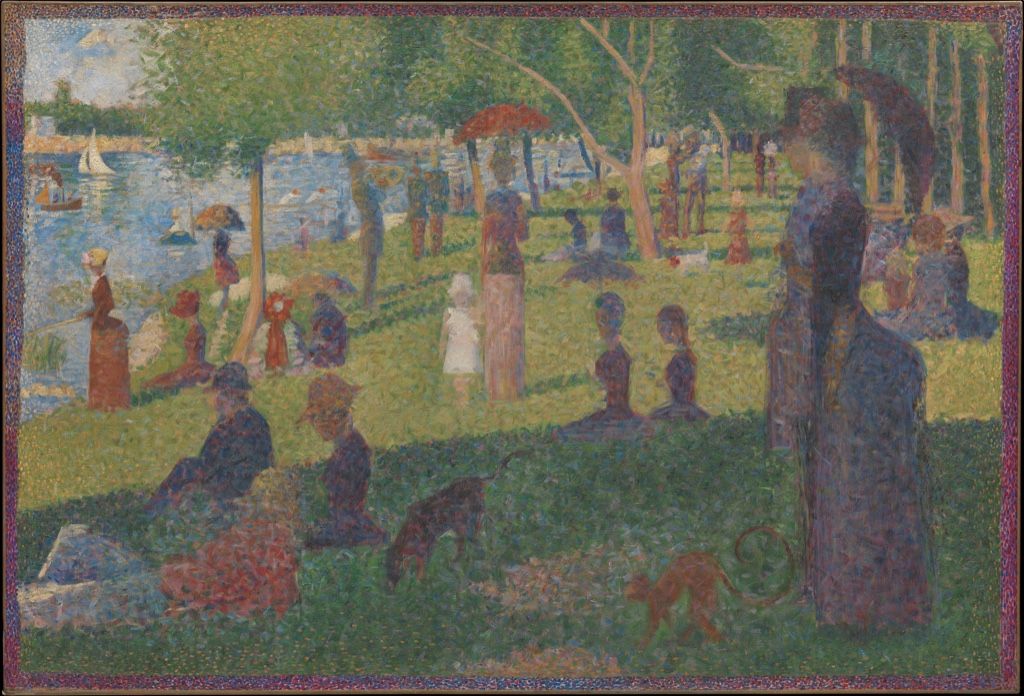
Study for A Sunday on La Grande Jatte
Seurat's 1884 study precedes the monumental A Sunday on La Grande Jatte.[10] Small strokes and patches establish figures, river, shade and brilliant light. Colour relationships matter more than polished contour.
As a study, the work preserves searching revisions and a compact rhythm. Oil supports separated touches that interact optically at viewing distance. It is neither a conventional sketch nor simply a miniature of the final canvas.
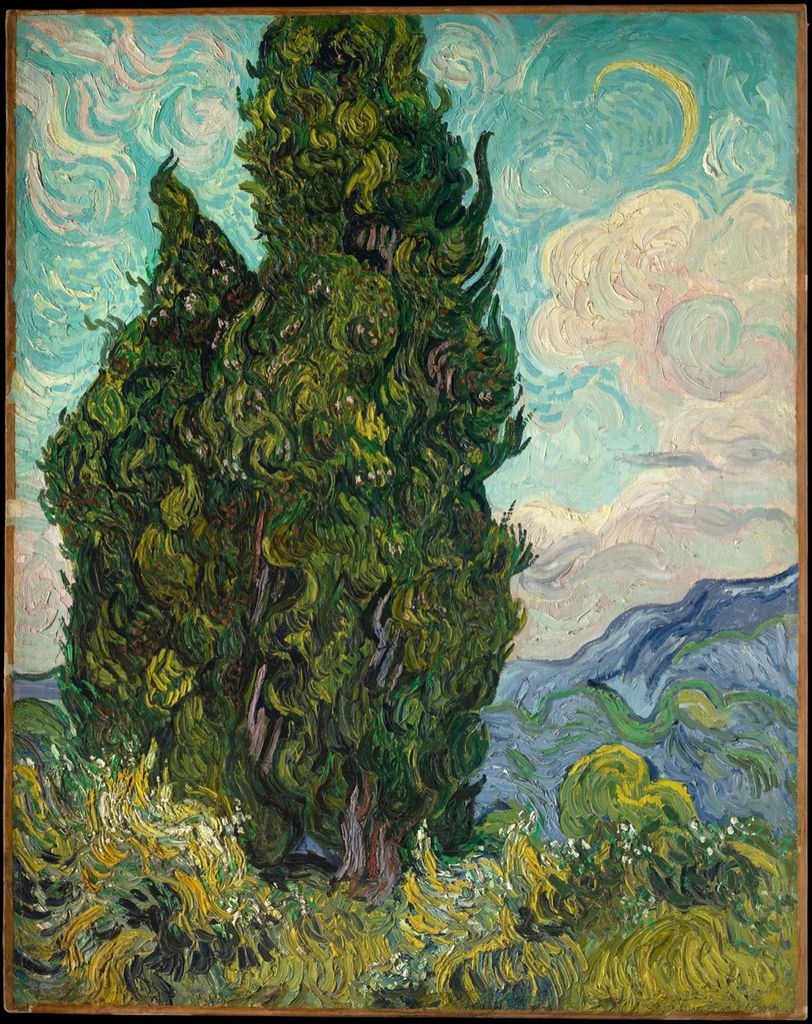
Cypresses
Van Gogh's Cypresses of 1889 builds trees, clouds and field from directional ridges of paint.[11] The dark cypresses rise like flames; curved sky strokes answer their motion. Colour and impasto make the surface physically active.
Thick handling catches real light on raised paint, so photographed colour cannot convey the entire object. The work demonstrates impasto as structure: strokes describe growth, wind and pressure rather than decorating an already finished design.
A history older than Van Eyck
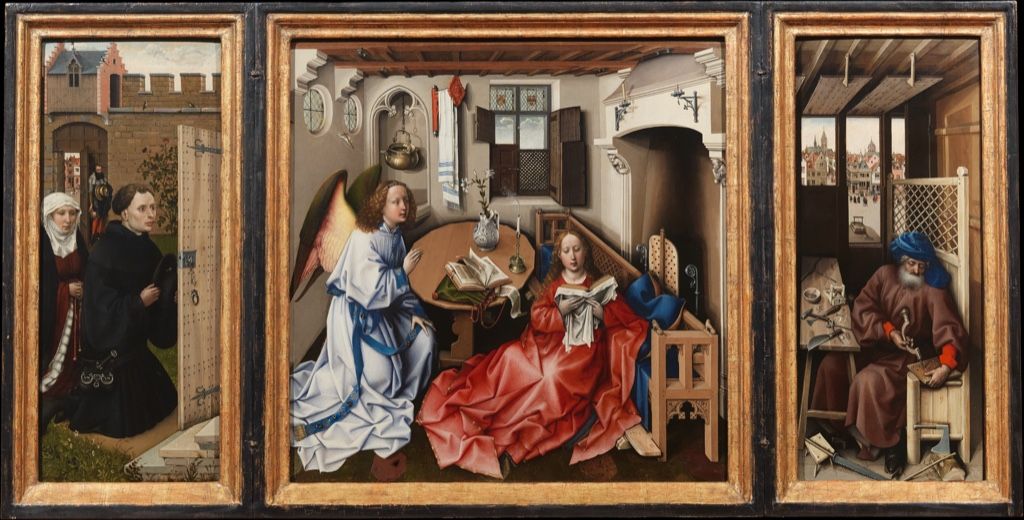
Drying oils were used before the fifteenth century. Jan van Eyck did not invent oil painting, although he and other Netherlandish painters exploited it with exceptional control. Transparent layers, soft shadows and precise highlights supported a newly compelling description of objects and light. Their works helped spread and transform oil practice across Europe.[2]
Italian workshops adopted and combined oil with existing tempera systems. By the sixteenth century, canvas and oil supported large Venetian paintings and increasingly varied brushwork. Seventeenth-century painters used the medium for everything from Rembrandt's layered darkness to landscape and still life.
Portable metal paint tubes, patented in the nineteenth century, made storage and travel more convenient, but outdoor oil sketching existed earlier.[12] Impressionist and post-Impressionist artists used manufactured colours, portable equipment and direct strokes in new ways. The story is one of changing materials and markets, not one invention causing modern painting overnight.
Small oil studies made outdoors had gained momentum by the late eighteenth century. Lightweight sheets of prepared paper and portable paint boxes helped artists record changing light quickly; these studies could function as independent observations rather than scaled plans for a particular finished canvas.[14] By the nineteenth century, industrial chemistry also widened the palette with pigments based on cobalt, chromium and synthetic ultramarine. Availability did not mechanically create a style, but it changed the range, consistency and portability of materials painters could choose.
The twentieth century multiplied the category again. Artists used commercial house paints, oil sticks, unvarnished absorbent surfaces and mixtures whose long-term behaviour differed from traditional layered easel painting. “Oil painting” thus names a binder family, not a promise of Old Master technique. Dates, supports and technical records are essential to understanding what the phrase means for a particular object.
Artists associated with oil painting
Jan van Eyck is associated with the refinement—not the invention—of early Netherlandish oil technique. El Greco stretched bodies and landscapes through mobile highlights and charged colour; Rembrandt ranged from translucent shadow to emphatic relief; Vermeer used controlled layers and edges to order daylight. Jacques-Louis David directed oil toward polished public history, while Édouard Manet made abrupt tonal construction and visible handling part of modern painting.
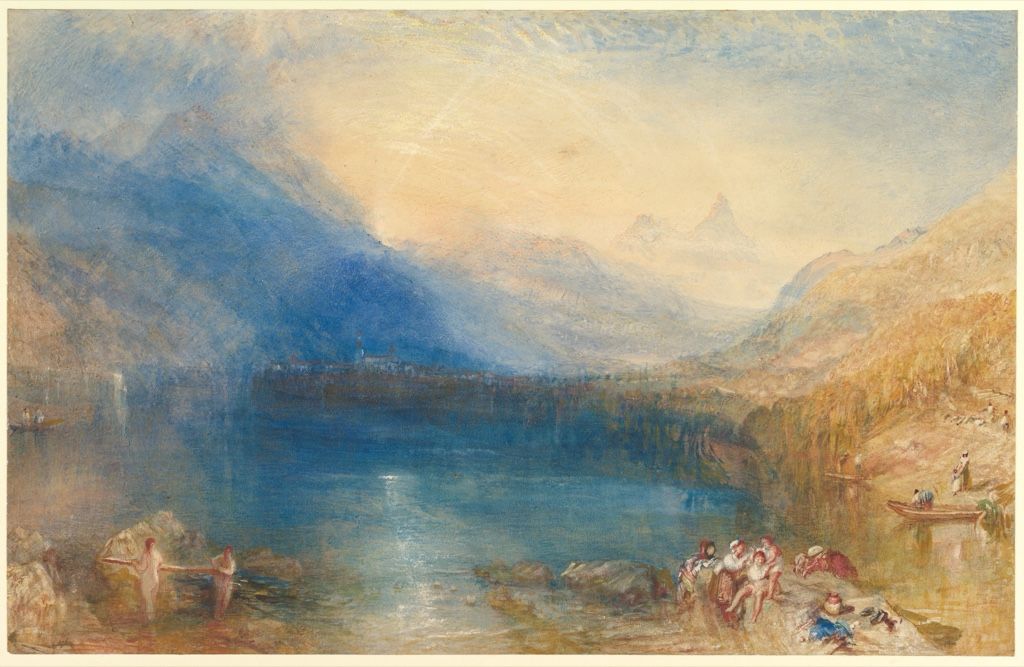
Landscape shows an equally broad range. J. M. W. Turner moved between watercolour knowledge and luminous oil surfaces. Georges Seurat organised separated colour touches, and Vincent van Gogh made the direction and relief of strokes carry pictorial energy. These artists are useful orientation points, not a ladder of technical progress: each selected different capacities from the same diverse medium family.
Oil compared with tempera, watercolour and acrylic
Egg tempera sets quickly and often favours thin, discrete strokes on rigid grounds. Watercolour normally uses a water-soluble gum binder and draws luminosity from paper; gouache is also water-based but is commonly handled for more opaque, matte coverage. Acrylic is a twentieth-century synthetic polymer system that can dry rapidly. Oil remains workable longer and its refractive binder can make darks and glazes appear deep, but formulation and handling can reverse easy stereotypes.
Oil is not always glossy, and watercolour is not always pale. Varnish may add saturation and surface sheen to an oil painting, then yellow or be removed later. The Art Mediums hub compares medium, support and technique without turning appearance into proof.
Ageing, conservation and close looking
Oil films continue to change. Oxidation and hydrolysis can make them more brittle; some fatty acids react with lead, zinc or other metals to form soaps. These may create protrusions, crusts or increased transparency.[3] Canvas can slacken or tear, wood can move, and varnish can discolour. Cleaning must distinguish original glazes and surface texture from later coatings.
Cracking is evidence, not a single diagnosis. Age-related networks may remain stable, while cupping, flaking or active cleavage can signal loss of adhesion among paint, ground and support. Varnish is also separate from the oil-paint binder: it may have been applied after completion, replaced during treatment or deliberately omitted. Removing a coating can reveal colour but can also endanger original glazes, so cleaning is preceded by examination and testing rather than an assumption that a brighter surface must be more authentic.
Begin close looking with the support and ground, then compare thin and thick passages. Follow edges: where are they blended, dragged or sharply redrawn? Watch how highlights sit—buried under glaze, brushed wet into colour or raised in impasto. Consider whether varnish changes the sheen. Oil painting becomes most intelligible when “versatile” is translated into exact decisions visible on one surface.
Watch: Oil Paint Making, Palette and Artist Process
Choose a museum palette study, a historical paint-making reconstruction, or object-led analysis of Van Gogh's materials.
Monet's Palette and Technique
Connect named colours, mixing and application to close study of an oil painter's practice.
Watch on YouTubeFrequently Asked Questions
Oil painting uses pigment dispersed in a drying oil, commonly linseed, walnut or poppy oil, applied over a prepared support.
No. Oil-based paint existed earlier; Van Eyck and other Northern European painters developed exceptionally influential methods and effects.
Its drying behaviour and optical range support thin transparent films, opaque passages, wet blending, revision, scumbling and raised impasto.
Historically it has been used on prepared wood panels, canvas, metal and other stable grounds; the full support system affects handling and ageing.
Varnish, dirt, cracking, pigment change, binder ageing, abrasion and past restoration can alter colour, gloss and layer relationships.
Discussion
Which oil painting on this page uses the medium’s range—from thin film to raised paint—most visibly within one surface?
Reader Insights
Oil’s versatility often appears in contrasts between transparent, opaque and raised passages.
Panel, canvas and ground change the paint’s behaviour.
Varnish and conservation can alter what now appears to be the artist’s finish.
Join the Conversation
Share one precise observation or a useful museum example below.
References
- National Gallery, London, “Oil.” https://www.nationalgallery.org.uk/paintings/glossary/oil
- Metropolitan Museum of Art, “Painting in Oil in the Low Countries and Its Spread to Southern Europe.” https://www.metmuseum.org/essays/painting-in-oil-in-the-low-countries-and-its-spread-to-southern-europe
- Metropolitan Museum of Art, “Investigating the Formation and Structure of Lead Soaps in Traditional Oil Paintings.” https://www.metmuseum.org/essays/lead-soaps-oil-paintings
- Metropolitan Museum of Art, “View of Toledo.” https://www.metmuseum.org/art/collection/search/436575
- Metropolitan Museum of Art, “Aristotle with a Bust of Homer.” https://www.metmuseum.org/art/collection/search/437394
- Metropolitan Museum of Art, “Young Woman with a Water Pitcher.” https://www.metmuseum.org/art/collection/search/437881
- Metropolitan Museum of Art, “Venice, from the Porch of Madonna della Salute.” https://www.metmuseum.org/art/collection/search/437853
- Metropolitan Museum of Art, “The Death of Socrates.” https://www.metmuseum.org/art/collection/search/436105
- Metropolitan Museum of Art, “Young Lady in 1866.” https://www.metmuseum.org/art/collection/search/436964
- Metropolitan Museum of Art, “Study for A Sunday on La Grande Jatte.” https://www.metmuseum.org/art/collection/search/437658
- Metropolitan Museum of Art, “Cypresses.” https://www.metmuseum.org/art/collection/search/437980
- National Gallery, London, “Landscape oil sketches.” https://www.nationalgallery.org.uk/paintings/glossary/landscape-oil-sketches
- National Gallery, London, “Titian’s Painting Techniques before 1540.” https://www.nationalgallery.org.uk/upload/pdf/vol-34-essay-1-2013.pdf
- Metropolitan Museum of Art, “The Aesthetic of the Sketch in Nineteenth-Century France.” https://www.metmuseum.org/essays/the-aesthetic-of-the-sketch-in-nineteenth-century-france