by Tom Gurney
Tom Gurney BSc (Hons) is an art history expert with over 20 years experience
Email: tomgurney1@gmail.com / Phone: +44 7429 011000
How Unequal Parts Can Hold a Whole Together
Balance in art is a relationship in the distribution of visual weight across an artwork. Some parts seem to carry more weight because of their size, placement, colour or value contrast, density, texture or surrounding space. Other parts counter, echo or leave room for them. Balance emerges from those relationships across the whole work, not from one object considered alone.[1][2]
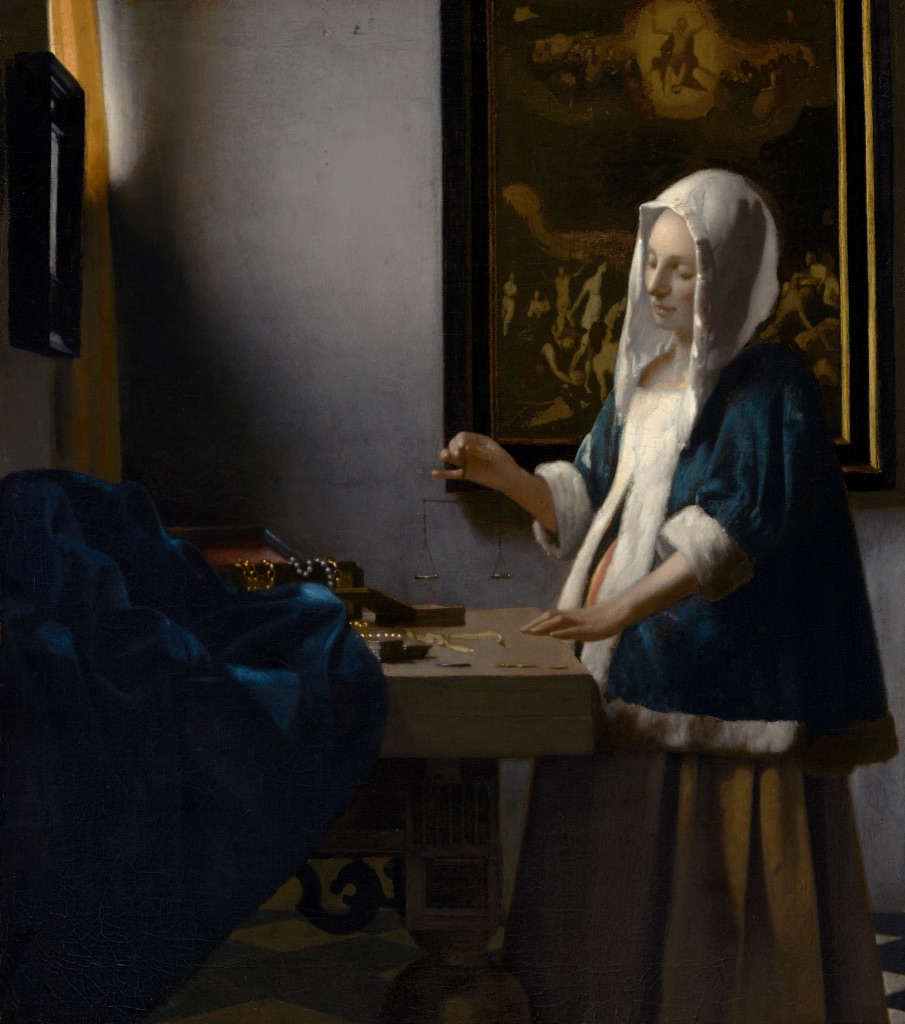
Johannes Vermeer · Woman Holding a Balance · c. 1664 · National Gallery of Art, Washington · Public Domain. The literal scales belong to the subject; formal balance emerges from the whole arrangement, examined below. Source details.
At a Glance
- Core ideathe distribution of visual weight across a work.
- Symmetricalcorresponding parts organised around an axis.
- Asymmetricalunlike parts that remain countered or held together.
- Radialparts spreading from or gathering around a centre.
- Evidencecompare placement, scale, contrast, density and space.
Contents
Visual weight is an interpretive description, not an objective measurement. It is not literal mass, a score or a record of where every viewer's eyes will travel. It simply gives us a useful way to describe why one area seems forceful, quiet, anchored or exposed in relation to another.
Museums and classrooms use overlapping vocabulary. Symmetrical, asymmetrical and radial organisation are useful descriptions taught by several institutions, but they are not three universal, exhaustive types into which every artwork must fit.[1][2][3][4] None guarantees a particular mood or level of quality. Symmetry need not be calm, asymmetry need not be unstable, and radial organisation is not automatically harmonious.
What gives a part visual weight?
A large form may seem weightier than a small one, but size never acts alone. A compact dark shape can press strongly against a broad pale field. A small isolated object may command more attention than a crowded group. Several modest forms can answer one tall or dense form across an image. These are possible contributors, not fixed weights in a calculation.[1][4]
Placement matters because every part sits in relation to edges, axes, centres and intervals. Colour and value difference can strengthen a form's presence; texture and density can make an area feel busy or concentrated. Direction can affect a particular reading, especially where figures, sails or diagonals lean across the frame. The task is to compare visible relationships rather than turn each cue into a rule.
Balance can feel held, tense or deliberately off-centre. Those responses are readings to support with evidence, not verdicts on whether an artwork succeeds.
Four questions for recognising balance
When you meet an unfamiliar artwork, begin with four questions:
- Where does apparent weight gather? Notice large, dark, bright, dense, isolated or strongly placed areas, while remembering that no single quality decides the answer.
- What counters, echoes or leaves room for it elsewhere? Look for another form, a cluster, an interval or an open field that changes the first area's effect.
- Does an axis or centre organise the parts? Correspondence may be exact, approximate or interrupted; a centre may gather parts without making them identical.
- Does the whole feel held, tense or deliberately off-centre, and what visible evidence supports that reading? Name the relationship before judging its effect.
Use the questions as prompts for comparing visible evidence. Different viewers may notice different centres of weight, but a persuasive explanation points back to placement, scale, contrast, density, space or another visible feature.
Symmetrical, asymmetrical and radial relationships
In a symmetrical relationship, corresponding parts are arranged around an axis. They may closely mirror one another, yet ordinary symmetry can contain variations in contour, material or detail. “Perfect symmetry” is a much narrower claim than a generally bilateral arrangement.[1][2][3]
In an asymmetrical relationship, unlike parts are distributed so that their differences still feel countered or held together. A tall form may answer a low cluster; a crowded area may be set against open space. The relationship does not have to be even, still or comfortable.[2][3][4]
In a radial relationship, parts spread from or gather around a centre.[2][4] Circular support alone does not prove it: the directions and intervals of the parts must actually relate to that centre. Many works combine these descriptions or resist them, so the terms should open looking rather than close it down.
Unequal parts held together
Vermeer: weight without a visual scale
Johannes Vermeer's Woman Holding a Balance, c. 1664, is an oil painting in the National Gallery of Art, Washington (accession 1942.9.97).[5] The woman stands near the middle, yet the picture is not divided into matching halves. A table laden with objects gathers below her left hand, a dark framed painting rises behind her, and a pale stretch of wall opens to the right.
The scales she holds belong to the subject; they do not prove the formal principle. The useful evidence lies in the whole painting: compact dark areas and small bright accents are set against quieter wall, while the standing figure connects them without turning the arrangement into a mirror image.
Homer: a heavy cluster beside open water
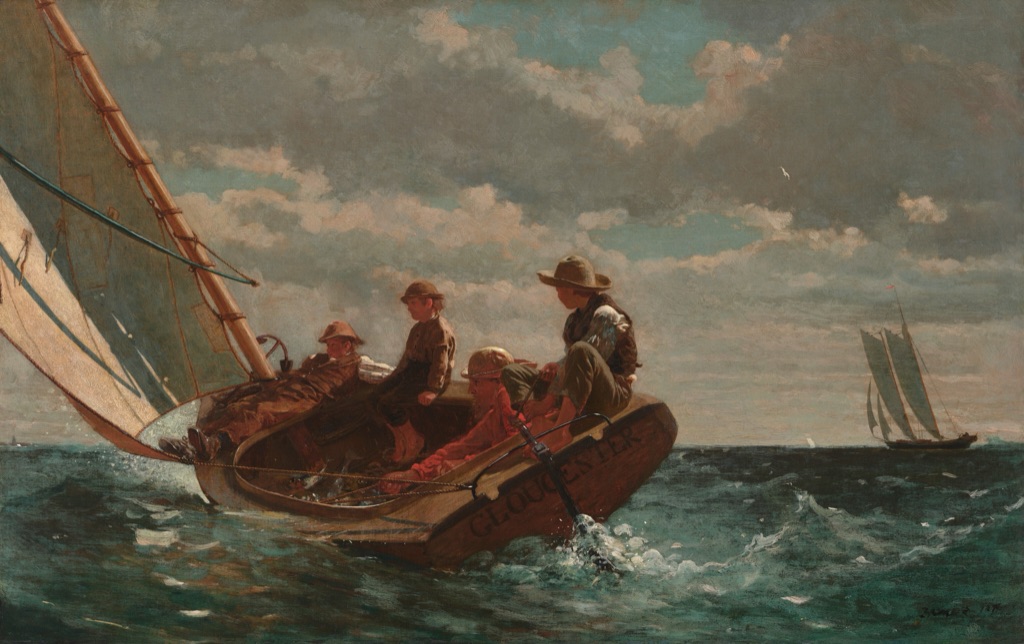
Winslow Homer's Breezing Up (A Fair Wind), 1873–1876, belongs to the National Gallery of Art, Washington (accession 1943.13.1).[6] Boat, figures and a large cropped sail gather strongly across one side of the painting. Much of the remaining field is open water and sky, punctuated by a small distant sail.
The open area is not empty in the reading of balance. Its breadth gives the clustered boat somewhere to press into, while the horizon and distant sail prevent the surrounding water from becoming inert. The boat's direction contributes to this exact relationship, but the page is not asking us to map a universal viewer path.
Manet: two figures, two orientations
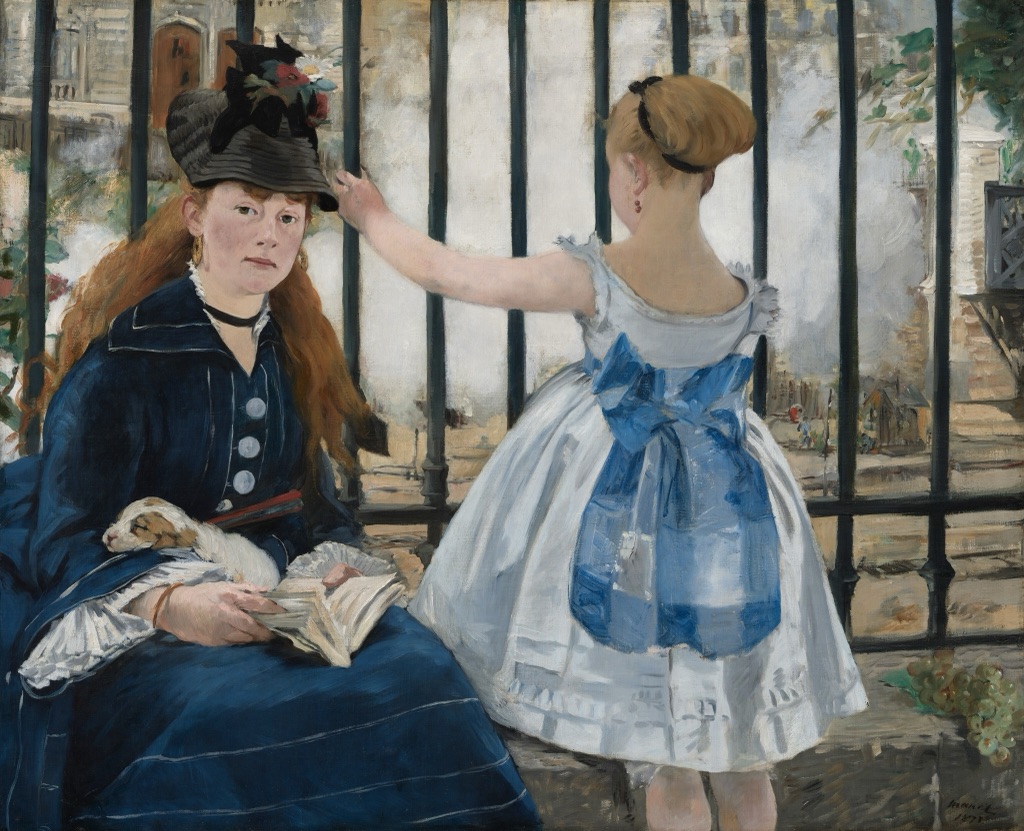
Édouard Manet's The Railway, 1873, is in the National Gallery of Art, Washington (accession 1956.10.1).[7] A seated woman faces forward while a standing child turns towards the railway. Their different heights, poses and clothing divide attention without producing two equal blocks.
Dark bars repeat across the background, pale steam occupies the upper right, and small objects concentrate around the seated figure. Difference in value and orientation contributes to apparent weight here, but those contrasts remain evidence within a balance reading rather than a lesson on contrast itself.
Cézanne: a tall pot and low fruit
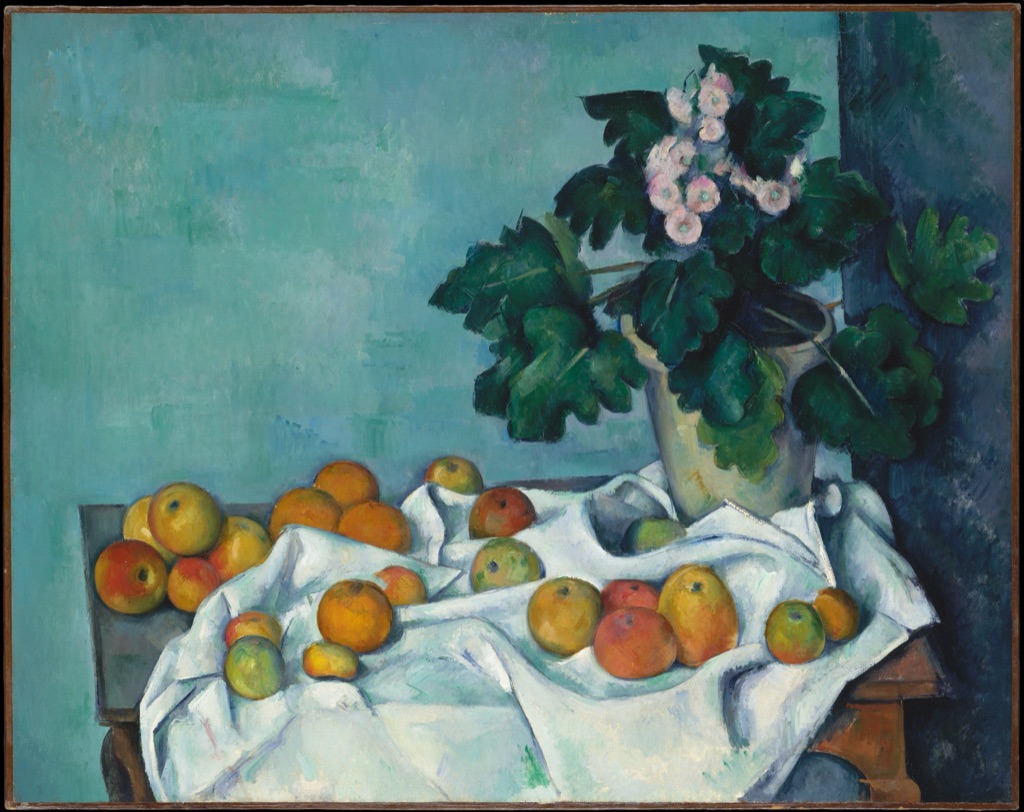
Paul Cézanne's Still Life with Apples and a Pot of Primroses, ca. 1890, is in the Metropolitan Museum of Art (accession 51.112.1).[8] The flowerpot rises above a low spread of apples and pears. Fruit gather in several groups rather than forming a matching counterpart to the pot.
Height, density and surrounding space keep the relationship active. The pot anchors one area, while the lower fruit extend weight across the tilted tabletop. The arrangement is asymmetrical, but that word describes the unequal distribution; it does not prescribe a mood or certify quality.
Correspondence around an axis
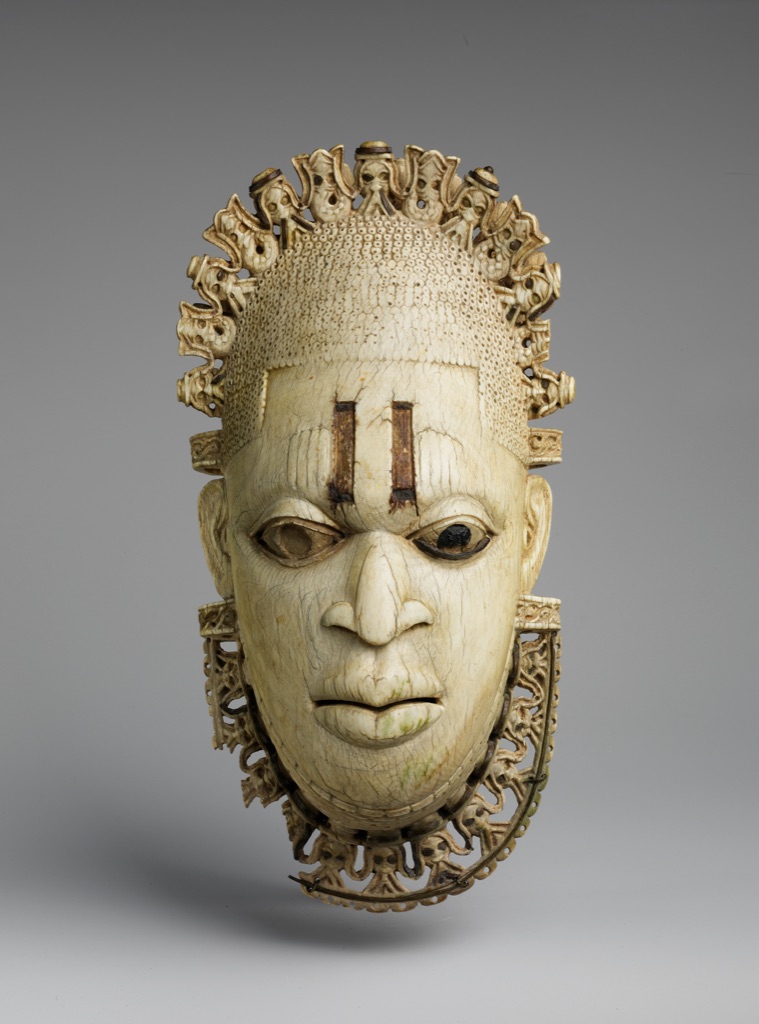
An Edo pendant: bilateral but not identical
The Pendant mask of Ìyọ́bà Idià was made by Ìgbèsànmwà ivory- and wood-carving guild artists for the Edo court in the 16th century. It is now in the Metropolitan Museum of Art (accession 1978.412.323).[11] The face is presented frontally, with corresponding eyes, cheek contours and framing features on either side of a vertical axis.
That bilateral organisation includes difference. Materials, projecting forms and carved details vary rather than repeating with mechanical exactness. Cultural identity and function matter before formal description: symmetry is one visible relationship within an Edo court object, not a complete account of the work.
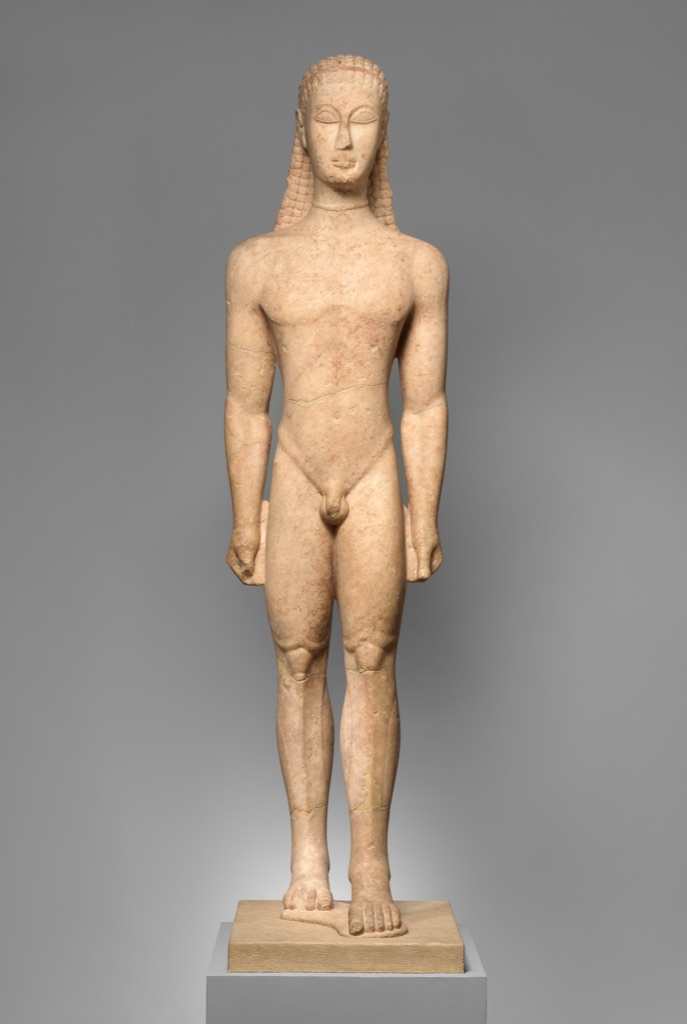
A Greek kouros: visual weight and actual support
The Greek, Attic Marble statue of a kouros (youth), ca. 590–580 BCE, is a freestanding object in the Metropolitan Museum of Art (accession 32.11.1).[12] The frontal body establishes a strong vertical axis; arms descend at the sides and corresponding forms answer one another across the torso and legs. One foot advances, so the pose is bilateral without being a frozen duplicate from left to right.
Here actual mass and support belong to the sculpture as an object, while visual weight describes how its visible parts relate. The two ideas can meet without becoming synonyms. This distinction also keeps the discussion away from a lesson on anatomy or proportion.
Organisation around a centre
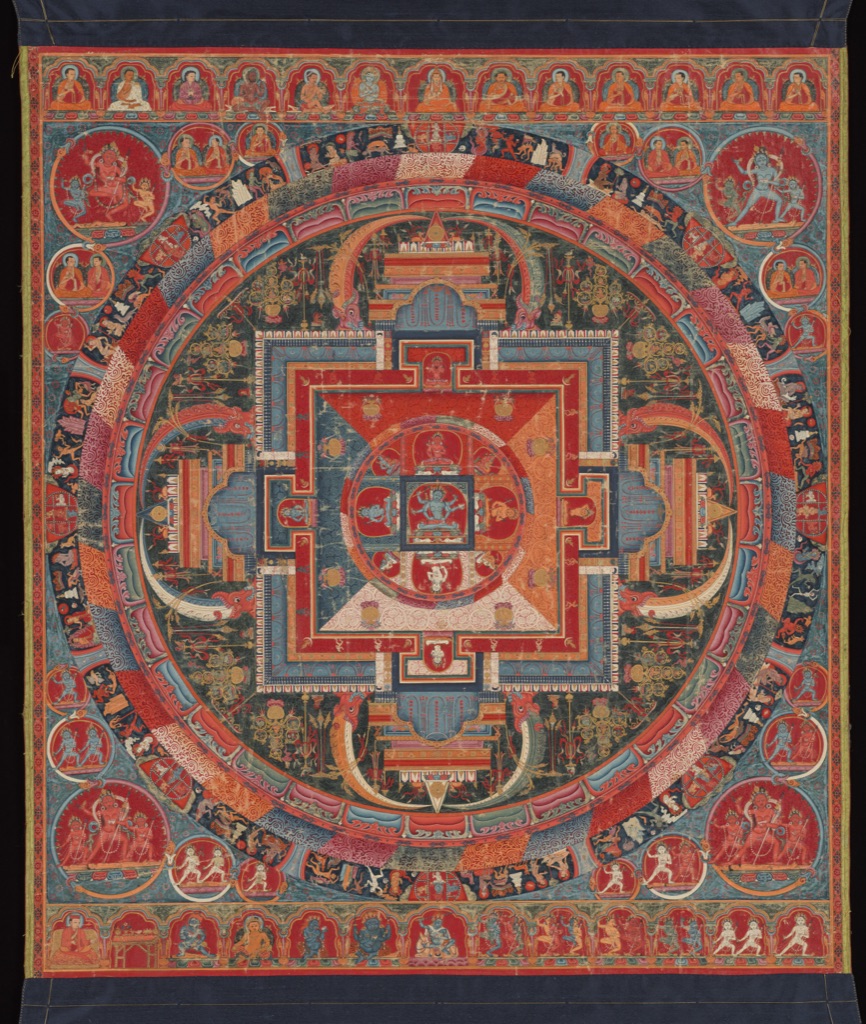
A Tibetan mandala: a ritual centre
The late-14th-century Tibetan Mandala of Jnanadakini, probably made by a Newari artist whose name is not recorded, is a thangka in the Metropolitan Museum of Art (accession 1987.16).[9] A dense central palace and deity assembly are surrounded by circles, geometric fields and many smaller figures. The work belongs to a ritual and religious context; its formal organisation is not merely decorative.
The centre gathers attention while repeated directional structures extend outwards and return towards it. The many unequal figures and fields do not disappear into sameness. Radial and concentric relationships help explain how complexity remains oriented, but they do not exhaust the mandala's meaning.
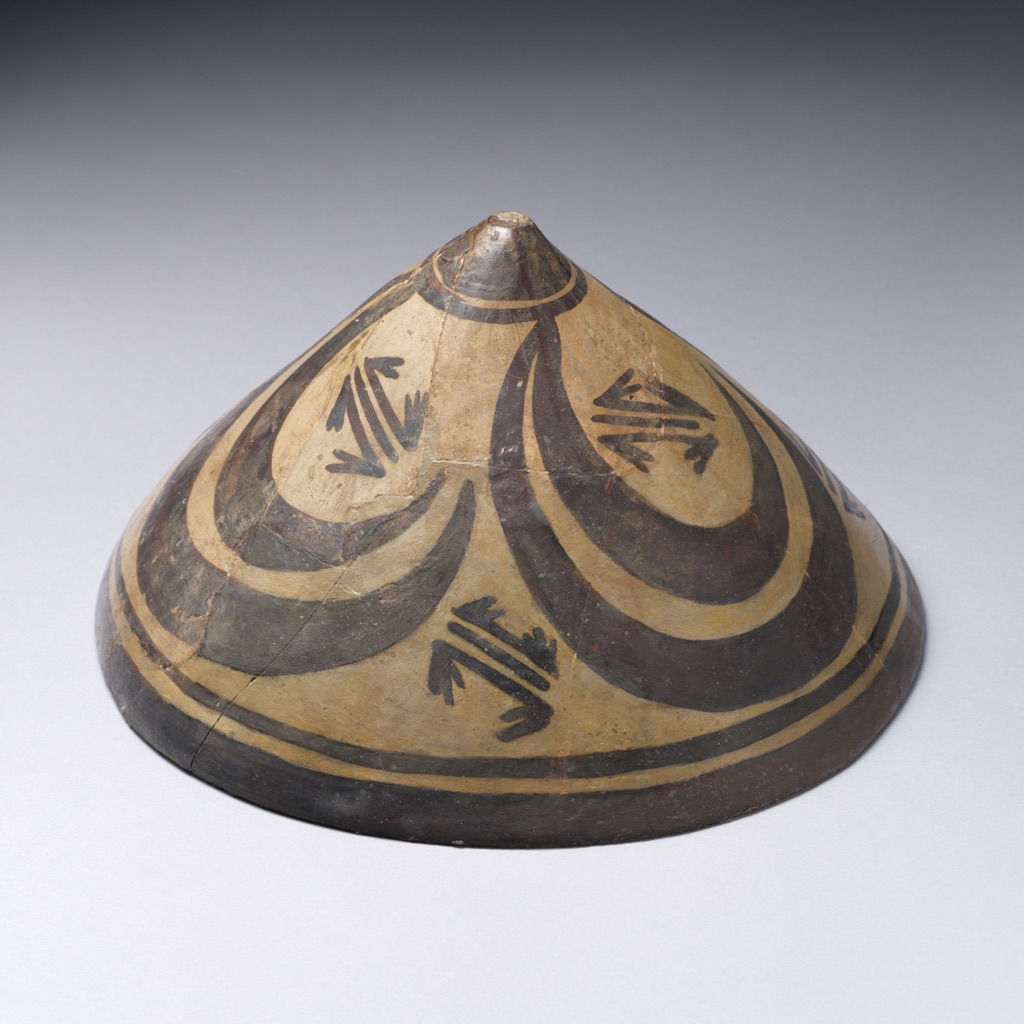
An Iranian bowl: radial design on an object
The Iranian Bowl with radial design of ibex horns, ca. 4500–4100 BCE, is a painted ceramic vessel in the Metropolitan Museum of Art (accession 51.25.24).[10] Four dark horn forms curve around the bowl's pointed centre. Their recurrence makes the central relation legible across the conical surface.
Pattern describes the organised recurrence of the painted units; balance describes how those units distribute visual weight around the centre. The vessel also has actual mass, but its physical weight is not what “visual weight” measures. A full-object view lets both support and painted organisation remain visible together.
Balance and its neighbours
Balance is one relationship within composition, which considers the complete realised organisation of a work. Emphasis concerns relative priority: a dominant area may carry visual weight, but prominence alone does not establish how the whole is balanced. Contrast concerns perceptible difference, even when difference changes apparent weight.
Unity concerns coherence, which can survive asymmetry or visible tension. Movement owns implied action and invited paths through a still work; direction appears here only where it changes a balance reading. Pattern owns organised recurrence, even when repeated units sit around a centre.
Relative size can affect weight, but Proportion in Art will examine part-to-part and part-to-whole size in depth. Repeated intervals can spread accents, while rhythm describes the pace they produce. Unlike parts may remain visibly different while balanced; variety describes diversity sustained across the work.
The Principles of Art introduces balance among other organising relationships. Composition, emphasis, contrast, unity, movement and pattern offer useful comparisons; balance keeps attention on how visual weight is distributed.
Look for balance yourself
Choose an artwork and resist the urge to divide it immediately into labelled types. Find where visual weight seems to gather, then look across the whole field for what counters it, echoes it or gives it room. Test whether an axis or centre matters, and notice where correspondence breaks.
Finally, describe the effect with evidence. A work may feel held because a low cluster answers a tall form, tense because one dense area presses towards an edge, or deliberately off-centre because open space remains active beside it. Another viewer may organise the evidence differently; the strength of the reading lies in what can be seen and compared.
Balance is not a demand for equal halves. It is a way of asking how different parts share, resist and redistribute visual presence across a work.
Watch: Balance through Formal Analysis
Choose a museum-led whole-work analysis, a close reading of tonal organisation, or a foundational overview.
Introducing Formal Analysis: Landscape
Follow how placement, scale, contrast and open space operate across a complete landscape.
Watch on YouTubeFrequently Asked Questions
Balance is the relationship created by the distribution of visual weight across an artwork.
Size, placement, contrast, density, texture, isolation and surrounding space can all contribute.
Symmetrical balance arranges corresponding parts around an axis, though those parts need not be identical.
Asymmetrical balance uses unlike parts whose visual weight still feels countered or held together.
Radial balance distributes or gathers parts around a centre.
Discussion
Where does visual weight gather most strongly in one work on this page, and what counters it?
Reader Insights
A single heavy form becomes meaningful through what answers or surrounds it.
Look for correspondence, then notice where scale, contour or detail differs.
Visual weight is a formal reading, not the object's literal physical weight.
Join the Conversation
Share one precise balance observation or a useful museum example below.
References
- J. Paul Getty Museum, “Understanding Formal Analysis — Principles of Design”
- Museum of Modern Art, A Vocabulary for Discussing Art
- National Gallery of Art, “Monet's Waterscapes”
- J. Paul Getty Museum, “Vocabulary for Describing an Artwork”
- National Gallery of Art, Johannes Vermeer, Woman Holding a Balance, c. 1664
- National Gallery of Art, Winslow Homer, Breezing Up (A Fair Wind), 1873–1876
- National Gallery of Art, Édouard Manet, The Railway, 1873
- The Metropolitan Museum of Art, Paul Cézanne, Still Life with Apples and a Pot of Primroses, ca. 1890
- The Metropolitan Museum of Art, Mandala of Jnanadakini, late 14th century
- The Metropolitan Museum of Art, Bowl with radial design of ibex horns, ca. 4500–4100 BCE
- The Metropolitan Museum of Art, Pendant mask of Ìyọ́bà Idià, 16th century
- The Metropolitan Museum of Art, Marble statue of a kouros (youth), ca. 590–580 BCE