 by
Tom Gurney
Tom Gurney BSc (Hons) is an art history expert with over 20 years experience
Published on June 19, 2020 / Updated on October 22, 2026
Email:
tomgurney1@gmail.com
/ Phone:
+44 7429 011000
Still Life with Apples and a Pot of Primroses by Paul Cézanne: Introduction
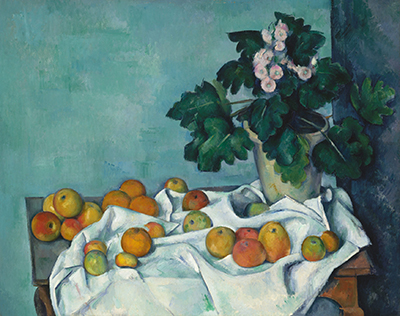
An apple sits at the edge of a white cloth; another almost disappears into its folds. Across the table, fruit gathers in small, separate groups beneath a flowering plant. In Still Life with Apples and a Pot of Primroses , Cézanne makes the familiar business of looking at fruit unexpectedly absorbing. The eye moves from one rounded shape to the next, but must repeatedly cross a ridge of fabric, a dark gap, or a change of colour to get there. The primrose offers a different kind of abundance: leaves and pale blossoms spread upward against a quiet blue-green wall.
The arrangement gains presence through the space Cézanne gives each cluster. Fruit occupies a broad stage while flowers extend into their own expanse of wall. Neither part can be taken in entirely without the other. Another painter, Claude Monet, would later own this canvas. [1]
At a Glance
- Artist Paul Cézanne. [1]
- Date About 1890. [1]
- Medium and size Oil on canvas, 73 × 92.4 cm. [1]
- Collection The Metropolitan Museum of Art, New York, accession 51.112.1. [1]
- Other catalogue identity Pot de primevères et fruits sur une table , FWN 824. [2]
This work across Paul Cézanne’s career
The Kiss of the Muse
c.1860The Artist’s Father, Reading L’Événement
autumn 1866The Hanged Man’s House
c.1873A Modern Olympia
1873–74Maincy Bridge
1879–80The Blue Vase
1889–90The Basket of Apples
c.1893Apples and Oranges
c.1899The Large Bathers (Philadelphia)
1900–1906 (Philadelphia Museum dating)Château Noir (MoMA)
1903–04Contents
- Fruit across the table
- The plant and the open wall
- A related still life, and a recurring table
- How the arrangement holds together
- From Monet's home to the Met
Fruit across the table
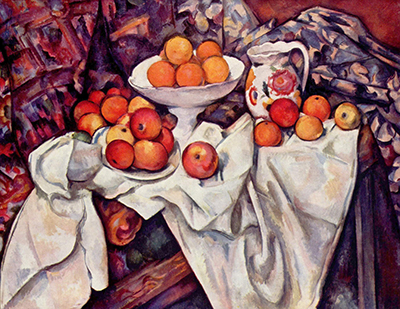
The apples form no single heap. At the far left, several crowd onto a small visible strip of bare tabletop. Others cross the centre in a loose sequence, while the group at lower right seems to press against the front fold of the cloth. A near-central yellow fruit, the warmer red and orange fruits beside it, and the green apple toward the right edge each hold their own patch of space. The groups are related by colour and shape, yet separated by white intervals. Counting the apples is less revealing than following how each cluster leads the eye toward another.
The tablecloth supplies the painting with much of its movement. A tall fold rises behind the left-hand fruit and drops steeply toward the foreground. Near the centre, white fabric becomes a chain of peaks and hollows. At the right, its edge turns up and back toward the pot, then drapes across the furniture. Pale blue, grey and faint green marks give those whites weight and direction. The cloth can look like terrain because its folds interrupt the fruit's route across the table; it is also plainly fabric, bunching where an apple rests against it and opening into dark pockets where the surface turns away.
Look closely at the front edge. The cloth is carried almost to the bottom of the canvas, so there is little comfortable distance between the viewer and the nearest fruit. A sliver of dark wood at left and a broader brown section at right disclose the furniture beneath. The left and right ends do not need to make an instantly seamless diagram of the tabletop for the arrangement to feel substantial. Cézanne gives more attention to the changing contacts among apple, cloth and exposed wood than to a neatly stated outline of the entire table.
The fruit, too, gets its solidity from differences within colour. A yellow apple shades through orange, green or muted red; another has a cool side next to a warmer neighbour. Some contours are firm, some soften where fruit meets cloth. This variation prevents the round objects from becoming a set of identical spheres. It also keeps the foreground active: no single apple serves as an obvious centre, and the viewer can start again from almost any point along the row.
The plant and the open wall
Above the apples is a much taller, less orderly form. Dark leaves reach left and right from a pale pot, with a small concentration of pink-white flowers near their upper centre. Their irregular outlines make a sharp change from the lower register of rounded fruit. Some leaves meet the turquoise wall in crisp silhouette; others bunch together so closely that their individual stems become hard to follow. The gap of open wall to the left gives the plant room to spread and makes its dark greens seem even more concentrated.
The flowers do not merely crown the fruit. The pot stands well to the right, and the cloth climbs toward it, linking the lower and upper halves of the picture. A fold pointing up to the pot acts almost like a path through the arrangement. At the same time, the high cluster of blossoms pulls the eye away from the horizontal procession of apples. The painting alternates between two rhythms: fruit distributed along a table and foliage radiating into the wall.
The title calls the plant a primrose. The Met's catalogue entry reports a botanist's 1982 identification of it as especially close to a Chinese primrose. Earlier titles were less settled: some called the flowers geraniums, while the online catalogue raisonné records a possible 1907 exhibition appearance under “begonia.” These changing names tell us something about the difficulty of identifying a painted plant from its leaves and blossoms. They do not change the visual role it plays here: the only growing subject in a gathering of picked fruit. [1] [2]
It is tempting to treat that contrast as a fixed allegory of life and decay. The picture gives us no need to impose one. The apples remain richly coloured rather than visibly spoilt; the potted plant is still flowering. Their different shapes and scales create a more immediate encounter. The plant stands above a landscape of cloth and fruit, with enough wall around it for its outline to read from a distance. The open area shapes the experience as strongly as the crowded tabletop.
A related still life, and a recurring table
Cézanne returned to the combination of a potted plant and fruit in Pot of Flowers and Fruit , now at the Courtauld Gallery in London. That smaller picture, dated around 1888–90, places its plant much nearer the middle of a compact arrangement of fruit and plate. Its background is busier, with forms that resist simple identification. The Courtauld's own catalogue notes that its plant, often called a primrose, has leaves more like a geranium. The Met canvas should therefore not be treated as an exact repeat of the Courtauld's plant, even though the two works invite comparison. [3]
The comparison brings out what is distinctive about the New York painting. In the Courtauld work, a small space presses fruit and foliage together. In the Met picture, an expanded tabletop lets the apples scatter into several groups, while the plant has almost a whole upper corner. The difference is not merely one of size. Empty wall, broad white cloth and a low line of fruit make this painting feel more open, though every apple still has a carefully negotiated place.
The furniture offers another route into its making. The Met identifies the table by its scalloped apron and bowed legs; it appears in other Cézanne still lifes, and John Rewald photographed it in the artist's Les Lauves studio around 1935. That history makes the partly exposed wood more than a generic prop. Even when the cloth hides most of it, the table belongs to a repeated working setting, rearranged with different objects across several pictures. [1]
A repeated table helps link works and places, but does not supply the day or season on which this canvas was painted. The current online catalogue raisonné, FWN 824, gives about 1890; it also records older, wider estimates running into the early 1890s. The painting belongs to a developing group of still lifes whose exact sequence remains open. [2]
How the arrangement holds together
Many lines in the picture do more than outline an object. The edge of a leaf also cuts a dark shape into the blue-green wall. A crease both describes cloth and sends the eye toward an apple. The pot's light rim joins the pale folds around it, while its darker lower half anchors the leaves above. The image remains easy to recognise, but recognising every object does not exhaust what the marks are doing. Their contacts, intervals and repeated curves are part of the subject.
There is an especially interesting interruption at the right of the plant. Several leaves extend outward, yet the connections between leaf and pot are not all clearly traced. Art historian Paul Smith has pointed to apparently vanished stalks here. He proposes that such gaps may evoke the effects of peripheral vision during sustained looking: a reading of the picture's appearance, rather than a certain account of why Cézanne made each mark. [4]
Whether or not one follows that explanation, the visible result is striking. The outer leaves can be read as part of the plant and as separate patches of green against the wall. The eye supplies some connections, hesitates over others, then returns to the blossoms and pot. Down below, the apples are more self-contained, but their boundaries also depend on neighbouring colours and folds. The painting rewards time because the viewer can shift between naming its objects and watching how those objects are made to appear.
This is why the apparently calm subject has such energy. The apples do not roll; the pot does not move. Movement happens in looking: across clustered fruit, up a white fold, into dark leaves, out over an unoccupied field of wall, and back down to the table. The picture's balance is dynamic because the crowded lower half and the expansive upper left continue to answer one another.
From Monet's home to the Met
The painting's history adds a second story of looking. The Met records Paul Helleu sending it to Claude Monet as a gift through Durand-Ruel in March 1894. Monet thanked Helleu and subsequently asked the dealer to forward “my Cézanne.” This documented gift differs from older accounts naming Cézanne as giver or Monet as buyer. [1]
Before Helleu, the record places the painting with Père Tanguy. Monet kept it until his death in 1926 and lent it to a Paris exhibition in 1925. After passing to his son Michel and then the Lewisohn family, it appeared in the Museum of Modern Art's first loan exhibition in 1929. Sam A. Lewisohn's 1951 bequest brought it to the Met. These public showings trace its shift from a painter's collection to a work through which later audiences came to know Cézanne. [2]
Its exhibition names also record changing attention. “Apples on a Table” foregrounded the fruit; titles using “geraniums” identified the plant differently; the Met's current title holds both apples and primroses in view. No title can replace the act of looking. The large quiet wall, the busy white cloth and the separate fruit make the painting more than an inventory of its ingredients. It presents ordinary things as a set of visual relationships that remain unsettled and engaging each time the eye crosses the table.
Cézanne artworks directory
Browse 217 identified works in this researched selection, including paintings, drawings and watercolours. This is a bounded selection, not a complete catalogue of Cézanne’s surviving oeuvre. Unlinked titles have no confirmed article in this collection.
| Name | Date | Medium |
|---|---|---|
| A Head, a Cup, and a Bread Roll | 1891/1894 | Drawing |
| A Man seen from Behind | 1880/1883 | Drawing |
| A Modern Olympia | 1873–74 | Painting |
| A Nude and Foliage | 1879/1882 | Drawing |
| A Smoking Man | 1892–96 (catalogue); c.1890–92 (museum) | Drawing |
| Afternoon in Naples | 1876–77 | Painting |
| An Old Woman with a Rosary | about 1895–96 | Painting |
| Apples and Oranges | c.1899 | Painting |
| Auvers, Panoramic View | 1873–75 | Painting |
| Avenue at Chantilly | 1888 | Painting |
| Banks of the Marne | 1888–94 | Painting |
| Basket | 1877/1900 | Drawing |
| Bather with Outstretched Arms | 1877–78 | Painting |
| Bellows in Front of a Fireplace | 1887/1892 | Drawing |
| Bibémus Quarry | c.1895 | Painting |
| Boy in a Red Vest, Barnes Foundation | 1888–90 | Painting |
| Boy in a Red Vest, MoMA | 1888–90 | Painting |
| Boy in a Red Waistcoat, National Gallery of Art | 1888–90 | Painting |
| Branch in Flower | 1886/1889 | Drawing |
| Carnival Scene | 1885/1888 | Drawing |
| Chair and Dresser | 1880/1883 | Drawing |
| Chateau Noir | 1903–04 | Painting |
| Chestnut Trees and Farm at Jas de Bouffan | c.1885 | Painting |
| Chestnut Trees and Farm at Jas de Bouffan, Pushkin | c.1886 | Painting |
| Chestnut Trees at Jas de Bouffan in Winter | 1885–86 | Painting |
| Château Noir | 1900–04 | Painting |
| Cistern in the Park of Château Noir | c.1900 | Painting |
| Curtain, Jug and Fruit | 1893–94 | Painting |
| Cushion of an Armchair | 1886/1889 | Drawing |
| Draft Letter and Studies of Bathers | c.1878 | Drawing |
| Farmhouse and Chestnut Trees at Jas de Bouffan | 1884–85 | Painting |
| Figure Resting Head on Hand | c. 1889 | Drawing |
| Fireplace Tongs and Poker | 1887/1892 | Drawing |
| Forest Interior, San Francisco | c.1898–99 | Painting |
| Four Bathers | 1888–90 | Painting |
| Fruit and a Jug on a Table | 1893–94 | Painting |
| Gardanne | 1885–86 | Painting |
| Gardanne, Barnes Foundation | c.1885 | Painting |
| Hand and Shoulder of a Boy | c. 1885 | Drawing |
| Harlequin, National Gallery of Art | 1888–90 | Painting |
| Head of a Boy | 1887/1889 | Drawing |
| Head of a Boy Seen from Behind | c. 1885 | Drawing |
| Head of a Young Woman | c. 1880 | Drawing |
| Head of the Artist's Son | 1888/1889 | Drawing |
| Hillside in Provence | c.1890–92 | Painting |
| Horse Chestnut Trees at Jas de Bouffan | c.1885 | Painting |
| House and Farm at the Jas de Bouffan | c.1887 | Painting |
| House in a Park | 1883/1886 | Drawing |
| House in Provence | c.1885 | Painting |
| House of Père Lacroix | 1873 | Painting |
| House Surrounded by Vegetation | 1889/1892 | Drawing |
| Houses in Provence The Riaux Valley near L’Estaque | c.1883 | Painting |
| Jas de Bouffan, the Pool | c.1876 | Painting |
| Kerosene Lamp | 1878/1881 | Drawing |
| L'Estaque, Melting Snow | c.1870 | Painting |
| Lake Annecy | 1896 | Painting |
| Landscape in Provence, Pola Museum | 1879–82 | Painting |
| Landscape Near Aix-en-Provence | 1877/1880 | Drawing |
| Landscape Seen from the Inside of a Cave | 1889/1892 | Drawing |
| Landscape with Poplars | c.1885–87 | Painting |
| Landscape with Trees | 1895/1898 | Drawing |
| Leda and the Swan | c.1880 (possibly later) | Painting |
| Little Girl with a Doll | 1902–04 | Painting |
| Louis Guillaume | 1879–1890 | Painting |
| Madame Cezanne | 1888/1891 | Drawing |
| Madame Cezanne | 1886/1889 | Drawing |
| Madame Cezanne | 1882/1887 | Drawing |
| Madame Cezanne | 1897/1900 | Drawing |
| Madame Cezanne with her Head Lowered | 1893/1896 | Drawing |
| Madame Cézanne in a Red Armchair | c.1877 | Painting |
| Madame Cézanne in a Red Dress, Metropolitan Museum of Art | 1888–90 | Painting |
| Madame Cézanne in a Yellow Chair | 1888–90 | Painting |
| Madame Cézanne in a Yellow Chair, Fondation Beyeler | 1888–90 | Painting |
| Madame Cézanne in the Conservatory | 1891 | Painting |
| Maincy Bridge | 1879–80 | Painting |
| Maison Maria with a View of Château Noir | c.1895 | Painting |
| Man Bending Forward | 1883/1886 | Drawing |
| Man Smoking a Pipe, Pushkin | c.1891, possibly later | Painting |
| Man with a Pipe | 1891–96 | Painting |
| Man with a Pipe, Nelson-Atkins | 1890–92 | Painting |
| Man with a Straw Hat (Gustave Boyer) | c.1871 | Painting |
| Man with Crossed Arms | c.1899 | Painting |
| Man with Pipe, National Gallery of Art | 1892–96 | Painting |
| Mont Sainte-Victoire | c.1902–06 | Painting |
| Mont Sainte-Victoire | 1900–02 | Painting |
| Mont Sainte-Victoire (recto) | c.1895 | Watercolour |
| Mont Sainte-Victoire and the Viaduct of the Arc River Valley | 1882–85 | Painting |
| Mont Sainte-Victoire Seen beyond the Wall of the Jas de Bouffan | c.1885/1888 | Watercolour |
| Mont Sainte-Victoire Seen from Bibémus Quarry | c.1897 | Painting |
| Mont Sainte-Victoire, Barnes Foundation | 1892–95 | Painting |
| Near the Pool at Jas de Bouffan | 1883/1887 | Drawing |
| Pelicans | 1877/1880 | Drawing |
| Peonies | 1890/1893 | Drawing |
| Pierrot and Harlequin | 1888 | Painting |
| Pine Tree | 1882/1885 | Drawing |
| Pont des Trois Sautets | 1906 | Watercolour |
| Poplars | 1879–80 | Painting |
| Portrait of Ambroise Vollard | 1899 | Painting |
| Portrait of Gustave Geffroy | 1895–96 | Painting |
| Portrait of Madame Cezanne with Loosened Hair | 1885–86 | Painting |
| Portrait of the Artist Looking Over His Shoulder | 1883–84 | Painting |
| Portrait of the Gardener Vallier | 1906 | Painting |
| Portrait of Victor Chocquet | 1876–77 | Painting |
| Portrait Of Victor Chocquet Seated | 1877 | Painting |
| Provençal Manor | c.1885 | Painting |
| Pyramid of Skulls | 1898–1900 | Painting |
| Reclining Nude (Leda?) | c.1887 | Painting |
| Scipio | 1866–68 | Painting |
| Seated Man, Oslo | 1898–1900 | Painting |
| Seated Peasant | c.1892–96 | Painting |
| Seated Peasant, Hiroshima | c.1897 | Painting |
| Seated Peasant, Orsay | c.1900 | Painting |
| Self-Portrait | c. 1895 | Drawing |
| Self-Portrait in a Bowler Hat, Ny Carlsberg Glyptotek | 1885–86 | Painting |
| Self-Portrait in a Casquette | c.1875 | Painting |
| Self-Portrait with a Beret | 1898–1900 | Painting |
| Self-Portrait with a Hat, Artizon Museum | c.1890–94 | Painting |
| Self-Portrait with a Pink Background | c.1875 | Painting |
| Self-Portrait with Olive-Coloured Wallpaper | about 1880–81 | Painting |
| Self-Portrait with Palette | 1886–87 | Painting |
| Self-Portrait with White Turban | c.1878–80 | Painting |
| Self-Portrait, c.1895 | c.1895 | Painting |
| Self-Portrait, Pushkin Museum | c.1882 | Painting |
| Spanish Dancers | 1883/1886 | Drawing |
| Still Life with a Curtain | 1892–94 | Painting |
| Still Life with Apples | c.1890 | Painting |
| Still Life with Apples | 1893–94 | Painting |
| Still Life with Apples and a Pot of Primroses | about 1890 | Painting |
| Still Life with Milk Jug and Fruit | c.1900 | Painting |
| Still Life with Open Drawer | 1877–79 | Painting |
| Still Life with Plaster Cupid | about 1894 | Painting |
| Still Life with Skull | 1890–93 | Painting |
| Still Life with Soup Tureen | 1877 | Painting |
| Still Life, Pitcher and Fruit | 1893–94 | Painting |
| Studies Including a Straw Hat | 1895/1898 | Drawing |
| Studies Including Madame Cezanne | 1884/1887 | Drawing |
| Study for "The Judgement of Paris" or "The Amorous Shepherd" | 1883/1886 | Drawing |
| Study for Woman with a Coffee Pot | c.1895 | Painting |
| Study of "The Roman Orator (Germanicus)" | 1883/1886 | Drawing |
| Study of "Venus de Milo" | 1881/1884 | Drawing |
| Study of a Decorative Ornament | 1879/1882 | Drawing |
| Study of a Standing Male Figure after the Antique | c. 1895 | Drawing |
| Study of an Angel in Rubens' "The Prophet Elijah" | 1892/1895 | Drawing |
| Study of Desiderio da Settignano's "Bust of a Child" | c. 1895 | Drawing |
| Study of Houses | 1879/1882 | Drawing |
| Study of Puget's "Hercules Resting" | c. 1879 | Drawing |
| Study of Puget's "Milo of Crotona" | 1895/1898 | Drawing |
| Study of Puget's "Milo of Crotona" | 1880/1883 | Drawing |
| Study of the Allegorical Figure Bellona in Rubens' "The Apotheosis of Henri IV" | 1883/1886 | Drawing |
| Study of the Allegorical Figure Bellona in Rubens' "The Apotheosis of Henri IV" | 1879/1882 | Drawing |
| Study of the Allegorical Figure France in Rubens' "The Exchange of the Two Princesses" | 1882/1885 | Drawing |
| Study of the Allegorical Figure of Health in Rubens' "The Birth of Louis XIII" | 1880/1883 | Drawing |
| Study of the Allegorical Figure of the Genius of Health from Rubens' "The Birth of Louis XIII at Fontainbleau" | 1895/1898 | Drawing |
| Sugar Bowl, Pears and Blue Cup | 1865–66 | Painting |
| The Aqueduct, Pushkin Museum | Dating differs between museum records | Painting |
| The Artist's Father, Reading L'Evenement | autumn 1866 | Painting |
| The Artist's Son | c. 1887 | Drawing |
| The Artist's Son Leaning on his Elbow | c. 1887 | Drawing |
| The Artist's Son Reading | c. 1887 | Drawing |
| The Artist's Son Writing | c. 1887 | Drawing |
| The Artist’s Son, Paul | 1886–87 | Painting |
| The Avenue at Jas de Bouffan | 1868–70 (possibly later) | Painting |
| The Avenue at Jas de Bouffan, Geneva | c.1890 | Painting |
| The Basket of Apples | c.1893 | Painting |
| The Bather, Museum of Modern Art | c.1885 | Painting |
| The Bay of Marseille seen from L'Estaque | c.1885 | Painting |
| The Blue Vase | 1889–90 | Painting |
| The Boy in the Red Vest, Bührle | 1888–90 | Painting |
| The Buffet | 1877–79 | Painting |
| The Card Players, Barnes Foundation | 1890–92 | Painting |
| The Card Players, Courtauld Gallery | 1892–96 | Painting |
| The Card Players, Metropolitan Museum of Art | 1890–92 | Painting |
| The Card Players, Musée d’Orsay | 1893–96 | Painting |
| The Card Players, Qatar | 1892–96 | Painting |
| The Eternal Feminine | c.1877 | Painting |
| The Gardener Vallier | 1906 | Painting |
| The Gardener Vallier, Tate | 1905–06 | Painting |
| The Grounds of the Château Noir | c.1900–04 | Painting |
| The Gulf of Marseille Seen from L’Estaque | c.1885 | Painting |
| The Hanged Man's House in Auvers | c.1873 | Painting |
| The House of Doctor Gachet at Auvers | 1872–73 | Painting |
| The House with the Cracked Walls | 1892–94 | Painting |
| The Kiss of the Muse | c.1860 | Painting |
| The Large Bathers, Barnes Foundation | 1895–1906 | Painting |
| The Large Bathers, National Gallery | 1895–1905 | Painting |
| The Large Bathers, Philadelphia Museum of Art | 1900–06 | Painting |
| The Mill | 1889/1892 | Drawing |
| The Painter’s Father, Louis-Auguste Cézanne | c.1865 | Painting |
| The Peasant | 1890–92 | Painting |
| The Plaster Mill (La Moulin à plâtre) | 1889/1892 | Drawing |
| The Smoker, Hermitage | c.1891 | Painting |
| The Smoker, Mannheim | c.1891 | Painting |
| The Stove in the Studio | c.1865 | Painting |
| The Vase of Tulips | c.1890 | Painting |
| Thistle | 1893/1896 | Drawing |
| Three Heads, One of Madame Cezanne | 1882/1885 | Drawing |
| Three Skulls | c.1898 | Painting |
| Three Skulls on a Patterned Carpet | 1904 | Painting |
| Trees and Shrubs | 1883/1887 | Drawing |
| Turning Road at Montgeroult | 1898 | Painting |
| Two Bathers | 1884/1887 | Drawing |
| Two Heads | 1888 | Drawing |
| Two Heads | 1890/1896 | Drawing |
| Two Heads of Women | 1890/1894 | Drawing |
| Two Studies for "The Judgement of Paris" or "The Amorous Shepherd" | 1883/1886 | Drawing |
| Uncle Dominique in a Tasseled Cap | 1866 | Painting |
| Uncle Dominique in a Turban | 1866–67 | Painting |
| Victor Chocquet and an Angel for "The Apotheosis of Delacroix" | 1878/1880 | Drawing |
| Woman in Blue | c.1904 | Painting |
| Woman Leaning Forward | 1888/1891 | Drawing |
| Woman Leaning Forward | 1890/1894 | Drawing |
| Woman Leaning Forward | 1890/1894 | Drawing |
| Woman with a Coffee Pot | c.1895 | Painting |
| Women Bathers and a Roll of Paper | 1882/1885 | Drawing |
| Young Girl with a Doll | c.1895 | Painting |
| Young Italian Woman at a Table | c.1895–1900 | Painting |
| Young Man and Skull | 1896–98 | Painting |
Frequently Asked Questions
It belongs to the Metropolitan Museum of Art in New York, accession number 51.112.1. [1]
The Met dates it to about 1890. Earlier catalogue estimates have ranged more widely, so the year is approximate. [1]
Yes. Paul Helleu gave it to Monet in March 1894, and it remained with Monet until his death. [2]
No. Pot of Flowers and Fruit is a separate, smaller Cézanne still life in London. Its related arrangement makes comparison useful, but its plant identification is itself debated. [3]
Discussion
Look again at the images and ideas explored in Still Life with Apples and a Pot of Primroses by Paul Cézanne. These editorial prompts invite your observations.
Reader Insights
Follow one apple from its warm face to the cool cloth beside it. Where does its edge become clearest, and where does the surrounding colour do the work?
Cover the pot of flowers with your hand, then uncover it. How does the balance between the full tabletop and the open wall change?
Look for places where a leaf or cloth fold seems to have a clear path, then loses it. What does your eye connect on its own?
Join the Conversation
Share a detail, comparison or question about Still Life with Apples and a Pot of Primroses by Paul Cézanne below.
References
- The Metropolitan Museum of Art. “Still Life with Apples and a Pot of Primroses,” collection record and catalogue entry by Jane R. Becker (2017), including provenance, exhibition history and references. View source .
- Société Paul Cezanne. “Pot de primevères et fruits sur une table, c. 1890 (FWN 824),” The Paintings, Watercolors and Drawings of Paul Cezanne: An Online Catalogue Raisonné , current online record. View source .
- The Courtauld Gallery. Rachel Sloan, “Pot of Flowers and Fruit,” catalogue entry 39 in Karen Serres (ed.), The Courtauld Collection: A Vision for Impressionism (Fondation Louis Vuitton and Paul Holberton Publishing, 2019), p. 208. View source .
- University of Warwick. Paul Smith, “Unfolding vision: Cezanne's ‘way of seeing’,” Leverhulme Trust Grants in Focus , p. 34, research summary. View source .
- Le Baiser de la muse, d'après Frillié (FWN 572). View source.
- Louis-Auguste Cezanne, père de l'artiste, lisant L'Événement (FWN 402). View source.
- La Maison du pendu, Auvers-sur-Oise (FWN 81). View source.
- Une moderne Olympia (FWN 628). View source.
- Le Pont de Maincy (FWN 143). View source.
- La Montagne Sainte-Victoire vue de Montbriand (FWN 185). View source.
- Gardanne (vue horizontale) (FWN 224). View source.
- Le Vase bleu (FWN 823). View source.
- Les Joueurs de cartes (FWN 681). View source.
- La Montagne Sainte-Victoire (FWN 296). View source.
- La Corbeille de pommes (FWN 860). View source.
- Pommes et oranges (FWN 871). View source.
- Portrait d'Ambroise Vollard (FWN 531). View source.
- Philadelphia Museum of Art,The Large Bathers,W1937-1-1. View source.
- Château Noir (FWN 360). View source.
- Société Paul Cezanne,online catalogue structure and objectidentification. View source.
- National Gallery of Art,Cezanne Sketchbook,1992.51.9. View source.
- Splash image, Paul Cézanne, Still Life with Apples and a Pot of Primroses.